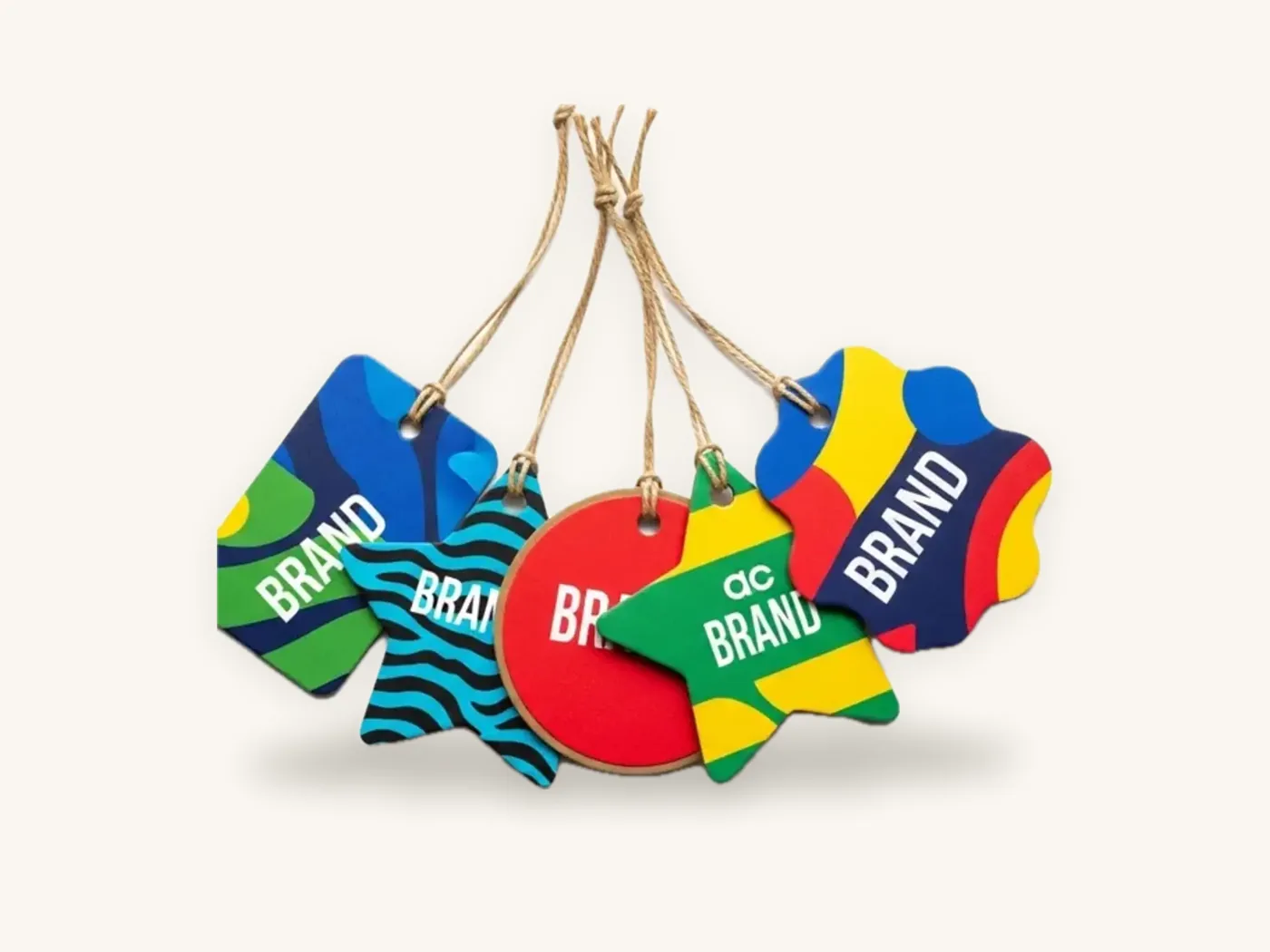
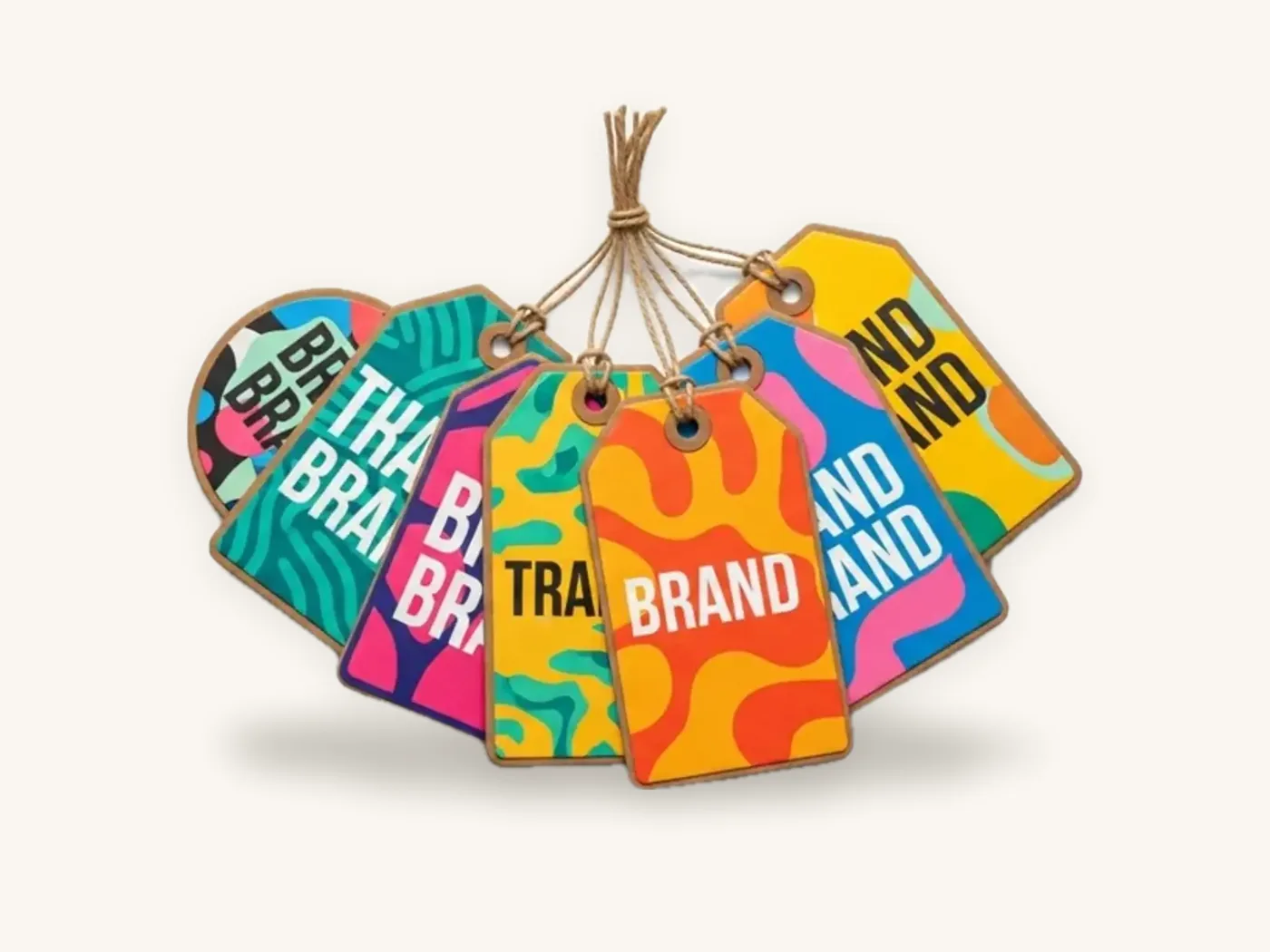
Custom hang tags are small printed cards, usually on thick paperboard, attached to a product with string, ribbon, a safety pin or a plastic fastener. On clothing they carry the brand, size, price and barcode; on candles, jars, bottles and gifts they tell the product story that will not fit on a label. The right tag comes from four choices: stock thickness, size and shape, the hole and attachment, and what you print on each side.
A hang tag is often the first branded thing a shopper touches in a store, and the last thing they remove at home. That makes feel important, but the tag also has to survive racks, tagging guns and shipping, and give a store clerk a barcode that scans first time. This guide covers the physical spec, the content, and the practical details that make printed tags work on the shop floor.
Key takeaways
- Thickness sets the impression. Around 14 to 16 pt feels like a business card; 24 pt and heavier duplexed boards feel substantial and resist creasing.
- The most common sizes sit around 2 x 3.5 in (business card) and 2 x 3 in, with slimmer tags for small accessories and larger ones for outerwear and gift sets.
- Choose the attachment before the design: string, ribbon, elastic, safety pin or plastic fastener each need different hole sizes and placements.
- Keep all important content at least 1/4 in away from the hole, and reinforce the hole with an eyelet on heavy or frequently handled items.
- Clothing hang tags are removable, so they do not replace the permanent fiber content and care labels US rules require on most garments.
- Box Sense prints custom hang tags with strings, eyelets and foil options, free design support and standard production of 8–12 business days after proof approval.
Anatomy of a hang tag
Every tag has the same basic parts. Designing each one on purpose avoids the most common problems: a hole that tears out, a barcode on the wrong side, or a logo that sits in the string's shadow.
| Part | Its job | Design notes |
|---|---|---|
| Front face | Brand recognition at a glance | Logo, brand name, maybe one line of tagline; keep it uncluttered |
| Back face | Information | Price, size, barcode, SKU, style name, care summary, brand story or QR code |
| Hole | Attachment point | Usually 1/8 to 3/16 in diameter, centered near the top or a corner |
| Eyelet or grommet | Reinforces the hole | Metal ring in silver, gold, black or brass; adds a finished look |
| Attachment | Holds the tag to the product | String, twine, ribbon, elastic, safety pin, plastic fastener or chain |
| Edges and corners | Shape and durability | Rounded corners resist dog-earing on racks |
Front or back first
Most shoppers flip a tag to see the price, so the back face does as much work as the front. Put the barcode and price on the back in a consistent position across every product in your line. Store staff learn where to scan, and shoppers learn where to look.
Hang tag stocks and thickness
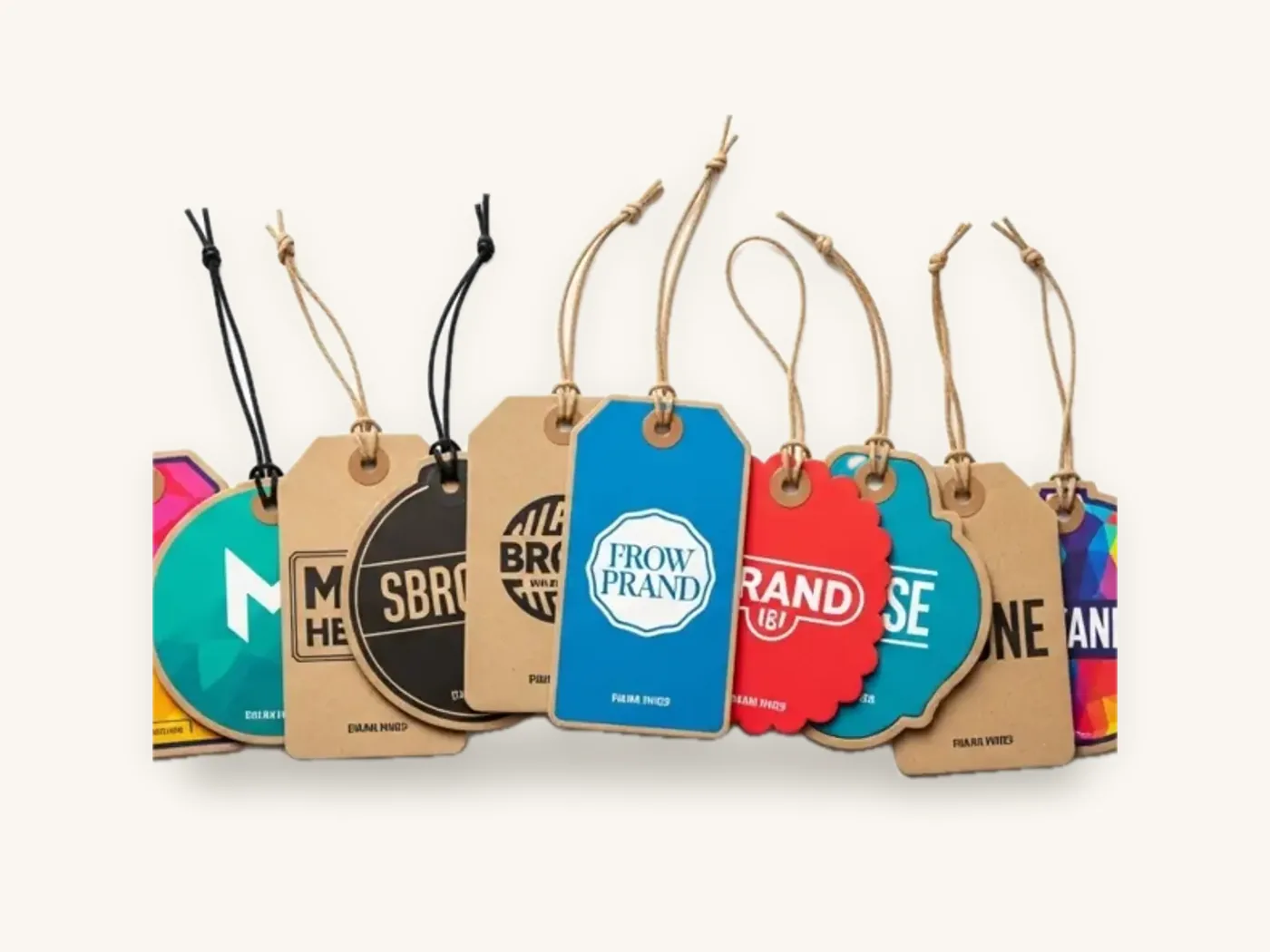
Tag stock is measured in points (pt), where 1 pt equals one thousandth of an inch. A 16 pt tag is 0.016 in thick. Heavier tags cost more but survive handling and feel more premium in the hand.
| Stock | Thickness (approx.) | Feel | Best for |
|---|---|---|---|
| Coated white cardstock (C1S or C2S) | 14 to 16 pt | Smooth, bright, business-card weight | Everyday apparel, price tags, accessories |
| Heavy coated board | 18 to 24 pt | Sturdy, resists creasing | Denim, outerwear, premium basics |
| Duplexed board (two sheets bonded) | 28 to 32 pt and up | Thick, rigid, luxurious | Luxury fashion, gift sets, spirits neck tags |
| Kraft board | 14 to 24 pt | Natural brown, visible fiber | Eco brands, candles, handmade and food gifts |
| Textured specialty paper | Varies | Felt, linen or cotton finish | Boutique fashion, stationery, wedding goods |
| Black or colored board | 14 to 24 pt | Bold, solid color through the edge | Foil-stamped streetwear and luxury tags |
| Synthetic or laminated stock | Varies | Tear and water resistant | Swimwear, outdoor gear, garden products |
Coated or uncoated
Coated stock gives the sharpest, brightest print and takes lamination well, so it suits photography and color-heavy designs. Uncoated and textured papers absorb ink, giving softer color with a tactile, natural feel, and they emboss and letterpress-style deboss beautifully. Uncoated tags are also easy to write on, which helps small makers who hand-price items.
Kraft and textured papers are covered in more depth on our textured and specialty papers and kraft paperboard pages.
When to go thicker
Move up in thickness when tags are handled often, such as in stores with lots of browsing, when the tag hangs from a heavy garment and swings against it, or when it doubles as a keepsake card. For online-only brands whose tags are removed at home, a mid-weight stock is usually enough.
Standard sizes and die-cut shapes
Size should fit the product and the information. A tag that is too large on a delicate top looks like a label for something else; too small and the barcode will not fit.
Common hang tag sizes
| Size (approx.) | Typical use | Room for |
|---|---|---|
| 1.5 x 3 in | Jewelry, socks, small accessories | Logo front, price and small barcode back |
| 2 x 3 in | Tops, knitwear, kids' clothing | Logo, size, price, barcode |
| 2 x 3.5 in (business card) | Most apparel, candles, gifts | Logo, short story, barcode, QR code |
| 2.5 x 4 in | Denim, outerwear, bags | Fit or fabric details plus barcode |
| 3 x 5 in or folded tags | Premium outerwear, gift sets | Brand story, care guidance, multiple features |
A UPC barcode at standard size is roughly 1.5 in wide by 1 in tall including its quiet zone, so check that the back face has space before choosing the smallest sizes. Barcodes can be printed somewhat smaller or larger than standard within limits set by GS1, the barcode standards body; follow the size guidance that came with your barcode numbers.
Shapes
Rectangles with square or rounded corners are the most economical and practical. Die-cut shapes, such as circles, arches, notched "luggage" tags or a silhouette of your logo, make a tag memorable but can add cutting setup. The die-cut boxes guide explains how cutting dies work, and the same principles apply to tags.
Keep shapes simple near the hole. Narrow necks or thin points around the attachment area tear easily when a shopper tugs the tag.
Folded and multi-page tags
A folded tag, printed on both inside and outside, doubles the space without doubling the footprint. Brands use them for fabric technology explanations, sustainability stories or a discount card inside. Score the fold line so the tag closes flat, and put the hole through both layers near the fold.
Strings, ribbons and fasteners
Choose the attachment before you finalize the design, because each one needs a different hole and changes how the tag hangs.
| Attachment | Look | Best for | Hole and notes |
|---|---|---|---|
| Cotton or waxed string | Classic, clean | Most apparel and gifts | 1/8 to 3/16 in hole; can be pre-tied |
| Jute or hemp twine | Rustic, natural | Kraft tags, candles, food gifts | Larger hole; twine sheds fibers on dark fabric |
| Satin or grosgrain ribbon | Premium, soft | Luxury gifts, bottles, lingerie | Needs a wider hole or slot |
| Elastic loop | Stretchy, secure | Bottle necks, jars, rolled items | Slips on without tying |
| String with plastic seal lock | Tidy, tamper-resistant | High-volume apparel | Pre-strung; the seal snaps closed through a buttonhole or loop |
| Plastic fastener (tagging gun) | Invisible, fast | High-volume retail apparel | Small hole; fastener passes through a seam or label loop |
| Safety pin | Simple, boutique | Knits, scarves, vintage-style brands | Small hole; pin through a label or seam allowance |
| Metal ball chain | Industrial, durable | Bags, leather goods, keychains | Needs a reinforced hole |
Where to attach on a garment
Attach through a seam allowance, the brand label loop, a button, or a belt loop, not through the face fabric. Tagging gun needles and safety pins can leave visible holes in fine knits, silk and technical fabrics. For delicate items, loop string around a button or through the label instead.
Tip: order your strings pre-attached if you tag at volume. Tying hundreds of tags by hand is slow and inconsistent, while pre-strung tags with a seal lock or a pre-tied loop go on in seconds and all hang at the same length.
Holes and eyelets
Place the hole centered about 1/4 in from the top edge on a vertical tag, or near one corner for a diagonal hang. Too close to the edge and it tears out; too far in and the tag flops forward. A metal eyelet or grommet reinforces the hole, stops string from cutting through thinner stocks and adds a small decorative touch.
What to print on clothing hang tags
A hang tag has limited space and a few seconds of attention. Decide what belongs on the tag, what belongs on a sewn-in label, and what belongs online.
Common hang tag content
- Front: logo, brand name, and optionally a tagline or collection name
- Back: retail price or a blank price area, size, style name or number, color name
- Barcode: a UPC or retailer-required code, with its human-readable number
- SKU or internal reference so staff can find stock quickly
- Short brand story or fabric highlight, one or two sentences at most
- QR code linking to care instructions, fit guides or the product page
- Sustainability or material information, stated accurately
Tags vs sewn-in labels
In the US, the Federal Trade Commission enforces rules that generally require most textile garments to disclose fiber content, country of origin and the identity of the manufacturer or dealer on a label, and to carry permanent care instructions. Because a hang tag is removed after purchase, it can repeat or expand on this information but generally does not replace the permanent label. Confirm current requirements for your product type with FTC guidance or counsel.
"Made in USA" and environmental claims on tags are also regulated. The FTC expects unqualified "Made in USA" claims to mean all or virtually all of the product is made in the US, and its Green Guides cover recyclable, organic-sounding and eco claims. Keep claims precise and substantiated.
Retailer tagging requirements
If you sell wholesale to department stores or large retailers, they may have vendor guides specifying tag size, barcode type and position, and even which attachment to use. Request those specifications before designing, because retailer requirements override your preferences. The retail and consumer goods page covers related retail packaging.
Finishes and printing for small tags
Small tags are held close to the eye, so finishes are noticed. They also carry one-time tooling for some effects, which spreads well over tag quantities because many tags fit on one sheet.
- Full-color printing: photography, gradients and multi-color logos on coated stock.
- One or two PMS colors: exact brand color, often the most refined look on kraft or textured paper.
- White ink on kraft or dark board: opaque white for readable text on dark stocks.
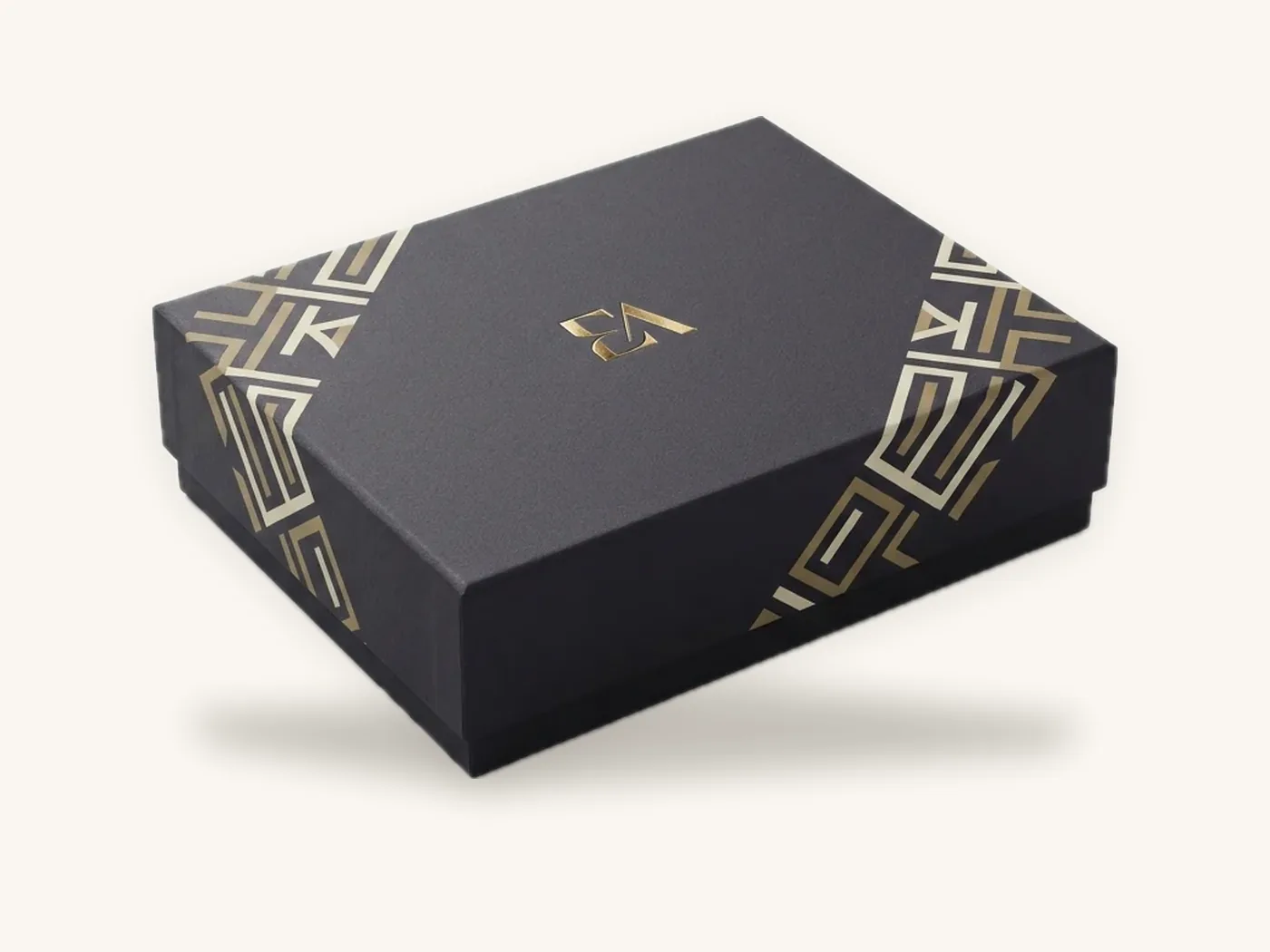
- Foil stamping: gold, silver, rose gold or holographic foil on logos, especially striking on black board.
- Embossing and debossing: a raised or pressed logo; works best on thick, uncoated stocks.
- Spot UV: glossy highlights on a matte background.
- Matte or soft-touch lamination: scuff resistance and a premium hand feel on coated tags.
- Round corners: fewer bent corners on racks.
Artwork rules for printed tags
- Use the template supplied for your size and shape, with cut line, bleed and hole position marked.
- Extend background colors about 1/8 in past the cut line as bleed.
- Keep text and logos at least 1/8 in inside the cut line and 1/4 in clear of the hole or eyelet.
- Keep body text at a readable size; very small type on uncoated stock fills in.
- Place the barcode on a light background, in a dark ink, with its full quiet zone clear of other elements.
- Leave a blank area if prices or sizes will be written, stamped or stickered in later.
- Confirm which side is front and back, and which way is up relative to the hole.
A blank price area or a small custom product label for sizes lets one printed tag serve a whole collection. The custom labels and stickers guide covers size and barcode sticker options.
Hang tags beyond apparel
Hang tags work wherever a product has a neck, handle or loop and a story to tell.
Candles, jars and bottles
A tag looped around a jar lid, candle, or bottle neck with elastic or twine carries scent notes, burn instructions or tasting notes without crowding the main label. Pair with a printed carton from our candle boxes range for retail gifting.
Gifts and events
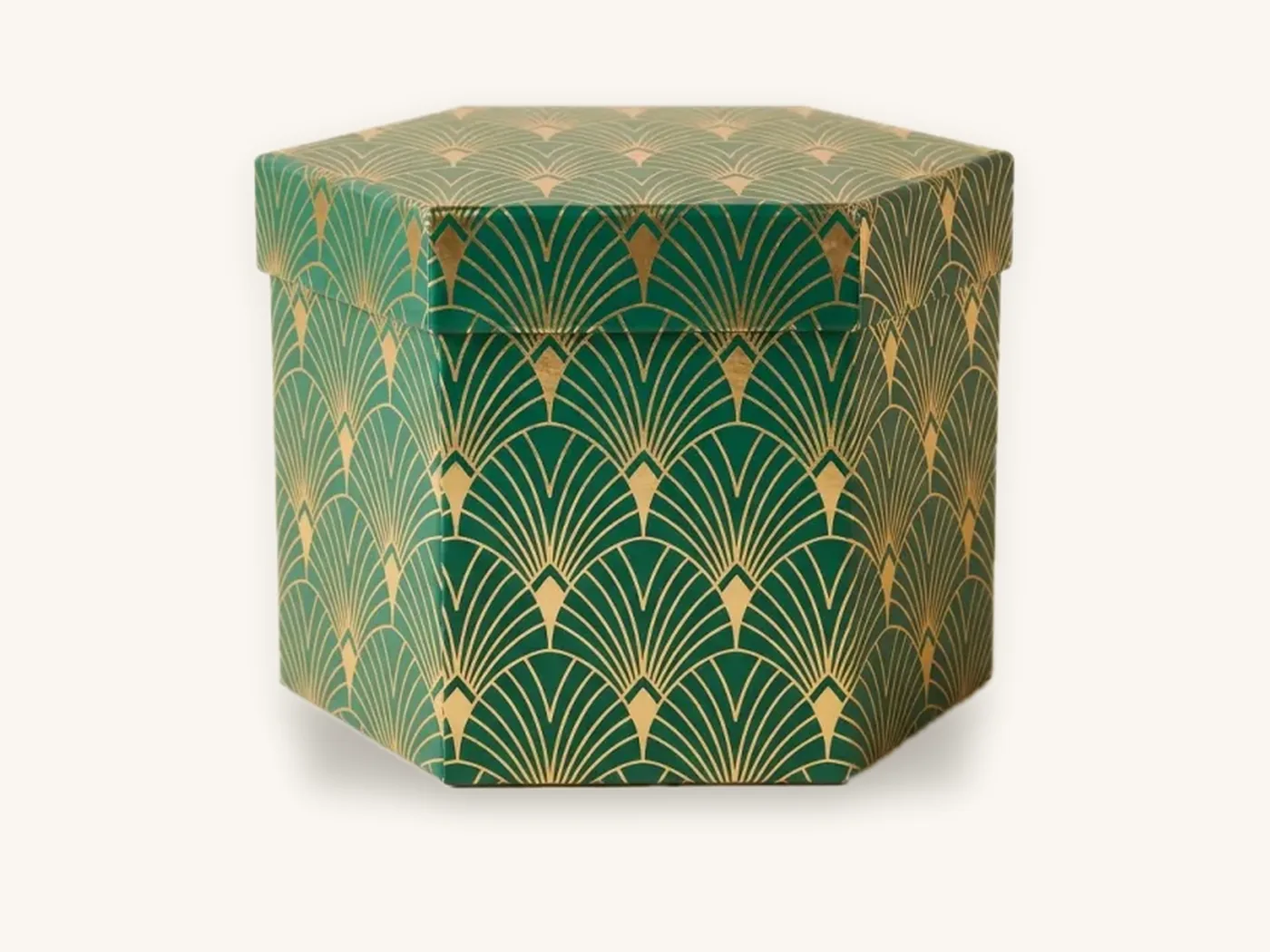
Wedding favors, corporate gifts and holiday sets use tags as gift cards: a name, a message, or a QR code for a digital greeting. Tie them to a ribbon on a gift box, or around unusual shapes like those in our hexagon boxes guide.
Bags, accessories and home goods
Leather goods, bags and home textiles use heavier duplexed tags on chain or cord, often designed to be kept. For shipped apparel, a tag inside a printed apparel box wrapped in tissue completes the unboxing; the custom tissue paper guide covers the wrap.
What drives the cost of custom hang tags
Tag pricing depends on the combination of stock, size, finishes and attachments, so request a confirmed quote and use our pricing page to plan the boxes and cartons in the same program.
| Cost driver | Why it matters | How to manage it |
|---|---|---|
| Quantity | Setup spreads across more tags | Price several tiers; tags store easily |
| Stock thickness | Heavier and duplexed boards use more material and processing | Use heavy stock where tags are handled most |
| Size and shape | Custom die shapes may need setup; larger tags use more board | Standard sizes with round corners are efficient |
| Print colors and sides | Double-sided full color adds printing | One or two PMS colors on kraft often look premium |
| Finishes | Foil, embossing and spot UV add one-time tooling and a press pass | Use one signature finish rather than several |
| Eyelets and strings | Each is a material plus an attaching step | Pre-string only the tags you apply at volume |
| Number of versions | Separate sizes or prices on each tag multiply setup | Print a shared design and add size or price stickers |
How to order custom hang tags from Box Sense
What to send
- Tag size and shape, or the product and a request for a recommendation
- Stock: coated, kraft, textured, black or duplexed, and preferred thickness
- Print: full color or PMS, one side or both
- Finishes: foil, embossing, spot UV, lamination, round corners
- Hole position, eyelet color and attachment type, and whether you need strings attached
- Content for front and back, including barcodes and any retailer tagging specifications
- Number of versions and quantities for each
- Artwork on our template, or a request for help from our design services team
What happens next
- Quote within 24 hours for your stock, size, finishes and quantities.
- Free design support: a template with cut line, bleed, safe zone and hole position, artwork setup and a digital proof with two revision rounds.
- Samples: ask about stock and finish samples so you can feel thickness before ordering; see samples for our policy.
- Production: standard production is 8–12 business days after proof approval.
- Delivery: free shipping on every US order; international shipping quoted at cost.
If you are ordering hang tags alongside apparel boxes, tissue or labels, request them in one quote so colors and delivery line up.
Frequently asked questions
What is the best thickness for custom hang tags?
For most apparel, 16 to 18 pt coated or kraft stock feels solid without being bulky. Choose 24 pt or duplexed boards of around 30 pt and above for luxury fashion, outerwear and gift sets, where the tag should feel substantial and resist creasing on busy retail racks. Lighter stocks around 14 pt suit simple price tags and online-only brands.
What size should clothing hang tags be?
Most clothing hang tags fall between about 2 x 3 in and 2 x 3.5 in, the size of a business card. Small accessories and jewelry often use slimmer 1.5 x 3 in tags, while denim and outerwear use larger tags around 2.5 x 4 in. Make sure the back has room for a barcode at a size your scanners read reliably.
How do you attach hang tags to clothing?
Attach tags through a seam allowance, the brand label loop, a button or a belt loop rather than the face fabric. High-volume brands use plastic fasteners with a tagging gun or pre-strung tags with a seal lock. Boutique brands often use cotton string, ribbon or a safety pin. Avoid tagging gun needles on delicate knits and silks.
Can a hang tag replace a care label?
Generally no. In the US, the FTC requires most textile garments to carry fiber content, country of origin and manufacturer identity on a label, plus permanent care instructions. A hang tag is removed after purchase, so it can repeat or add detail but usually cannot replace that label. Confirm current requirements for your product with FTC guidance.
What should be printed on a hang tag?
The front typically carries the logo and brand name. The back holds the price or a blank price area, size, style name, SKU and barcode, plus optional extras such as a one-line brand story, fabric highlight or QR code for care and fit information. Keep content brief and place the barcode in the same spot on every tag.
Are kraft hang tags eco-friendly?
Kraft tags use unbleached paperboard and are generally recyclable where paper is accepted, especially without plastic lamination. Choosing cotton or jute string over plastic fasteners, skipping metal eyelets where not needed, and printing with soy or water-based inks keeps them more easily recyclable. Follow the FTC Green Guides before printing any environmental claim on the tag.
Do hang tags need a hole reinforcement?
Not always. Light tags on items handled gently work fine with a plain punched hole. Add a metal eyelet or grommet when tags are thin, hang from heavy items, use a thin cord that could cut through the board, or face lots of handling in stores. Eyelets also give a finished, premium look.
Next steps
Decide your attachment method and tag size first, then choose stock thickness and finishes to match your brand. When the spec is ready, request a quote for custom hang tags, and check pricing for the apparel boxes or cartons they go with. We confirm quotes within 24 hours and send a template ready for your artwork.
Boxes in this guide
Order the packaging we covered
Written by the Box Sense Packaging Team
Our structural designers, prepress technicians and production staff print and convert custom boxes every day for brands in the United States, United Kingdom and UAE. Questions about this guide? Talk to us.