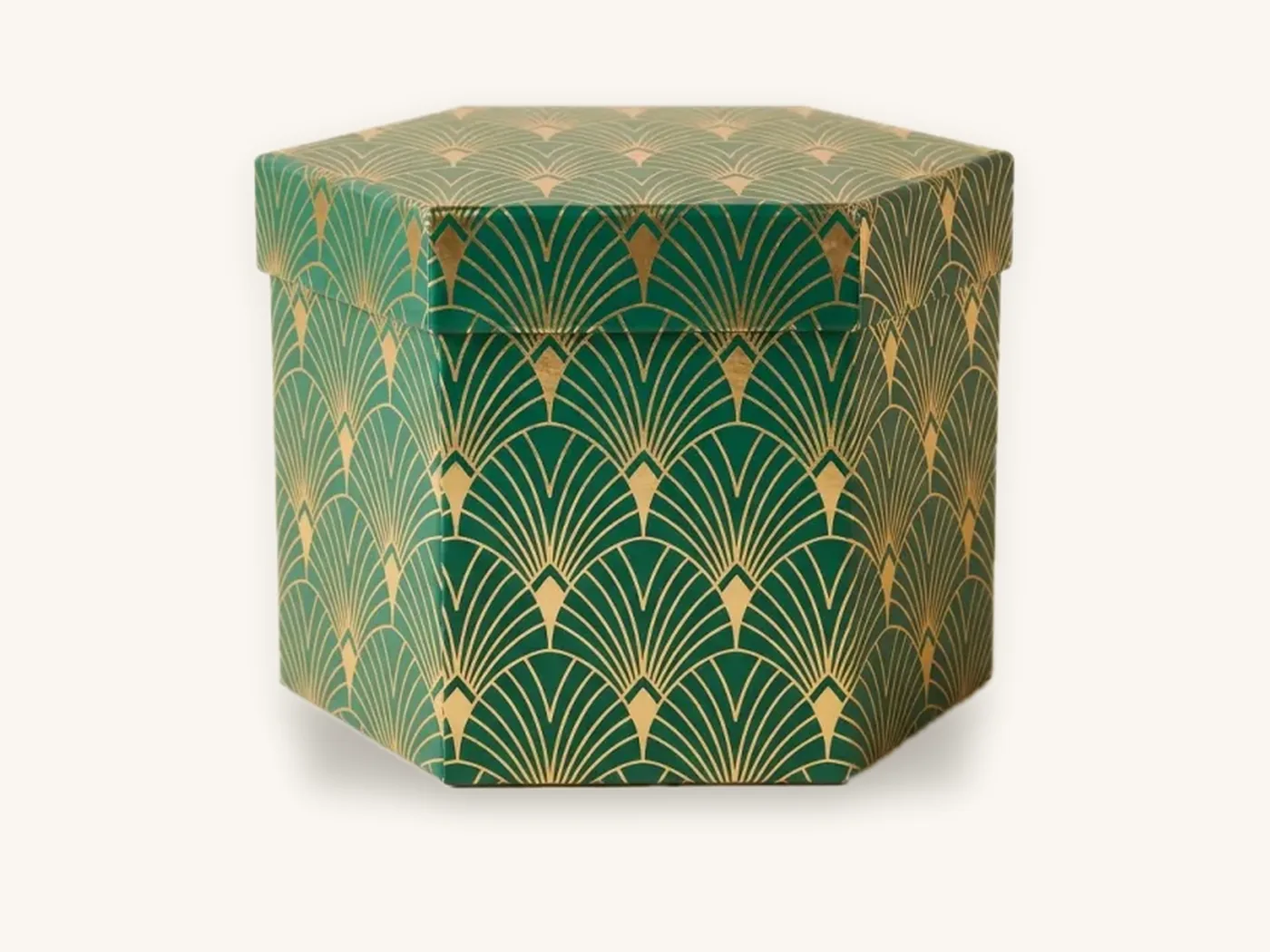
Custom hexagon boxes are six-sided cartons or rigid boxes used when a product needs to look like a gift before anyone opens it. They are built either as a folding paperboard carton that ships flat, or as a rigid lid and base box that arrives set up. Both stand out on a shelf full of rectangles, and both tessellate into a tidy honeycomb when displayed together.
The shape brings tradeoffs a rectangle never has: sizing is measured differently, artwork wraps across six panels instead of four, and hexagons waste space inside square shipping cartons. This guide covers the structures, the geometry, the design rules and the products that suit hexagon packaging best, so you can decide whether the shape earns its place.
Key takeaways
- Hexagon packaging comes in two main builds: a folding paperboard hexagon (tuck or crash-lock, ships flat) and a rigid hexagonal gift box (lid and base, arrives set up).
- Size a hexagon by across flats (wall to opposite wall), across corners (point to opposite point) and height. A regular hexagon's across-corners measurement is exactly twice its side length.
- A round product fits a hexagon whose across-flats measurement is slightly larger than the product's diameter.
- Artwork crosses six narrow panels, so logos belong on the lid or a single front panel, not across a fold.
- A hexagon fills about three quarters of its rectangular footprint, so plan shipping cartons and display trays around that loss.
- Box Sense makes custom hexagon boxes from 10 units, with no die charges and free structural samples.
Why brands choose a six-sided box
A hexagon reads as intentional. Shoppers scanning a shelf register rectangles as background, and a six-sided outline breaks the pattern. That makes the shape popular for products where the packaging carries the purchase decision: confectionery gifts, beauty sets, candles and event favors.
The shape also groups well. Six-sided boxes nest edge to edge in a honeycomb with no gaps, which lets retailers and event planners build a display wall or a table centerpiece from individual units. A rectangle stacks, but a hexagon composes.
Finally, a hexagon holds round products better than a square does. A jar, tin or candle in a square box has four large empty corners; in a hexagon the gaps are six small ones, so the product shifts less and needs a lighter insert.
When a hexagon is the wrong shape
Skip it when cost per unit is the dominant concern, when the product is rectangular (a hexagon around a rectangle wastes volume), or when the box ships bare through the parcel network. It is also a poor fit for high-speed automated packing lines, which are set up for rectangular cartons. For those needs, a tuck carton or a mailer is the better call; the custom mailer boxes guide covers the one-piece shipping option.
Hexagon box constructions compared
Hexagon packaging is not one structure. It is a family of builds that share an outline and differ in board, closure and cost.
| Construction | Board | How it closes | Arrives | Best for |
|---|---|---|---|---|
| Folding hexagon with tuck top | 14–18 pt SBS or kraft | Six-point tuck lid or petal lid folds down | Flat | Candy, favors, small cosmetics |
| Folding hexagon with crash-lock bottom | 18–24 pt SBS | Tuck top; pre-glued bottom snaps open | Flat, pops up | Heavier contents, faster packing |
| Rigid hexagonal gift box | About 2 mm greyboard, paper wrapped | Separate lid slides over the base | Set up | Premium chocolates, fragrance, keepsake gifts |
| Hexagon with window | SBS with PET or PLA film | Tuck or lid, window on top or one panel | Flat or set up | Macarons, soap, anything that sells on sight |
| Open hexagon tray or sleeve | SBS or E-flute | No lid, or a sleeve slides over | Flat | Display trays, multi-pack holders |
Folding hexagon cartons
A folding hexagon is die-cut from one sheet with six side panels in a row, a glue flap, and a top and bottom closure. The top is usually a set of six triangular or curved flaps that interlock into a star or petal pattern, which doubles as decoration. A crash-lock bottom is pre-glued at the factory, so the carton pops open and locks its own floor in one motion.
Folding hexagons keep storage small and are the lower-cost route. They suit products under about a pound; above that, the petal closure can push open under the weight when the box is lifted from the top.
Rigid hexagonal gift boxes
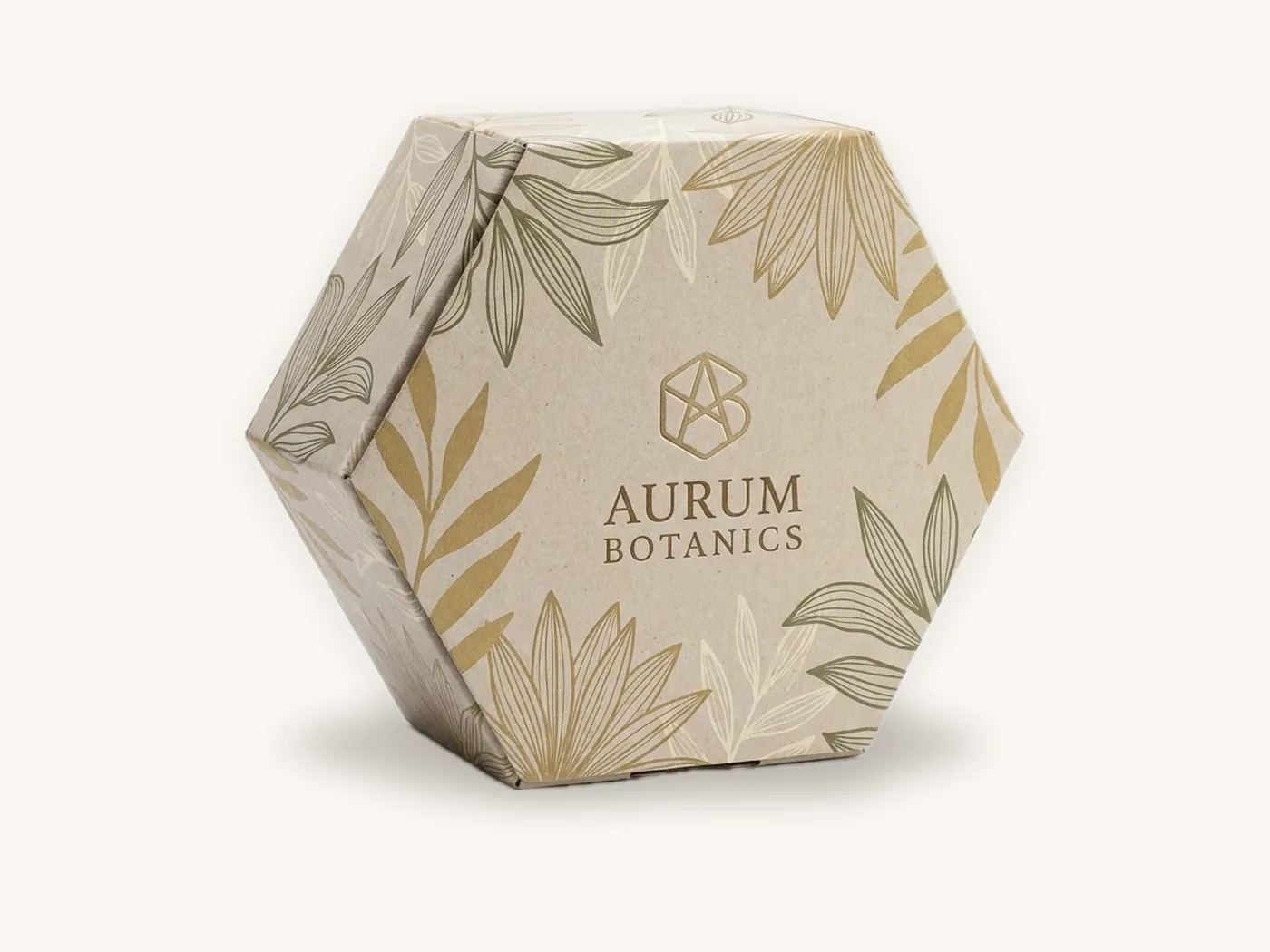
A rigid hexagonal gift box uses six greyboard wall pieces joined into a base, with a matching six-sided lid, and a printed or specialty paper wrapped over both. The lid fit works exactly like a rectangular lid and base box, and the same decisions about lid depth apply; the two-piece boxes guide walks through full versus partial telescoping lids.
Rigid hexagons cost more because each extra corner is another wrapping step. In return, the box holds its shape empty, survives being reused, and gives a crisp, dense feel that a folding carton cannot match. The rigid greyboard page explains the board.
Hexagon geometry: how to measure and size a six-sided box
Most sizing mistakes with hexagon packaging come from using the wrong measurement. A rectangle has length, width and depth. A regular hexagon has one side length, and two different widths depending on where you measure.
- Side length (s): the length of one panel edge.
- Across flats: the distance between two opposite walls. Equal to side length x 1.732.
- Across corners: the distance between two opposite points. Equal to side length x 2.
- Height: the depth of the box, floor to lid.
Across flats is the measurement that matters for fitting a round product, because that is the narrowest inside width. Across corners is the measurement that matters for fitting the box into a shipper, a shelf slot or a bag.
Hexagon size reference table
The table uses the formulas above for regular hexagons. Inside dimensions will be slightly smaller than these outside figures by the board thickness.
| Side length | Across flats | Across corners | Perimeter | Top face area |
|---|---|---|---|---|
| 1 in | 1.73 in | 2 in | 6 in | 2.6 sq in |
| 1.5 in | 2.6 in | 3 in | 9 in | 5.85 sq in |
| 2 in | 3.46 in | 4 in | 12 in | 10.39 sq in |
| 2.5 in | 4.33 in | 5 in | 15 in | 16.24 sq in |
| 3 in | 5.2 in | 6 in | 18 in | 23.38 sq in |
Sizing around a round product
Say you sell a candle in a tin 3.25 in across. The inside across-flats measurement should be a little larger than the diameter, around 3.4 in, so the tin drops in without scraping the walls. Working backwards, 3.4 divided by 1.732 gives a side length of about 1.96 in. Round up to a 2 in side, which gives 3.46 in across flats and 4 in across corners. Add the board thickness and you have the outside size.
For a stack of round items, such as macarons or truffles, measure the stack height and add clearance for a tissue or insert. For irregular products, send us the item or a photo with measurements and we will fit the shape around it.
Watch out: a customer's "4 inch hexagon box" could mean 4 in across flats or 4 in across corners, and the difference is more than half an inch. Always state which measurement you mean, and whether it is inside or outside.
Designing artwork for hexagon packaging
Six panels change how artwork behaves. Each side panel is narrow; on a 2 in side hexagon, it is only 2 in wide. A logo that looks balanced on a rectangular front panel will wrap around a fold and break on a hexagon.
Artwork checklist for six-sided boxes
- Put the primary logo on the lid or top face. It is the only large, unbroken surface and the one seen from above on a display table.
- Pick one front panel for the product name, and treat the other five as supporting surfaces.
- Keep type at least 1/8 in from every crease. On narrow panels, that margin eats a lot of space, so reduce copy rather than shrinking the margins.
- Use repeating patterns across the side panels. Patterns hide slight fold variation, where a single image spread across folds exposes it.
- Check pattern continuity at the glue flap. The seam where the first and sixth panels join is where a misaligned pattern shows.
- Place required text on one or two adjacent panels. Ingredients, net weight and barcodes need a flat reading area.
- Mind the lid orientation. On a tuck top with petal flaps, the flap art shows when closed, and the underside shows when opened.
- Extend background color 1/8 in past every cut line as bleed.
The dieline we supply labels every panel, which matters on a hexagon because it is easy to lose track of which panel faces forward once folded.
Finishes that work well on hexagons
Foil and embossing on the lid top are the natural focal point, since that face is flat and uninterrupted. Soft-touch lamination suits rigid hexagonal gift boxes. On folding hexagons, gloss or aqueous coating keeps the many fold lines from cracking the print. Spot UV on a repeating pattern across the side panels adds shine without needing perfect registration at every crease. Our printing and finishes page shows each option.
Best uses for custom hexagon boxes
Hexagon packaging earns its cost in categories where the box is part of the gift.
Chocolate and confectionery
Truffle sets, bonbons and macarons are the most common use. A hexagon holds a ring of six pieces around a center, which is a natural layout for an insert. A window on the lid lets the assortment sell itself. The chocolate and candy packaging page shows related formats, and candy boxes and chocolate boxes can both be built as hexagons.
If confectionery touches the board directly, food-contact rules apply. The FDA regulates materials that contact food in the US, so specify a food-safe liner, glassine or inner bag where needed, and confirm current requirements with the FDA or your counsel. For loose candy that needs a moisture barrier, a small pouch inside the box works well; the stand-up pouches guide covers barrier options.
Gifts, favors and events
Wedding favors, corporate gift sets and holiday assortments use hexagons because a table of them looks designed. Small folding hexagons in the 1.5 in side range work as favors; larger rigid ones hold a full gift set. See custom gift boxes, favor boxes and the gifts and events packaging page.
Candles, cosmetics and bath products
Round candle tins, jars of cream, bath bombs and soap rounds all sit well in hexagons, because the shape follows the product more closely than a square. Candle boxes in hexagonal form are a good way to differentiate a candle line on a crowded shelf.
Hexagons in shipping and display: the space tradeoff
Here is the part most brands discover after they order. A regular hexagon occupies about 75 percent of the rectangle that surrounds it, calculated from its area divided by across flats times across corners. The rest is empty corner space.
Packing hexagons into shipping cartons
In a rectangular shipper, hexagons laid in straight rows leave four triangular gaps around each box. Offsetting alternate rows by half a box, the honeycomb pattern, fills most of those gaps inside the carton, though the edges still waste some space. If you ship cases of hexagon boxes to retailers, ask us to size the case around the honeycomb layout rather than simply multiplying across corners by box count. The custom shipping boxes guide covers case board grades.
For direct-to-consumer orders, pack the hexagon inside a mailer with a simple die-cut insert that holds it centered. A bare hexagon shifting in a rectangular box will crush at the corners.
Retail display and bags
On a shelf, hexagons face forward with one flat panel or one point. A flat panel gives a clean face for the product name; a point forward makes the box look larger and more dimensional. Decide early, because it determines which panel carries the front artwork.
For boutique sales, check that the across-corners measurement fits your carry bag's gusset. The custom paper bags guide explains bag gusset sizing.
Inserts for hexagon boxes
An insert turns a hexagon from an empty shape into a planned presentation. The most common layouts are a single central cavity for a jar or candle, a ring of six cavities around a center for confections, and a stacked two-tier insert for larger gift sets.
Paperboard inserts are light, printable and cut on the same kind of equipment as the box. Foam inserts suit fragrance bottles and fragile glass. Molded pulp is a plastic-free option for heavier items. Each custom insert carries a one-time insert die charge, and it must be sized together with the box so the six corners of the insert meet the six corners of the walls. See box inserts and dividers for materials.
Tip: order an unprinted structural sample with the insert included and put your real product in it. On a hexagon, a 1/16 in error in the insert shows up as a visible gap along one wall, which is easy to fix before printing and expensive after.
What drives the cost of hexagon packaging
Hexagons cost more than rectangular boxes of similar volume for three reasons: the blank uses more board relative to the space inside, the gluing and folding have more steps, and rigid versions need more hand wrapping at six corners instead of four.
For a sense of where a small printed carton sits, a rectangular candle box in 18 pt SBS at 3.5x3.5x4 in with matte finish, foil and an insert is about $1.03 each at 1,000 units. A hexagon of similar size and spec will price higher, and the gap depends on closure style and whether it is rigid. Use the instant estimator for your exact spec, or request a quote.
| Cost driver | Lower cost choice | Higher cost choice |
|---|---|---|
| Construction | Folding paperboard hexagon | Rigid wrapped hexagon |
| Closure | Simple tuck lid | Petal lid, crash-lock bottom or separate rigid lid |
| Board | 14–18 pt SBS or kraft | 24 pt SBS or 2 mm greyboard |
| Outside only, patterns | Outside and inside, full-bleed photography | |
| Finishes | Aqueous coating | Soft-touch, foil, embossing, spot UV |
| Extras | None | Window film, custom insert |
| Quantity | 1,000 or more | 10 to 100 |
There is no die charge for the box structure itself at Box Sense. One-time tooling applies only if you add foil, embossing, spot UV or a custom insert.
How to order custom hexagon boxes from Box Sense
Hexagons are among the styles where a sample is most worth it, because both the geometry and the artwork placement are easy to misjudge on screen.
What to send
- Product dimensions, especially diameter for round products, and weight
- Your preferred measurement: side length, across flats or across corners, and whether it is inside or outside
- Construction: folding carton or rigid, and closure style
- Whether a flat panel or a point faces forward on shelf
- Print coverage, finishes and any window
- Insert requirements
- Quantities to compare and target delivery date
- Artwork, or a request for help from our design services team
The process
- Quote confirmed within 24 hours.
- Free dieline and 3D proof, with every panel labeled and two revision rounds included.
- Free unprinted structural sample to test fit; a printed sample of approved artwork is free on orders of 100 or more. See samples.
- Production in 8–12 business days after proof approval as standard. Rush production in 5 business days is available on most paperboard styles.
- Free shipping on every US order; international shipping is quoted at cost.
The minimum is 10 boxes. Defective boxes reported within 14 days are reprinted free. Browse the hexagon boxes product page for the standard build, or the die cut boxes style page for other shaped structures. If you want to go beyond six sides, the die cut boxes guide explains how fully custom shapes are engineered.
Frequently asked questions
How do you measure a hexagon box?
Measure a hexagon box by side length, across flats and height. Across flats is the distance between two opposite walls and equals side length times 1.732. Across corners is the distance between two opposite points and equals side length times 2. Use across flats to fit a round product inside, and across corners to fit the box into a shipper, shelf slot or bag.
What are hexagon boxes used for?
Hexagon boxes are used mainly for gifts and presentation: chocolates, truffles, macarons, candy, candles, cosmetics, bath products, wedding favors and corporate gift sets. The shape stands out among rectangular packages, holds round products with less movement, and arranges into a honeycomb for displays and event tables. They are less suited to heavy products or bare parcel shipping.
Are hexagon boxes more expensive than square boxes?
Yes, typically. A hexagon uses more board relative to its inside volume, has more folding and gluing steps, and rigid versions require more hand wrapping at the extra corners. Folding paperboard hexagons keep the premium modest, while rigid hexagonal gift boxes cost more. Box Sense charges no die fee for the structure, so the difference comes from material and labor.
Can hexagon boxes ship flat?
Folding paperboard hexagon boxes ship flat and fold into shape, and crash-lock bottom versions pop open with the floor already locked. Rigid hexagonal gift boxes arrive fully set up and take their full volume in storage. If storage space is limited but you want a premium feel, a heavier 24 pt folding hexagon with soft-touch lamination is a practical middle ground.
What size hexagon box fits a round candle or jar?
Choose a box whose inside across-flats measurement is slightly larger than the product's diameter, usually by about an eighth of an inch. Divide that number by 1.732 to get the side length, then round up. For a 3.25 in tin, a 2 in side hexagon gives about 3.46 in across flats, enough for the tin to drop in cleanly.
Can I get a hexagon box with a window?
Yes. A window can be cut into the lid, which shows the product from above, or into one side panel, which shows it on a shelf. Windows use clear PET film or compostable PLA film. Keep windows away from creases and closure flaps so the film does not wrinkle or pull loose when the box is folded or opened.
What is the minimum order for custom hexagon boxes?
Box Sense produces custom hexagon boxes from a minimum of 10 units, in folding paperboard or rigid construction. Short runs are digitally printed, so small quantities work for event favors, product tests and seasonal gift sets. Unprinted structural samples are free, which is especially useful on hexagons, where geometry and artwork placement are easy to misjudge on screen.
Next steps
Pick your construction, measure your product's diameter or footprint, and decide which measurement you will use to specify the box. Then check indicative costs in the hexagon box price estimator and request a custom hexagon box quote. We will confirm pricing within 24 hours and send a labeled dieline for your artwork.
Boxes in this guide
Order the packaging we covered
Written by the Box Sense Packaging Team
Our structural designers, prepress technicians and production staff print and convert custom boxes every day for brands in the United States, United Kingdom and UAE. Questions about this guide? Talk to us.