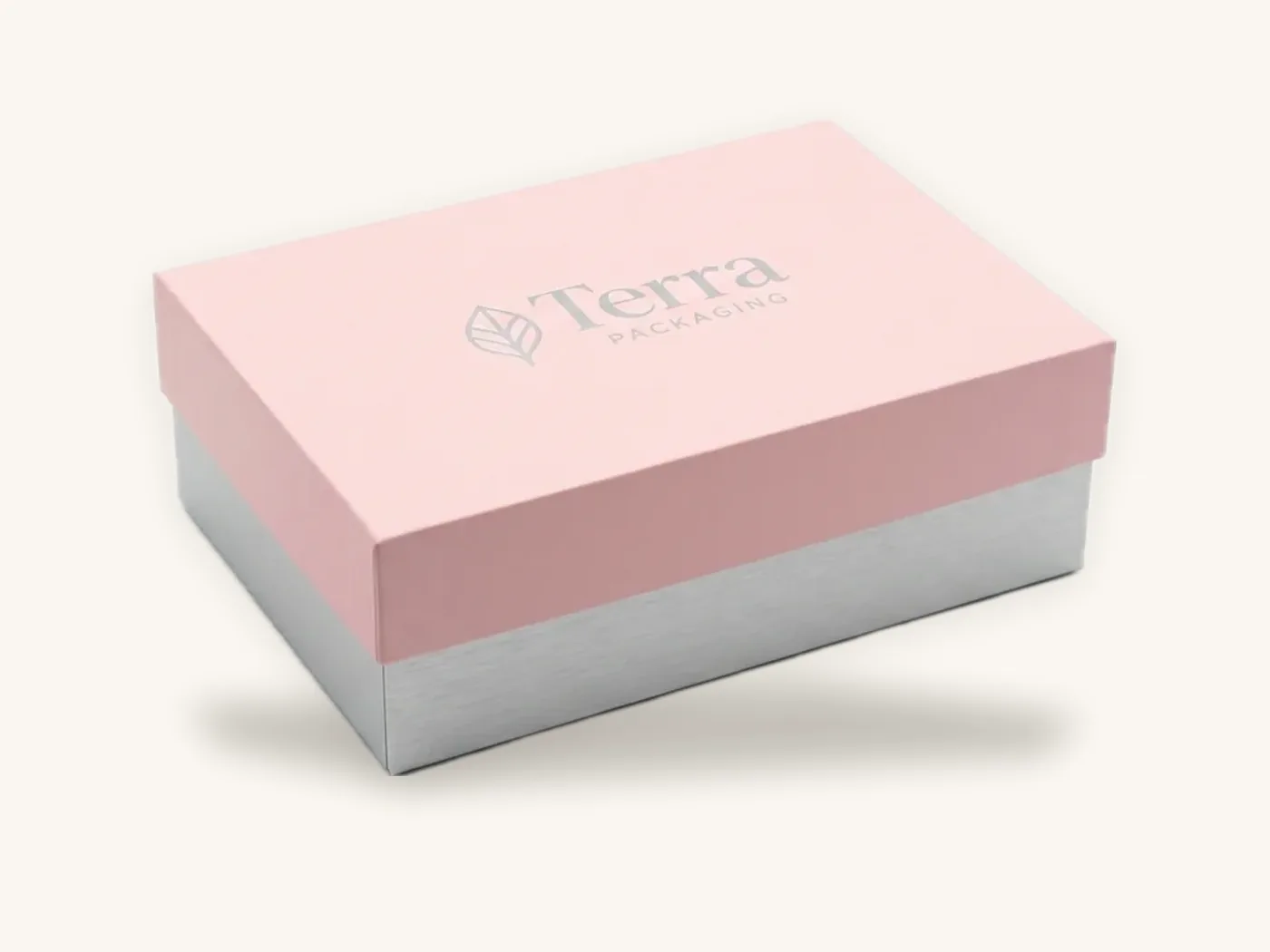
Two piece boxes are exactly what the name says: a separate base and a lid that slides down over it. You can build them from folding paperboard, which ships flat and costs less, or from rigid greyboard wrapped in printed paper, which arrives set up and feels like a keepsake. The right choice depends on how much the box has to impress, how it travels and how much storage space you have.
This guide is built around that one decision, paperboard or rigid, and everything that follows from it: lid depth, fit tolerances, finishes, cost at different quantities and the practical realities of storing and packing a lid and base box. If you sell apparel, shoes, gift sets or retail goods that are handed over rather than shipped bare, it will help you spec the box correctly the first time.
Key takeaways
- A two-piece box is a base plus a separate lid. The lid is sized off the outside of the base, so board thickness directly affects how snug the fit feels.
- Paperboard two-piece boxes (typically 18–24 pt SBS or kraft) ship flat, assemble by folding or locking corners and suit apparel, shoes and volume retail.
- Rigid two-piece boxes use about 2 mm greyboard wrapped in paper. They arrive assembled, resist crushing on shelf and suit gifts, premium apparel and presentation sets.
- Lid depth is a design choice: a full telescoping lid covers the entire base, a partial lid shows a band of the base, and a shoulder style adds an inner neck.
- An 8x6x3 in rigid box, 2 mm greyboard with full color and matte finish, runs about $9.10 each at 100 units and about $4.05 at 1,000.
- Box Sense makes two piece boxes from 10 units with free dielines, a 3D proof and standard production of 8–12 business days after approval.
How a lid and base box is built
Every two-piece box has the same logic. The base is an open-top tray with four walls. The lid is a second, slightly larger tray turned upside down. When the lid drops over the base, friction between the inside of the lid walls and the outside of the base walls holds it in place.
That friction fit is the whole product. Too tight and the lid sticks; too loose and it drops off when someone lifts the box by the lid. A well-made lid and base box releases with a slow, cushioned lift as air seeps in, which is much of why the format feels premium.
Telescoping lid depths and shoulder styles
The term telescoping box describes the way the lid slides over the base like the sections of a telescope. How far it slides is the first structural decision.
| Lid style | What you see when closed | Best for | Tradeoff |
|---|---|---|---|
| Full telescope | Lid covers the base walls completely | Shoes, apparel, heavier contents, stacking | Uses the most board; lid can be slow to lift |
| Partial telescope | Lid covers roughly a third to half of the base; a band of base shows | Gift boxes, two-tone color schemes, candles | The visible base band must be printed or wrapped to match |
| Shallow lid | A short cap, often under an inch deep | Stationery, flat gifts, sets with a lift-out tray | Less grip, so it slides off more easily if overfilled |
| Shoulder (neck) box | Lid meets a raised inner collar; the neck shows as a contrast band | Fragrance, jewelry, luxury sets | Three components, so more cost and lead time on assembly |
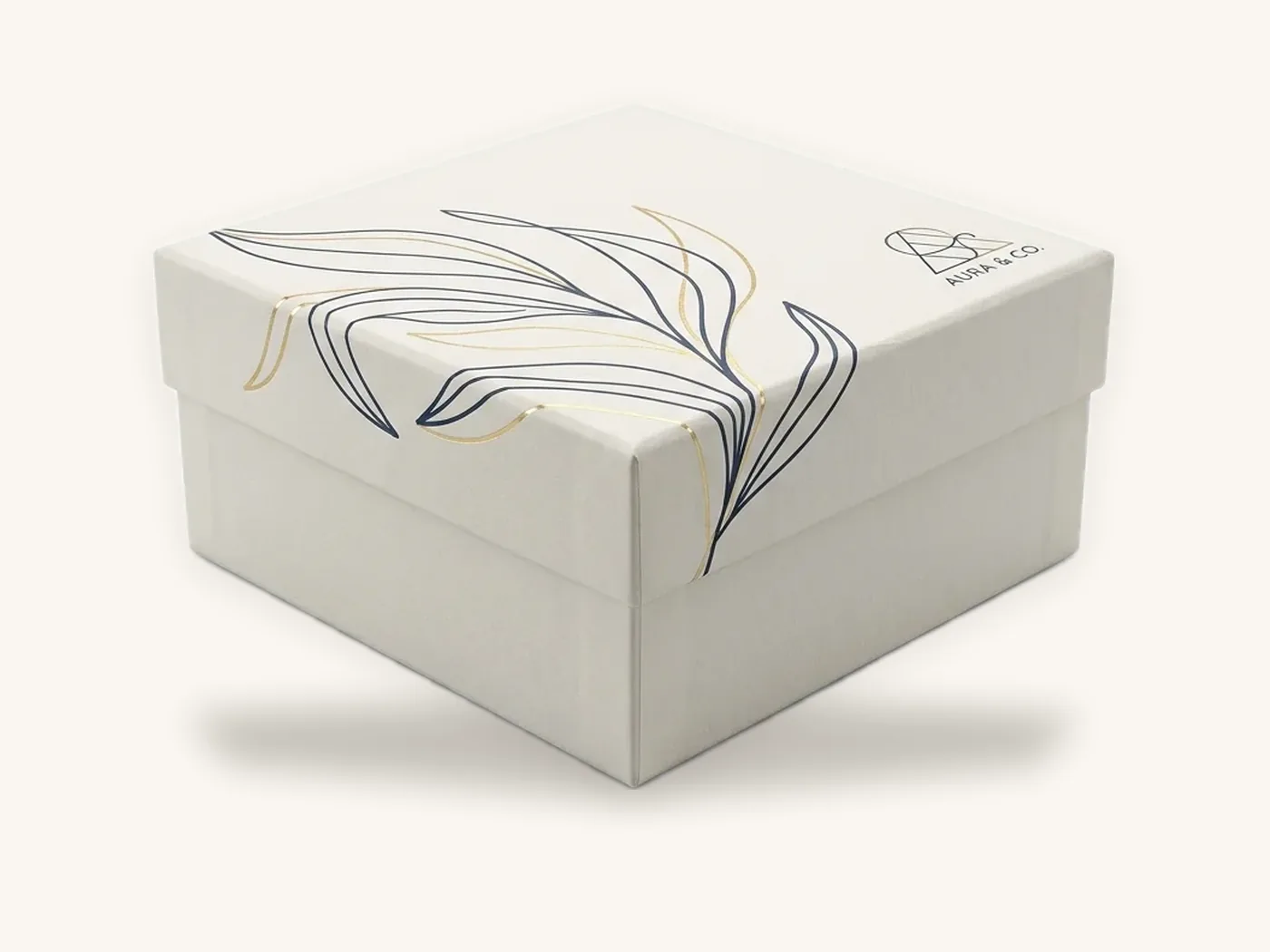
A partial telescope is the most common gift-box look, because it gives you two print surfaces in one glance: the lid and a stripe of base. If you want that stripe as a deliberate accent with a lid that sits perfectly flush, look at shoulder neck boxes, which add a third piece between lid and base.
Paperboard vs rigid two-piece boxes: the core decision
Most buyers already know which camp they lean toward. The table below makes the tradeoffs explicit so you can defend the choice to whoever signs off on the budget.
| Factor | Paperboard two-piece box | Rigid two-piece box |
|---|---|---|
| Board | 18–24 pt SBS or kraft paperboard (about 0.46–0.61 mm) | About 2 mm greyboard, paper-wrapped |
| Arrives | Flat, folded on your packing line | Fully set up, nested or stacked |
| Storage footprint | Small; hundreds fit on a shelf | Large; each box takes its full volume |
| Crush resistance | Moderate; relies on contents for support | High; holds shape empty and under light stacking |
| Print surface | Printed directly on the board | Printed on the wrap paper, which can be specialty stock |
| Feel in hand | Light, clean, retail-ready | Heavy, dense, reads as a keepsake |
| Unit cost | Lower | Higher, driven by manual wrapping |
| Typical uses | Apparel, shoes, retail sets, bakery, promotional kits | Gifts, premium apparel, jewelry, launch kits, corporate gifting |
Choose paperboard when
Choose paperboard when you pack large volumes, when storage space is limited, or when the box sits inside another shipper and mostly serves as retail presentation. Paperboard shoe boxes are the classic example: they are stacked in stockrooms by the thousand, they need to be light, and they are opened once.
It also suits brands that change designs often, such as seasonal collections. See SBS paperboard for grades and folding cartons for related structures.
Choose rigid when
Choose rigid when the box is part of the product. If customers keep it, reuse it or display it, rigid greyboard pays for itself. It also makes sense when the contents are light or soft, like a silk scarf, a knit sweater or a set of cards, because paperboard would flex and dent with nothing inside to support the walls.
Rigid is also the better format when a lift-off lid reveal is the whole point, such as influencer kits and corporate gifts. The rigid boxes style page shows the wider range, and custom rigid boxes covers the build details. Read about rigid greyboard if you want to understand how board thickness changes the feel.
Tip: if you are torn, ask for one unprinted structural sample in each construction. Put your actual product inside, hand both to someone who has not seen them, and watch which lid they lift first and how they set it down. That tells you more than any spec sheet.
Fit and tolerances: sizing a lid and base box correctly
Sizing a two-piece box is more exacting than sizing a mailer or a tuck carton, because two separate parts have to meet with the right amount of friction. The base is sized from your product. The lid is sized from the base.
A worked sizing process
- Measure the product as packed. Include tissue, a tray, a card or a pouch. Measure at the widest point in each direction.
- Set the base internal size. For folded apparel, add very little, around 1/16 in on length and width. For rigid items like a bottle set, add roughly 1/8 in so the tray drops in without scraping.
- Add wall thickness to get the base external size. Each wall adds its board thickness twice across the box: once on each side. A rigid wall is about 2 mm of greyboard plus the wrap, so the outside grows by roughly 4–5 mm in each direction. An 18 pt paperboard wall adds under 1 mm.
- Set the lid internal size from the base external size. Add a small clearance so air can escape. Paperboard lids typically need only a fraction of a millimeter; rigid lids usually take slightly more because the wrap paper adds bulk and some variation at the corners.
- Choose lid depth. Decide between full, partial or shallow, then set the depth in inches.
- Check total height. Make sure the base walls are tall enough that the product does not push the lid up.
- Sample and test. Pick the closed box up by the lid only. It should stay on. Then lift the lid off; it should release in a smooth, slightly slow motion.
Say you sell a folded cashmere sweater that packs to 11.5 x 8.5 x 2.25 in with tissue. A rigid base with internal dimensions of 11.75 x 8.75 x 2.5 in gives light clearance. With about 2 mm walls plus wrap, the base outside comes to roughly 11.95 x 8.95 in, and the lid is sized a hair larger than that. A 1 in partial lid would leave a 1.5 in band of base visible; a full 2.5 in lid would cover it entirely.
Watch out: always tell your supplier whether the dimensions you send are internal or external, and for which part. A lid specified with the base's internal size will not fit over the base at all. At Box Sense we ask for product or base internal size and calculate the lid ourselves.
Why paperboard lids feel looser
Paperboard flexes, so even a perfectly sized paperboard lid feels looser than a rigid one. For a firmer fit, use a double-wall lid or base, which also leaves a clean folded edge.
Where lid and base boxes work best
The format shows up across very different categories, and each one pushes the spec in a different direction.
Apparel and fashion
Apparel is the natural home of the lid and base box. A folded shirt or knit lies flat in a shallow base, tissue wraps it, and the lid lifts off to reveal it. Paperboard suits volume retail and department-store gift boxes; rigid suits premium knitwear, lingerie and accessories. Apparel boxes and t-shirt boxes are both available in two-piece construction, and the apparel and fashion packaging page shows how brands combine them with tissue and bags.
For in-store purchases, the box usually goes straight into a branded bag. The custom paper bags guide covers gusset sizing so the bag actually fits the box you choose.
Shoes and footwear
Shoe boxes are almost always two-piece or hinged-lid paperboard, because they are stacked high and opened and closed repeatedly by shoppers trying on sizes. A full telescope lid helps them survive that handling. Sizing is by shoe size range, so brands usually run two or three box sizes rather than one per style.
Gifts, sets and corporate kits
Gift sets need a lid that lifts cleanly and a base that holds items in a planned layout. That almost always means an insert. Paperboard or foam inserts sized together with the base keep bottles, candles or electronics from sliding into each other. The box inserts guide explains when to choose paperboard, foam or molded pulp, and box inserts and dividers can be built into either construction.
Wraps, printing and finishes for two-piece boxes
On a paperboard box, artwork is printed directly onto the sheet before die-cutting. On a rigid box, artwork is printed onto a wrap paper that is then glued over the greyboard. That difference opens up different finishing options. Our printing and finishes page shows samples of each.
What to print, and where
A two-piece box has more visible surfaces than people expect. The lid top gets the brand. The lid walls carry the logo or a pattern that must read when boxes are stacked sideways. On a partial telescope, the exposed base band is a third surface, and the inside of the lid is a fourth that appears the moment the box opens.
You do not need to print everything. A common spec is full color on the lid, a solid color on the base, and a plain or single-color interior. On rigid boxes, a contrasting solid-color base wrap under a printed lid is one of the most cost-effective premium looks.
Finishes that suit lid and base boxes
- Matte lamination: the default for rigid wraps. It resists fingerprints on a lid that gets handled constantly.
- Soft-touch lamination: a velvety feel that makes lifting the lid feel deliberate. Popular for fragrance, beauty and knitwear.
- Gloss lamination or aqueous coating: better color saturation on paperboard shoe and apparel boxes, with aqueous keeping the box easier to recycle.
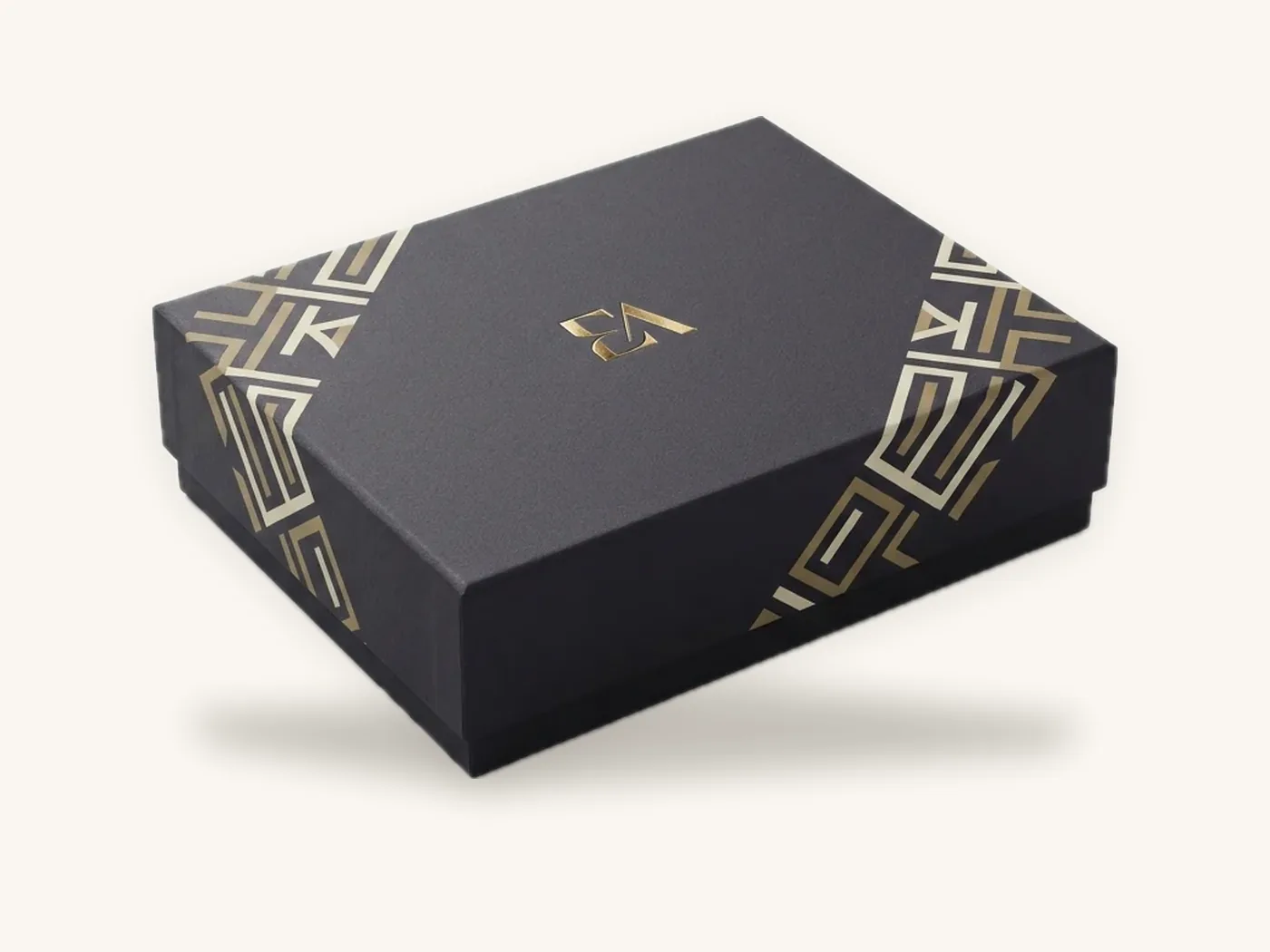
- Foil stamping: a logo in the center of the lid is the classic use. It carries one-time tooling.
- Embossing or debossing: works especially well on rigid lids, where the greyboard behind the wrap supports a crisp impression.
- Specialty wrap papers: textured, linen or colored papers on rigid boxes, often with just a foil logo and no printing at all.
Keep critical text and logos away from the lid edges. On rigid boxes, the wrap folds over the top edge and into the inside, and anything placed within about 1/8 in of that fold can roll out of sight.
What two piece boxes cost
Two-piece construction always uses more material than a single-piece box of the same size, because you are building two trays. Rigid costs more again, because wrapping greyboard involves more manual steps than folding and gluing paperboard.
Indicative per-unit prices from our current rates, with free US shipping included, look like this for rigid construction:
| Spec | 10 | 100 | 500 | 1,000 | 5,000 |
|---|---|---|---|---|---|
| Rigid box, 2 mm greyboard wrapped, 8x6x3 in, full color, matte | $13.76 | $9.10 | $4.85 | $4.05 | $2.87 |
| Rigid magnetic box, 2 mm, 10x8x3 in, soft-touch, foil, insert | $21.50 | $14.23 | $7.59 | $6.32 | $4.49 |
The magnetic box row is included as a reference point, because it is the rigid format buyers most often compare with a lift-off lid. For paperboard two-piece boxes, size and print coverage vary so much that a single figure would mislead; run your exact dimensions through the instant price estimator.
What moves the price
- Construction: rigid over paperboard is the largest single jump.
- Lid depth: a full telescope lid uses noticeably more board and wrap than a shallow cap.
- Print coverage: printing the base band and interior adds cost; solid colors cost less than full-bleed artwork on every surface.
- Finishes: foil, embossing and spot UV each carry one-time tooling; laminations do not.
- Inserts: a custom insert adds its own material and a one-time insert die charge.
- Quantity: as the table shows, going from 100 to 1,000 rigid boxes cuts the unit price by more than half.
Shipping, storage and assembly realities
A lid and base box is a presentation format first. Before ordering, plan how it moves through your warehouse and the parcel network.
Two-piece boxes are rarely shipped bare
A separate lid can be knocked off in transit, and neither paperboard nor wrapped rigid walls are designed for conveyor impacts. Most brands pack the two-piece box inside a corrugated shipper or mailer. If you do, size the shipper to the lid's outside dimensions plus padding. Our custom shipping boxes guide covers board grades for outer cartons, and the custom mailer boxes guide covers branded one-piece shippers if you want the outer box to carry the brand too.
For retail pickup or gifting without an overbox, a paper band, a ribbon or a small sticker across the seam keeps the lid on and doubles as a light tamper indicator.
Storage math
Rigid two-piece boxes take their full volume in storage. A thousand 8x6x3 in rigid boxes occupy far more space than a thousand flat paperboard blanks of the same size. Lids can nest over bases, and bases can sometimes nest inside each other if the design tapers slightly, but plan pallet space before a large order arrives. If storage is the dealbreaker but you still want rigid quality, collapsible rigid boxes ship flat and fold up with magnets.
How to order two piece boxes from Box Sense
We can recommend a construction if you are undecided, but the more of the following you share upfront, the more precise the first quote will be.
Details to include with your request
- Product dimensions as packed, and whether they are internal box sizes or product sizes
- Construction preference: paperboard, rigid, or a request for a recommendation
- Lid style: full telescope, partial with the lid depth you want, shallow cap or shoulder
- Print: lid only, lid and base, inside printing, full color or solid colors
- Finishes: lamination type, foil, embossing, specialty wrap paper
- Inserts or trays, with product photos or sizes
- Quantities to compare, for example 100, 500 and 1,000
- Target delivery date and where the boxes ship to
- Artwork files, or a note that you need our design services team
From quote to delivery
- Quote within 24 hours for your spec and quantity tiers.
- Dieline and proof. We supply the dieline for both lid and base, set up artwork and send a 3D digital proof. Design support is free and includes two revision rounds.
- Samples. Unprinted structural samples are free, which is the best way to confirm lid friction. A printed sample of approved artwork is free on orders of 100 or more; see samples.
- Production. Standard production is 8–12 business days after proof approval. Rush production in 5 business days is available on most paperboard styles.
- Delivery. Free shipping on every US order; international shipping is quoted at cost.
The minimum order is 10 boxes, there are no die or plate charges, and defective boxes reported within 14 days are reprinted free. You can see the finished product range on the two piece boxes page.
If your product needs a shape other than a rectangle, the same lid and base logic extends to six sides; the hexagon boxes guide covers that format, and the die cut boxes guide explains how fully custom structures are engineered.
Frequently asked questions
What is a two piece box called?
A two-piece box is also called a lid and base box, a telescoping box, or a lift-off lid box. When the lid covers the base completely it is a full telescope box; when a band of the base shows, it is a partial telescope. A version with a raised inner collar between lid and base is called a shoulder or neck box. All share the same principle: a separate lid slides over a base.
Are two piece boxes more expensive than one piece boxes?
Generally yes, because a lid and base box uses two separate trays instead of one folded blank, so it consumes more board and, on rigid versions, more wrapping labor. The difference is smaller on paperboard and larger on rigid. For reference, an 8x6x3 in rigid box with full color and matte finish is about $4.05 each at 1,000 units. Use the estimator for your exact size.
Should I choose paperboard or rigid for a lid and base box?
Choose paperboard for high-volume retail, shoes, apparel and any box that ships inside another carton, since it is lighter, cheaper and ships flat. Choose rigid when the box is meant to be kept, when the contents are soft or light and need the walls to hold their shape, or when the lid-lift reveal is central to the brand experience, such as gifts and premium kits.
How loose should the lid on a two piece box be?
The lid should stay on when the closed box is lifted by the lid alone, yet release with a smooth, slightly slow pull as air enters. If you have to shake the base free, it is too tight; if it drops off when lifted, it is too loose. Rigid lids usually feel firmer than paperboard ones because the walls do not flex under your fingers.
Can two piece boxes be shipped without an outer box?
It is not recommended for parcel shipping. A separate lid can be knocked loose, and neither paperboard nor wrapped greyboard is designed for conveyor impacts or heavy stacking. Most brands pack two-piece boxes inside a corrugated shipper or mailer. For local delivery or hand-off, a ribbon, paper band or seal sticker across the lid seam keeps it closed.
Do two piece boxes come assembled?
Rigid two-piece boxes arrive fully set up, with lids and bases usually packed nested or in separate cartons. Paperboard versions typically ship flat and are folded on your packing line; some styles use pre-glued or locking corners that pop into shape in seconds. If storage space is tight but you want rigid quality, collapsible rigid boxes are an alternative.
What is the minimum order for custom two piece boxes?
Box Sense makes custom two piece boxes from 10 units, in both paperboard and rigid construction. Short runs are printed digitally, so small quantities are practical for launches, influencer kits and testing a design before a larger order. There are no die or plate charges, and an unprinted structural sample is free so you can check the lid fit first.
Next steps
Measure your product as it will be packed, decide whether you lean paperboard or rigid, and pick a lid depth. Then check the numbers in the two-piece box price estimator and request a quote for lid and base boxes. We will confirm pricing within 24 hours and send dielines for both lid and base.
Boxes in this guide
Order the packaging we covered
Written by the Box Sense Packaging Team
Our structural designers, prepress technicians and production staff print and convert custom boxes every day for brands in the United States, United Kingdom and UAE. Questions about this guide? Talk to us.