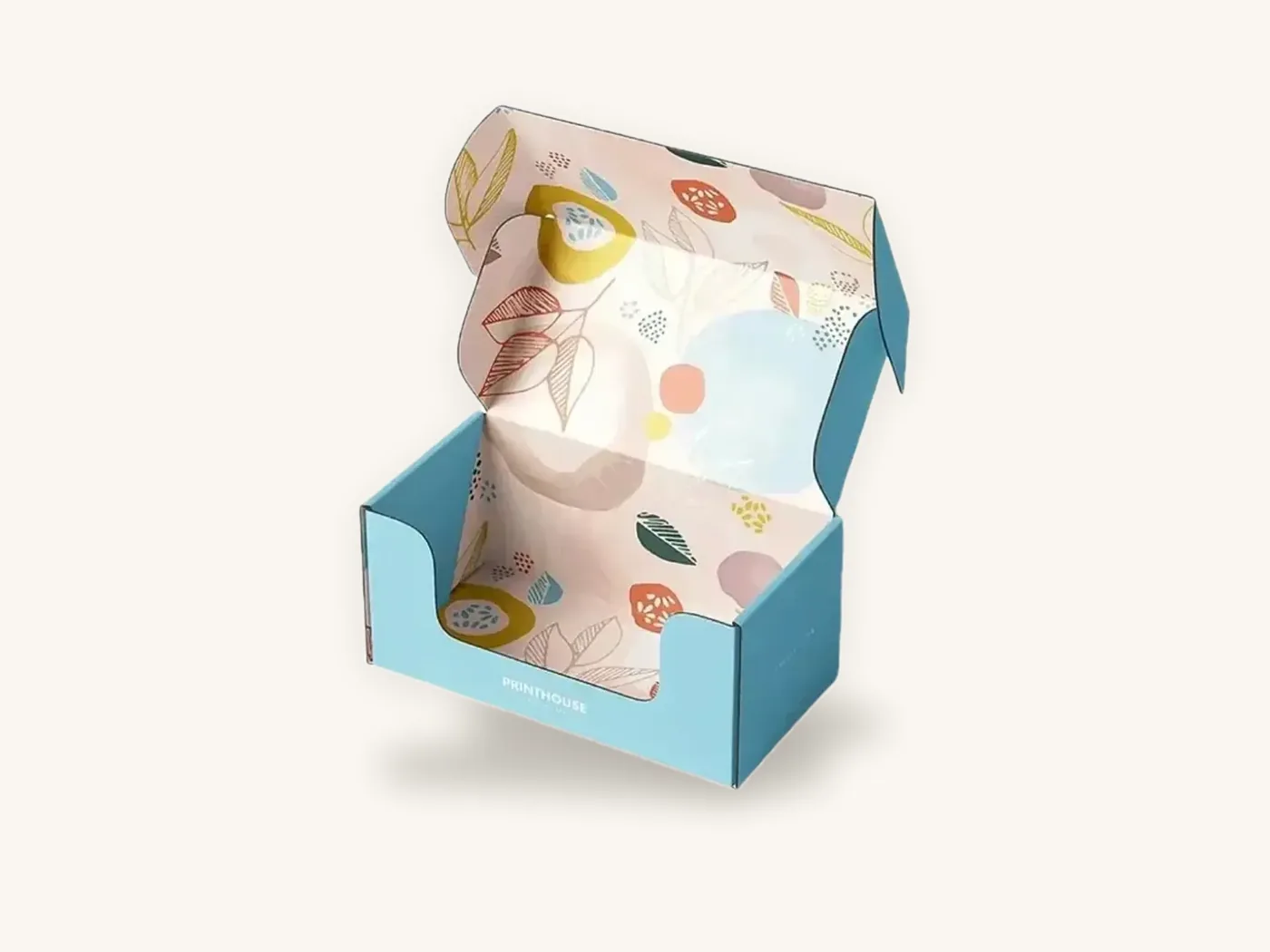
Custom mailer boxes are self-locking corrugated boxes, usually E-flute, that ship flat, fold together without tape and can be printed edge to edge on the outside and inside. They are the default choice for direct-to-consumer brands because one box does two jobs: it survives the parcel network and it serves as the presentation box when the customer opens it.
Getting them right comes down to five decisions: style, board grade, internal dimensions, print method and finish. This guide covers each with real numbers, shows what mailer box packaging costs at different quantities, and ends with an ordering checklist.
Key takeaways
- A mailer box is a one-piece, die-cut corrugated structure with a hinged lid and locking side ears; it assembles in seconds without tape or glue.
- E-flute (about 1.5 mm) is the standard for printed mailer boxes; move to B-flute (about 3 mm) for heavier, denser or sharper-edged products.
- Always specify internal dimensions as length x width x depth, and leave a small clearance so the lid closes without bulging.
- Digital printing keeps short runs of roughly 10 to 500 affordable; offset gives the best unit price on larger runs.
- An 8x6x3 in E-flute mailer printed full color outside runs about $2.64 each at 100 units and about $1.17 at 1,000, with US shipping included.
- Box Sense makes custom mailer boxes from 10 units, with free design support, no die or plate charges and standard production of 8–12 business days after proof approval.
What a custom mailer box is and how it differs from a shipping box
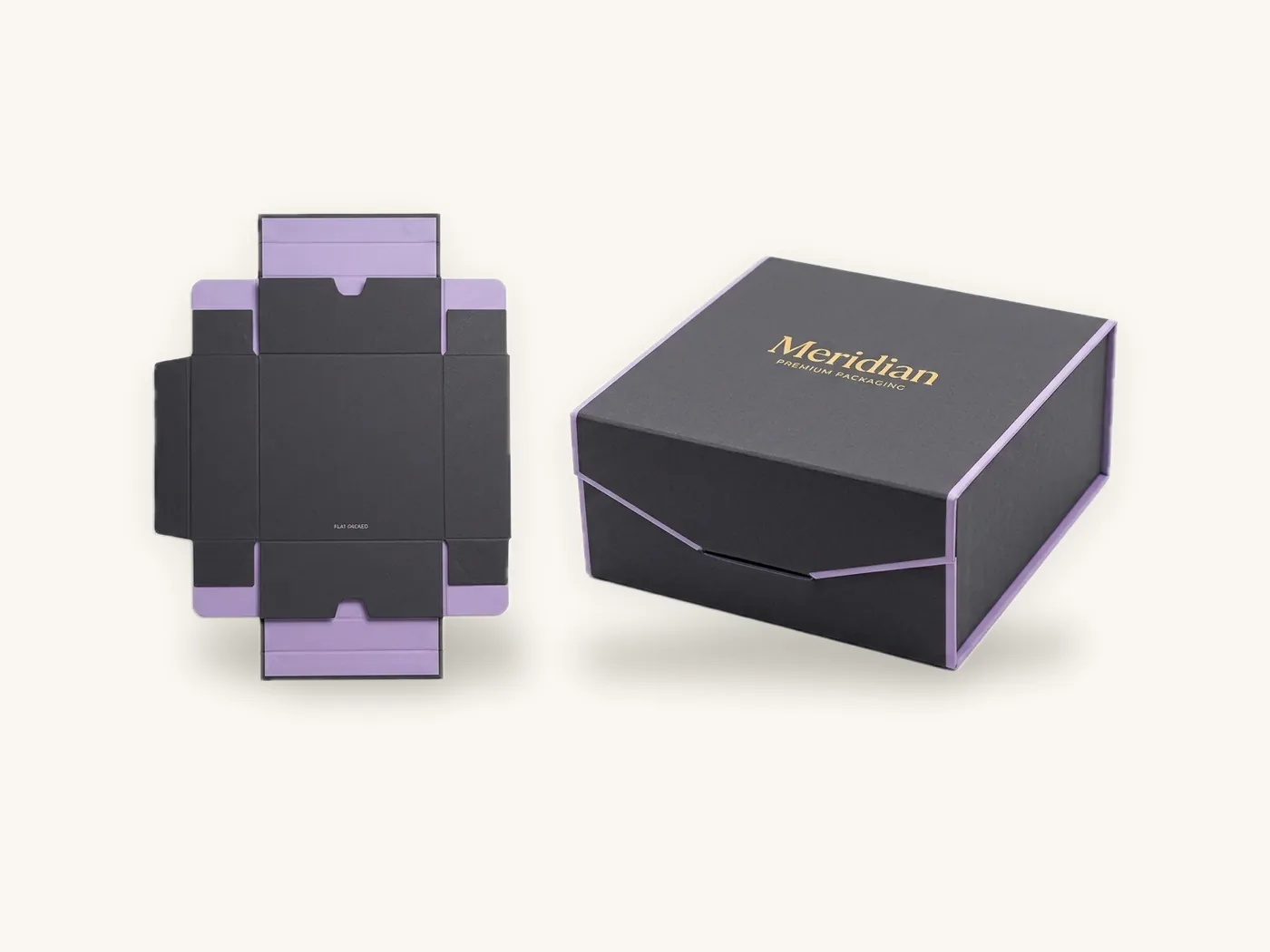
A mailer box is die-cut and creased from a single sheet of corrugated board. When folded, the front panel of the lid tucks into the base, and "ears" on the lid or side walls lock into slots to hold the whole structure square.
The most common construction is called roll-end tuck-front (RETF). The side walls are formed by rolling a double panel over itself, so the ends are two layers thick with no raw flute edges showing. That rolled wall is what gives a mailer its clean, premium look and a surprising amount of crush resistance for its weight.
A shipping box is usually a regular slotted container (RSC): flaps that meet in the middle and must be taped. RSCs are cheaper per cubic inch and come in heavier board, so they suit bulk, heavy or warehouse freight.
When a mailer box is the right call
Choose a mailer when the box ships directly to the end customer, when the product weighs roughly under 10 lb, and when the opening experience matters. Choose an RSC when you are shipping multiple units, heavy goods or inner cartons that will be overboxed anyway. Our custom shipping boxes guide covers RSC grades and sizing in detail.
For a keepsake presentation, the custom rigid boxes guide explains when greyboard is worth it, and the collapsible rigid boxes guide covers rigid boxes that ship flat.
Mailer box styles compared
"Mailer box" covers a family of one-piece, tape-free structures that close and protect in different ways. The mailer boxes style page shows the full range; here is how the main options compare.
| Style | How it closes | Best for | Watch for |
|---|---|---|---|
| Roll-end tuck-front (RETF) | Front lid flap tucks inside the base; ears lock the lid | Apparel, beauty sets, gifts, most DTC products | Needs a snug fit; loose contents rattle |
| Roll-end tuck-top | Lid flap tucks down over the front wall, often with a tear strip | Subscription kits, tamper-evident shipping | Tear strip adds a small cost per unit |
| Book / wrap mailer | Flat tray with flaps that fold around the item | Books, planners, prints, frames | Only suits flat, rigid items |
| Double-wall side mailer | Extra locking side panels for reinforcement | Heavier items, glass, dense kits | Uses more board, so costs more |
| Mailer with die-cut insert | Any of the above plus a paperboard or corrugated insert | Multi-item kits, bottles, electronics | Insert must be sized with the box, not after |
Which style to start with
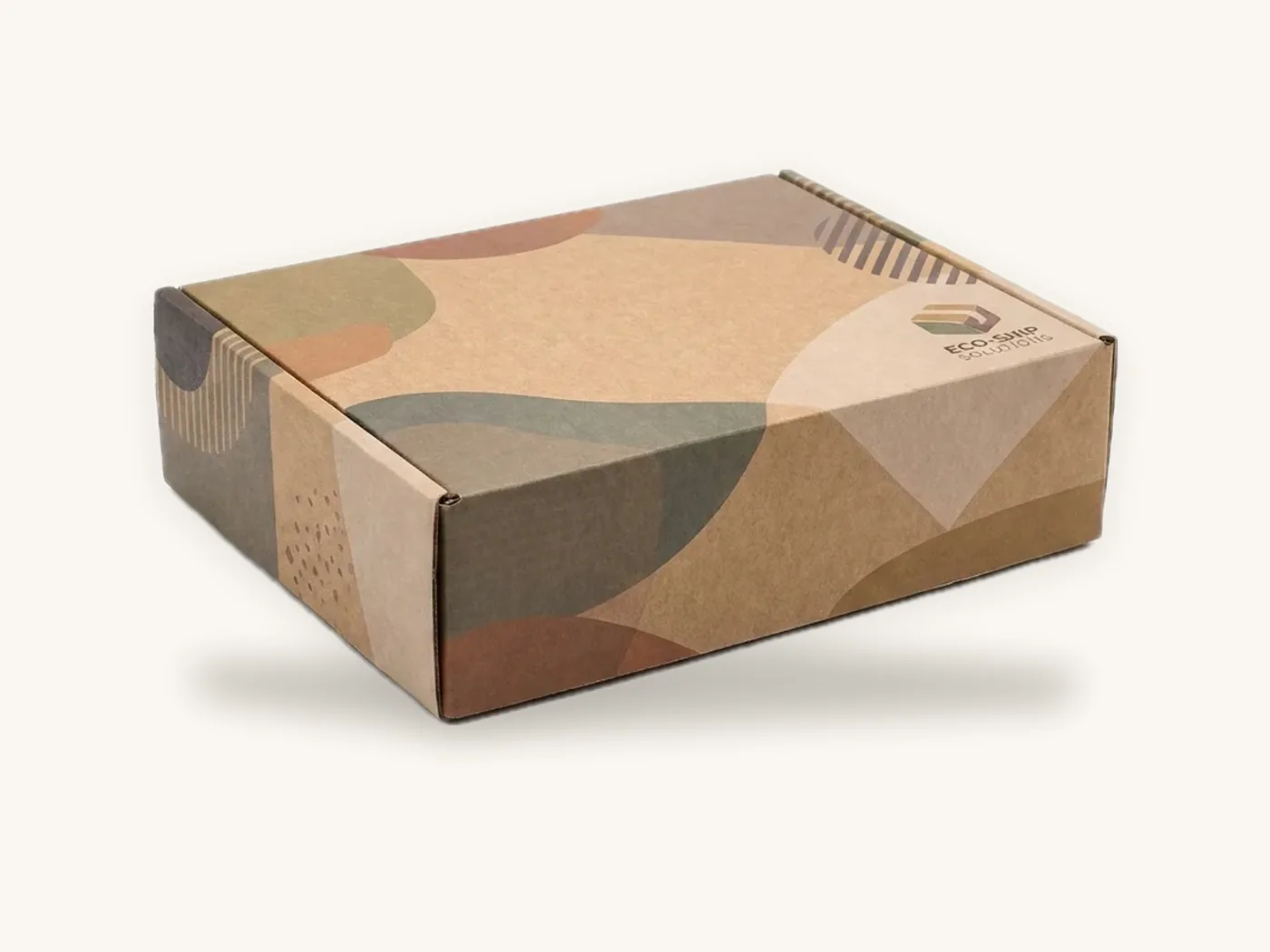
Roll-end tuck-front is the style most people picture, and it is what we make as standard custom mailer boxes. The lid opens like a chest and gives you three strong print surfaces: the lid top, the inside lid and the inner base.
Tuck top mailer boxes close over the outside of the front wall, and a tear strip makes tampering visible. Book mailer boxes wrap tightly around flat items, which prevents the corner crush that damages books and prints in a deeper box.
Choosing board grade: E-flute vs B-flute, kraft vs white
The board is where most of the protection comes from. Corrugated board is a wavy fluted medium glued between two flat liners. The flute size sets the thickness, stiffness and print surface, and the liner sets the color. Our corrugated board page lists every grade we run.
| Board | Thickness | Strengths | Choose it when |
|---|---|---|---|
| E-flute | about 1.5 mm | Smooth print surface, crisp folds, compact when flat | Most mailers, products roughly under 5 lb |
| B-flute | about 3 mm | Better crush and puncture resistance | Heavier or dense products, sharp corners, long transit |
| Kraft liner | natural brown | Natural look, hides scuffs, pairs with white ink or one dark color | Eco-positioned, rustic or minimal brands |
| White liner | bleached white | Brightest full-color reproduction | Beauty, fashion and color-heavy artwork |
E-flute or B-flute
E-flute prints almost like a folding carton and folds into sharp corners. For clothing, skincare, accessories and most subscription kits, it is plenty. Treat roughly 5 lb as the point to start asking questions, and roughly 10 lb as the point where B-flute or a double-wall side design usually earns its place.
B-flute doubles the caliper, so it absorbs impacts and resists crushing when parcels are stacked. The tradeoff is a softer fold line and a thicker flat stack that takes more storage space.
Kraft or white
Kraft mailer boxes use a natural brown outer liner. Full-color ink printed directly on kraft looks darker and more muted, because the brown shows through, so kraft designs work best with one or two strong colors or opaque white ink. Kraft also hides scuffs from the carrier network.
White mailer boxes use a bleached liner that makes color look closest to your screen proof. If your brand relies on a specific pastel, a bright gradient or photography, white is the safer base. You can also print a white box to look like any color, including solid black.
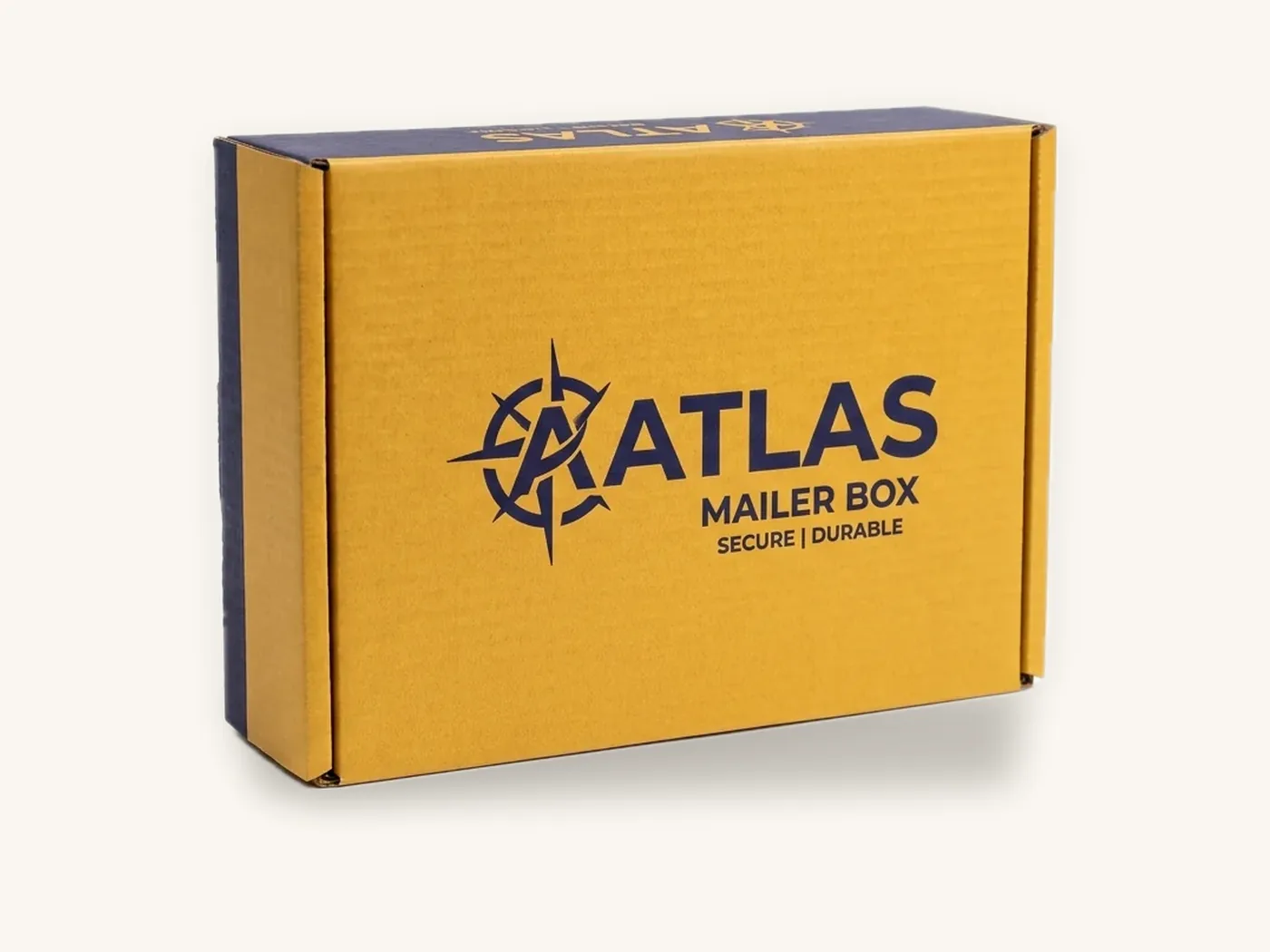
Watch out: a solid, dark flood color across a large E-flute panel can show faint flute lines under raking light. If your design uses big solid areas, ask for a white liner, a lamination, or a pattern that breaks up the flat color.
How to size a mailer box
Sizing mistakes are expensive because the whole run is cut to one die. Too tight and the lid will not close; too loose and the product slides, board is wasted and shipping can cost more.
Mailer dimensions are always given as length x width x depth, measured on the inside. Length is the side-to-side width of the front opening, width is front to back, and depth is the height from the floor of the box to the underside of the closed lid.
A step-by-step sizing process
- Pack the product the way it will ship. Include any tissue, pouch, card or insert. Measure that bundle, not the bare product.
- Measure the three longest points. Measure at the widest bulge.
- Add clearance. For rigid items, add roughly 1/8 in (3 mm) to length and width so the item drops in cleanly. Soft goods like folded apparel can go closer to zero.
- Account for inserts. A die-cut insert adds its own board thickness on every side it touches, and a raised platform adds depth. Size the insert and box together.
- Check the lid. Depth should let the lid close flat. A bowed lid strains the locking ears.
- Consider carrier pricing. Carriers bill larger parcels by dimensional weight, a formula based on the box's outer volume. Trimming half an inch off an oversized box can matter more than the board grade. Confirm current dimensional weight rules with USPS, UPS or FedEx for your service level.
- Order a structural sample. Test fit the real product, close the lid, shake it and drop it from waist height onto a hard floor.
Say you sell a boxed set of two skincare jars in a paperboard tray that measures 7.6 x 5.7 x 2.8 in. An 8x6x3 in internal mailer gives about 3/8 in of play in length and 1/4 in in width and depth. That is enough for the tray to drop in and the lid to sit flat, and small enough that a sheet of tissue takes up the slack.
Printed mailer boxes: print methods, inside printing and finishes
The right print method depends mostly on quantity and on how exact your colors need to be. The printing and finishes page has samples of every option.
Digital vs offset printing
For short runs, roughly 10 to 500 units, digital printing prints directly onto the corrugated sheet with no plates. It handles full-color artwork, gradients and photography, and it lets you change designs between small batches without setup costs. It is the reason a 10-box order is practical.
For larger runs, offset printing applies ink through plates, usually onto a printed liner that is then laminated to the corrugated board. It gives the finest detail, the most consistent color from box to box and the lowest unit cost as quantity rises.
PMS spot colors and white ink
If a brand color must match exactly across every print run, specify a PMS spot color rather than relying on CMYK. On kraft board, opaque white ink is what makes lighter colors and fine type readable; without a white underlay, pale colors largely disappear into the brown.
Inside printing
The inside lid is the first thing a customer sees on opening, so a message or pattern there gets more attention than a busy exterior.
You do not have to print every inside surface. Printing only the inside lid, or using one color inside and full color outside, often delivers most of the effect at a lower cost. Keep critical text away from the rolled walls and crease lines, where it can crack or fold out of sight.
Coatings and finishes that work on mailers
- Aqueous coating: a thin, water-based layer that reduces scuffing and keeps the box recyclable. A sensible default for most mailers.
- Matte or gloss lamination: a film that improves scuff resistance and color depth. Matte hides fingerprints; gloss makes color look more saturated.
- Soft-touch lamination: a velvety feel that suits premium beauty and gift boxes.
- Foil stamping and spot UV: highlight a logo or pattern. Each carries a one-time tooling charge.
- Embossing: a raised logo on the lid, possible on E-flute with a simple design, also with one-time tooling.
What custom mailer boxes cost
Price per box depends on size, board grade, printed surfaces, finishes and inserts, and quantity. Quantity has the biggest effect, because setup is spread across more units.
The table below shows indicative per-unit prices from our current rates, with free US shipping included. Use the instant price estimator for your exact size and spec.
| Spec | 10 | 100 | 250 | 500 | 1,000 | 5,000 |
|---|---|---|---|---|---|---|
| Mailer, E-flute, 8x6x3 in, full color outside | $3.99 | $2.64 | $1.88 | $1.41 | $1.17 | $0.83 |
| Mailer, E-flute, 10x8x4 in, full color inside and outside | $6.54 | $4.33 | $3.08 | $2.31 | $1.92 | $1.36 |
| Subscription mailer, E-flute, 12x9x4 in, full color both sides, insert and tear strip | $8.83 | $5.85 | $4.16 | $3.12 | $2.60 | $1.84 |
Going from 10 to 100 units cuts the unit price by roughly a third, and from 100 to 1,000 by more than half. Beyond a few thousand units, savings flatten because material becomes most of the cost.
How to trim the cost
- Right-size the box: less board, and often a lower shipping charge.
- Limit print coverage: full color outside plus a simple inside lid message is a common middle ground.
- Choose finishes deliberately: foil, embossing, spot UV and custom inserts each add one-time tooling.
- Check the next quantity tier: if you will reorder within a few months, 500 units can cost only modestly more in total than 250.
If you are also pricing retail packaging, such as dispenser boxes, the same estimator covers those styles.
Inserts, tear strips and the unboxing sequence
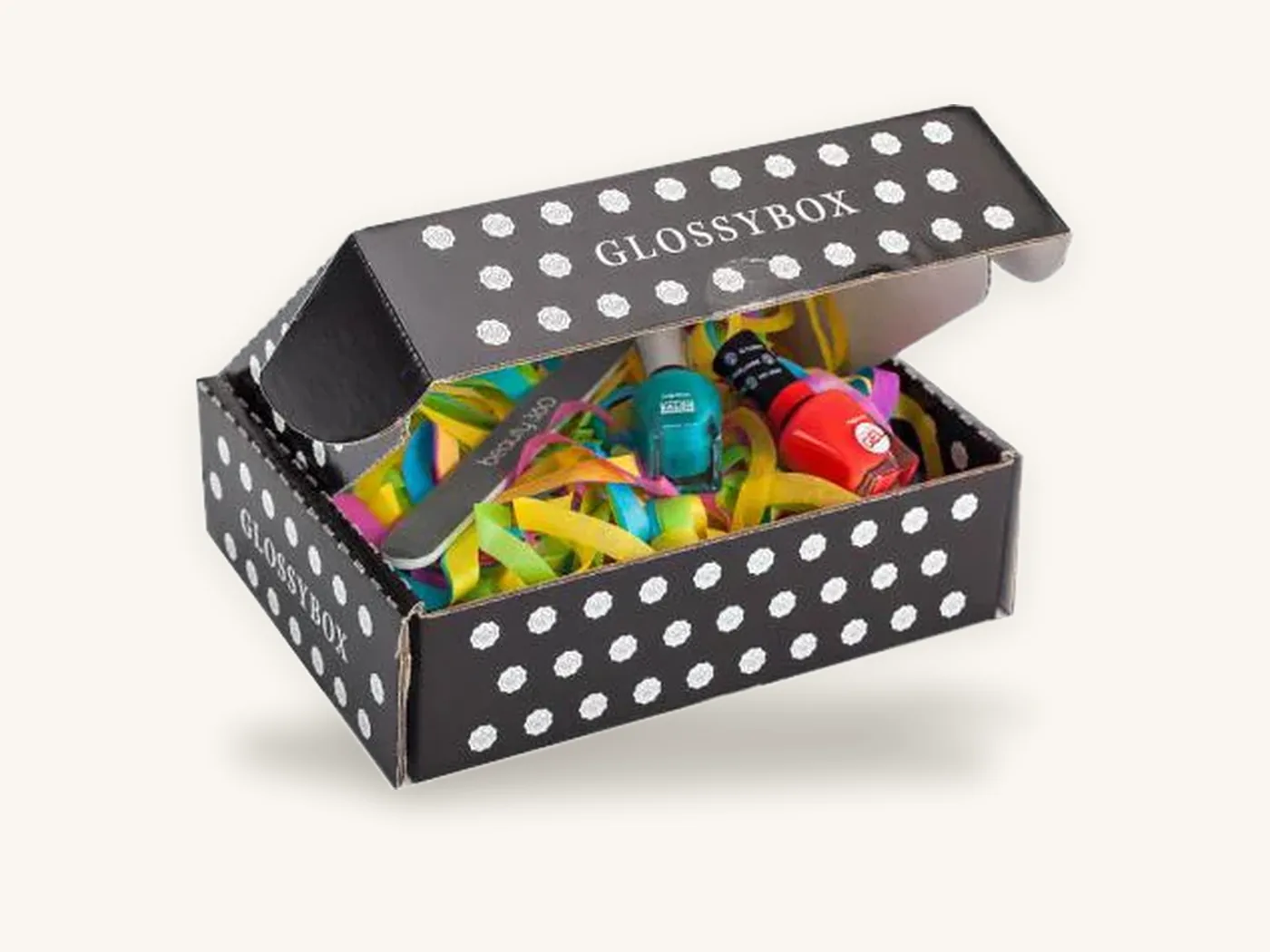
Mailer box packaging is at its best when the opening follows a deliberate order: the outside identifies the brand, the tear strip or tuck opens cleanly, the inside lid delivers a message, and the product sits exactly where the eye lands.
Choosing an insert
Box inserts and dividers keep items from colliding and hold them in a planned layout. Paperboard inserts are light and printable. Corrugated inserts give more cushioning for glass. Molded pulp trays are a plastic-free option for fragile items, and foam inserts suit electronics or high-value pieces that need a precise cavity.
Tissue, cards and fill
Printed tissue paper adds a reveal layer for apparel and gifts, and it takes up small gaps without loose fill. A printed card in the lid gives care instructions or a discount code. If you use void fill, choose paper-based fill so the whole package stays curbside recyclable.
Tip: put your most important message on the inside lid, not the outside of the box. The exterior gets scuffed and labeled in transit, while the inside lid is seen at the exact moment the customer is paying attention.
For kit-based brands, our e-commerce and subscription packaging page shows how mailers, inserts and tissue combine for monthly boxes, and the subscription boxes product page covers standard kit sizes.
Shipping performance and sustainability
Before committing to a large run, ship a packed sample to someone a few states away and inspect the corners, locking ears and print on arrival.
What causes mailer damage
Most damage comes from products shifting in a loose box, corner impacts on conveyors, and heavy parcels stacked on top. Tight sizing and inserts fix the first; B-flute or reinforced side panels help with the rest. If the closed box rattles, fix the fit before upgrading the board.
Many brands still seal the front flap for security; a tear strip or custom packaging tape does that while looking intentional.
Sustainable mailer box options
Corrugated mailers are made with recycled content and are widely recyclable in curbside programs. To keep them that way, favor aqueous coating over plastic lamination where you can, use paper tape or a tear strip, and choose paper-based inserts and fill. FSC-certified board and soy or water-based inks are available, and the eco-friendly boxes and sustainability pages explain the options.
If you print recyclability or compostability claims on the box, they need to be accurate and substantiated. The Federal Trade Commission's Green Guides set out how environmental marketing claims should be qualified in the US, so review current FTC guidance or ask counsel before adding a claim.
How to order custom mailer boxes from Box Sense
You can start with rough numbers and let our structural team refine them, but the more you send upfront, the faster the quote.
What to send with your request
- Product dimensions and weight, packed the way it will ship
- Preferred style (tuck-front, tuck-top, book mailer) or a note that you want a recommendation
- Board preference: E-flute or B-flute, kraft or white
- Print: outside only or inside and outside, full color, one color or PMS
- Finishes and extras: lamination, foil, tear strip, inserts
- Quantities to price, for example 100, 500 and 1,000
- Target in-hand date and ship-to location
- Artwork files, or a note that you need help from our design services team
Artwork checklist
- Place artwork on the dieline we supply, with the lid, inside panels and tuck flap clearly labeled
- Extend background colors 1/8 in (3 mm) past the cut line as bleed
- Keep text and logos at least 1/8 in inside every cut and crease
- Use vector logos and outlined fonts; keep images at 300 dpi at final size
- Set up files in CMYK, and name any PMS colors exactly
- Check that inside-lid artwork reads the right way up when the box is opened
What happens next
- Quote within 24 hours. We confirm pricing for your spec and quantities.
- Free design support. We supply the dieline, set up artwork, and send a 3D digital proof, with two revision rounds included.
- Samples if you want them. Unprinted structural samples are free, and a printed sample of approved artwork is free on orders of 100 or more. See samples for details.
- Production. Standard production takes 8–12 business days after proof approval. Rush production in 5 business days is available on most corrugated styles.
- Delivery. Shipping is free on every US order, and international shipping is quoted at cost.
The minimum order is 10 boxes, with no die or plate charges. Defective boxes reported within 14 days are reprinted free.
Frequently asked questions
What is the minimum order for custom mailer boxes?
Box Sense produces custom mailer boxes from a minimum of 10 units. Short runs are printed digitally, which needs no plates, so small orders are practical for product launches, samples for retailers or testing a new design. The unit price falls steeply as quantity rises, so compare a few quantity tiers in the estimator before deciding how many to order.
How much do custom mailer boxes cost?
It depends mainly on size, print coverage, finishes and quantity. As a reference, an 8x6x3 in E-flute mailer printed full color outside is about $2.64 per box at 100 units and about $1.17 at 1,000, including US shipping. A 10x8x4 in mailer printed inside and outside is roughly $1.92 at 1,000. Use the pricing page for your exact spec.
Are mailer boxes strong enough to ship without an outer box?
Yes, for most direct-to-consumer products. Mailer boxes are designed to go through parcel carriers on their own. E-flute handles most items under a few pounds, while B-flute or reinforced side panels suit heavier or fragile goods. A snug fit or an insert matters as much as board grade, so test a structural sample through the carrier before a large run.
What is the difference between a mailer box and a shipping box?
A mailer box is a one-piece, die-cut box with a hinged lid and locking tabs that assembles without tape and is designed to be opened by the customer. A shipping box, usually a regular slotted container, has flaps that meet in the middle and must be taped. Shipping boxes suit heavier, bulk or overboxed shipments; mailers suit branded direct deliveries.
Can you print on the inside of a mailer box?
Yes. Inside printing is one of the main reasons brands choose mailers, because the inside lid is the first surface a customer sees on opening. You can print the full interior in color or keep costs down by printing only the inside lid or using a single color. Keep important text clear of crease lines and rolled walls.
How long does it take to get custom mailer boxes?
Box Sense confirms quotes within 24 hours. After you approve the digital proof, standard production takes 8–12 business days, and rush production in 5 business days is available on most corrugated styles. Allow extra time for proof revisions or a physical sample. Shipping within the US is free, and international delivery times depend on the destination.
Are kraft mailer boxes recyclable?
Corrugated kraft mailers are widely accepted in curbside recycling programs. To keep the whole package recyclable, choose aqueous coating instead of plastic lamination, paper tape or a tear strip instead of plastic tape, and paper-based inserts or fill. FSC-certified board and soy or water-based inks are also available if sourcing matters to your brand.
What size mailer box do I need?
Measure your product as it will be packed, including any pouch, tissue or insert, then specify internal length, width and depth. Add roughly 1/8 in of clearance on length and width for rigid items, and less for soft goods. Avoid oversizing, which lets items shift and can raise dimensional weight charges. A free structural sample confirms the fit.
Next steps
Have your packed product dimensions and quantities ready, then run them through the mailer box price estimator to see where your costs land. When the spec looks right, request a custom mailer box quote and we will confirm pricing within 24 hours, send a dieline and prepare a 3D proof for your artwork.
Boxes in this guide
Order the packaging we covered
Written by the Box Sense Packaging Team
Our structural designers, prepress technicians and production staff print and convert custom boxes every day for brands in the United States, United Kingdom and UAE. Questions about this guide? Talk to us.