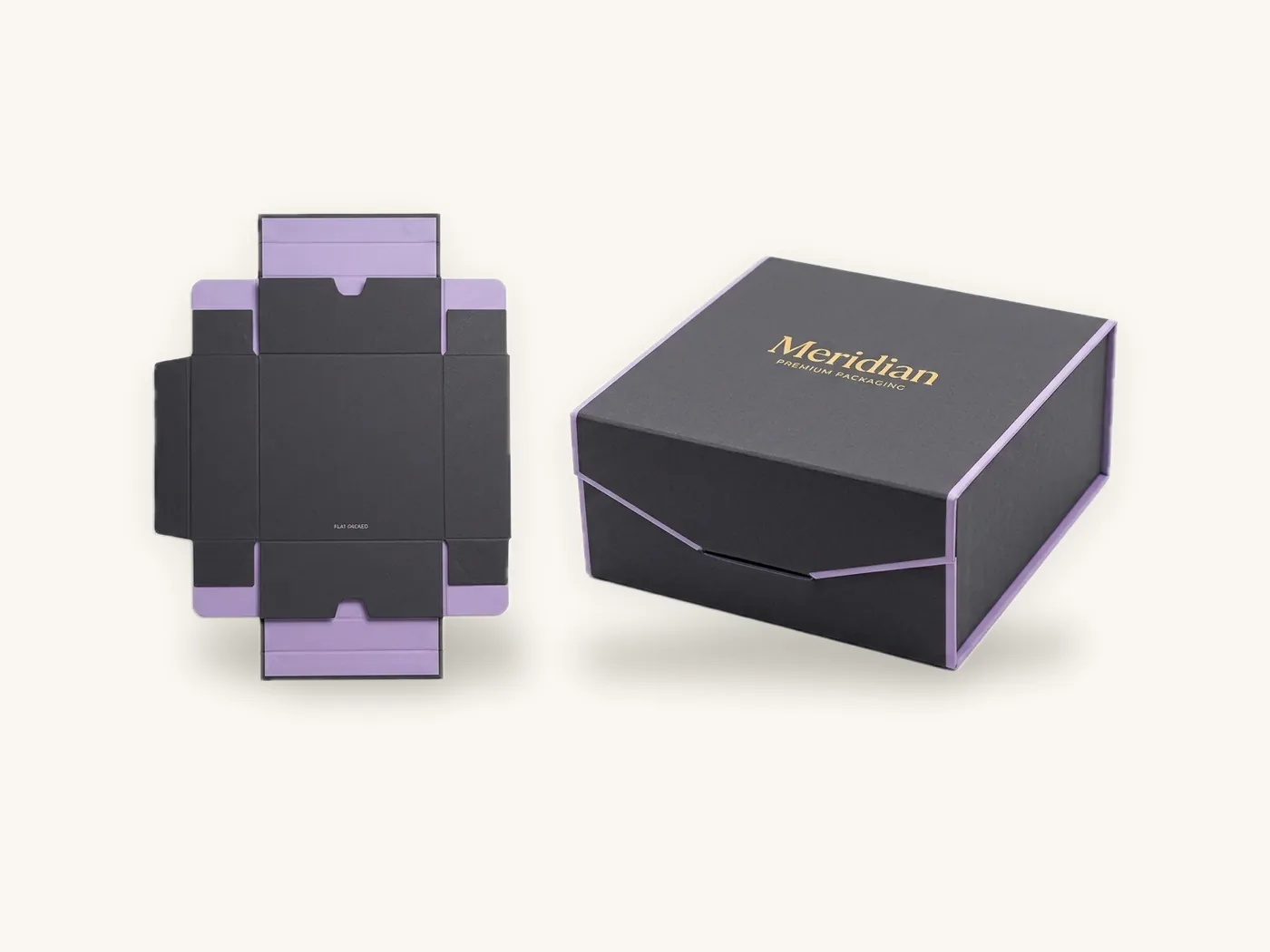
Collapsible rigid boxes are luxury presentation boxes made from wrapped greyboard that fold flat for shipping and storage, then pop up into a solid, rigid box in a few seconds. You get the weight, crisp corners and magnetic snap of a premium gift box without paying to ship and warehouse cartons full of air.
The trade-off is small and specific: a collapsible box relies on hinges and a locking step, so it needs a moment of assembly and a slightly different design approach from a traditional set-up rigid box. This guide explains how foldable rigid boxes are built, when they beat a fixed rigid box, what they cost, how to assemble them at scale, and what to send when you order.
Key takeaways
- A collapsible rigid box uses the same greyboard wrapped in printed paper as a traditional rigid box, but the side walls are hinged so the box stores flat and is assembled at packing time.
- The main benefit is logistics: a flat box takes a fraction of the pallet and shelf space of a set-up box, which lowers inbound freight and storage costs, especially for large or seasonal gift programs.
- Most flat pack magnetic box designs lock the walls with a magnetic lid flap, a double-sided adhesive strip or both; know which one you are ordering before you plan fulfillment labor.
- 2 mm greyboard is the usual default; heavier or larger boxes move up in board thickness and may need inserts to hold the walls square.
- For reference, a 2 mm rigid magnetic box at 10x8x3 in with soft-touch, foil and an insert runs about $14.23 each at 100 units and about $6.32 at 1,000, with US shipping included.
- Box Sense makes collapsible rigid boxes from 10 units, with free design support, free unprinted structural samples and standard production of 8–12 business days after proof approval.
What makes a rigid box collapsible
A traditional rigid box is "set up" at the factory. Board panels are cut, the corners are stayed with tape, and printed paper is wrapped around the finished shape. It leaves the factory fully formed and stays that way forever. That is what gives it strength, but it also means every box ships and stores at its full volume.
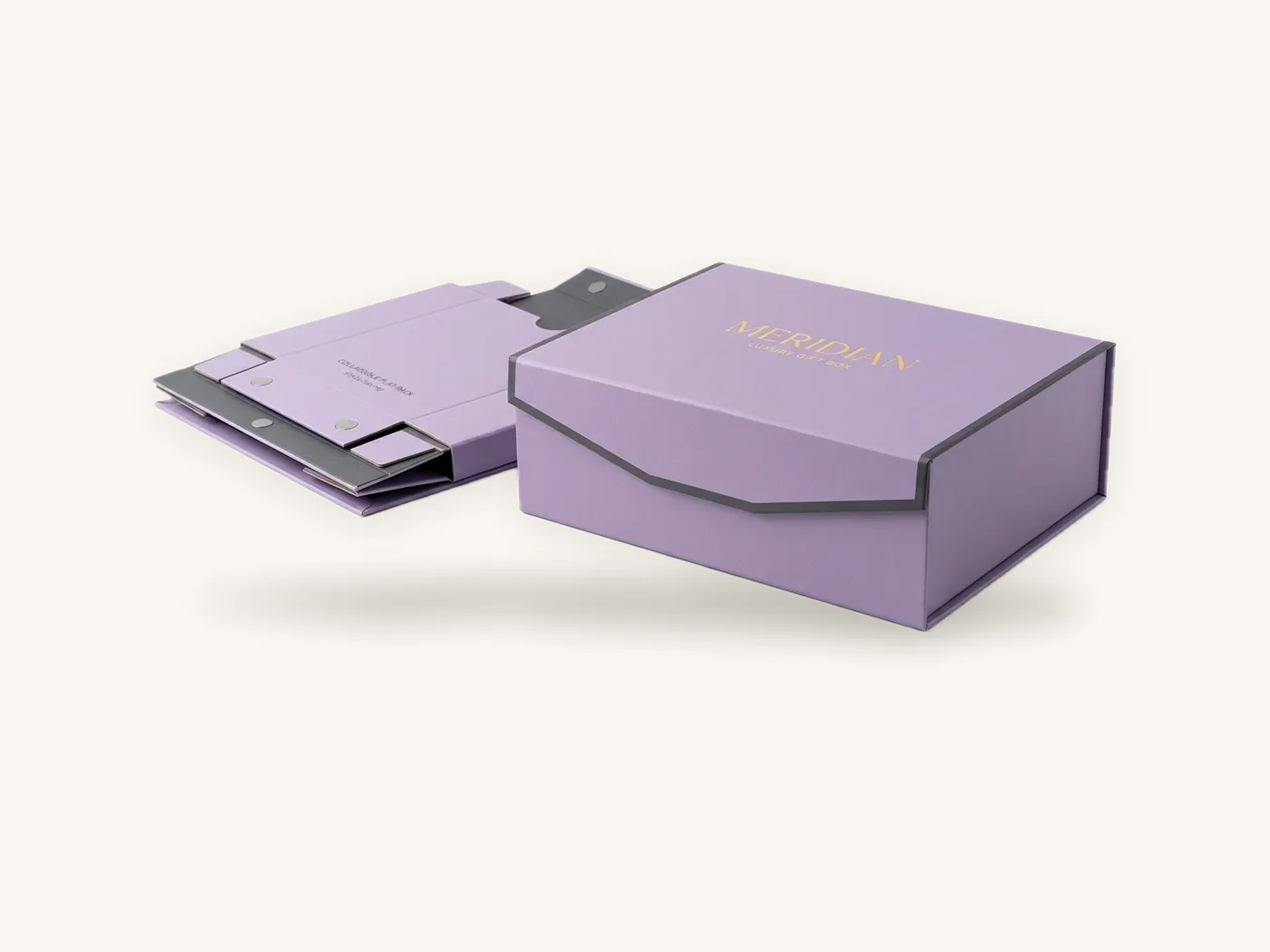
A collapsible rigid box keeps the materials but changes the construction. Instead of a solid tray, the base and walls are separate greyboard panels laid out on one continuous sheet of wrapping paper. The paper acts as the hinge between panels. Flat, the box looks like a thick printed folder. Folded, the walls stand up, tabs tuck inside, and the lid locks everything into shape.
The three common constructions
| Construction | How it locks | Assembly effort | Best for |
|---|---|---|---|
| Magnetic flap book-style | Walls fold up; a lid flap with hidden magnets holds them square | A few seconds, reusable | Gift boxes, apparel, corporate kits |
| Adhesive-strip lock | Pre-applied double-sided tape on wall tabs; peel and press once | A few seconds, permanent | High-volume programs where boxes are not re-flattened |
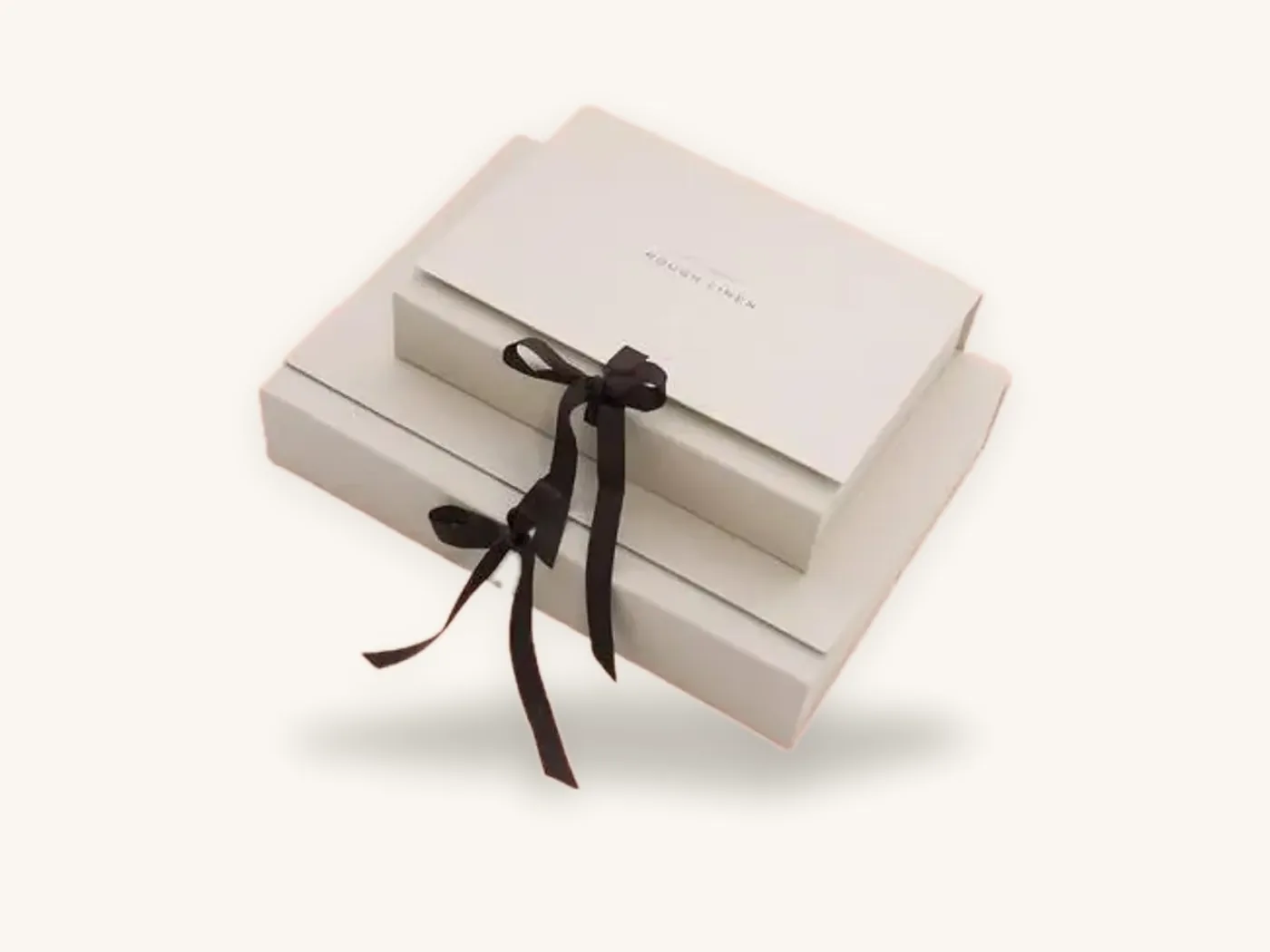
| Tab-and-slot or ribbon lock | Walls held by tucked tabs, sometimes finished with a ribbon | Slightly longer, reusable | Keepsake and event boxes where a ribbon is part of the look |
Most brands searching for a foldable rigid box end up with the magnetic book-style version, because the customer experience is identical to a fixed magnetic closure box: the lid swings open and closes with a soft snap.
Collapsible vs set-up rigid boxes vs mailers
Collapsible rigid boxes sit between two familiar options. Understanding where they fit helps you avoid paying for luxury you do not need, or saving on logistics at the cost of a disappointing unboxing.
| Factor | Set-up rigid box | Collapsible rigid box | Printed corrugated mailer |
|---|---|---|---|
| Material | 1.5–3 mm greyboard, paper-wrapped | 1.5–3 mm greyboard, paper-wrapped | E-flute or B-flute corrugated |
| Ships to you | Fully assembled | Flat | Flat |
| Storage footprint | Large | Small | Small |
| Assembly at packing | None | A few seconds per box | A few seconds per box |
| Perceived value | Highest | Very high, close to set-up | Good |
| Stands up to parcel shipping alone | Usually needs an outer box | Usually needs an outer box | Yes |
| Reusable by customer | Yes | Yes, and can be flattened again (magnetic styles) | Sometimes |
Choose a set-up rigid box when
Your quantities are modest, you pack near where the boxes are made, the box has an unusual shape such as a deep drawer or a shoulder neck box, or you need the absolute stiffest walls for heavy items like glass bottles. The custom rigid boxes guide goes deeper on those builds.
Choose a collapsible rigid box when
You ship boxes to a fulfillment center, 3PL or several event locations, when storage space is tight, when you order a large batch for a holiday or corporate gifting season, or when the box is big enough that shipping it assembled would mean paying mostly for air.
Choose a mailer when
The box must travel through the parcel network on its own and the presentation budget is limited. The custom mailer boxes guide covers printed mailers in detail.
The logistics case: freight and storage
The reason collapsible rigid boxes exist is volume. A set-up rigid box is mostly empty space from the moment it leaves the factory until the product goes in. Every carton of set-up boxes on a pallet carries that air, and you pay for it twice: once in freight and again in warehouse space.
Folding the walls flat changes the math. A flat box is only a few board thicknesses deep, so many more fit in the same outer carton. How much you save depends on the box's depth and size, but the pattern is consistent: the deeper and larger the box, the bigger the difference between shipping it flat and shipping it assembled.
A hypothetical example
Say you run a corporate gifting program of 1,000 boxes at 12x10x4 in. Assembled, those boxes need many cartons and a noticeable share of a pallet, and they fill racking at your fulfillment partner for weeks before and after the season. Flat, the same order arrives in a handful of cartons that can sit on a single shelf. If your 3PL charges by pallet position or cubic foot, that reduction continues to pay off every month the boxes sit in storage.
Where the savings disappear
- Small boxes. A 3x3x1.5 in jewelry box has little air to eliminate, so a fixed rigid box is often the better choice.
- Very low volumes. If you pack 50 boxes in your own studio, storage is not a real cost and assembly time is.
- Labor-sensitive packing lines. Assembly takes seconds, but seconds multiply. Include it in your fulfillment quote.
Tip: ask your 3PL or fulfillment partner how they bill for kitting before you choose. Some charge per touch, which makes a quick assembly step a visible line item; others charge by storage, where flat boxes win clearly. The right structure depends on which cost is larger for you.
Construction details that decide quality
Two collapsible boxes can look identical in a render and feel very different in the hand. These are the specs that matter.
Board thickness
Rigid boxes are built from rigid greyboard, also called chipboard. 2 mm is the common default for gift and apparel boxes. Smaller boxes can use 1.5 mm without feeling flimsy. Larger boxes, or those carrying bottles, electronics or heavy kits, move toward 2.5 to 3 mm so the walls do not bow when the lid is closed.
Wrapping paper
The printed wrap is what the customer sees and touches. It must be thin enough to fold cleanly over board edges yet tough enough to act as a hinge through repeated folding. Coated art paper with a lamination is the standard; textured and specialty papers such as linen or felt-finish stocks give a tactile, uncoated look. Specialty papers can crack more easily at hinges, so ask for a structural sample if you choose one.
Magnets
Magnetic versions hide flat magnets between the greyboard and the wrap, usually one or two in the lid flap and matching ones or a steel plate in the front wall. The closing force needs to be firm enough to hold the walls square but not so strong that opening feels like a struggle. Larger boxes use two magnets spaced apart so the lid closes evenly.
Hinges and corner fit
On a well-made collapsible box, walls meet at clean, tight corners with no gaps and no paper wrinkling at the fold. Poor corner fit is the most common complaint about cheaper foldable rigid boxes, and it usually comes from panels cut without enough allowance for the board thickness. That allowance is part of the dieline engineering, which is why a structural sample is worth checking.
Inserts
An insert does more than hold the product. In a collapsible box, a snug insert also braces the walls from the inside, making the assembled box feel as solid as a set-up box. Paperboard, foam and molded pulp inserts all work; the box inserts guide compares them.
Assembling flat pack magnetic boxes at scale
If you are packing hundreds or thousands of boxes, assembly method matters as much as box design. Set up a small, repeatable process before the boxes arrive.
A packing-station process
- Stage flat boxes in stacks of a manageable count, with the printed side facing down so the base panel is ready.
- Fold the walls up in the order shown on the assembly guide, usually the two long walls first, then the short walls with their tucking tabs.
- Lock the structure. On magnetic styles, close the lid flap to seat the walls; on adhesive styles, peel the liner and press the tabs firmly for a second or two.
- Drop in the insert. This squares the box and should seat without force.
- Load the product and any printed card, tissue or ribbon.
- Close and inspect the corners, the lid alignment and the magnet snap.
- Place the finished box in its shipping carton immediately, rather than stacking assembled boxes where they can be scuffed.
Ask for a one-page assembly diagram with your order. New staff should be able to assemble a box correctly on the first try from that sheet alone.
Watch out: adhesive-strip boxes cannot be flattened again without damage, so you cannot assemble a batch "just in case" and put extras back into storage. If your volumes are unpredictable, a magnetic-lock style is more forgiving.
Design and finishing for collapsible boxes
Because the wrap is a single continuous sheet, collapsible boxes give you a large, uninterrupted print surface. A few design details are specific to the folding construction.
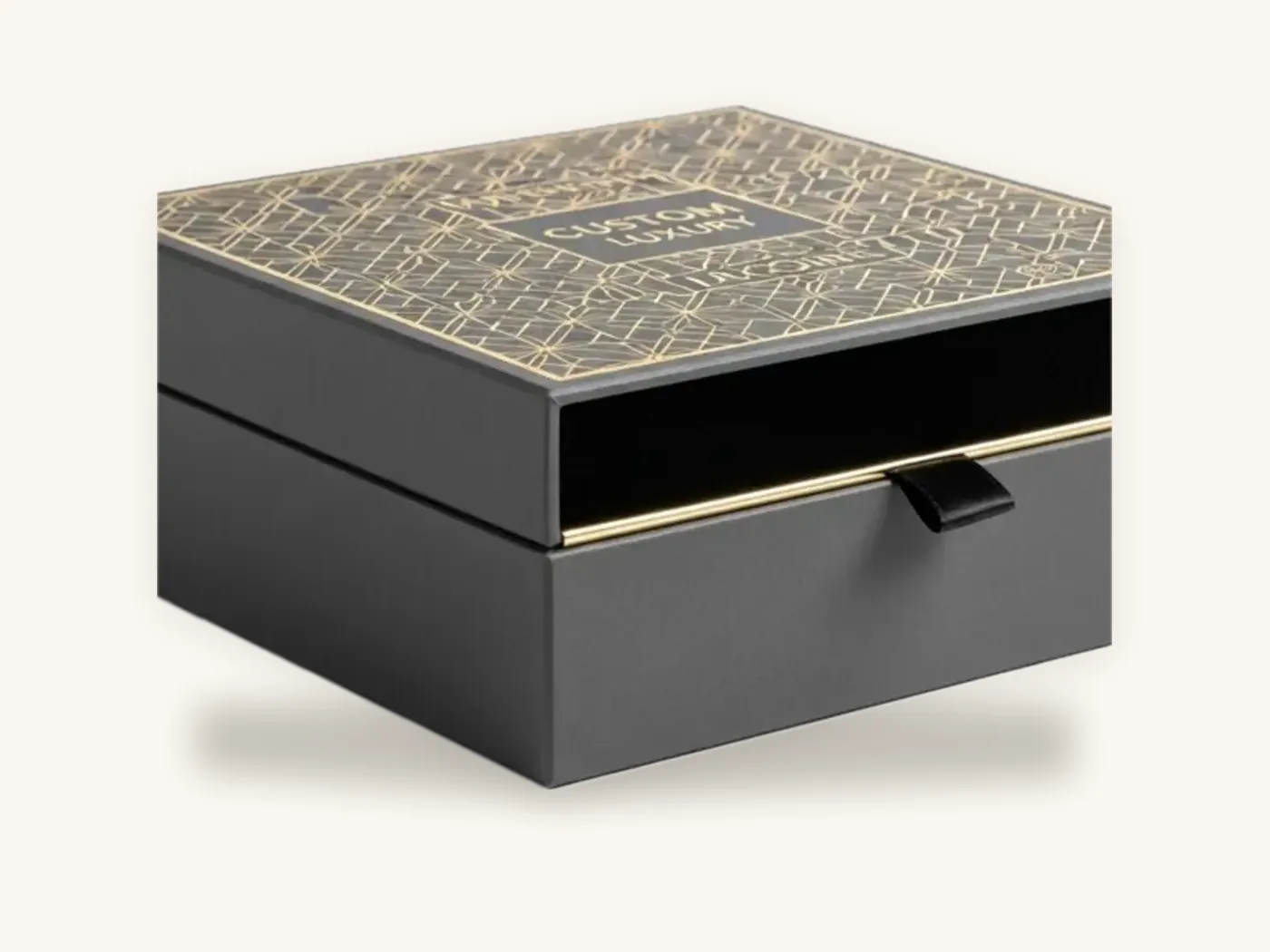
- Mind the hinge lines. Fine text and thin rules across a hinge can crack or look misaligned after folding. Keep type at least about 1/8 in away from every hinge.
- Plan the inside. The inside of the lid flap and the interior walls can be printed or wrapped in a contrasting paper. This is where a message, pattern or brand color gives the reveal.
- Use finishes on flat panels. Foil stamping, embossing and spot UV sit best on the lid face, away from folds. Each adds one-time tooling: foil and embossing about $60 each, spot UV about $40.
- Choose lamination for durability. Matte and soft-touch lamination both protect the wrap from scuffing during assembly and shipping; soft-touch gives the velvety feel buyers associate with luxury.
- Add a ribbon pull. A small ribbon tab on the lid flap makes a firmly magnetic box easier to open.
The printing and finishes page shows each option, and the luxury gift boxes page shows how they combine on premium sets.
What collapsible rigid boxes cost
Rigid box pricing is driven by board thickness, box size, wrap paper, print coverage, magnets, finishes, inserts and quantity. A collapsible build typically involves more precise panel cutting than a set-up box of the same size, and your quote reflects the exact structure, so treat the figures below as a reference point for comparable rigid specs rather than a collapsible price list.
| Spec | 10 | 100 | 250 | 500 | 1,000 | 5,000 |
|---|---|---|---|---|---|---|
| Rigid box, 2 mm greyboard wrapped, 8x6x3 in, full color, matte | $13.76 | $9.10 | $6.47 | $4.85 | $4.05 | $2.87 |
| Rigid magnetic box, 2 mm, 10x8x3 in, soft-touch, foil, insert | $21.50 | $14.23 | $10.12 | $7.59 | $6.32 | $4.49 |
Prices are indicative per unit with free US shipping included. Enter your size and options in the rigid box price estimator for your exact spec.
How total cost compares
Unit price is only part of the picture. When comparing a collapsible box with a set-up box, add up:
- Inbound freight, which falls when boxes ship flat
- Storage at your warehouse or 3PL for the months the boxes sit before and after a launch or season
- Assembly labor at packing, a few seconds per box
- Outbound shipping cartons, which you need for either rigid style
For large seasonal programs, the storage and freight lines often matter more than a small difference in unit price. For small, frequent runs packed in-house, the set-up box may come out ahead.
Where collapsible rigid boxes work best
Corporate gifting and employee kits
Corporate programs usually involve a single large order, a tight deadline and packing at a fulfillment partner or event venue. Flat boxes are easy to ship to several locations and store until kitting day. Our corporate gift boxes and the gifts and events page cover typical sizes and insert layouts.
Apparel and accessories
Folded knitwear, scarves, silk pieces and leather goods fit shallow, wide boxes, exactly the proportions where collapsing saves the most space. Many apparel brands use a collapsible box as a reusable keepsake that customers keep for storage.
Subscription and e-commerce premium tiers
A quarterly or annual premium box can use a collapsible rigid box inside a plain shipper, giving a rigid-box unboxing while keeping warehouse space under control between shipments.
Retail gift sets
For holiday gift sets shipped to stores, collapsible boxes arrive flat at your co-packer and are assembled with the products. Once assembled and shrink-wrapped, they present on shelf exactly like set-up boxes.
How to order collapsible rigid boxes from Box Sense
Collapsible rigid boxes need a little more upfront detail than a simple carton, because the structure, locking method and insert are designed together.
What to send
- Internal dimensions (length x width x depth) and product weight, including any insert or tissue
- Locking style: magnetic, adhesive strip, ribbon, or a request for a recommendation
- Board thickness preference, or product details so we can advise
- Wrap paper: coated and laminated, soft-touch, or a textured specialty paper
- Printing outside and inside, plus any foil, embossing or spot UV
- Insert type: paperboard, foam or molded pulp, and a sketch of the layout
- Quantities, packing location, and whether you need an outer shipping carton quoted too
- Target in-hand date
How the process runs
- Quote within 24 hours for each quantity you want priced.
- Free design support: we supply the dieline, set up artwork across the hinged wrap, and send a 3D digital proof, with two revision rounds included.
- Structural sample: unprinted structural samples are free, so you can check corner fit, magnet strength and assembly time with your packing team. Printed samples of approved artwork are free on orders of 100 or more. Details are on the samples page.
- Production: standard production takes 8–12 business days after proof approval.
- Delivery: US shipping is free on every order; international shipping is quoted at cost.
The minimum order is 10 boxes. There are no die or plate charges; one-time tooling applies only if you choose foil, embossing, spot UV or a custom insert. Defective boxes reported within 14 days are reprinted free. You can see the standard format on the collapsible rigid boxes product page.
Frequently asked questions
What is a collapsible rigid box?
A collapsible rigid box is a premium box made from paper-wrapped greyboard that folds flat when not in use. The walls are hinged by the wrapping paper and lock into shape with magnets, adhesive tabs or tucked panels. It looks and feels like a traditional rigid gift box once assembled, but ships and stores flat, which reduces freight and warehouse space.
Are collapsible rigid boxes as strong as regular rigid boxes?
Once assembled with a good insert, a collapsible rigid box feels very close to a set-up rigid box and is strong enough for most gifts, apparel and accessories. Set-up boxes still have the stiffest walls, so for heavy glass bottles or very large, deep boxes, a fixed construction or thicker board may be the better choice. A structural sample confirms the fit.
How do you assemble a flat pack magnetic box?
Lay the flat box printed side down, fold the long walls up, fold the short walls in so their tabs tuck inside, then close the magnetic lid flap to hold everything square. Add the insert to brace the walls, load the product and close the lid. With a little practice, assembly takes a few seconds per box.
Can a foldable rigid box be flattened again after use?
Magnetic and tab-locking designs can usually be flattened and reassembled several times, which makes them popular as reusable keepsake boxes. Adhesive-strip designs are meant to be assembled once; pulling the walls apart after the tape has bonded will tear the wrap. If you expect boxes to be reassembled or restocked, choose a magnetic style.
How much do collapsible rigid boxes cost?
Pricing depends on size, board thickness, wrap, printing, magnets, finishes and quantity. As a reference for comparable rigid specs, a 2 mm rigid magnetic box at 10x8x3 in with soft-touch, foil and an insert is about $14.23 per unit at 100 and about $6.32 at 1,000, including US shipping. Use the pricing page or request a quote for your exact collapsible structure.
Can collapsible rigid boxes be shipped by mail on their own?
Rigid boxes are presentation packaging, and their printed wrap scuffs easily in parcel networks, so most brands place them inside a corrugated shipping carton or mailer. The outer box protects the finish and corners. For direct-to-consumer orders, choose an outer box sized closely to the rigid box so it does not slide around in transit.
What is the minimum order for collapsible rigid boxes?
Box Sense makes collapsible rigid boxes from a minimum of 10 units, with no die or plate charges. Small runs are useful for launch samples, influencer kits or testing a design before a large seasonal order. One-time tooling applies only if you add foil, embossing, spot UV or a custom insert, and unit prices fall steadily as quantity rises.
Next steps
Measure your product with its insert, decide which locking style suits your packing process, and estimate how many boxes you will store at once. Then run the spec through the instant pricing tool and request a collapsible rigid box quote; we will confirm pricing within 24 hours and send a dieline and 3D proof. If your range also needs a keepsake cylinder, the round boxes guide covers that shape.
Boxes in this guide
Order the packaging we covered
Written by the Box Sense Packaging Team
Our structural designers, prepress technicians and production staff print and convert custom boxes every day for brands in the United States, United Kingdom and UAE. Questions about this guide? Talk to us.