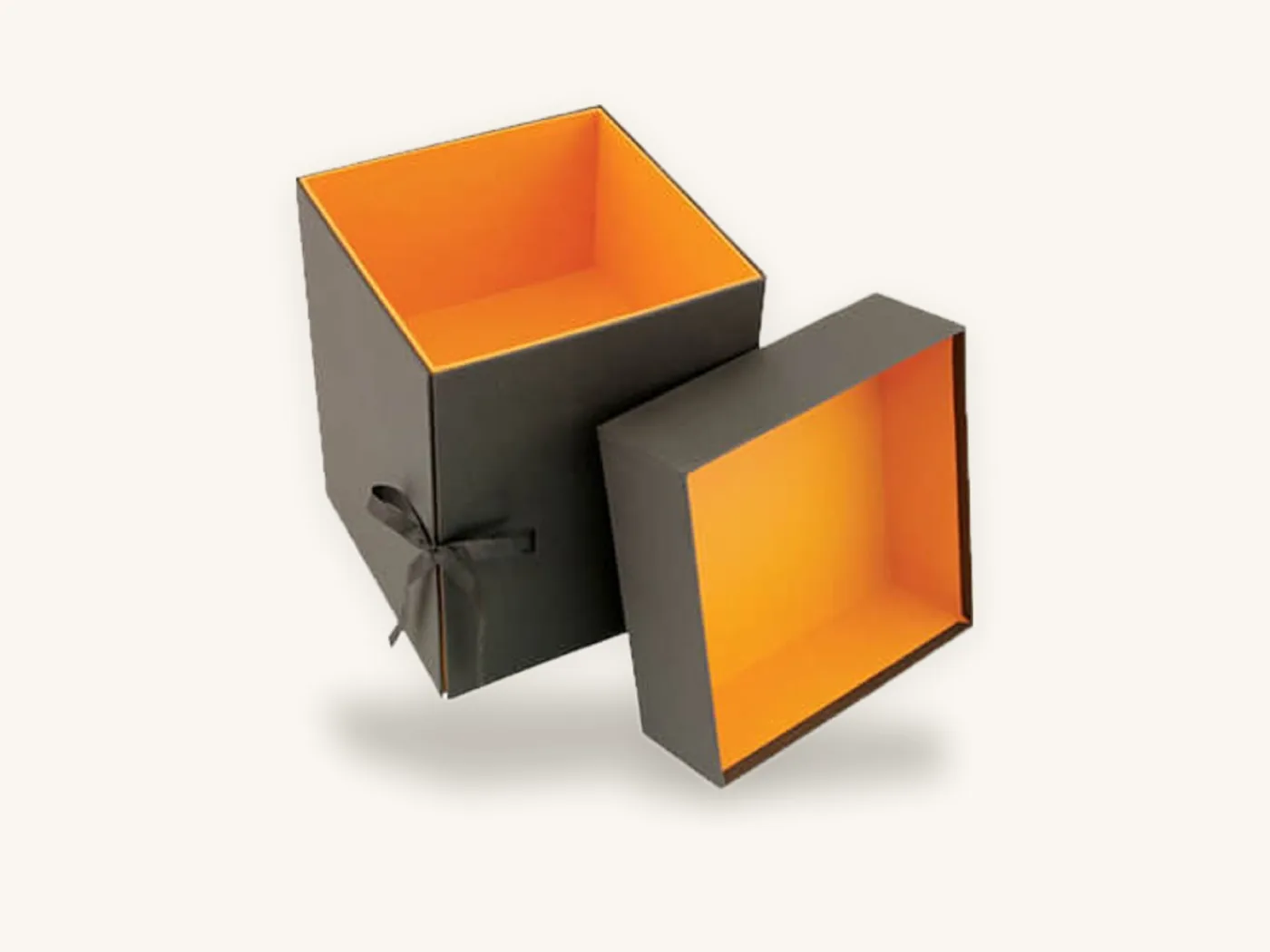
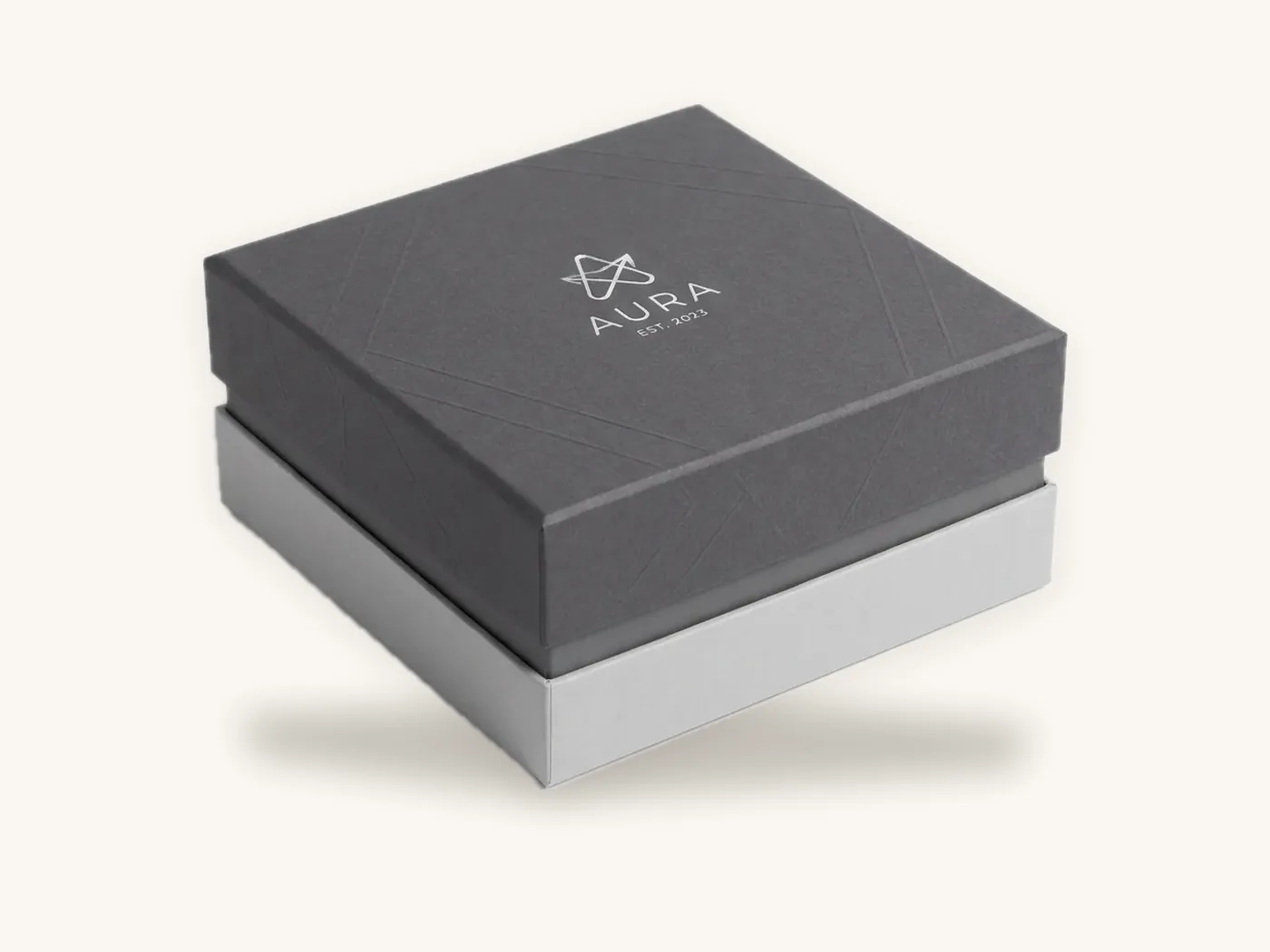
Shoulder neck boxes are three-piece rigid boxes: a base, a lid, and an inner collar called the neck that rises above the base. When the lid is closed it rests on a ledge, the shoulder, so the lid and base sit flush. When the lid lifts away, a band of contrasting neck appears between them. That strip of color, and the slow, cushioned lift the snug neck creates, is the reveal luxury fragrance, candle and spirits brands pay for.
The structure is simple to describe and exacting to build. The neck height, the gap between lid and neck, and the contrast between surfaces decide whether the box feels expensive or merely heavy. This guide takes the box apart piece by piece, explains the dimensions that matter, shows where shoulder box packaging earns its extra cost, and covers what to send when you order.
Key takeaways
- A shoulder neck box has three components: base, neck (an inner collar glued inside the base) and lid. The lid closes over the neck and rests on the exposed shoulder of the base.
- The reveal depends on fit. A lid that is too loose drops off without drama; one that is too tight sticks. Aim for a smooth friction fit with a slight air cushion.
- The visible neck band is usually roughly 3/16 to 1/2 in tall on small boxes when the lid is lifted slightly, and more on larger presentation boxes.
- Contrast is the design tool: a different color, paper texture or foil on the neck makes the reveal visible.
- It suits perfume, candles, watches, spirits and high-end skincare, where a lift-off lid and a cradling insert present one hero product.
- Box Sense makes custom shoulder neck boxes from 10 units, with free design support and standard production of 8–12 business days after proof approval.
Anatomy of a shoulder neck box
Think of the box as a stack of three rigid parts, each made from greyboard wrapped in paper.
The base
The base is a rigid tray, open at the top. Its walls are shorter than the finished box because the lid will cover the upper portion. The top edge of the base wall is the shoulder, the ledge the lid lands on.
The neck
The neck is a rigid collar, a four-sided band with no top or bottom, glued inside the base walls. It extends above the shoulder, so part of it is hidden inside the base and part stands proud. The exposed part is what the lid slides over. Because it is glued inside the base, the neck also doubles the wall thickness at the lower part of the box, which makes the whole structure noticeably stiffer.
The lid
The lid is a rigid cap whose inner dimensions match the outer dimensions of the neck plus a small clearance. When closed, its bottom edge meets the shoulder of the base, and the outer surfaces of lid and base line up in one continuous wall.
| Component | What it does | Typical build | Design surface |
|---|---|---|---|
| Base | Holds the product and insert; forms the shoulder ledge | 2 mm greyboard, wrapped outside and inside | Lower outer walls, inner floor |
| Neck | Guides the lid, creates the reveal band, stiffens the base | 1.5–2 mm greyboard, wrapped on exposed faces | Exposed band, often in a contrast paper or foil |
| Lid | Closes over the neck and lands on the shoulder | 2 mm greyboard, wrapped | Lid top and upper walls, inside lid |
Some builders call this construction a "neck box," others a "shoulder box," and some reserve "shoulder box" for designs where the base is visibly wider than the lid. For how it relates to other lid styles, see the box styles glossary.
Why the reveal feels premium
A plain two-piece box opens in one motion: lift the lid, done. A shoulder neck box adds two small moments that people read as quality.
First, resistance. The lid slides over the neck with a controlled friction fit. As it rises, air has to find its way in through the narrow gap, so the lid lifts slowly and evenly rather than popping off. That slow lift is the same effect people notice on high-end watch and phone boxes.
Second, the band. As the lid clears the shoulder, a stripe of neck appears. If the neck is a different color, texture or finish, that stripe signals that there is more to the box than its outside. It turns opening into a sequence: outer color, contrast band, then the product.
Neither effect needs electronics, magnets or mechanisms. It is all geometry and paper, which is why the construction has stayed a staple of fragrance packaging for so long.
Fit and dimensions: where good boxes are won
Nearly every problem with shoulder box packaging comes down to measurement. The table below gives practical starting points; your structural engineer will adjust for board thickness and wrap paper.
| Dimension | What it controls | Practical starting point | If it is wrong |
|---|---|---|---|
| Neck height above shoulder | How deep the lid sits and how much band shows as the lid lifts | Roughly 3/8 to 3/4 in on small boxes; more on tall boxes | Too short: lid wobbles; too tall: lid is hard to start lifting |
| Lid-to-neck clearance | Friction and air cushion | Very small; set by board and paper thickness | Too loose: lid falls off; too tight: lid sticks or scuffs the wrap |
| Shoulder alignment | Whether lid and base walls line up flush | Neck set in by exactly the lid wall thickness | Visible step or overhang at the seam |
| Base wall height | Where the seam falls on the box | Often one-third to one-half of total height | Seam in an awkward place for artwork |
| Internal cavity | Space for product and insert | Product plus insert plus small clearance | Product rattles or lid will not seat |
Deciding where the seam falls
The seam between lid and base is a strong visual line. Put it low, so the lid covers most of the box, and the box looks like a single block with a thin base. Put it near the middle for a balanced two-tone look. Put it high for a deep base with a shallow cap, which works well for candles, because the jar stays mostly surrounded when the lid comes off.
Humidity and wrap paper
Paper expands slightly in humid conditions. A lid fitted perfectly in a dry plant can feel tight after weeks in a humid warehouse, and vice versa. Laminated wraps are more stable than uncoated textured papers. If your boxes will be stored or sold in very humid markets, mention it so the clearance can be adjusted.
Watch out: approving a shoulder neck box from a digital render alone is risky. The render shows the look, but only a physical sample shows how the lid lifts. Always handle an unprinted structural sample before approving a production run.

Designing the contrast
A shoulder neck box without contrast is just a heavy two-piece box. The neck band is your most valuable real estate, so plan it deliberately.
Contrast strategies
| Strategy | How it works | Suits |
|---|---|---|
| Color contrast | Neck wrapped in a second brand color against the lid and base | Most brands; strongest visual effect |
| Material contrast | Textured, linen or felt paper on the neck; smooth laminated wrap outside | Fragrance, artisan candles, understated luxury |
| Metallic band | Neck wrapped in metallic board or finished with foil | Holiday editions, spirits, gift sets |
| Tone-on-tone | Same color, different finish, such as matte outside and gloss neck | Minimal, monochrome brands |
| Printed pattern | A repeating pattern or message printed on the neck wrap | Limited editions and collaborations |
Metallic and holographic board and textured specialty papers are the two most common neck materials. A contrast paper does not require foil tooling, so it is often the most cost-effective way to create the reveal.
Where to put the logo
The lid top is the obvious spot and the place for foil stamping or embossing. The neck band is usually too narrow for a full logo, but a small wordmark or a short phrase repeated around the band works well. The inside of the lid is the final surface: a message there is seen right after the reveal. Finishes and their effects are shown on the printing and finishes page.
Artwork tips for three-part boxes
- Supply separate artwork for base wrap, neck wrap and lid wrap, each on its own dieline.
- Keep text away from the wrapped edges, where paper turns over board; roughly 1/8 in is a safe margin.
- Avoid artwork that must line up exactly across the lid-to-base seam; small variations in how the lid is placed will make it look misaligned.
- Remember that the lower part of the neck is hidden inside the base, so only design the exposed band.
Shoulder neck boxes vs other rigid lid styles
If you are choosing between rigid structures for a premium product, this comparison helps narrow it down.
| Style | Opening experience | Relative cost | Best for |
|---|---|---|---|
| Shoulder neck box | Slow friction lift with a contrast band | Higher: three components | Single hero products: perfume, candles, watches |
| Two-piece lid and base | Simple lift-off | Lower | Apparel, stationery, broad gift ranges |
| Magnetic closure box | Hinged lid swings open with a snap | Mid to high | Kits, multi-item sets, reusable gift boxes |
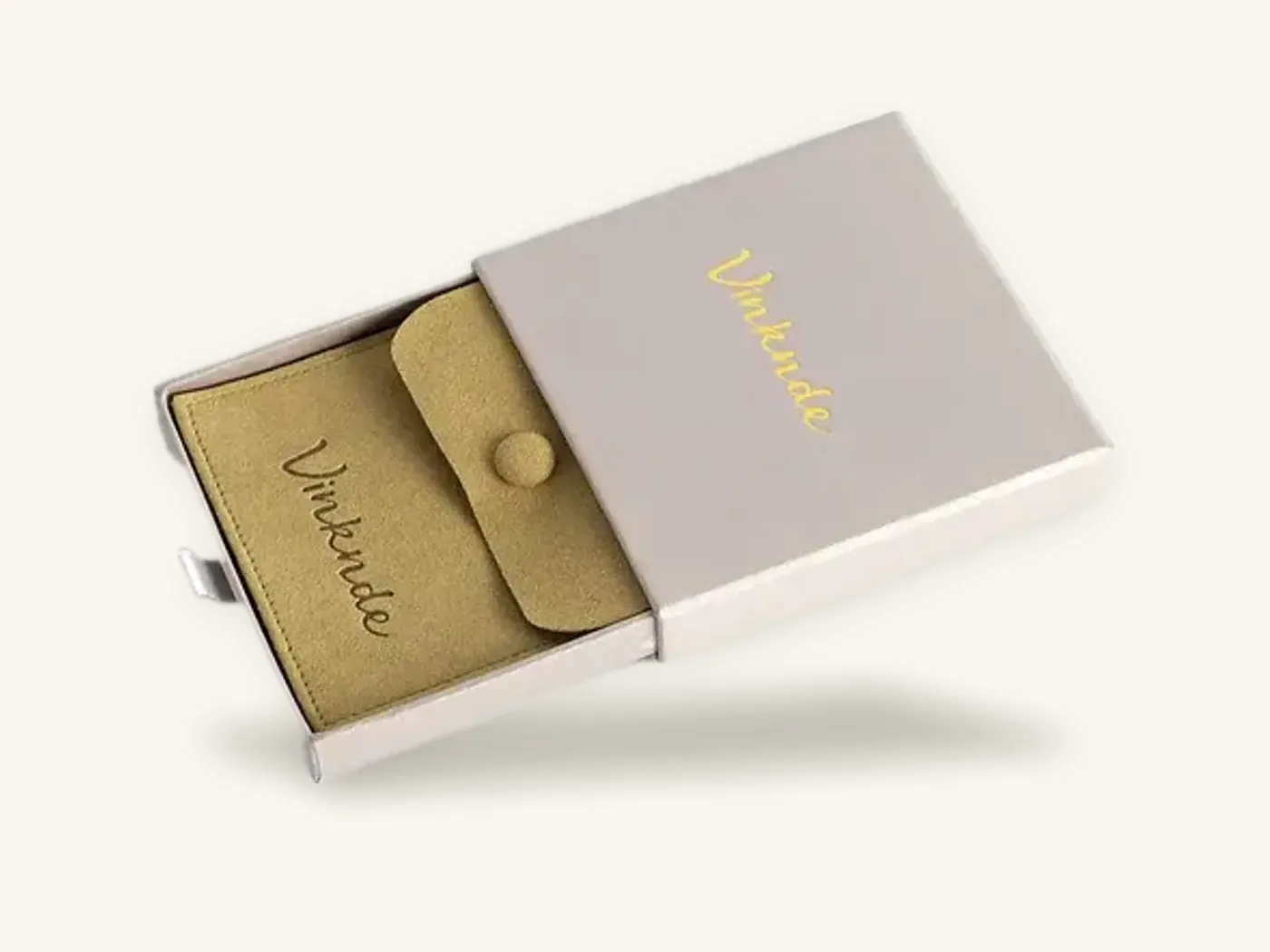
| Drawer box | Tray slides out of a sleeve | Mid | Jewelry, chocolates, small accessories |
| Collapsible rigid box | Hinged lid; ships flat | Mid to high | Large gift programs with storage limits |
A two piece box is the natural step down when the reveal is less important than price. If you need a rigid box that ships flat for a large program, the collapsible rigid boxes guide explains that trade-off. Shoulder neck construction is almost always a set-up rigid build, because the glued neck cannot fold.
The same idea also works on cylinders. A round rigid box with an inner neck gives the same slow lift on a circular profile; the round boxes guide and the paper tube packaging guide cover those shapes.
Best products for shoulder box packaging
Perfume and fragrance
A neck box perfume presentation is the archetype. A bottle sits upright in a cradle insert, the lid lifts slowly, and the contrast band frames the bottle's cap as it appears. Tall, narrow proportions suit most bottles. See perfume boxes, the fragrance and perfume page and our perfume packaging guide for bottle-specific details.
Candles
Luxury candles in glass or ceramic vessels work well in shoulder neck boxes with a high seam, so the vessel stays enclosed until the lid is fully off. A neck box can also be kept as a storage container once the candle is used, which gives it a life beyond the unboxing. Candle boxes covers standard formats.
Watches and fine jewelry
Watch boxes benefit from the controlled lift because the product sits on a raised pillow or cushion insert. The watch boxes page shows common layouts.
Spirits and premium beverages
Single bottles of spirits in tall rigid boxes use the construction for gifting occasions. Weight matters here: a full bottle is heavy, so board thickness and a firm insert are essential.
High-end skincare
Single-jar serums and creams in limited editions use shoulder neck boxes to separate a premium line from standard cartons.
Inserts for shoulder neck boxes
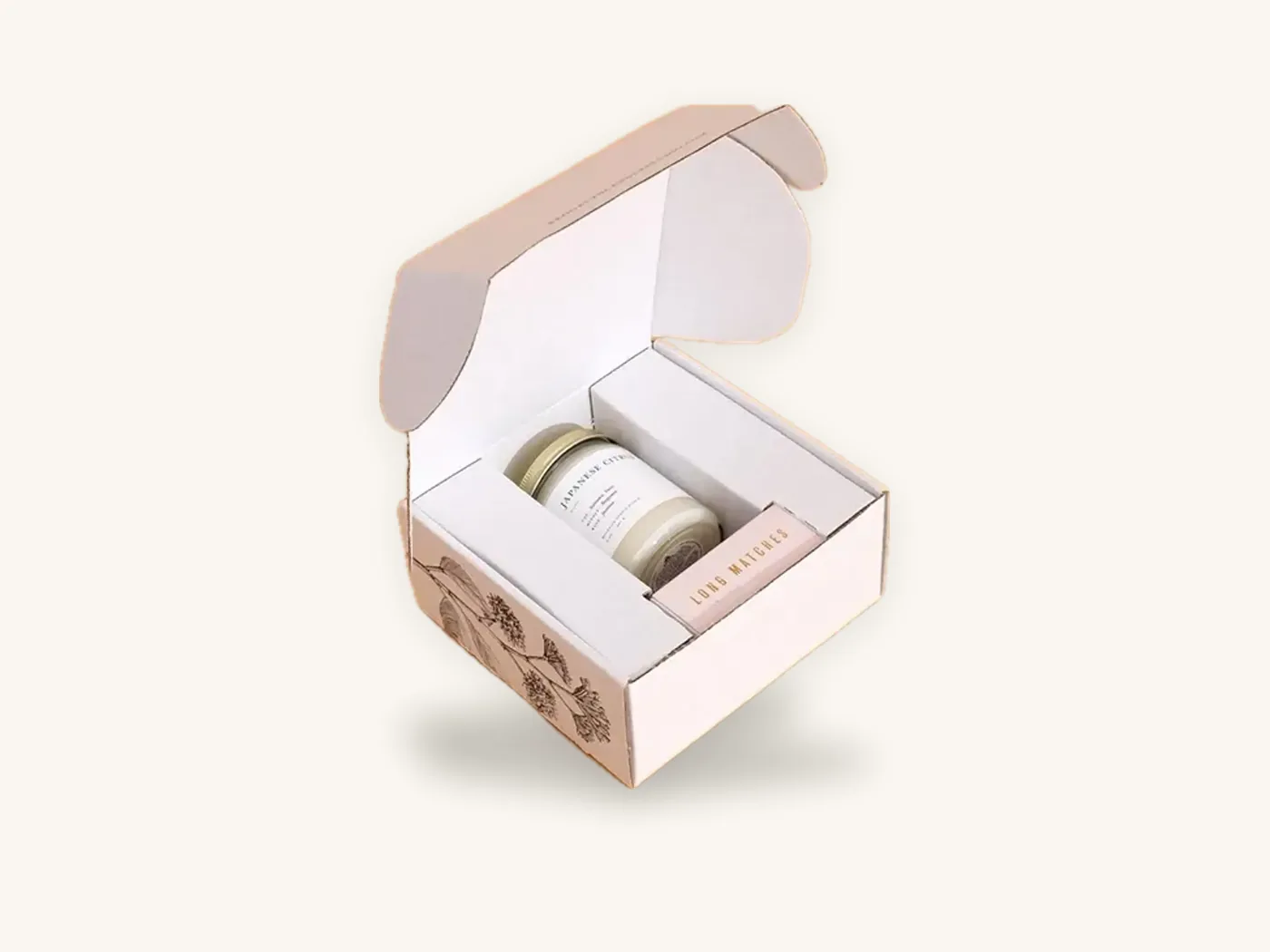
The insert holds the product in the exact spot the reveal was designed around. In a box built for one hero product, the insert matters as much as the box.
Choosing and specifying an insert
- Measure the product precisely, including caps, pumps and any flared base. Bottles are rarely a perfect cylinder.
- Decide how the product should present: upright, lying at an angle, or recessed into a platform.
- Choose the material. Paperboard inserts are light and recyclable; wrapped board platforms look most luxurious; EVA foam holds irregular shapes firmly; molded pulp is a plastic-free option.
- Plan a lift feature. A ribbon under the bottle or a finger notch in the insert helps customers remove a tightly held product.
- Size the box cavity around the insert, not the other way around.
- Test with a filled sample, closing and lifting the lid repeatedly to make sure the product never touches the lid.
Custom inserts carry a one-time insert die charge of about $45. The box inserts guide compares materials in more depth.
Tip: leave a little headroom between the top of the product and the underside of the lid. If a perfume cap touches the lid, it pushes back as the lid closes and ruins the slow, cushioned feel.
Cost drivers for shoulder neck boxes
Shoulder neck boxes cost more than two-piece rigid boxes of the same size because they have a third component that must be cut, wrapped and glued in precisely. The main cost drivers:
- Size and board thickness: more greyboard and more wrap paper per box
- Three wraps instead of two, especially if the neck uses a specialty or metallic paper
- Print coverage on the lid, base, neck and interior
- Finishes: foil and embossing add about $60 one-time tooling each; spot UV about $40
- Inserts: a custom insert adds its own material plus a one-time die charge
- Quantity: unit price falls steeply from short runs to larger ones
As a reference point for rigid construction, a 2 mm wrapped rigid box at 8x6x3 in with full color and matte finish is about $9.10 per unit at 100 and about $4.05 at 1,000, and a 2 mm jewelry rigid box at 3x3x1.5 in with matte finish, foil and an insert is about $3.35 at 100 and about $1.49 at 1,000, with free US shipping included. A shoulder neck build of similar size is quoted on its exact structure, so use the instant price estimator as a starting point and request a quote for the neck construction.
How to order shoulder neck boxes from Box Sense
What to send
- Product dimensions, including cap and base, and weight
- Preferred orientation of the product and any insert idea
- Overall box dimensions if you have a target, or a request that we size it
- Where you want the seam: low, middle or high
- Wrap choices for lid, base and neck, plus the contrast approach
- Print and finishes: foil, embossing, spot UV, soft-touch
- Quantities to price and target in-hand date
- Artwork, or a note that you want help from our design services team
What happens next
- Quote in 24 hours for your spec and quantities.
- Free design support: we create dielines for all three components, set up artwork and send a 3D digital proof, with two revision rounds included.
- Structural sample: unprinted structural samples are free, so you can test the lid lift with your actual product. A printed sample of approved artwork is free on orders of 100 or more. See samples.
- Production: standard production is 8–12 business days after proof approval.
- Delivery: US shipping is free on every order; international shipping is quoted at cost.
The minimum order is 10 boxes, and there are no die or plate charges beyond tooling for optional foil, embossing, spot UV or custom inserts. Defective boxes reported within 14 days are reprinted free. Explore standard formats on the shoulder neck boxes product page or the wider rigid boxes range.
Frequently asked questions
What is a shoulder neck box?
A shoulder neck box is a three-piece rigid box made of a base, an inner collar called the neck, and a lid. The neck is glued inside the base and rises above it. The lid slides over the neck and rests on the base's top edge, the shoulder. When the lid is lifted, the neck shows as a band between lid and base, creating a premium reveal.
What is the difference between a shoulder box and a two-piece box?
A two-piece box has only a base and a lid; the lid lifts straight off. A shoulder neck box adds an inner neck, which guides the lid, slows its lift with a friction fit and exposes a contrasting band when opened. The extra component makes it stiffer and more premium, and also more expensive than a two-piece box of the same size.
Why are neck boxes used for perfume?
Perfume is usually a single, visually important bottle, and a neck box presents it in stages. The lid lifts slowly, the contrast band appears, and the bottle is revealed standing in a cradle insert. The doubled walls from the neck also protect the glass. That combination of theater and protection makes the construction a long-standing choice for fragrance packaging.
How tall should the neck be on a shoulder neck box?
On small boxes, the neck typically extends roughly 3/8 to 3/4 in above the shoulder, with larger presentation boxes going higher. Too short and the lid wobbles; too tall and the lid is awkward to start lifting. The right height depends on the box size and board thickness, so your structural sample is the best way to confirm the feel.
Can shoulder neck boxes ship flat?
No. The neck is glued inside the base, so a shoulder neck box is built as a set-up rigid box and ships assembled. If flat shipping is important because of storage or freight costs, consider a collapsible rigid box with a magnetic lid instead, which gives a premium unboxing while folding flat until you pack it.
How much do shoulder neck boxes cost?
They cost more than a two-piece rigid box of the same size because of the extra neck component. For comparison, a 2 mm wrapped rigid box at 8x6x3 in with full color and matte finish is about $9.10 per unit at 100 and about $4.05 at 1,000. Box Sense quotes shoulder neck builds on their exact spec within 24 hours.
What materials are used for the neck?
The neck is made from greyboard, usually 1.5 to 2 mm, wrapped in paper on its exposed faces. Brands often choose a contrasting wrap: a second color, a textured or linen paper, a metallic board or a foil finish. Because the band is narrow, a contrast paper alone often creates a strong reveal without extra tooling costs.
Next steps
Measure your product, decide where the seam should fall and choose the contrast you want the neck to show. Then check comparable rigid specs in the pricing estimator and request a shoulder neck box quote. We will confirm pricing within 24 hours, engineer the neck fit and send a free structural sample so you can feel the lift before you approve.
Boxes in this guide
Order the packaging we covered
Written by the Box Sense Packaging Team
Our structural designers, prepress technicians and production staff print and convert custom boxes every day for brands in the United States, United Kingdom and UAE. Questions about this guide? Talk to us.