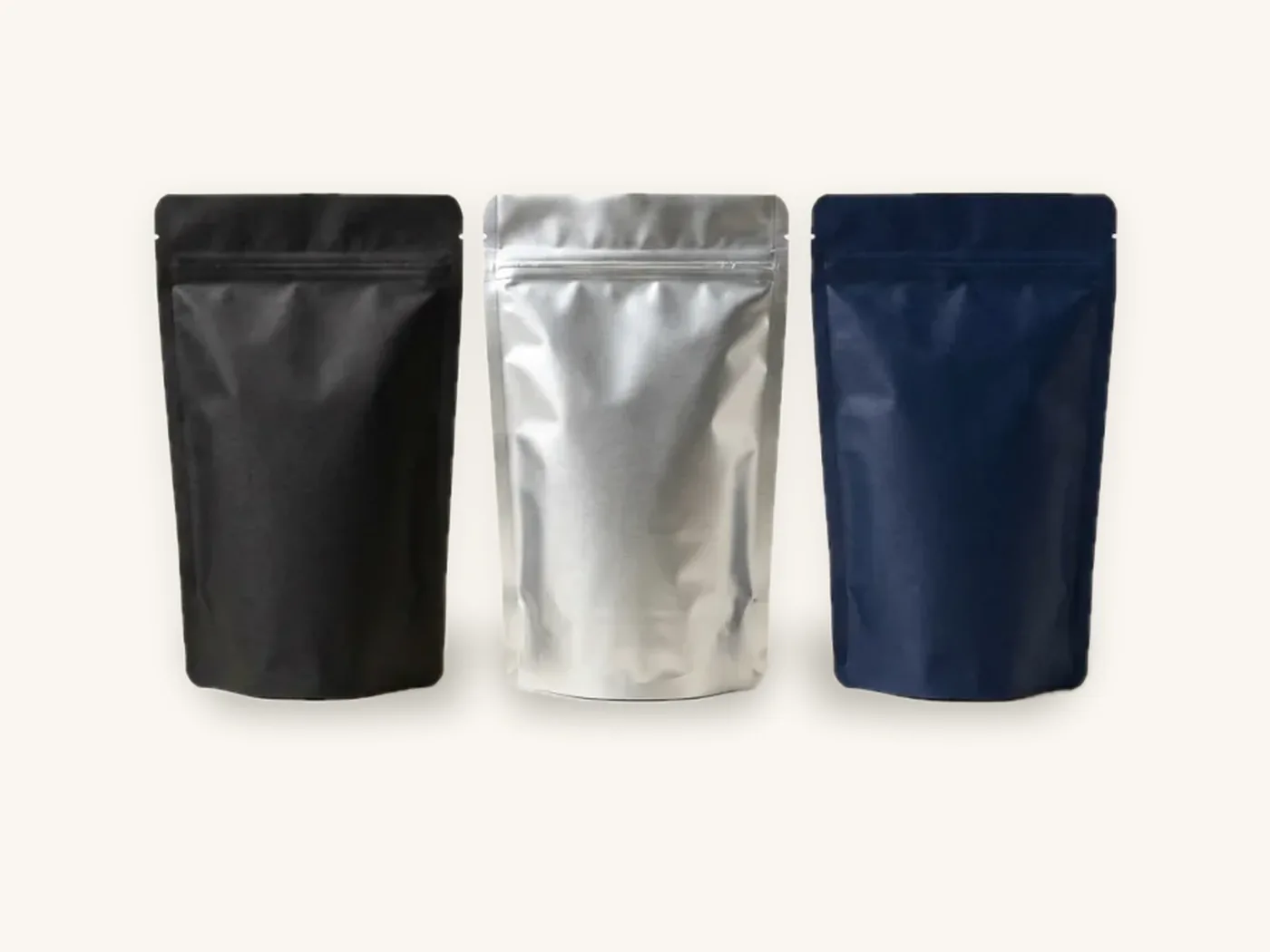
Custom stand up pouches are flexible bags made from two to four laminated film layers, with a gusseted bottom that lets them stand on a shelf and, usually, a resealable zipper at the top. You choose the film structure for the barrier your product needs, the bottom style for how it stands, the closures for how customers use it, and the print method for your quantity.
Most pouch problems trace back to one of those choices made in the wrong order. Brands pick a look first (matte black, a clear window), then discover the film does not keep coffee fresh or the window lets light degrade a supplement. This guide works from the inside out: what your product needs protection from, then structure, then features, then print.
Key takeaways
- A stand-up pouch is a laminate: an outer print layer, an optional barrier layer, and an inner sealant layer that melts to close the bag.
- Pick the film by what degrades your product: oxygen, moisture, light, aroma loss or grease. Foil and metallized layers block the most; clear films show the product but block less.
- Doypack (round) bottoms suit light fills, K-seal bottoms carry heavier fills, and flat-bottom pouches stand like a box and hold the most per shelf inch.
- Size pouches with a fill test using your actual product, not a weight chart; density varies wildly between granola, powder and whole beans.
- Digital printing makes short runs of printed pouches practical without plates; gravure and flexo suit long runs of a single design.
- Box Sense makes custom stand up pouches with free design support and quotes within 24 hours. Standard production is 8–12 business days after proof approval.
How a stand-up pouch is built
Understanding the layers makes every later decision easier, because the "material" of a pouch is really a stack.
The outer layer: print and scuff resistance
The outside film is usually PET (polyester) or BOPP (oriented polypropylene), often 12 to 20 microns thick. Ink is typically reverse printed on the inside face of this film, so the artwork sits buried between layers rather than on the surface.
Kraft paper can also serve as the outer layer. It gives a natural, uncoated look, but it prints on the surface, so ink is more exposed and colors look muted.
The barrier layer: what keeps the product fresh
The middle layer is where protection comes from. Aluminum foil is the strongest common barrier against oxygen, moisture and light. Metallized PET (a microscopically thin aluminum coating on film) gives a good barrier at lower weight and a shiny look. Clear high-barrier films, such as coated PET, keep some visibility with moderate protection.
The sealant layer: how the pouch closes
The inside film, usually LLDPE (linear low-density polyethylene), melts under heat and bonds to itself. Its thickness determines seal strength and puncture resistance. Heavier fills and sharp-edged products, such as jerky, dried pasta or pet kibble with hard corners, need a thicker sealant layer.
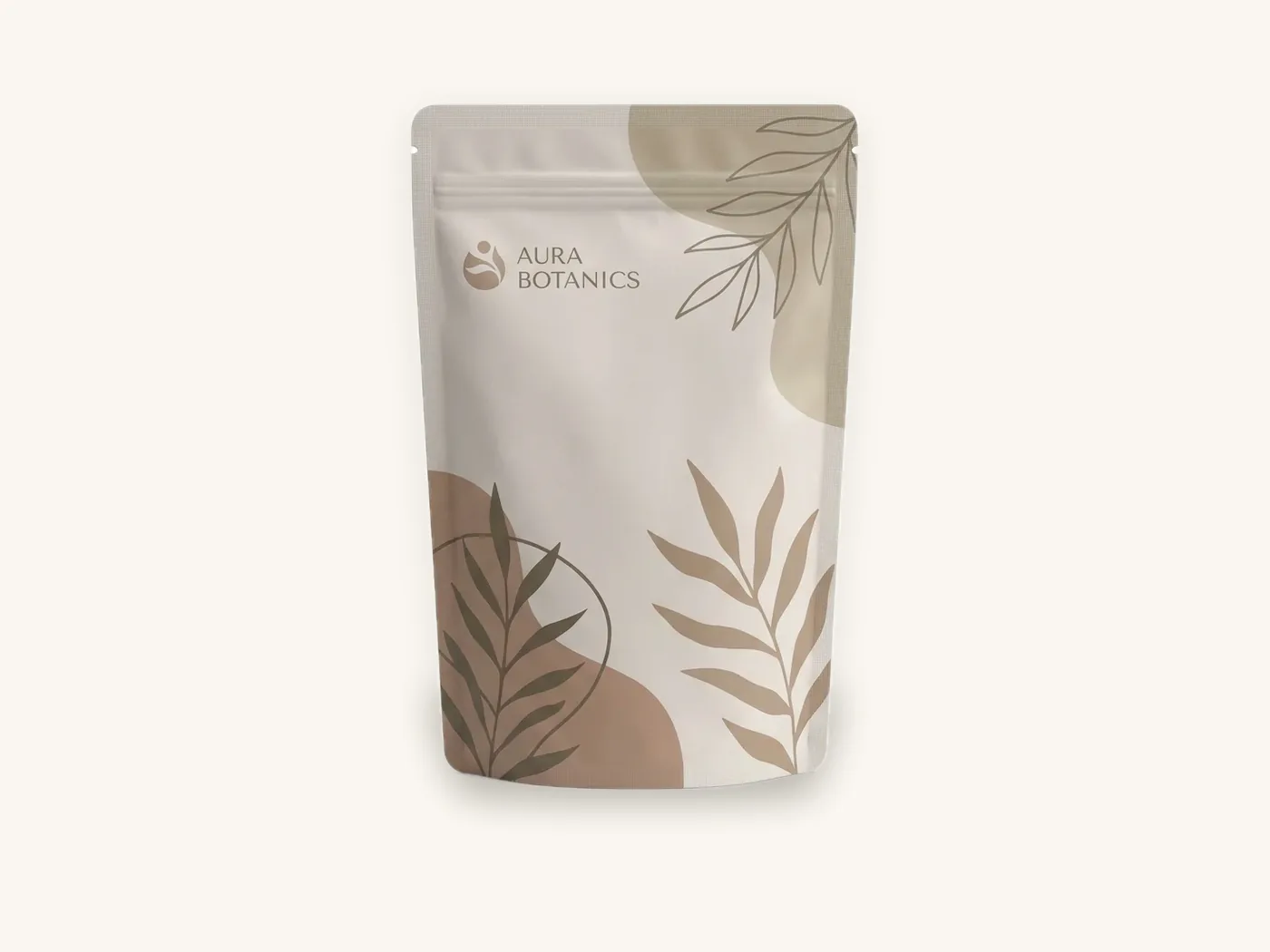
Choosing a film structure by what your product fears
Start by naming the thing that spoils your product. Coffee loses aroma and goes stale with oxygen. Dried fruit picks up moisture. Supplements with oils oxidize in light. Pet treats can leak fat through thin films. The table below maps common structures to those threats.
| Structure (outside to inside) | Barrier level | Look | Best for |
|---|---|---|---|
| PET / aluminum foil / LLDPE | Highest against oxygen, moisture and light | Opaque, printed surface only | Coffee, powdered supplements, long shelf life foods |
| PET / metallized PET / LLDPE | High | Opaque with a metallic sheen under inks | Snacks, tea, protein powders, bath salts |
| Matte BOPP / metallized PET / LLDPE | High | Soft matte exterior, opaque | Premium snacks and wellness products |
| Kraft paper / metallized PET / LLDPE | High | Natural paper outside, foil-like inside | Granola, coffee, artisan foods |
| Kraft paper / PLA or clear PET / LLDPE | Moderate | Natural paper, often with a window | Short shelf life dry goods, cookies, loose tea |
| Clear PET / LLDPE | Low to moderate | Fully transparent | Candy, dry pasta, bath products sold on sight |
| Mono-material PE (all polyethylene layers) | Moderate | Matte or gloss, printable | Brands prioritizing recyclability where accepted |
Matching barrier to shelf life
Shelf life depends on the product, the fill method and the storage conditions as much as on the film, so no pouch spec comes with a guaranteed number of months. As a working rule, choose a foil or metallized structure when you need a shelf life measured in many months, and accept a clear or kraft-with-window structure when the product sells through in weeks.
Food contact and product safety
Films used for food should be made from materials that comply with FDA food contact regulations for the intended use, including the temperature and fat content of the food. Ask for compliance documentation for the exact structure you order, and confirm requirements for your product category with the FDA or your regulatory advisor. Box Sense's food and beverage packaging page covers the wider range of food packaging we make.
Watch out: a clear window is a frequent weak point in food pouch barrier. If your product is light-sensitive or oily, keep the window small, place it low on the front, or skip it and use photography on an opaque film instead.
Pouch bottoms and formats compared
"Stand-up pouch" covers several constructions. The bottom style decides how stable the bag is, how much it holds for its footprint, and how it looks on a shelf. The stand-up pouches style page shows the family of options.
| Format | How the bottom is formed | Stands well when | Choose it for |
|---|---|---|---|
| Doypack (round bottom) | A W-shaped gusset sealed in a curved, U-shaped seal | Filled at least halfway | Light fills: snacks, candy, tea, bath salts |
| K-seal bottom | Angled seals at the bottom corners spread the weight | Heavier, dense fills | Coffee, granola, pet food, rice |
| Plow (folded) bottom | The bottom gusset is folded, with no seal across it | Loose, heavy product | Larger bags of kibble or grain |
| Flat-bottom (box pouch) | A rectangular base with side gussets, five printable panels | Almost any fill level | Premium coffee, protein powder, retail shelf standouts |
| Three-side seal (lay-flat) | No gusset; sealed on three sides | Does not stand | Samples, single servings, jerky strips |
Doypack or flat bottom
A doypack is the most economical format and the one most people picture. It works best when the product settles to fill the bottom curve.
A flat-bottom pouch costs more to convert but gives you a front, back, two side gussets and a base to print. It stands squarely even when half empty, which matters for coffee and powders that customers use over several weeks. Our coffee bags are commonly made in flat-bottom and side-gusset formats for exactly that reason.
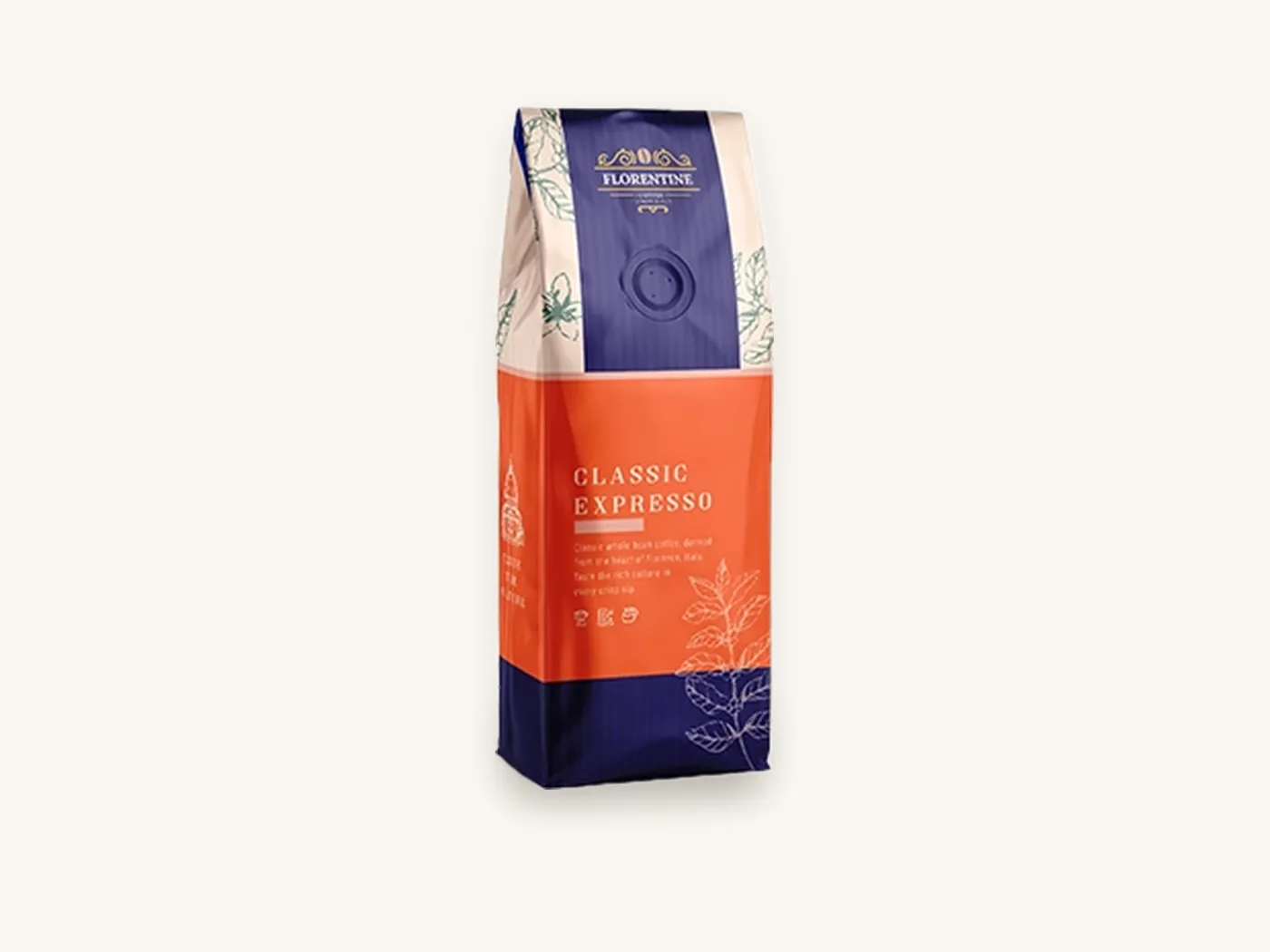
Resealable pouches: zippers, valves and other features
Features are where a pouch becomes usable. Each one adds converting steps and usually a small cost per bag, so add them for a reason.
Zipper and closure options
- Press-to-close zipper: the standard interlocking track. Reliable, low cost and familiar to customers.
- Pocket zipper: a zipper hidden behind a tear-off strip, so the pouch shows no track until opened. Useful as a tamper indicator.
- Slider zipper: a plastic slider that opens and closes the track. Easier for customers with limited grip, and common on larger bags.
- Child-resistant zipper: a closure designed to be difficult for young children to open. Certification and state rules apply; see our custom mylar bags guide for how that works.
Tear notches, hang holes and handles
A tear notch is a small cut in the side seal above the zipper that lets customers open the heat seal by hand. Place it so the tear line runs above the zipper with a clean margin, or the zipper tears out with it.
A hang hole, either round or "sombrero" shaped, lets a pouch hang on a peg hook. It needs a sealed area at the top of the bag, which adds height. Handles, usually a die-cut slot, help with large pet food and bulk bags.
Degassing valves and windows
Freshly roasted coffee releases carbon dioxide. A one-way degassing valve lets gas out without letting oxygen in, so the bag does not puff up or burst. Skip the valve for pre-ground coffee that has already degassed, or for non-coffee products.
A window can be a clear panel in a kraft pouch or an unprinted area on clear film.
Feature decision table
| Feature | Add it when | Skip it when |
|---|---|---|
| Press-to-close zipper | Customers use the product over several sessions | Single-serve or one-time use |
| Tear notch | There is a heat seal above the zipper | The pouch is open-top for hand filling and sealing only at the zipper |
| Hang hole | You sell on peg hooks | Shelf or online only |
| Degassing valve | Whole-bean or fresh-roasted coffee | Any product that does not off-gas |
| Window | Seeing the product sells it and it tolerates light | Oily, light-sensitive or long shelf life products |
| Rounded corners | Sharp corners could scratch hands or puncture other bags | Budget is tight and corners are not an issue |
How to size a pouch with a fill test
Pouch sizes are listed as width x height + bottom gusset, for example 6 x 9 + 3.5 in. Unlike a box, the usable volume depends on how full the bag is and how the product settles, so weight charts are only a starting point.
- Get sample pouches in two or three sizes. Use unprinted stock pouches close to the format you plan to order.
- Fill by weight with your real product. A pound of popcorn and a pound of sugar need completely different bags.
- Leave headspace above the product. Allow roughly 1 to 1.5 in between the top of the product and the zipper, plus the area above the zipper needed for the heat seal and tear notch.
- Seal and stand it up. The bag should stand without leaning. Doypacks that lean forward are underfilled or too tall.
- Check the front panel. Make sure the product line does not hide your key artwork on a window, and that the logo sits in the flat upper area, not in the gusset curve.
- Shake, squeeze and drop it. Drop a sealed bag onto a hard floor from counter height. Check seals and zipper for leaks, especially with powders.
- Record the final dimensions and fill weight. Send those to your supplier with the fill weight noted on the dieline request.
Say you sell a 12 oz bag of granola clusters. Clusters are bulky with air gaps, so a pouch that holds 12 oz of whole-bean coffee may overflow. You test three stock doypacks, find the middle size stands straight with about an inch of headspace, and order that size with a K-seal bottom so it stays upright on the shelf.
Tip: always fill test with product from a normal production batch. The first, lighter-density batch from a test kitchen can make a bag look right, then regular production overflows it.
Printed pouches: print methods, artwork and finishes
The print method depends mostly on how many pouches you need and how many designs or flavors you run. The digital vs offset printing guide explains the tradeoffs for boxes; flexible packaging follows the same logic with different presses.
Digital printing for short runs and multiple SKUs
Digital presses print directly from files with no plates or cylinders. That makes short runs, test launches and multi-flavor lines practical, because each flavor can be a separate design without a separate setup cost. Color is full CMYK, and many digital presses add white ink for use on clear and metallized films.
Gravure and flexo for long runs
Rotogravure prints from engraved metal cylinders, one per color. It gives rich, consistent color and the lowest unit cost at very high volumes, but every cylinder is a one-time cost and changing artwork means new cylinders. For most growing brands, digital covers early runs and gravure only makes sense once a single design sells in large, steady volumes.
Artwork rules specific to flexible film
- White ink underlay: on clear or metallized film, colors print translucent unless you place white behind them. Knock white out deliberately where you want a metallic or clear effect.
- Seal and zipper keep-out zones: keep text and logos out of the side seals, bottom seal and zipper track, which distort or hide artwork.
- Gusset awareness: artwork in the bottom gusset curves and is mostly hidden when the bag stands. Put ingredients or a pattern there, not the logo.
- Barcode placement: place UPCs on a flat back panel, away from seals, with a light background for contrast.
Finishes
Matte and gloss finishes are usually built into the film structure (matte BOPP or a matte varnish) rather than added as a separate lamination. A registered matte or gloss varnish puts shine or matte only on selected areas, like a spot UV effect on a box. Soft-touch films give a velvety hand. Foil effects are typically created by printing on metallized film and leaving areas without white ink, which is cheaper and more durable than stamping foil on a flexible surface.
Filling, sealing and handling your pouches
Most custom stand up pouches arrive open at the top with the zipper already installed. You fill through the top and heat seal above the zipper.
Heat sealing basics
A tabletop impulse sealer works for low volumes; a continuous band sealer suits a small production line. Seal temperature, dwell time and pressure depend on the sealant layer, so run a few test seals on empty bags and pull them apart. A good seal tears the film rather than peeling cleanly apart.
Keep product dust out of the seal area. Powder in the seal is a frequent cause of leaking bags. A funnel or a folded paper collar during filling keeps the seal zone clean.
Recyclable and compostable pouch options
Traditional multi-layer pouches combine different plastics, and sometimes foil, that cannot be separated in most recycling facilities. That is the main sustainability tradeoff with flexible packaging.
Your main options
- Mono-material PE pouches: every layer is polyethylene, which makes the pouch technically recyclable in programs that accept flexible PE, often through store drop-off rather than curbside.
- Paper-based pouches: a higher paper content, sometimes with a thin barrier coating. Recyclability depends on the coating and local programs.
- Compostable structures: films such as PLA and cellulose-based layers designed to break down under composting conditions, often industrial composting rather than a backyard pile. Barrier is usually lower than foil.
Be careful with on-pack claims. The FTC's Green Guides explain how recyclable and compostable claims should be qualified, including whether recycling facilities are available to a substantial share of consumers. Review current FTC guidance or consult counsel before printing a claim. The sustainable packaging guide and our sustainability page cover the broader picture.
What drives the cost of custom pouches
The price sheet for flexible packaging depends on your exact structure and features, so use our pricing page as a starting point and request a confirmed quote for your spec. These are the variables that move the number.
| Cost driver | Why it matters | How to control it |
|---|---|---|
| Quantity | Setup is spread across more bags | Price two or three quantity tiers before deciding |
| Film structure | Foil and specialty films cost more than clear or metallized PET | Match barrier to real shelf life needs |
| Pouch size | More film per bag | Right-size with a fill test |
| Format | Flat-bottom pouches take more converting than doypacks | Use a flat bottom only where shelf presence or stability justifies it |
| Features | Zippers, valves, windows and hang holes each add a step | Add features customers actually use |
| Print method | Gravure cylinders are a one-time cost per color and design | Use digital for short runs and multiple flavors |
| Number of designs | Each SKU may be a separate setup on plate-based presses | Share one base design with a flavor sticker for tests |
A useful strategy for launches is a single printed brand pouch with flavor-specific custom product labels applied on top. Our custom labels and stickers guide explains label materials that stick well to film.
How to order custom stand up pouches from Box Sense
You do not need a finished spec to start. Send what you know and our team will recommend a structure, then confirm it against your fill test.
What to send
- Product type, fill weight and whether it is oily, powdered, sharp or light-sensitive
- Target shelf life and where the product is sold (shelf, peg hook, online)
- Preferred format: doypack, K-seal, flat-bottom or lay-flat
- Finished pouch dimensions if known, or a request for sample sizes
- Features: zipper type, tear notch, hang hole, valve, window, rounded corners
- Finish: matte, gloss, soft-touch, kraft, or registered spot effects
- Number of designs and quantities to price for each
- Artwork files, or a note that you want help from our design services team
What happens next
- Quote within 24 hours. We confirm pricing for your structure, features and quantities.
- Dieline and artwork setup. Design support is free: we supply a pouch dieline showing seals, zipper and gusset zones, set up artwork and send a digital proof, with two revision rounds included.
- Samples. Ask about stock sample pouches for fill testing before you approve artwork. The samples page explains our sample policy.
- Production. Standard production is 8–12 business days after proof approval. Ask about rush timing for your specific structure when you request a quote.
- Delivery. Shipping is free on every US order, and international shipping is quoted at cost.
If your pouches ship to customers inside a branded outer box, plan both together. A custom mailer box sized around several pouches, or a gable box for gift sets, keeps the bags upright and protected in transit. Mylar bags use the same basic construction with a focus on opacity and child resistance.
Frequently asked questions
What are custom stand up pouches made of?
Most are laminates of two to four layers. A PET, BOPP or kraft paper outer layer carries the print, an optional barrier layer of aluminum foil or metallized film blocks oxygen, moisture and light, and an inner polyethylene layer heat seals the bag shut. The right combination depends on how sensitive your product is and how long it needs to stay fresh.
What is the difference between a doypack and a flat-bottom pouch?
A doypack has a curved, W-folded gusset at the base and stands best when filled at least halfway. A flat-bottom pouch has a rectangular base with side gussets, so it stands like a box even when partly empty and gives you five printable panels. Flat-bottom bags cost more to make but look more premium and hold more product per shelf inch.
How do I know what size pouch I need?
Fill test with your real product. Get sample pouches in two or three sizes, fill each to your target weight, leave roughly an inch of headspace below the zipper, seal them and check that they stand straight. Product density varies so much that weight charts are only a rough starting point, especially for bulky snacks or granola.
Can printed pouches be made in small quantities?
Yes. Digital printing needs no plates or engraved cylinders, so short runs and multiple flavors are practical. Plate-based gravure printing only becomes cost-effective at high volumes of a single design. Many brands start with digitally printed pouches, then move their best-selling design to gravure once demand is steady and predictable.
Do coffee pouches need a degassing valve?
Whole-bean and freshly roasted coffee releases carbon dioxide for days after roasting, so a one-way valve lets that gas escape without letting oxygen back in. Without it, bags can puff up or split, or roasters must wait before packing. Pre-ground coffee that has already degassed, and most non-coffee products, do not need a valve.
Are stand-up pouches recyclable?
Conventional multi-layer pouches mixing different plastics or foil are not accepted in most curbside programs. Mono-material polyethylene pouches can be recycled where flexible PE is collected, often through store drop-off. Compostable films exist but usually need industrial composting. Check local program acceptance and FTC Green Guides guidance before printing any recycling or compostability claim.
Next steps
Pick your product's biggest freshness threat, fill test two or three sample sizes, and note the features customers will actually use. Then check pricing for your packaging program and request a quote for custom stand up pouches. We will confirm pricing within 24 hours and send a dieline ready for your artwork.
Boxes in this guide
Order the packaging we covered
Written by the Box Sense Packaging Team
Our structural designers, prepress technicians and production staff print and convert custom boxes every day for brands in the United States, United Kingdom and UAE. Questions about this guide? Talk to us.