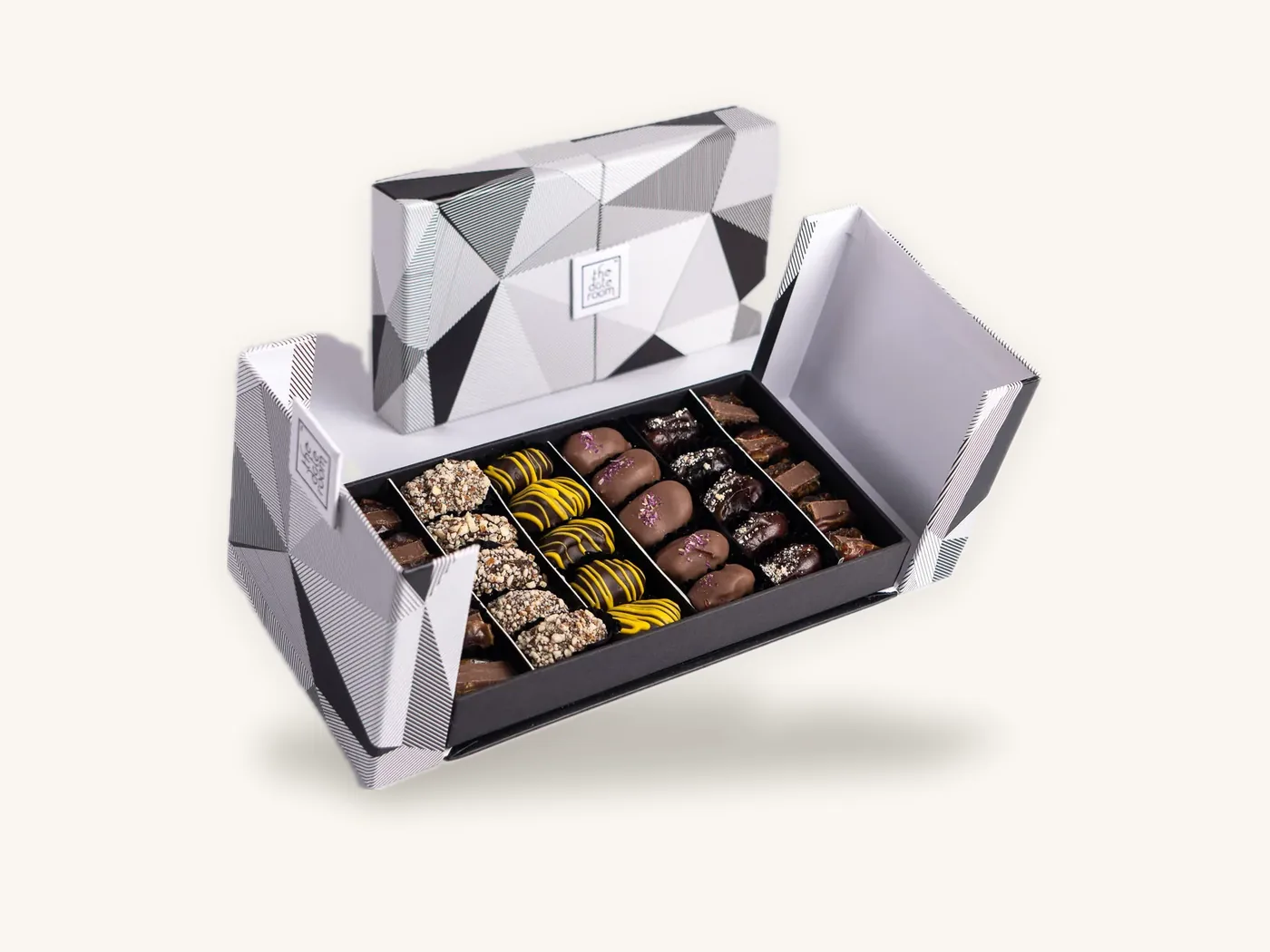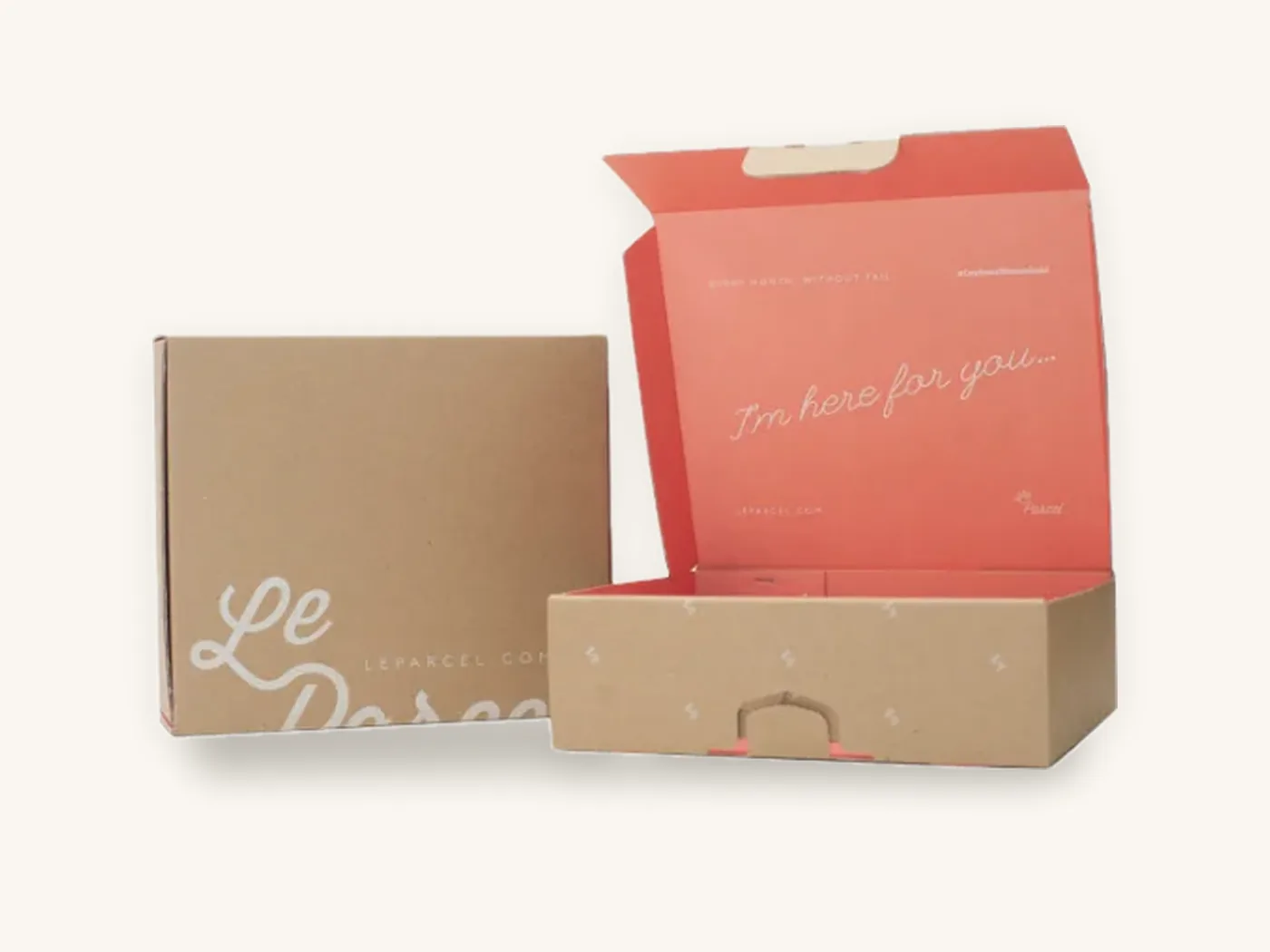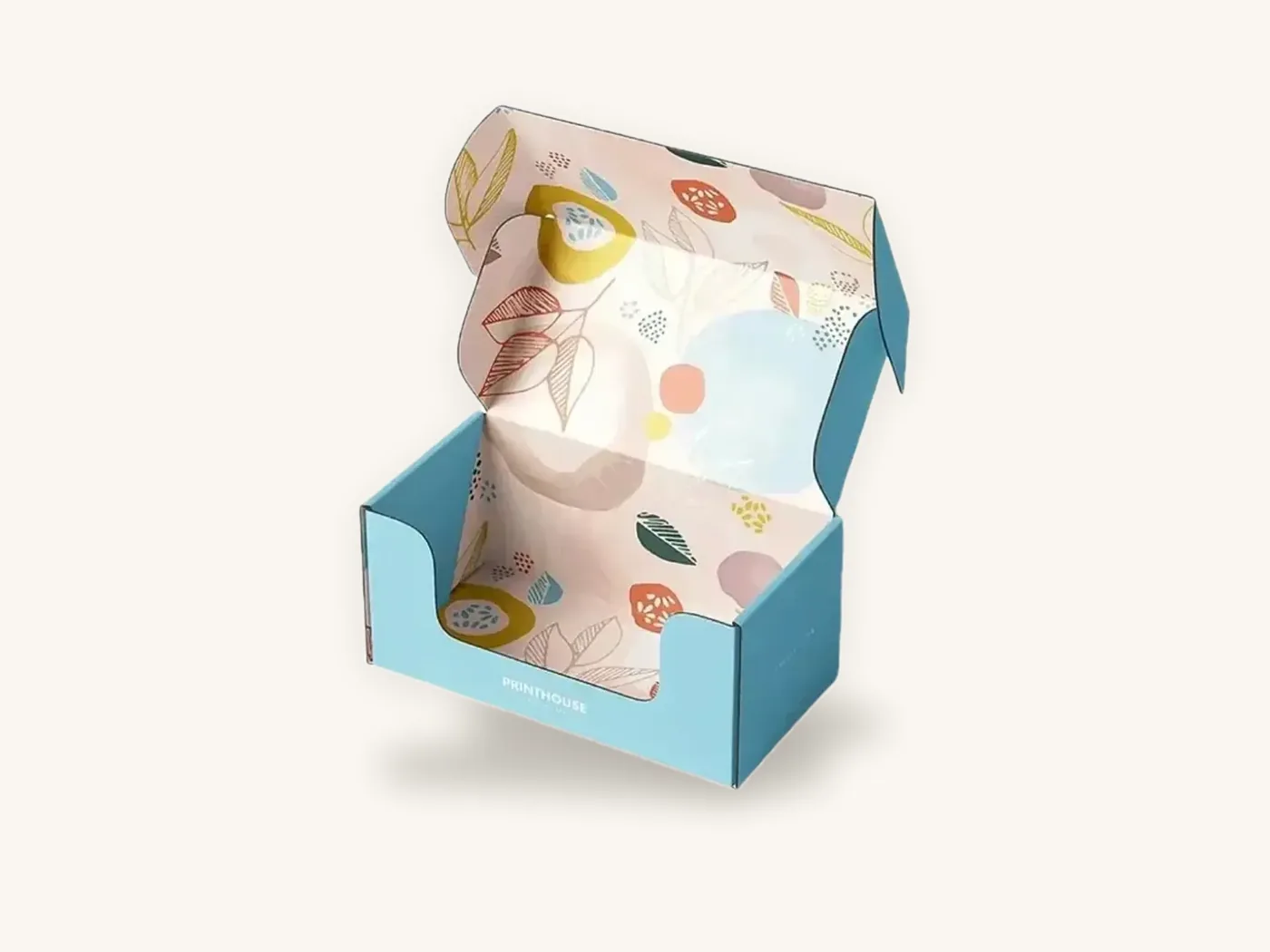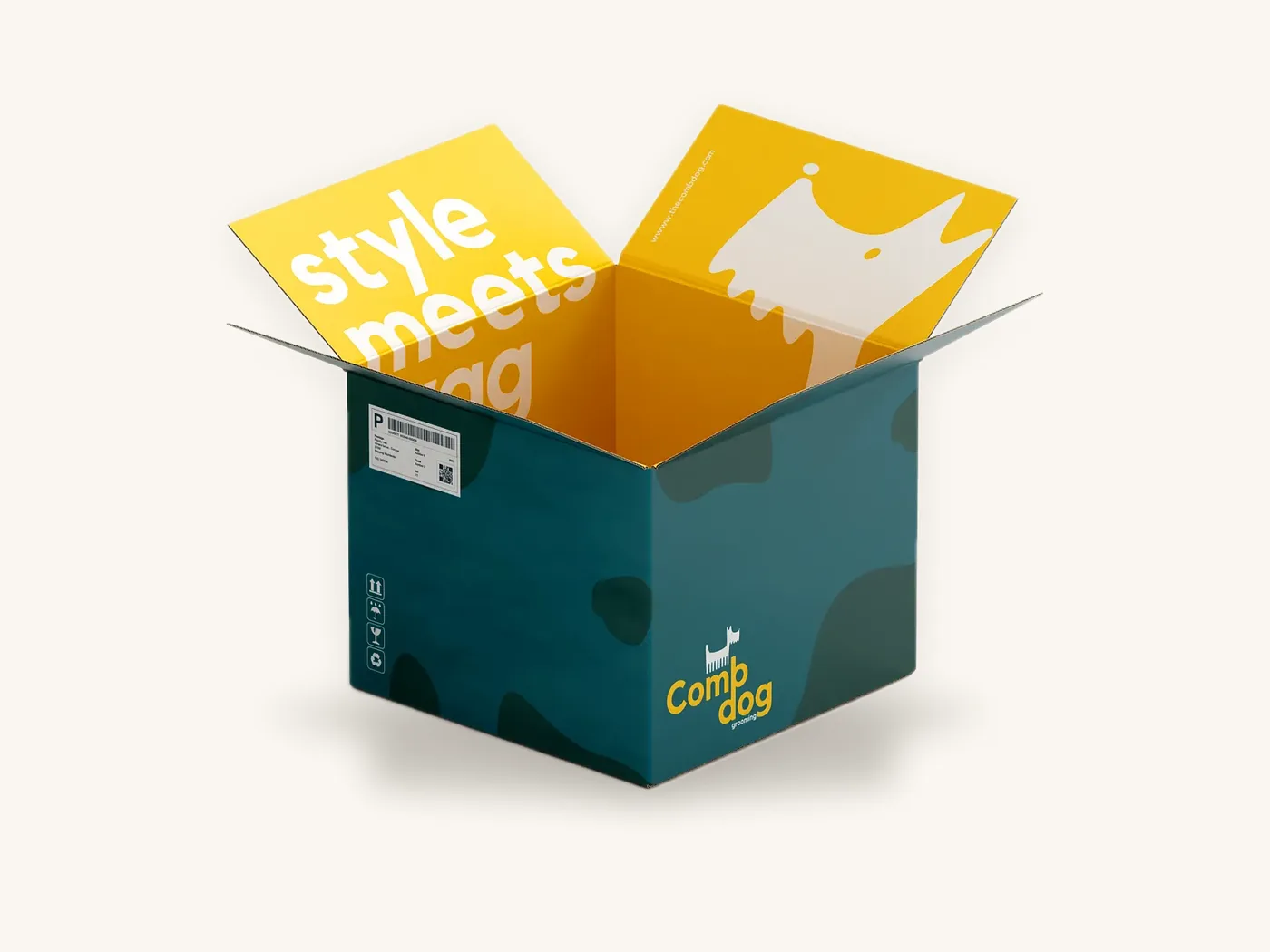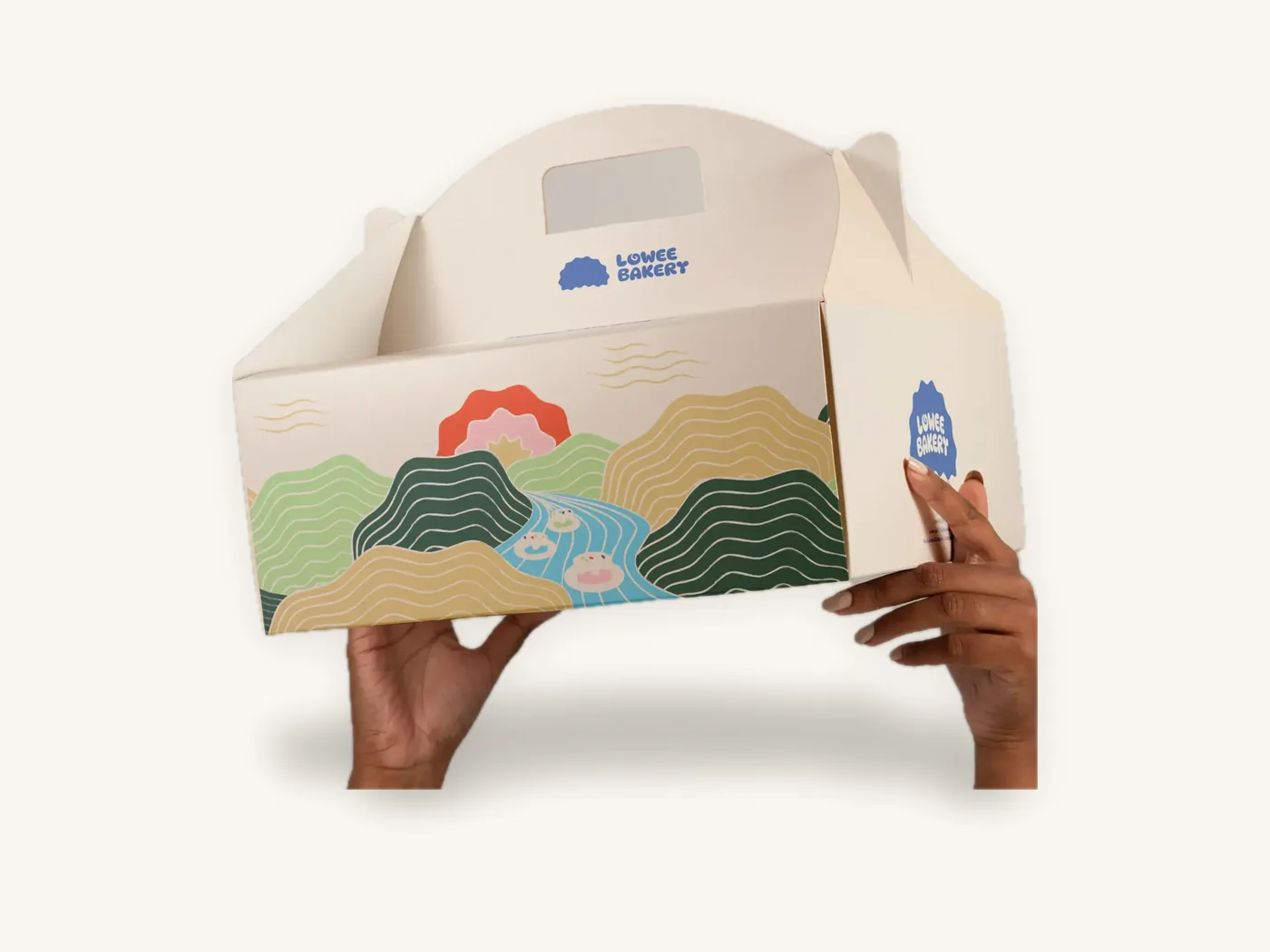
Custom gable boxes are paperboard cartons with a peaked, house-shaped top whose two roof panels meet in a die-cut carry handle. They fold flat, pop up in seconds and let a customer walk out holding the box like a small bag. That combination of box and handle is why gable box packaging is a favorite for bakeries, takeout, party favors, corporate gifts and retail gift packs.
They are not a universal answer. Gable boxes are best for light to moderate loads carried by hand over short distances, and weaker choices for anything heavy, liquid or shipped through the parcel network without an outer box. This guide starts with where they work and where they do not, then covers sizes by use, board and handle strength, food-contact considerations, printing ideas that suit the shape and how to order.
Key takeaways
- A gable box has an auto-lock or tuck bottom, four side walls and two sloping roof panels that meet in a handle; it ships flat and assembles without tape.
- Use gable boxes for hand-carried items: pastries, sandwiches, favors, gift sets, sample kits. Put them inside a mailer or shipper if they travel by parcel.
- 18 pt paperboard handles light loads such as favors and single pastries; heavier gifts and multi-item meals call for thicker board, an auto-lock bottom or E-flute corrugated.
- Size from the product up, then check that the roof slope leaves room for tall items and a comfortable handle grip.
- The two roof panels are the most visible print surface when a box is carried, so put the logo there, not only on the front wall.
- Box Sense makes gable boxes with handles from 10 units, with free design support, no die or plate charges and standard production of 8–12 business days after proof approval.
Where gable boxes work, and where they do not
The quickest way to decide whether gable box packaging suits your product is to ask how the box will travel. Gable boxes shine when a person carries them. They struggle when they are stacked, crushed or tumbled.
| Use | Fit | Why | Consider instead |
|---|---|---|---|
| Bakery counter: cookies, muffins, pastries | Excellent | Light, hand-carried, handle doubles as a bag | A cake box for tall, decorated cakes |
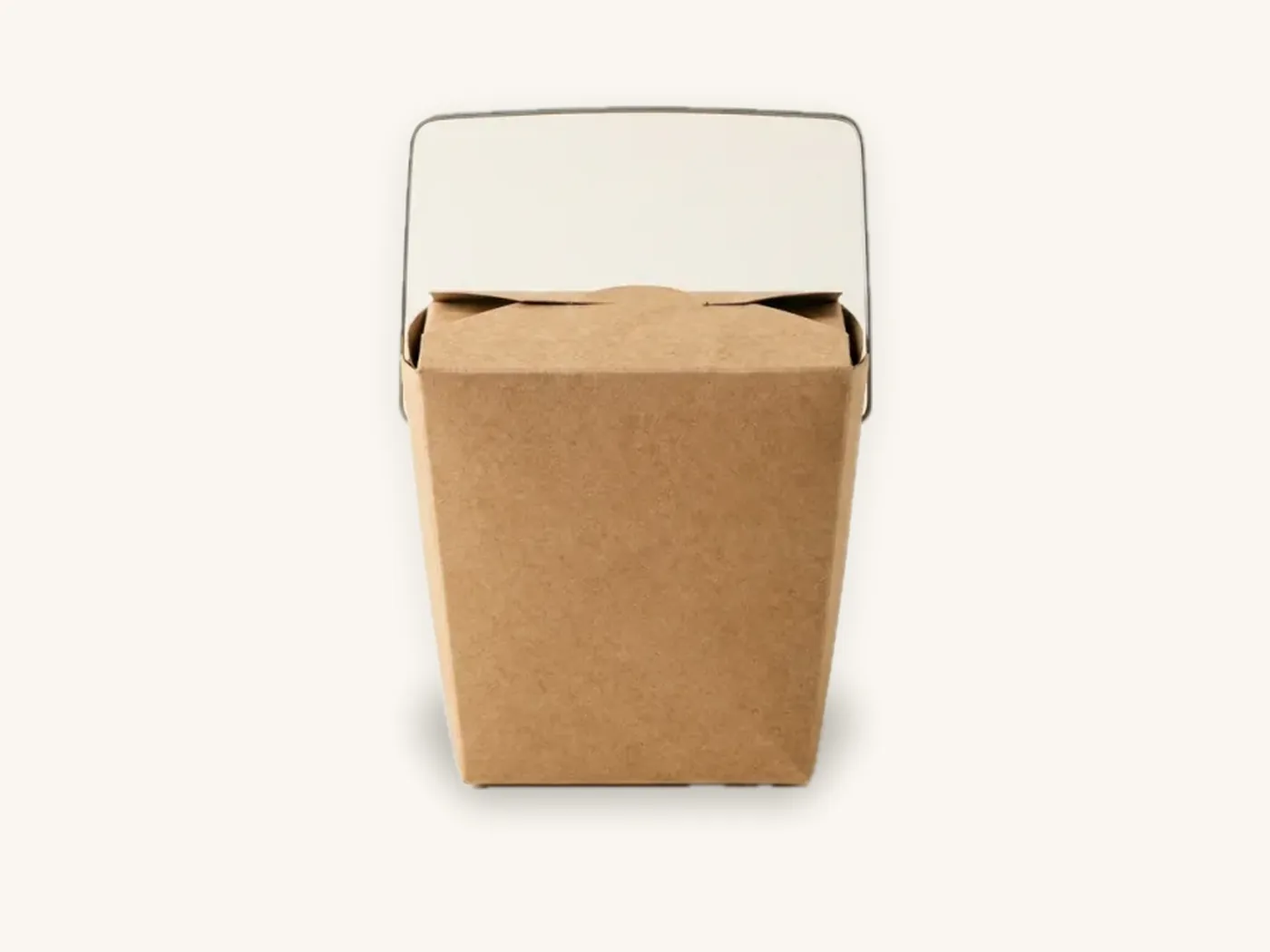
| Takeout sandwiches, wraps, snack meals | Very good | Grab-and-go, stacks of flat blanks store easily | A takeout or noodle box for saucy, hot food |
| Wedding, birthday and party favors | Excellent | Small, decorative, easy to set out on tables | A pillow box for flat, tiny favors |
| Corporate gifts and event swag | Very good | Carried from an event, big print panels | A rigid or two-piece box for high-value gifts |
| Retail gift packs, candles, soaps | Good | Handle makes the pack a gift bag substitute | An auto-lock carton for shelf stacking |
| Kids' meals and activity kits | Very good | Easy for small hands, fun shape | Add inserts for small parts |
| Heavy goods, glass bottles, liquids | Poor | Handle and roof strain under weight | A custom shipping box or beverage carrier |
| Direct parcel shipping | Poor on its own | Peaked roof crushes when stacked | Overbox in a mailer; see below |
The handle is the feature and the limit
The die-cut handle is formed by the two roof panels, so every gram of product weight hangs from a narrow strip of paperboard at the top of the box. That is fine for a few cookies and a real problem for a bottle of wine. If the handle is doing serious work, the board, the handle reinforcement and the bottom construction all need to step up, which we cover in the materials section.
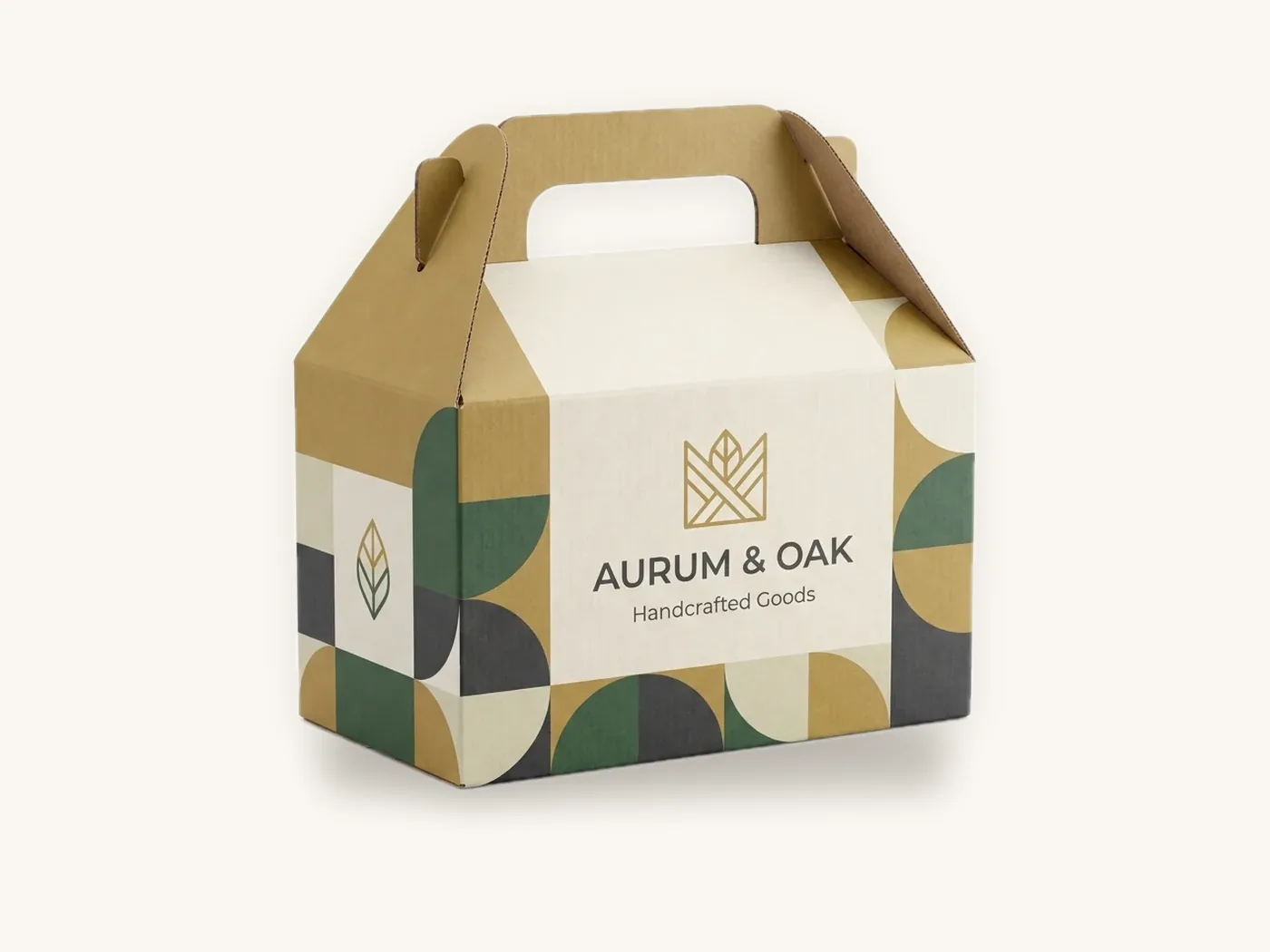
Anatomy of a gable box
Knowing the parts helps you read a dieline and make sensible requests.
- Base. Usually an auto-lock (crash-lock) bottom that springs into place when the box is opened, which is quick to assemble and holds more weight than a tuck bottom. Small favor boxes sometimes use a simpler tuck or four-flap base.
- Side walls. Four walls, glued along one side seam.
- Roof panels. Two large, sloping panels that rise from the front and back walls toward the handle.
- Gussets or end triangles. The short ends fold inward into triangles as the roof closes.
- Handle. A die-cut hand hole through both roof panels, which lie back to back once closed. Larger boxes may have a double layer of board at the handle for strength.
- Closure. A locking tab or slot at the handle holds the roof shut. A sticker seal across the handle adds tamper evidence for food.
Gable box variations
Beyond the standard shape, a few variations change how the box performs:
- Window gable boxes add a die-cut, film-backed window on a side wall to show pastries or favors. The custom window boxes guide covers window placement rules that apply here too.
- Long gable boxes stretch the base for sandwiches, baguettes or multi-item gift sets.
- Mini gable favor boxes are small enough to hold a few chocolates or a keepsake.
- Ribbon or rope handle gable boxes replace the die-cut handle with punched holes and a ribbon, which looks softer and moves the load to a separate handle.
Gable box sizes by use
There is no single standard gable size, because the right box is the one that fits your product with a little room and keeps the roof clear. The ranges below are practical starting points based on how these boxes are commonly used, measured as internal length x width x wall height (to where the roof starts).
| Use | Starting size range (L x W x wall height) | Board starting point | Notes |
|---|---|---|---|
| Wedding or party favor | about 3x2x2 in to 4x3x3 in | 14–18 pt SBS or kraft | Leave space for tissue or a tag |
| Single pastry, cupcake or cookie stack | about 4x4x4 in to 6x4x4 in | 18 pt food-contact SBS or kraft | Add an insert to stop a cupcake sliding |
| Sandwich or wrap meal | about 8x4x3 in to 9x5x4 in | 18–24 pt board with a grease-resistant surface | Long base keeps a wrap flat |
| Kids' meal or snack combo | about 6x5x4 in to 7x6x5 in | 18–24 pt board | Round the handle edges for small hands |
| Retail gift set or corporate gift | about 8x4x6 in to 10x5x8 in | 24 pt board or E-flute corrugated | Auto-lock bottom, reinforced handle |
A sizing process for gable boxes
- Measure the product as packed, including wrapping, a napkin, a card or an insert.
- Set the internal base to the product's footprint plus roughly 1/8 in (3 mm) on each dimension so it drops in easily.
- Set the wall height to at least the product's height. Tall items can rise into the roof area, but only in the middle, because the roof slopes toward the handle.
- Check the roof clearance. Picture a triangle over the base: items near the front and back walls have less headroom than items in the center.
- Check the handle grip. Four fingers need space inside the closed roof. A shallow roof on a small box can pinch the knuckles on the contents.
- Order a free structural sample and load it with the real product, then carry it around and swing it gently.
Tip: gable boxes look taller than they are because of the roof. If you are comparing sizes from photos, ask for the wall height and overall height separately, and always size from the wall height.
Board, weight and handle strength
The board decides whether a gable box feels like a sturdy carrier or a flimsy favor. Here is how to match board to load.
Paperboard for light loads
SBS paperboard gives a bright white surface for full-color printing and is widely used for bakery and favor boxes. Kraft paperboard gives a natural brown look that suits cafés, farmers' markets and handmade products, and it hides small scuffs and grease marks better than white.
For favors and single pastries, 14–18 pt is typical. As a rough guide, once contents become noticeably heavy in the hand, such as several muffins or a small candle, move up to 24 pt board and an auto-lock bottom.
Corrugated for heavier gifts
E-flute corrugated board is thicker, at about 1.5 mm, and much stiffer. Gable boxes in E-flute suit corporate gift sets, jarred goods and multi-item kits. The tradeoff is a slightly less crisp handle edge and a bulkier flat stack.
Making the handle stronger
- Double the board at the handle. Some dielines fold an extra layer into each roof panel.
- Enlarge and round the hand hole. A wider, rounded hole spreads the load and is kinder to fingers.
- Swap to a ribbon or rope handle. It moves the load to a separate handle threaded through reinforced holes.
- Lower the load. If a box keeps tearing at the handle in testing, the honest fix may be a smaller pack or a different structure.
Gable boxes for food: grease, heat and food contact
Food is the largest use for gable box packaging, and it brings extra considerations.
Food-contact materials
Board, coatings and inks on surfaces that touch unwrapped food should be suitable for food contact. In the US, the Food and Drug Administration regulates food contact materials, and packaging suppliers can provide documentation for the materials used. Confirm current requirements for your food and use with the FDA's food packaging guidance or your food safety advisor. For wrapped items, such as a sandwich in paper, the inside of the box is not in direct contact.
Grease and moisture
Buttery pastries and fried foods can leave grease spots that soak through uncoated board. Options include grease-resistant board, a food-safe barrier coating on the inside, or a simple paper liner or wrap. Kraft board shows grease marks less than bright white board.
Heat and steam
Hot food releases steam that softens paperboard and can make a handle fail. For hot meals, choose thicker board, leave vent gaps at the roof ends, and keep carrying distances short. The takeout packaging guide compares structures designed for hot and saucy food, and our food and beverage packaging page shows the range.
Printing ideas for gable box packaging
The gable shape gives you more distinct panels than most small boxes, and they are seen in a different order. On a counter, the front wall faces the customer. In the hand, the roof panels face everyone else. Design for both moments.
Ideas that suit the shape
- Roof-first logo. Put the logo large on both roof panels. When the box is carried, those panels are what passers-by see.
- House or storefront illustration. The peaked top already looks like a roof. Bakeries and toy shops can print a shopfront with the handle as a chimney or sign.
- Wraparound pattern. A continuous pattern across all four walls reads well from every angle on a party table.
- Handle message. A short line printed near the hand hole, such as a thank-you or social handle, gets seen at the moment of pickup.
- Name or table-number panel. For weddings and events, leave a clear space on a side wall for a handwritten name or a printed label.
- Menu or reheating instructions on the base. Useful but out of the way, and it keeps the main panels clean.
- Inside print. A simple pattern or message inside the roof panels shows when the box is opened.
Keeping print costs sensible
- One color on kraft is the classic café and bakery look and is very economical. Add opaque white ink for lighter colors on brown board.
- Full color digital printing makes short runs of seasonal designs practical, since there are no plates per design.
- Consistent structure, changing artwork. Use one gable size across holidays and swap only the print, which keeps setup simple.
- Finishes sparingly. A foil logo on each roof panel is striking on gift boxes, but foil, embossing and spot UV each carry one-time tooling. Our printing and finishes page shows the options.
Artwork checklist for gable boxes
- Place artwork on the dieline we supply and check the 3D proof to see how the roof panels lean in toward the handle, since artwork near the top of each roof panel ends up close to the hand hole.
- Keep logos and text at least 1/8 in clear of the handle cut-out and every crease.
- Extend backgrounds 1/8 in (3 mm) past the cut lines as bleed, including around the hand hole.
- Remember the end triangles fold inward; artwork there is partly hidden.
- Keep ingredient or allergen text on a flat wall, not across the roof crease.
Gable boxes for favors, events and gifts
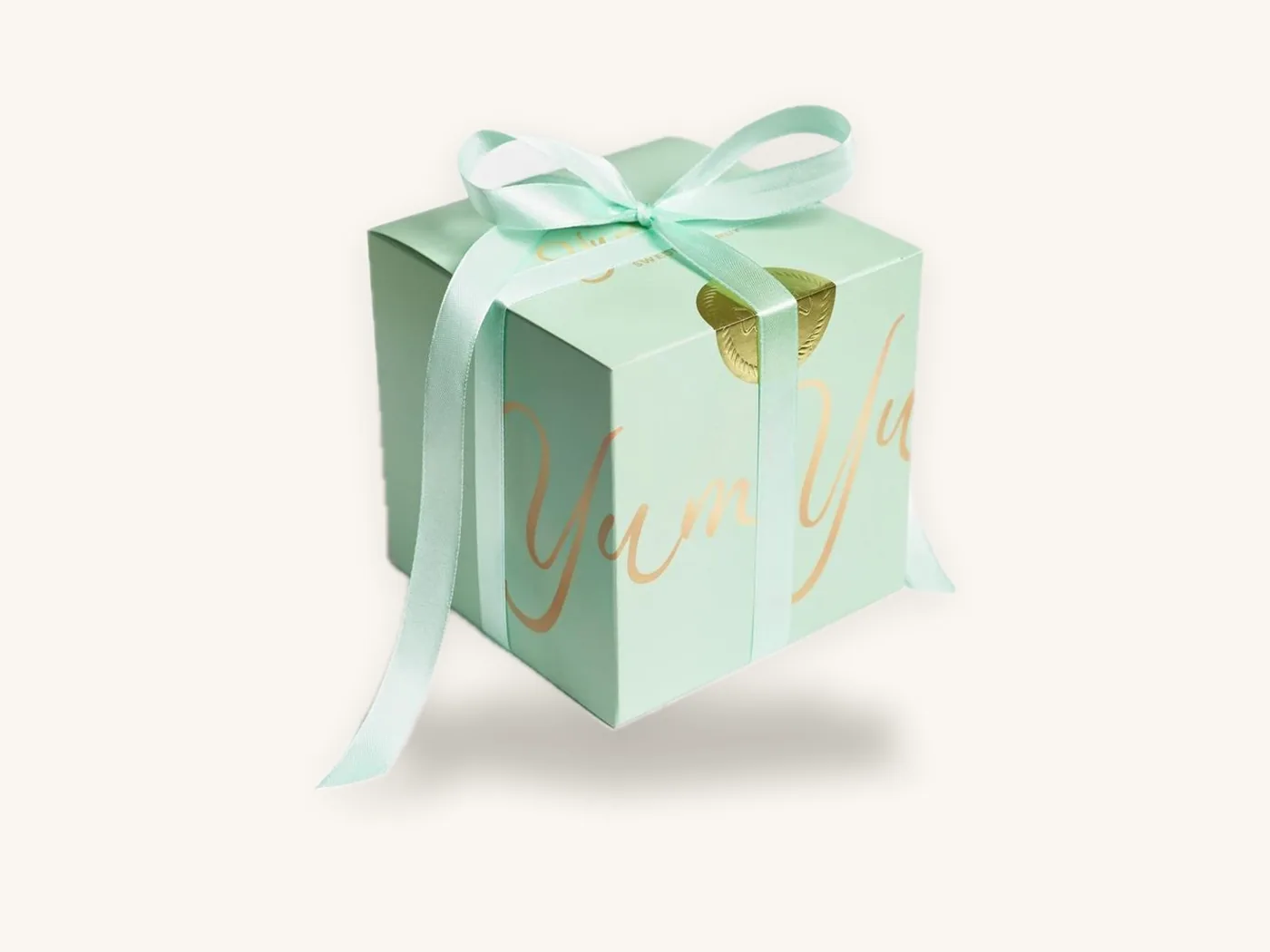
Events are where gable boxes show their personality. A table of matching favor boxes, each with a handle and a name, looks deliberate in a way a pile of bags does not.
Planning event quantities
Order your guest count plus a small buffer for assembly mistakes and late additions. Because the minimum order at Box Sense is 10 boxes and short runs are printed digitally, a small dinner or a large wedding are both practical. Favor boxes and gift boxes cover alternative structures if the gable shape does not suit the item.
Corporate and seasonal gifting
For client gifts, sample kits or holiday treats, a larger gable box in 24 pt board or E-flute with an auto-lock bottom holds a small set of products and doubles as a carry bag at an event. If the gift is shipped rather than handed over, overbox it, or consider a mailer with inside printing instead. The subscription boxes guide compares kit formats, and the luxury packaging guide covers higher-end gift structures.
Shipping gable boxes
Gable boxes can ship, but the peaked roof and handle are vulnerable when parcels are stacked. Two approaches work.
- Ship flat, assemble on arrival. For retail stores and event venues, gable boxes arrive flat in cases and are erected on site.
- Overbox filled gable boxes. Place the filled box in a custom mailer box or shipper with enough height for the roof and a little void fill around the handle. The custom mailer boxes guide explains outer box sizing, and the custom shipping boxes guide covers case packs for wholesale.
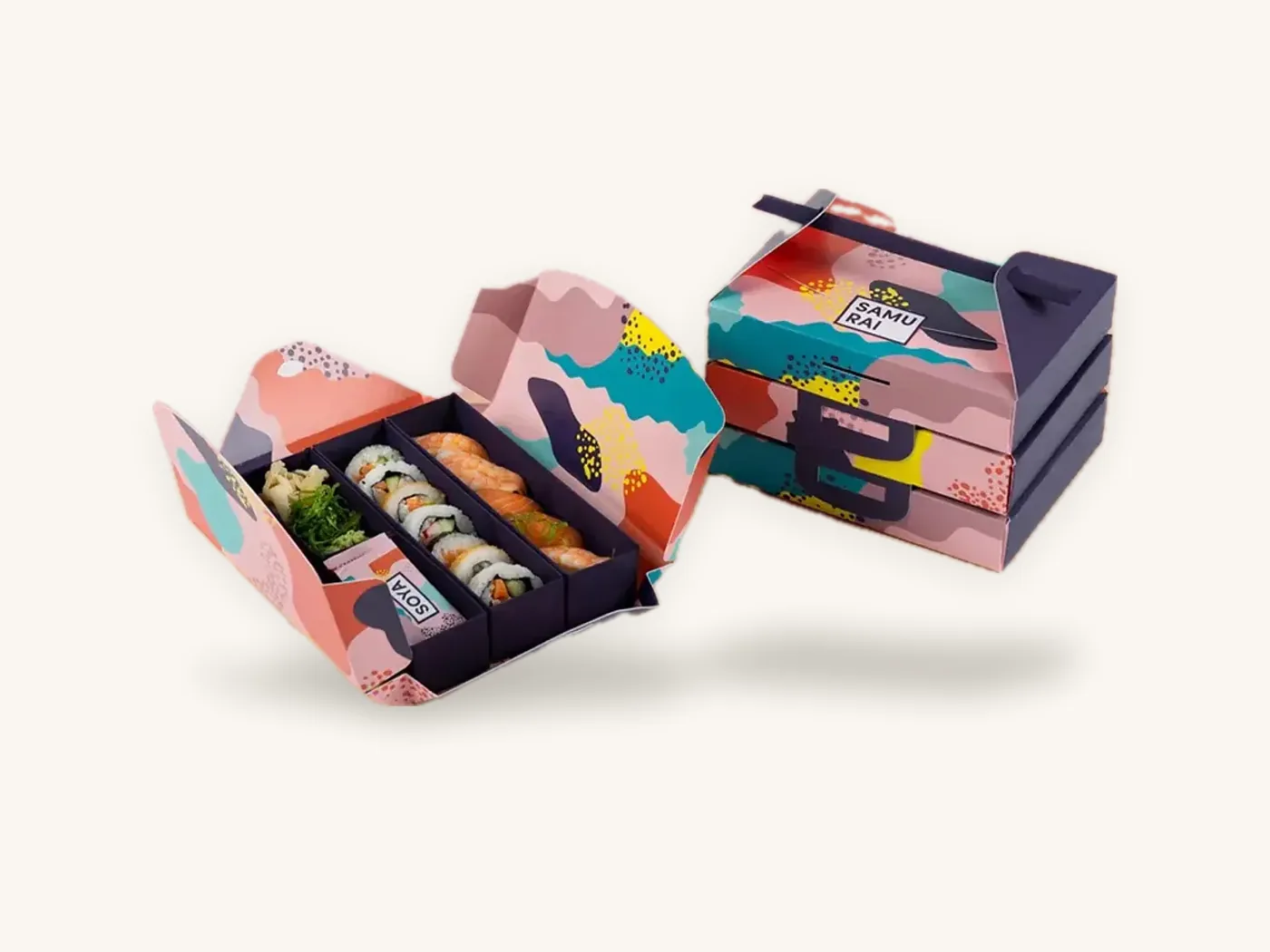
How to order custom gable boxes from Box Sense
Pricing for gable boxes depends on size, board, print coverage, handle reinforcement, windows and quantity, so the fastest route is to send your spec and let us price it. The instant estimator is a good way to see how quantity changes unit cost across paperboard styles before you ask for a quote.
What to send
- Product dimensions and weight as packed, and what the box will carry
- How the box travels: handed over the counter, carried from an event, or shipped
- Board preference: SBS, kraft or E-flute, and whether food contact applies
- Handle type: die-cut, reinforced die-cut or ribbon
- Extras: side window, insert, grease-resistant surface
- Print: one color, full color, inside printing, any finishes
- Quantities to price and your target delivery date
- Artwork, or a request for help from our design services team
What happens next
- We confirm your quote within 24 hours.
- We supply the dieline, set up artwork and send a 3D digital proof, with two revision rounds included.
- Unprinted structural samples are free, so you can load and carry the box with your product. A printed sample of approved artwork is free on orders of 100 or more; see samples.
- Standard production takes 8–12 business days after proof approval. Rush in 5 business days is available on most paperboard and corrugated styles.
- Shipping is free on every US order; international shipping is quoted at cost. The minimum is 10 boxes and there are no die or plate charges.
Watch out: plan event and holiday orders around the proof, not just production. The 8–12 business day production window starts after you approve the proof, so allow time for artwork revisions and a sample check before your date.
Frequently asked questions
What are gable boxes used for?
Gable boxes are used for hand-carried items: bakery goods, sandwiches and snack meals, party and wedding favors, corporate gifts, sample kits and retail gift packs. The built-in handle lets the box double as a small bag. They are less suitable for heavy items, liquids or direct parcel shipping unless they are placed inside an outer box.
How much weight can a gable box with a handle hold?
It depends on board thickness, box size, bottom construction and handle design, so test with your real product. Standard 18 pt paperboard suits light loads like favors and pastries. For heavier gifts or multi-item meals, choose thicker board or E-flute corrugated, an auto-lock bottom and a reinforced or ribbon handle, then carry-test a free structural sample.
Are gable boxes food safe?
They can be. For food that touches the box, choose board, coatings and inks suitable for food contact, and consider grease-resistant surfaces for buttery or fried foods. In the US, the FDA regulates food contact materials, so confirm current requirements for your product. Wrapped items, such as a sandwich in paper, do not contact the box directly.
What size gable box do I need?
Measure the product as packed, add roughly 1/8 in to the base length and width, and set the wall height to at least the product height. Remember the roof slopes toward the handle, so tall items only fit in the center. Common favor boxes start around 3x2x2 in, while sandwich and gift boxes run much larger.
Can gable boxes be printed on kraft paper?
Yes. Kraft gable boxes are popular with bakeries, cafés and handmade brands. One dark color on kraft is economical and looks natural, while full color printed directly on kraft looks more muted. For light colors or fine text, specify opaque white ink underneath so the design stays readable against the brown board.
Can you ship gable boxes?
Gable boxes ship flat to your location and assemble in seconds. Once filled, they should travel inside a mailer or shipping box, because the peaked roof and handle can crush when parcels are stacked. Leave enough height in the outer box for the roof and add a little paper fill around the handle.
What is the minimum order for custom gable boxes?
Box Sense makes custom gable boxes from a minimum of 10 units. Short runs are printed digitally with no plates, so small events, test batches and seasonal designs are practical. Unit prices fall as quantity rises, so compare a few quantity tiers when you request a quote.
Next steps
Measure your product, decide how the box will travel, and use the packaging price estimator to see how quantity affects cost. Then request a quote for custom gable boxes and we will confirm pricing within 24 hours, send a dieline and prepare a free structural sample you can load and carry.
Boxes in this guide
Order the packaging we covered
Written by the Box Sense Packaging Team
Our structural designers, prepress technicians and production staff print and convert custom boxes every day for brands in the United States, United Kingdom and UAE. Questions about this guide? Talk to us.