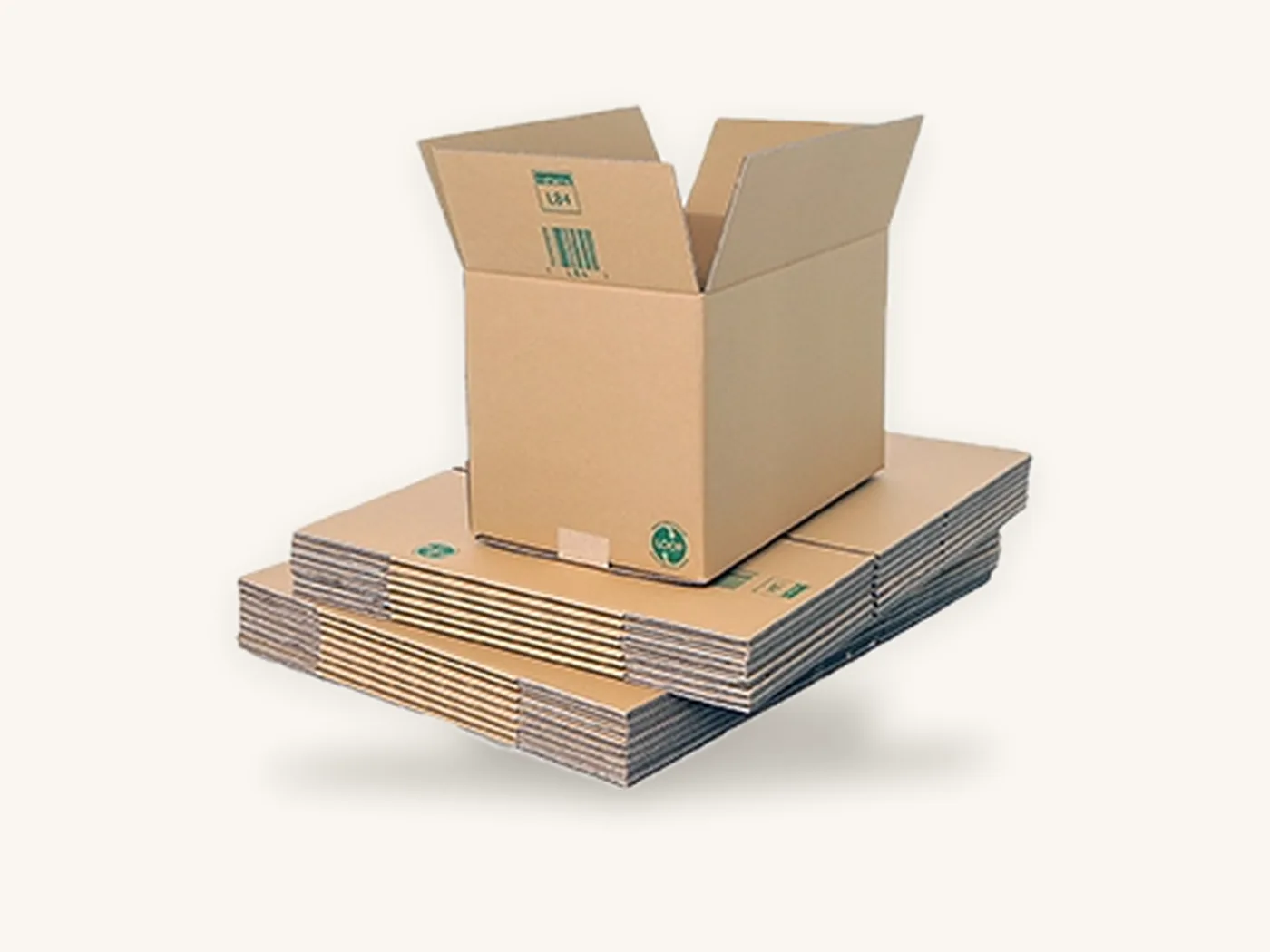
The edge crush test (ECT) measures how much force corrugated board can take on its edge before it buckles, which predicts how well a box resists stacking. The burst test (often called the Mullen test) measures how much pressure it takes to rupture the face of the board, which relates to rough handling, puncture and heavy contents pushing outward. A 32 ECT box and a 200 lb test box are two ways of certifying single wall board, and they are not conversions of each other.
That is why the round stamp on the bottom flap of a shipping box shows either an ECT rating or a bursting test value, not both. If you understand what each number measures, you can pick the right rating for how your boxes actually travel, and you can spot when a supplier's spec does not match what you asked for.
Key takeaways
- ECT is stated in pounds per inch of edge (lb/in) and predicts stacking and compression strength. It is the dominant rating for modern parcel and pallet shipping in the US.
- Burst strength is stated in pounds per square inch (psi), usually shown as "lb test", and reflects resistance to rupture, plus a minimum weight of liner paper.
- Common single wall pairings are 32 ECT or 200 lb test and 44 ECT or 275 lb test; common double wall pairings are 48 ECT or 275 lb test and 61 ECT or 400 lb test.
- ECT feeds into formulas that estimate box compression strength (BCT), but real stacking performance also depends on humidity, time, box size and how the pallet is built.
- Specify the rating your retailer, 3PL or carrier requires, then confirm the stamp on your production boxes matches it.
- Box Sense produces corrugated shipping boxes from 10 units in 32 to 48 ECT single and double wall board, with quotes confirmed within 24 hours.
The box maker's certificate: what the stamp tells you
Look at the bottom flap of most corrugated shipping cartons in the US and you will find a circular or rectangular printed stamp. It is usually called the box maker's certificate (BMC). It exists because carrier classification rules have long set minimum construction standards for fiberboard boxes, and the certificate is how a box maker declares that a box meets one of them.
You will often hear these rules referred to by their old names, such as the rail freight rule and the motor freight item that described corrugated box construction. Today, parcel carriers and freight carriers each publish their own packaging guidelines, and many no longer require a certificate at all for small parcels. The stamp remains the industry's shorthand for board strength, and many retailers, 3PLs and marketplaces still ask for a specific grade. Always check the current requirements of your carrier or customer rather than relying on older rules.
What appears on a certificate
A typical stamp includes:
- The box maker's name and location. Responsibility for the claim sits with them.
- The test type and value. Either "Edge Crush Test" with a value in lb/in, or "Bursting Test" with a value in lb per square inch.
- Board construction. Single wall, double wall or triple wall.
- A gross weight limit. The maximum weight of box plus contents the grade is meant for.
- A size limit. The maximum sum of outside length, width and depth.
- For burst-rated boxes, a minimum combined weight of facings. The liners together must weigh at least a stated amount per thousand square feet.
Those weight and size limits are general classification guidelines, not a guarantee that your specific product will arrive intact. A box rated for a certain gross weight can still fail with a dense, sharp product that concentrates load on one spot.
How the edge crush test works
The edge crush test takes a small rectangular sample of combined board, typically 2 in by 1.25 in, cut so the flutes run vertically. The sample stands on its edge between two platens that move together at a controlled rate until the board buckles. The peak force is divided by the length of the edge to give a value in pounds per inch.
In the US, the test is defined by TAPPI standards, including a clamp method and a neckdown method that shapes the sample so it fails in the middle rather than at the edges. Internationally, ISO 3037 describes edgewise crush testing, and results are usually reported in kilonewtons per meter.
What drives an ECT value
ECT rises with the compressive strength of the liners and the medium, and with how well the flutes are formed and glued. Because the test loads the board the way a stacked box wall is loaded, it tracks stacking performance closely. That is why ECT became the preferred rating for boxes that spend their lives on pallets, conveyors and warehouse racks.
Higher-performance recycled and virgin papers can reach a given ECT with less total fiber than older grades needed. That was one of the main reasons the industry moved toward ECT ratings: they reward paper that performs, not paper that is merely heavy.
How the burst (Mullen) test works
The burst test clamps a piece of board over a circular opening and inflates a rubber diaphragm underneath it until the board ruptures. The pressure at the moment of failure is the bursting strength, reported in pounds per square inch. In the US it is defined by a TAPPI method; internationally, ISO 2759 covers board bursting strength, with results in kilopascals.
Burst testing reflects the tensile strength and stretch of the liners more than the flute structure. It is a good proxy for how board holds up when contents press outward, when a corner is driven into a conveyor, or when a box is thrown, dragged or overloaded.
Why burst-rated boxes also specify paper weight
A burst certificate traditionally pairs the psi value with a minimum combined weight of the facings. That makes a burst-rated box heavier in fiber by definition. It can be the right choice for rough handling and puncture risk, but it can also mean paying for paper you do not need if your main risk is stacking.
ECT vs burst strength side by side
| Edge crush test (ECT) | Burst (Mullen) test | |
|---|---|---|
| What it measures | Force to crush board standing on its edge | Pressure to rupture the board face |
| Unit on a US certificate | lb per inch (lb/in) | lb per square inch, shown as "lb test" |
| Metric unit | kN/m | kPa |
| Predicts best | Stacking, compression, pallet storage | Puncture, rough handling, outward pressure |
| Paper weight requirement | No minimum weight stated | Minimum combined facing weight stated |
| Typical board efficiency | Often lighter for the same stacking strength | Heavier, more fiber per square foot |
| Common today for | Parcel and palletized shipping, e-commerce | Heavy or irregular loads, export, rough handling |
Common ECT ratings and burst equivalents
These pairings are the grades most frequently printed on certificates. They are alternatives that a box maker can certify against, not mathematical conversions; a 32 ECT board does not necessarily burst at 200 psi.
| Construction | ECT rating | Commonly paired burst grade | Typical role |
|---|---|---|---|
| Single wall | 32 ECT | 200 lb test | The everyday parcel and shipping carton |
| Single wall | 40 ECT | 250 lb test | Heavier parcels, moderate stacking |
| Single wall | 44 ECT | 275 lb test | Dense products, case packs, higher stacks |
| Single wall | 55 ECT | 350 lb test | Heavy single wall applications |
| Double wall | 42 ECT | 200 lb test | Entry double wall |
| Double wall | 48 ECT | 275 lb test | Common heavy duty shipper |
| Double wall | 51 ECT | 350 lb test | Heavy loads, higher stacks |
| Double wall | 61 ECT | 400 lb test | Very heavy or long-term storage loads |
Notice that double wall board carries a higher ECT at the same burst grade. Two flutes and three liners stack far better than one flute, even when the liner paper is similar. Our guide to corrugated flutes explains how B, C and BC constructions differ.
An ECT rating to start from
For most brand buyers, the useful short list is:
- 32 ECT single wall for everyday parcels and light to moderate products
- 44 ECT single wall for dense products or cartons that stack several high
- 48 ECT double wall for heavy, fragile or long-storage loads
We run 32 to 48 ECT board for custom shipping boxes, which covers the large majority of e-commerce and wholesale needs.
From ECT to stacking strength: box compression
ECT describes a strip of board. What you actually care about is the box, which is tested as box compression strength (BCT): an empty box squeezed between two platens until it buckles. BCT depends on ECT, but also on board thickness and box size.
The McKee estimate
A widely used engineering approximation, known as the McKee formula, estimates BCT for a regular slotted container:
BCT ≈ 5.87 × ECT × √(board caliper × box perimeter)
with BCT in pounds, ECT in lb/in, caliper in inches and perimeter as 2 × (length + width) in inches. It is an estimate for standard RSCs in lab conditions, not a guarantee, but it shows which levers matter.
A worked example
Take a 12 x 10 x 6 in RSC in single wall B-flute, with a caliper of roughly 0.125 in. The perimeter is 44 in.
- At 32 ECT: 5.87 × 32 × √(0.125 × 44) ≈ 5.87 × 32 × 2.35, or roughly 440 lb of lab compression strength.
- At 44 ECT: the same box estimates roughly 605 lb.
Now take an 18 x 14 x 12 in shipper in BC double wall at 48 ECT, with a caliper of roughly 0.27 in and a perimeter of 64 in. The estimate is roughly 1,170 lb. Thicker board and a longer perimeter both raise BCT, which is why double wall gains so much.
What the formula tells you
- Raising ECT raises BCT in direct proportion.
- Doubling caliper raises BCT by only about 40 percent, because caliper sits under a square root.
- Larger boxes with longer perimeters carry more total load, though each unit of wall area is not stronger.
- Box height barely appears in the formula for typical sizes, but very tall, narrow boxes buckle earlier in practice.
Watch out: a lab BCT figure is measured on an empty, dry box for a few seconds. A carton sitting at the bottom of a pallet for a month in a humid warehouse can carry far less. Never stack to the lab number.
Why real boxes carry less than the lab number
Paper is a natural fiber that responds to moisture, time and how load is applied. Packaging engineers usually apply a combined safety factor, often somewhere around 3 to 5 for warehouse stacking, to account for the conditions below. The right factor depends on your supply chain, so treat that as a starting range rather than a rule.
| Condition | What happens to strength | What to do |
|---|---|---|
| High humidity or cold storage | Fibers absorb moisture and soften; compression strength drops substantially at very high humidity | Step up a grade, consider moisture-resistant coatings, avoid condensation |
| Long storage under load | Board slowly creeps and loses strength over days and weeks | Stack lower, use higher ECT for long dwell times |
| Pallet overhang | Box walls hang past the pallet edge and lose support | Keep cartons fully on the pallet deck |
| Interlocked stacking | Walls no longer align with walls below | Column stack when strength matters |
| Hand holes and vents | Cutouts remove load-bearing wall | Place away from corners, upgrade board |
| Rough handling | Crushed corners and edges reduce stacking capacity | Consider burst-rated or double wall board |
| Heavy print coverage and flood coats | Generally minor, but wet processes can soften board | Use suitable coatings and allow drying |
Most of the stacking strength sits near the corners, where the box walls meet. A crushed corner, a hand hole close to an edge, or a pallet that lets cartons hang over the side can cut real-world performance well below the calculation.
Which rating should you specify?
Specify ECT when stacking and compression are the main risks. Specify burst when rupture and rough handling dominate. Here is how that plays out.
| Your situation | Rating to lead with | Suggested starting grade |
|---|---|---|
| Single parcel through carrier networks, under roughly 20 lb | ECT | 32 ECT single wall |
| Dense or heavy parcel, hard corners | ECT, check puncture | 44 ECT single wall |
| Case packs on pallets in a distribution center | ECT | 44 ECT single wall or 48 ECT double wall |
| Long-term storage, cold rooms or humid climates | ECT, with safety margin | Double wall 48 ECT or higher |
| Heavy, irregular or sharp-edged industrial parts | Burst | 275 lb test or higher, often double wall |
| Export shipments with many handoffs | Both, or burst for rough handling | Double wall, confirm with testing |
| A customer, retailer or marketplace names a grade | Whatever they require | Match it exactly on the certificate |
For heavy duty double wall boxes carrying parts, tools or glassware, a burst-rated grade can make sense because puncture and rough handling cause more failures than stacking. For e-commerce cartons and Amazon FBA boxes, ECT is usually the more efficient choice. Amazon and other marketplaces publish their own carton requirements, so check their current seller guidance; our guide to Amazon FBA packaging requirements is a good starting point.

Metric ratings for UK and UAE buyers
Outside the US, board is often described differently. UK and European specifications commonly list the liner and medium papers by grams per square meter and type (for example, a kraft or test liner), plus the flute, and quote ECT in kN/m and burst in kPa.
| US rating | Approximate metric equivalent |
|---|---|
| 32 ECT | about 5.6 kN/m |
| 44 ECT | about 7.7 kN/m |
| 48 ECT | about 8.4 kN/m |
| 61 ECT | about 10.7 kN/m |
| 200 lb test (psi) | about 1,380 kPa |
| 275 lb test (psi) | about 1,900 kPa |
These use the standard unit conversions (1 lb/in is about 0.175 kN/m, 1 psi is about 6.9 kPa). Test methods differ slightly between standards bodies, so a value tested under one method may not match a value tested under another. If you ship the same box into the US, UK and UAE, agree on one test method and unit with your supplier.
How to check a supplier's board spec
Use this checklist when you receive a quote, a sample or a first production run.
- Confirm the test type. Does the quote say ECT or burst? If you asked for one and received the other, ask why.
- Confirm the value and construction. 44 ECT single wall is not the same as 44 ECT double wall in thickness or cost.
- Check the flute. The grade and the flute should make sense together; the flute guide lists typical calipers.
- Read the stamp on the sample. Printed boxes sometimes omit the certificate for design reasons, so ask for written confirmation of the grade if the stamp is missing.
- Measure the caliper. A crushed or thin board can indicate damage in converting, which lowers stacking strength.
- Pack, stack and drop. Load a few boxes with real product, stack them for several days, then drop-test corners, edges and faces. The ISTA drop testing guide explains standardized procedures.
- Record the spec. Put the agreed flute, grade, liner and test method on every reorder so the board does not quietly change.
Tip: if you are printing a heavy flood color or printing inside the box, tell your supplier the required grade up front. Print processes and coatings are chosen with the board, and it is easier to design around a grade than to retrofit one.
Ordering tested shipping boxes from Box Sense
We make corrugated shippers, mailers and corrugated boxes in E, B, C and BC board, with single wall and double wall grades from 32 to 48 ECT. Tell us how the box travels and we will recommend a construction.
What to include in your request
- Internal dimensions and packed weight
- How the box travels: parcel, pallet, export, cold storage
- Any grade your retailer, 3PL or marketplace requires, in writing
- Stacking height and expected storage time, if cartons will be palletized
- Print: one color, full color, and whether you need the certificate stamp printed
- Quantities to price
Indicative pricing
These per-unit figures include free US shipping and show how board and size move cost. Your exact spec is in the price estimator.
| Spec | 250 | 1,000 | 10,000 |
|---|---|---|---|
| Shipping box RSC, B-flute, 16x12x8 in, 1-color | about $5.31 | about $3.32 | about $2.13 |
| Double wall shipper, BC flute, 18x14x12 in, 1-color | about $12.78 | about $7.98 | about $5.11 |
Proofing, samples and timeline
Quotes are confirmed within 24 hours, and design support is free, including dieline, artwork setup, 3D proof and two revision rounds. Unprinted structural samples are free, so you can stack and drop-test before committing, and a printed sample of approved artwork is free on orders of 100 or more; the samples page has details. Standard production is 8–12 business days after proof approval, and rush production in 5 business days is available on most corrugated styles. The minimum order is 10 boxes, shipping within the US is free, and defective boxes reported within 14 days are reprinted free. For industrial loads, the automotive and industrial packaging page shows typical constructions.
Frequently asked questions
What does 32 ECT mean on a box?
32 ECT means a strip of the box's corrugated board withstood about 32 pounds of force per inch of edge before crushing in the edge crush test. It is the most common rating for single wall shipping boxes and indicates how well the walls resist stacking loads. It suits everyday parcels and light to moderate products, especially when the box fits the contents closely.
Is ECT or burst strength better?
Neither is better in general; they measure different things. ECT predicts stacking and compression strength, which matters most for parcels and palletized cartons, and it often achieves that with less fiber. Burst strength reflects resistance to rupture and rough handling, which matters for heavy, sharp or irregular loads. Choose the rating that matches your main risk, or the one your customer requires.
Is 44 ECT the same as 275 lb test?
No. They are commonly paired as alternative certifications for heavier single wall board, but they come from different tests. A 44 ECT board is certified for edge crush performance, while a 275 lb test board is certified for bursting strength plus a minimum liner weight. A board that meets one does not automatically meet the other, so specify the test you need.
What is the bursting strength of a box?
Bursting strength is the pressure needed to rupture the face of corrugated board, measured with a Mullen tester that inflates a diaphragm under a clamped sample. In the US it is reported in pounds per square inch and shown on the certificate as "lb test", such as 200 lb test. Internationally it is reported in kilopascals. It indicates resistance to puncture and rough handling.
Do I need a box maker's certificate on my shipping boxes?
Many small parcel shipments no longer require one, but some freight shipments, retailers, 3PLs and marketplaces still ask for a specific grade or certificate. Carrier and customer requirements change, so check the current packaging guidelines from your carrier and any retailer or fulfillment partner. If you need the stamp printed on a custom printed box, include that in your quote request.
How much weight can a 32 ECT box hold?
It depends on box size, board caliper, how the load is distributed and storage conditions, so there is no single figure. A certificate states a general gross weight guideline for the grade, and formulas such as McKee estimate lab compression strength. Real stacking capacity is usually much lower than the lab value after humidity and time, so pack, stack and test with your product.
Does humidity affect the edge crush test rating?
The ECT rating is measured on conditioned samples in a controlled lab environment, so the printed value does not change. The board itself does: corrugated absorbs moisture in humid warehouses, cold rooms and trailers, and it loses compression strength as it does. If boxes will spend time in damp or refrigerated conditions, choose a higher grade or double wall and allow a generous safety margin.
Next steps
Write down how your boxes travel, how heavy they are and whether anyone downstream requires a grade. Then compare single and double wall options in the shipping box price estimator, or send your spec for a quote and we will recommend an ECT or burst grade and confirm pricing within 24 hours.
Boxes in this guide
Order the packaging we covered

Written by the Box Sense Packaging Team
Our structural designers, prepress technicians and production staff print and convert custom boxes every day for brands in the United States, United Kingdom and UAE. Questions about this guide? Talk to us.