Amazon FBA packaging requirements cover three layers: how each sellable unit is prepped and labeled, how those units are packed into shipping cartons, and how the cartons are labeled and described so the fulfillment center can receive them without manual work. Get all three right and inventory is checked in quickly. Get one wrong and Amazon may refuse the shipment, charge for unplanned prep, or hold units in an unfulfillable state.
Amazon publishes and updates these rules in Seller Central, and details such as weight limits, label formats and which products need which prep can change with little notice. This guide explains each requirement category, why it exists, and how to design packaging that makes compliance routine. Use it to plan your packaging, then confirm every current specification in Seller Central before you ship.
Key takeaways
- Think in three layers: the unit (product packaging and prep), the carton (the shipping box) and the shipment (labels, box content data, pallets).
- Each unit needs one scannable barcode, usually an Amazon FNSKU label or an eligible manufacturer barcode, with every other barcode covered.
- Poly bags generally need a visible suffocation warning above a certain opening size and a minimum film thickness; confirm current values in Seller Central.
- Shipping cartons must be sturdy, six-sided and within Amazon's weight and dimension limits, with lift labels on heavier boxes.
- Box content information must be supplied for every carton, and each carton needs its own shipment label on a flat, unfolded surface.
- Amazon has reduced the prep work it performs for sellers in the US, so plan to arrive fully prepped rather than relying on fulfillment center services.
How FBA receiving works, and why packaging rules exist
Every rule in Amazon's prep guidelines traces back to one goal: a receiving associate or an automated line should be able to open a carton, scan each unit once, and send it to storage without judgment calls.
That explains the patterns you see across the requirements. One barcode per unit, because two barcodes create a choice. Sets clearly marked, because a scanner cannot tell that three loose bottles are one listing. Poly bags sealed and labeled, because loose items fall apart on conveyors. Carton labels on flat faces, because labels wrapped over an edge do not scan.
What happens when requirements are missed
Non-compliant inventory can be refused at the dock, prepped or relabeled by Amazon for a fee where that service is still offered, placed into an unfulfillable status, or flagged for problems that affect future inbound shipments. Your Seller Central account shows the current fees and consequences. The practical lesson is that packaging design decisions made months earlier often cause these problems.

Unit-level requirements: the product package
The unit is whatever the customer receives as one listing. Its packaging must protect the product through storage and picking, and it must identify itself unambiguously.
Barcodes and FNSKU labels
Amazon tracks units with either a manufacturer barcode (such as a UPC on eligible products) or an Amazon-specific FNSKU label. Either way, only one scannable barcode should be exposed on the unit. If your product box has a printed UPC and you use FNSKU labels, the UPC typically needs to be covered.
Labels must be placed on a flat surface, not wrapped around corners or curves, and must scan cleanly. Thermal-printed labels on a matte surface are the usual choice. The UPC barcodes on packaging guide covers barcode size, quiet zones and contrast, which apply equally to FNSKU labels.
Common prep categories
Amazon's prep guidance groups products by what can go wrong with them. The table summarizes the typical categories and the packaging response. Specific thresholds, materials and which products fall into each group are set in Seller Central.
| Prep category | What Amazon is guarding against | Typical packaging response |
|---|---|---|
| Fragile or glass | Breakage in bins and totes | Sturdy product box, inserts or cushioning; drop-tested unit |
| Liquids | Leaks onto other inventory | Sealed caps, secondary seal or bag for some containers |
| Powders, pellets, granular | Spills from loose closures | Sealed container, bag or box that contains any leak |
| Sharp items | Injury to associates and customers | Fully enclosed edges and points |
| Small items | Loss and damage in handling | Bagging or a box above a minimum practical size |
| Sets sold as one unit | Separation into single items | Bagged, shrink-wrapped or boxed together, with a "sold as set" style notice |
| Textiles and apparel | Dust, dirt and snagging | Bagged in a clear poly bag with a warning where required |
| Expiration-dated products | Selling expired goods | Expiration date printed clearly on unit and carton in Amazon's required format |
| Adult products | Exposure of graphic packaging | Opaque bag or plain outer covering |
Poly bag requirements
Poly bags are one of the most common prep failures. Amazon's requirements typically include:
- A suffocation warning printed on the bag or applied as a label when the opening exceeds a set size, in a legible type size and placed prominently.
- A minimum film thickness so the bag does not tear in handling.
- A transparent bag so the barcode can be scanned through it, or a barcode label applied on the outside.
- A sealed opening so the product cannot slide out.
- No excess bag that hangs loose or catches on equipment.
Confirm the current opening size, thickness and warning wording in Seller Central before you order bags.
Sets, bundles and multipacks
If three items are sold as one listing, they must stay together and scan as one. A printed multipack carton is the cleanest solution because it carries one barcode and cannot come apart. Bagging or shrink-wrapping works, but make sure individual item barcodes inside are covered so the scanner does not pick up a single unit.
Watch out: retail product boxes often carry a UPC on the back and a second code, such as a QR code or a component barcode, elsewhere. Amazon's scanners do not know which one you meant. Plan one barcode position on the box, and keep any other codes non-scannable in format or placement, or covered by the FNSKU label.
Category-specific labeling
Some products carry regulatory labeling that has nothing to do with Amazon but is checked more often on Amazon: supplement facts, cosmetic ingredient lists and food labels. Amazon may request documentation or remove listings where labels look incomplete. The supplement label requirements guide and cosmetic labeling requirements guide explain those rules for product boxes.
Carton-level requirements: the shipping box
Once units are prepped, they travel to the fulfillment center in shipping cartons. These FBA box requirements are about safe handling, efficient receiving and consistent data.
Box construction
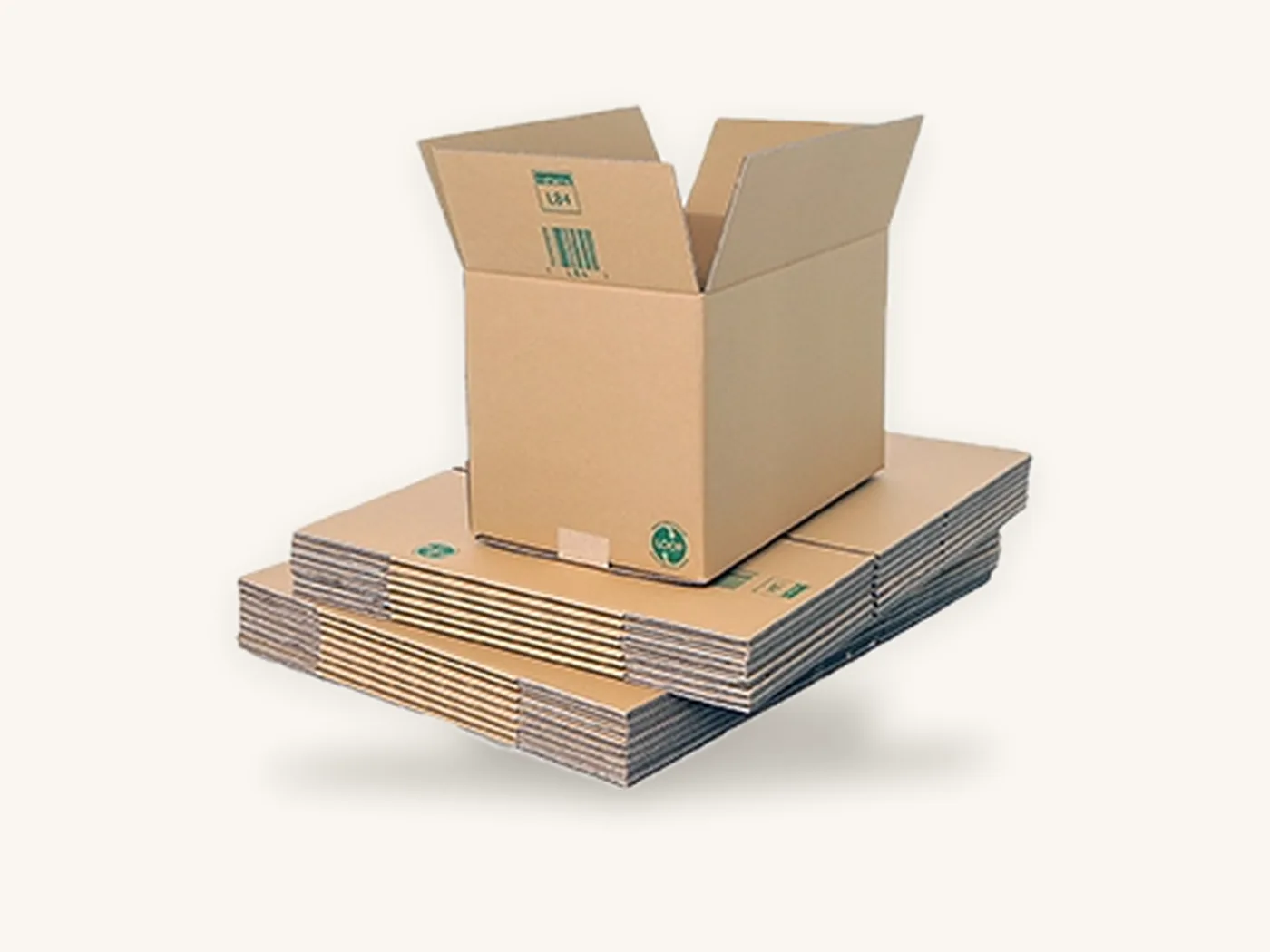
Amazon generally expects a rigid, six-sided corrugated box with flaps intact, in good condition, and closed with appropriate tape. Reused boxes are often allowed if old labels and markings are fully removed or covered, but damaged or weak boxes are a common reason for problems at receiving.
Common prohibited or discouraged closures include strapping and banding, excessive tape, and staples. Loose fill materials that create a mess, such as some foam peanuts and shredded paper, are often restricted. Use air pillows, kraft paper, bubble wrap or box inserts and dividers to fill gaps.
Weight and dimension limits
Amazon sets a maximum weight for standard cartons and a maximum length for any side of a box containing multiple standard-size units. For many years these limits have been in the range of 50 lb per box and 25 in per side, with exceptions for single oversize items and additional labeling above certain weights. Treat those figures as a planning reference only and confirm the current limits for your marketplace and shipment type in Seller Central.
| Carton factor | Why it matters | Planning approach |
|---|---|---|
| Gross weight | Associate safety and conveyor limits | Size cartons so a full box stays comfortably under the current limit; add lift labels where required |
| Longest side | Conveyor and storage equipment | Keep multi-unit cartons within the current side-length limit; split into more boxes if needed |
| Board strength | Stacking in trucks and on pallets | Choose single-wall or double-wall based on weight and stacking, not appearance |
| Units per box | Receiving speed and box content accuracy | Keep one SKU per box where possible, in consistent case packs |
| Void space | Crushing and shifting | Right-size cartons and fill gaps with approved dunnage |
Choosing board grade
Single-wall B-flute or C-flute corrugated suits most FBA cartons in the lower and middle weight range. Double-wall board makes sense for heavy case packs, dense products like liquids or supplements in glass, and any carton that will sit at the bottom of a pallet. The ECT vs burst strength guide explains how to read board ratings, and our corrugated board page lists the grades we run.
Case-packed versus mixed cartons
A case-packed carton holds identical units in a fixed quantity. A mixed carton holds several SKUs. Case packs receive faster and reduce box content errors, so design your master carton around a sensible case pack for each SKU. If you sell in multiple sizes, a small set of standard carton sizes that fit common case packs saves money and storage space.
Shipment-level requirements: labels, box content and pallets
The final layer ties each carton to your shipment plan.
Shipment and box ID labels
Each carton needs its own shipment label generated for that shipment, placed on a flat surface on the side of the box, not on a seam or across a corner where it could be cut when the box is opened. If you reuse boxes, cover or remove every old shipping label and barcode. Carrier labels go alongside the Amazon label without covering it.
Box content information
Amazon needs to know which units are in each carton. You typically provide this in the shipment workflow, through a supported 2D barcode or file upload, or pay for manual processing where that option exists. Accurate box content data is one of the most effective ways to reduce receiving discrepancies, which is another reason to keep SKUs separated by carton.
Palletized shipments
Less-than-truckload and full truckload shipments add pallet requirements: pallet type and condition, maximum pallet height and weight, stacking and stretch-wrap rules, and pallet labels on specified sides. Carton strength matters more here, because the bottom layer supports the whole load. Confirm current pallet specifications before booking freight.
Ships in Own Container and ISTA-6 testing
Some products can ship to customers in their own packaging without an Amazon overbox. Amazon manages this through packaging programs that often reference ISTA-6-Amazon.com testing, a set of lab test procedures that simulate Amazon's distribution environment for items shipped in their own container (SIOC).
When SIOC is worth pursuing
SIOC makes most sense for larger or heavier products where an overbox adds real cost, and for products already shipped in a sturdy corrugated box. Certification typically involves testing the packaging at an ISTA-certified lab and registering results with Amazon. The packaging must protect the product without extra outer packaging and usually cannot reveal what is inside in ways that invite theft.
Designing a SIOC-ready box
A SIOC box is usually a custom shipping box or mailer designed around the product with inserts, rather than a retail carton with graphics. Keep graphics simple, avoid loose parts, and ensure the box can survive drops and compression on its own. The Amazon seller packaging guide covers Frustration-Free Packaging and fee-based sizing in more depth.
Tip: before investing in lab testing, run your own rough checks on a structural sample: pack it, drop it on each face and corner from waist height, and stack a few filled boxes on top overnight. If it fails a basic home test, it will fail the formal one, and you have saved a lab fee.
An FBA packaging readiness checklist
Use this sequence when designing new packaging for Amazon, and repeat the Seller Central check before every major inbound shipment.
- Check Seller Central. Review current prep, labeling, carton and pallet requirements for your category and marketplace.
- Classify each SKU. Decide which prep categories apply: fragile, liquid, set, textile, expiration-dated, small item.
- Design the unit package. Choose a structure that meets the prep need, with one barcode position on a flat panel.
- Plan warnings and notices. Add suffocation warnings to bags, "sold as set" notices to bundles, and expiration dates in Amazon's required format.
- Decide the barcode strategy. Use the manufacturer barcode where eligible, or plan FNSKU labels and cover other codes.
- Set case packs. Choose units per carton for each SKU so cartons stay within weight and dimension limits.
- Choose carton size and board. Right-size the shipping box and pick single-wall or double-wall board.
- Plan dunnage. Use approved void fill or inserts so units do not shift.
- Test samples. Pack, drop, stack and check the fit before ordering in volume.
- Prepare shipment labels and box content data. Label each carton on a flat side and enter accurate contents.
- Document it. Keep a one-page packing spec per SKU so every shipment is packed the same way.
How to order FBA-ready packaging from Box Sense
Box Sense manufactures retail product boxes, Amazon FBA boxes, shipping cartons and labels in-house, so the unit package and master carton can be designed together. We produce to the specs you approve; checking them against Amazon's current requirements remains your responsibility.
What to send
- Product dimensions and weight, and the prep category that applies
- Unit packaging style, such as a custom product box, mailer or bag
- Barcode plan: printed UPC position, or a clear area for FNSKU labels
- Required notices: suffocation warnings, "sold as set", expiration date areas
- Case pack quantity and master carton dimensions, or a request for us to suggest them
- Board preference for cartons: single-wall or heavy duty double wall boxes
- Quantities for unit boxes, cartons and any custom labels
- Target delivery date and whether cartons ship to you or to a prep center
Timeline and pricing references
We confirm quotes within 24 hours and provide the dieline, artwork setup and a 3D digital proof with two revision rounds. Unprinted structural samples are free, so you can test case packs and fit; a printed sample of approved artwork is free on orders of 100 or more. See samples for details. Standard production is 8–12 business days after proof approval, with rush in 5 business days on most paperboard and corrugated styles, and US shipping is free.
As a reference, a 12x10x6 in B-flute shipping box with 1-color print is about $4.69 each at 100 units and about $2.08 at 1,000. A 16x12x8 in version is roughly $7.47 at 100 and $3.32 at 1,000. A straight tuck end retail carton in 18 pt SBS at 3x2x5 in with full color is about $1.15 at 100. The minimum order is 10 boxes with no die or plate charges; get your exact figure from the packaging price estimator, and see how volume changes cost in the custom box cost guide. Our e-commerce and subscription page shows related formats.
Frequently asked questions
What are the basic Amazon FBA packaging requirements?
Each unit must be prepped for its product type and carry one scannable barcode, typically an FNSKU label or eligible manufacturer barcode. Units go into sturdy six-sided shipping cartons within Amazon's weight and dimension limits. Each carton needs its own shipment label on a flat side, and box content information must be provided. Confirm current details in Seller Central.
What size and weight limits apply to FBA boxes?
Amazon limits the gross weight of standard cartons and the length of any side for boxes with multiple standard-size units, with exceptions for single oversize items. These limits have long been around 50 lb and 25 in, and heavier boxes need lift labels. Limits can differ by marketplace and shipment type, so check Seller Central before designing master cartons.
Do poly bags need a suffocation warning for Amazon?
Generally yes, when the bag opening is above a size Amazon specifies. The warning must be printed on the bag or applied as a label, in legible type and in a prominent position. Amazon also sets minimum film thickness and requires the barcode to scan through the bag or be labeled on the outside. Confirm the current wording and sizes in Seller Central.
Can I use my UPC instead of an FNSKU label?
Some products are eligible to be tracked by manufacturer barcode, which lets you skip FNSKU labels, but eligibility depends on factors Amazon controls, such as brand and commingling settings. If you use FNSKU labels, cover any other scannable barcodes on the unit. Your GTIN should come from GS1 so it matches your brand in Amazon's catalog.
Can I reuse boxes for FBA shipments?
Reused boxes are often acceptable if they are rigid, undamaged, six-sided, and have every old shipping label and barcode removed or fully covered. Weakened boxes are a common cause of damage and receiving problems, especially for heavy case packs. New cartons sized for your case packs usually pay for themselves in fewer issues and easier packing.
What is SIOC and do I need ISTA-6 testing?
SIOC means ships in own container: the product ships to the customer in its own box without an Amazon overbox. Amazon's related packaging programs often reference ISTA-6-Amazon.com test procedures performed at an ISTA-certified lab. You only need testing if you are pursuing those programs, which usually make sense for larger or heavier products that already ship in sturdy corrugated boxes.
Does Amazon still prep inventory for sellers?
Amazon has reduced the prep and labeling services it performs for sellers in the US, and availability varies by marketplace and program. The safest approach is to send inventory fully prepped and labeled, either by doing it in-house, using a third-party prep center, or having packaging printed with the required barcodes and warnings. Check Seller Central for the current policy.
Next steps
Classify each SKU by prep category, set case packs and carton sizes, and mark barcode and warning areas on your dielines. When your specs are ready, compare options in the shipping box price estimator and request a quote for FBA packaging. We confirm pricing within 24 hours and can send free structural samples to test your case packs before production.
Boxes in this guide
Order the packaging we covered
Written by the Box Sense Packaging Team
Our structural designers, prepress technicians and production staff print and convert custom boxes every day for brands in the United States, United Kingdom and UAE. Questions about this guide? Talk to us.