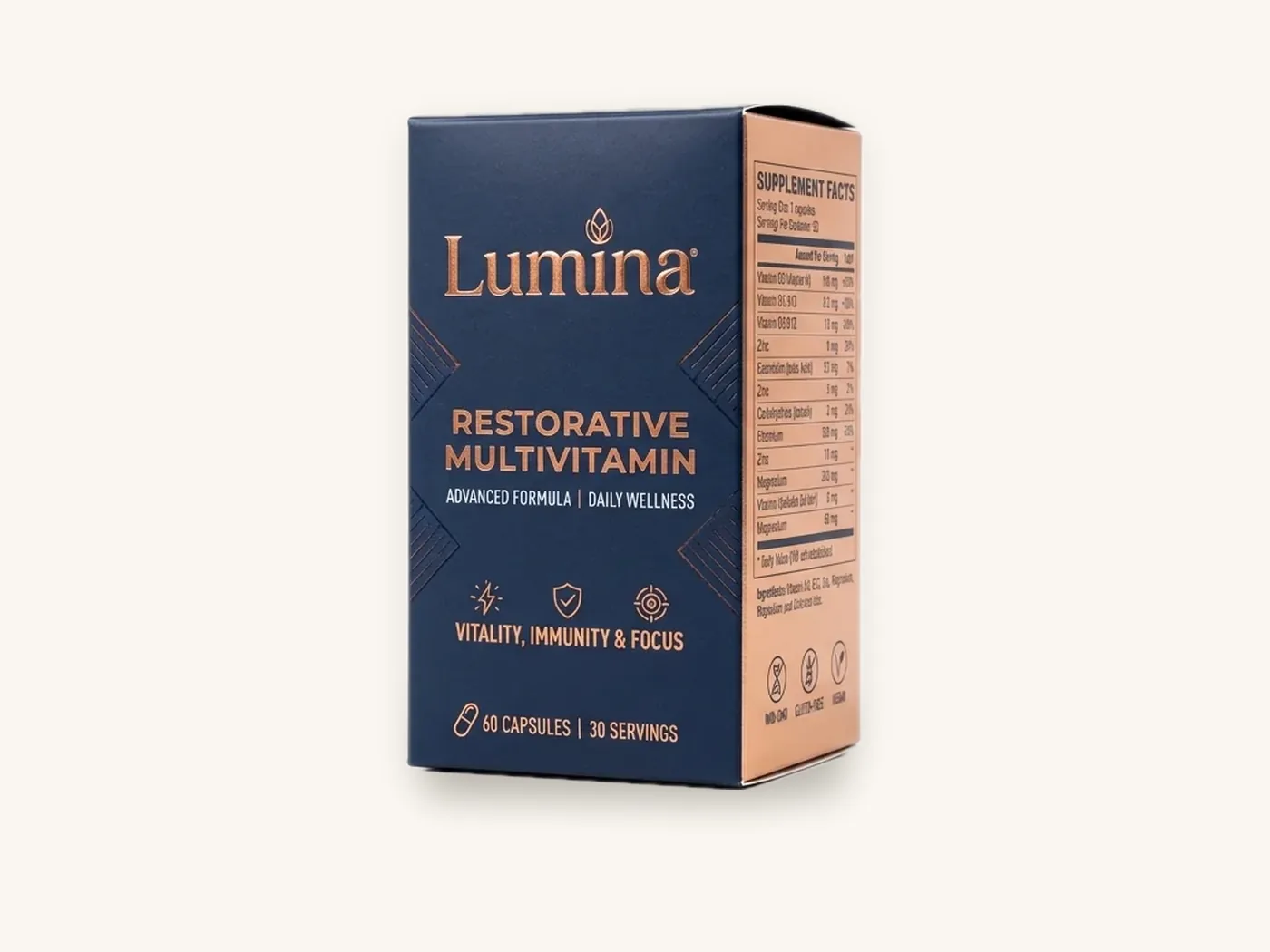
US supplement label requirements come from the Dietary Supplement Health and Education Act of 1994 (DSHEA) and FDA's labeling regulations in 21 CFR Part 101. In short, the front of the package needs a statement of identity and net quantity, and the package also needs a Supplement Facts panel, an ingredient list, the name and place of business of the manufacturer, packer or distributor, a domestic contact for adverse event reports, and, if you make a structure/function claim, the required FDA disclaimer.
The hard part is not knowing the list. It is fitting every element onto a small carton or bottle label so that each one is in the right place, at a legible size, and consistent with the claims on the rest of the box. This guide walks through each requirement in the order a designer lays out a dieline. It is a general explanation, not legal advice, so have a regulatory specialist or counsel review your final artwork.
Key takeaways
- The principal display panel (PDP) carries the statement of identity, which must include the words "dietary supplement" or a descriptive variant, and the net quantity of contents.
- The Supplement Facts panel lists serving size, servings per container, and each dietary ingredient with its amount per serving and percent Daily Value where one exists.
- Ingredients not declared in the panel, such as capsule shells, fillers and flow agents, go in an "Other ingredients" list.
- Structure/function claims are allowed without FDA pre-approval, but they require the DSHEA disclaimer on the label and notification to FDA. Disease claims are not allowed.
- Allergen declarations, iron warnings where applicable and a domestic address or phone number for serious adverse event reports are frequently missed.
- Box Sense prints the artwork you approve. Compliance review of that artwork is the brand's responsibility.
Where supplement label rules come from
Under DSHEA, dietary supplements are regulated as a category of food, not as drugs. That has two big consequences for packaging. First, supplements do not need FDA approval before sale, so no one checks your label before it reaches shelves. Second, the labeling framework borrows heavily from food labeling, with supplement-specific rules layered on top.
The main sources a label reviewer works from are:
- 21 CFR 101.3 for the statement of identity
- 21 CFR 101.105 for net quantity of contents
- 21 CFR 101.36 for the Supplement Facts panel
- 21 CFR 101.4 for ingredient declarations
- 21 CFR 101.5 for name and place of business
- 21 CFR 101.93 for structure/function claims and the disclaimer
FDA's dietary supplements pages link to its labeling guide and guidance documents, and the current regulation text is on the Electronic Code of Federal Regulations.
Food labeling rules still apply
Because supplements are foods, several general food rules carry over: allergen labeling, the requirement that label information be prominent and conspicuous, and the rule that if any required information appears in a foreign language, all required information must appear in that language too. If you also sell conventional foods, our FDA food labeling guide covers the Nutrition Facts side of the line, which is a different panel with different rules.

The principal display panel: identity and net quantity
The principal display panel is the part of the package most likely to be seen by a shopper at purchase. On a tuck end carton, that is normally the front face. On a bottle, it is the portion of the label facing forward on the shelf.
Statement of identity
The statement of identity tells the shopper what the product is. For supplements, it must use the term "dietary supplement", and the word "dietary" can be replaced by a description of the ingredients, such as "vitamin C supplement" or "herbal supplement with ashwagandha". A brand or fanciful name alone, such as "Night Calm", is not a statement of identity.
Place it prominently on the PDP, in bold type, generally parallel to the base of the package, not as small print under a large product name.
Net quantity of contents
Net quantity goes in the bottom 30% of the PDP, parallel to the base. For capsules, tablets and softgels, it is typically a count, such as "60 capsules". For powders and liquids, it is weight or volume, stated in both US customary and metric units.
Minimum type height scales with the area of the PDP. The table below reflects the tiers in 21 CFR 101.105; the height is measured on a lowercase letter such as "o" or on uppercase letters if you use all caps.
| PDP area | Minimum type height for net quantity |
|---|---|
| 5 sq in or less | 1/16 in |
| More than 5 up to 25 sq in | 1/8 in |
| More than 25 up to 100 sq in | 3/16 in |
| More than 100 up to 400 sq in | 1/4 in |
| More than 400 sq in | 1/2 in |
A 2x2x5 in carton has a front panel of about 10 sq in, so the net quantity needs to be at least 1/8 in tall. Measure the PDP from the dieline, not from a scaled-down mockup.
Watch out: "60 capsules" in the bottom 30% of the front panel is compliant placement. The same text printed only on a side panel, or at the top of the front beside the logo, is a common mistake that is expensive to fix after a full print run.
The Supplement Facts panel explained
The supplement facts panel is the most technical part of the label. It can appear on the PDP or on the information panel, which is the panel immediately to the right of the PDP as the shopper faces the package.
What the panel contains
- The title "Supplement Facts", set larger than any other type in the panel.
- Serving size, such as "1 capsule" or "2 scoops (10 g)".
- Servings per container.
- A column heading "Amount Per Serving", with "% Daily Value" where applicable.
- Dietary ingredients that have Daily Values, such as vitamins and minerals, listed in the order and with the names the regulation specifies, each with an amount and a percent Daily Value.
- Dietary ingredients without Daily Values, such as botanicals, amino acids or other compounds, listed below a heavy bar with their amount per serving and a symbol referring to a footnote such as "Daily Value not established".
- Footnotes, including the percent Daily Value footnote where required.
Botanicals, sources and proprietary blends
For botanicals, the panel identifies the part of the plant used, such as root, leaf or seed. When a vitamin comes from a specific source compound, the source can be named in parentheses after the ingredient, such as "Vitamin C (as ascorbic acid)", and it then does not need repeating in the other ingredients list.
A proprietary blend must be identified by name, with the total weight of the blend per serving and its components listed in descending order of predominance by weight. Components without a Daily Value do not need individual amounts, but any ingredient that has a Daily Value still has to be declared with its amount.
Formatting and layout on a carton
The regulation specifies formats, type sizes, rules and alignment, and it allows modified formats such as tabular or linear layouts when the package does not have room for the standard vertical format. Small-package provisions exist too. On a narrow carton, the panel often runs vertically on a side panel, which gives you the full height of the box.
Practical layout rules from the print side:
- Set the panel in a single, highly legible sans serif font and avoid condensed weights.
- Print it in one dark color on a light, uncoated or aqueous-coated background. Avoid placing it over a photo, gradient or metallic foil.
- Keep it at least 1/8 in inside any fold, cut or glue flap.
- Do not run it across a crease; a panel that wraps around a corner is hard to read and can crack at the fold.
- Check small type on the physical proof, because hairline rules and small letters can fill in on textured or kraft stock.
For tolerances on thin rules and reversed type, see our guide to packaging print tolerances.
Ingredient list, allergens and required warnings
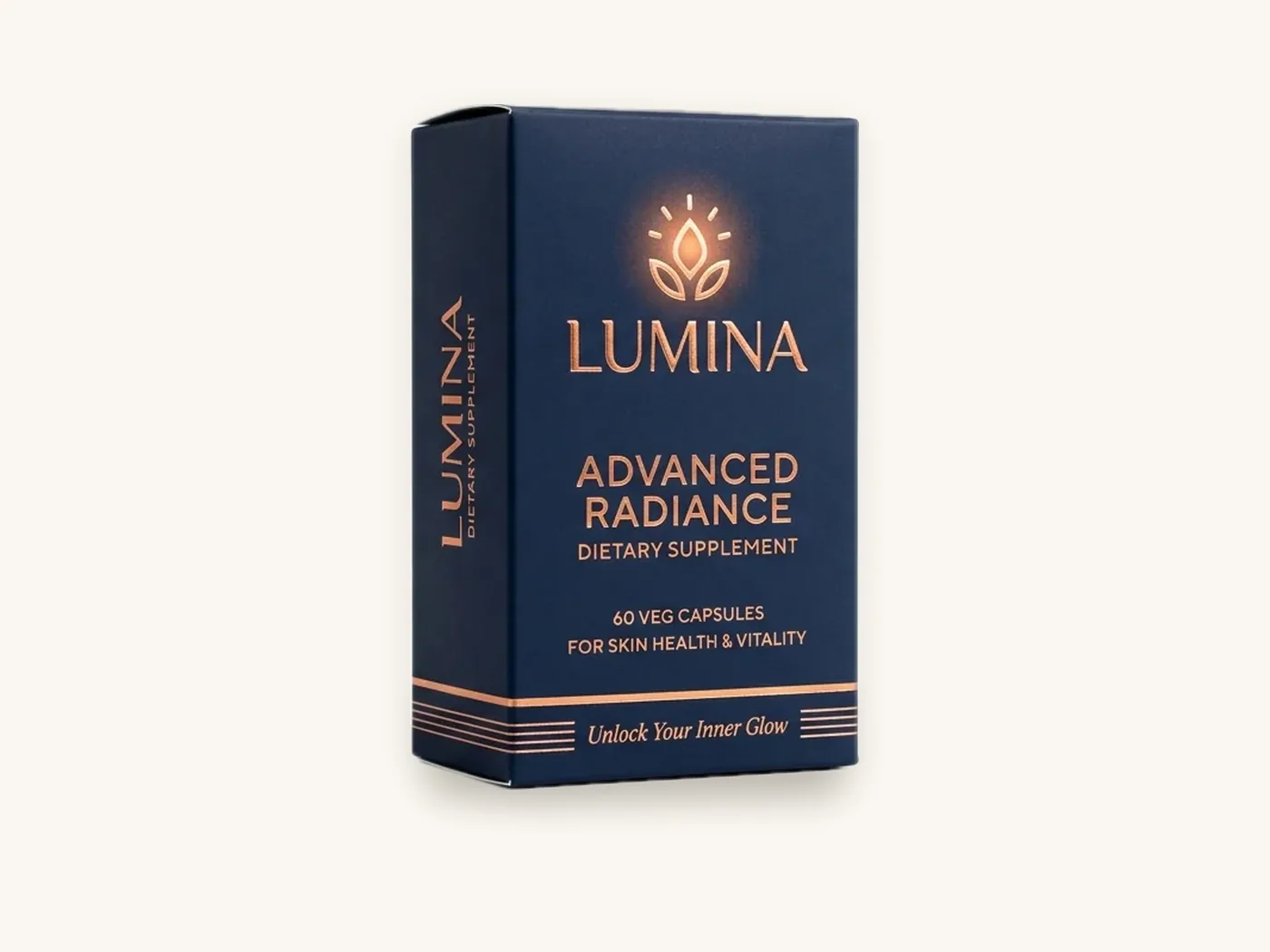
After the Supplement Facts panel, the information panel carries the rest of the mandatory text. This is where most small errors hide.
Other ingredients
Any ingredient not already declared in the Supplement Facts panel, including source ingredients not named in parentheses, goes in a list headed "Other ingredients". Typical entries are gelatin or cellulose capsule shells, rice flour, magnesium stearate, silicon dioxide, flavors, sweeteners and colors. List them in descending order of predominance by weight, using common or usual names. Place the list immediately below the panel or, if it will not fit, elsewhere on the information panel.
Allergen declarations
Supplements must declare major food allergens as defined in federal law, which include milk, eggs, fish, crustacean shellfish, tree nuts, peanuts, wheat, soybeans and sesame. You can do this within the ingredient list, by naming the allergen source in parentheses, or in a separate "Contains:" statement placed right after the ingredients. Fish oils, whey proteins, soy lecithin and softgels made with certain ingredients are frequent triggers.
Precautionary statements such as "made in a facility that also processes" are voluntary and are not a substitute for declaring an allergen that is an ingredient.
Warnings you may need
Some ingredients carry mandatory label warnings. Iron-containing supplements packaged in solid oral dosage forms require a specific accidental overdose warning, and it must be set off in a box or placed in a prominent position. Other warnings may apply to particular ingredients or to specific states. California's Proposition 65, for example, can require a warning when a product exposes consumers to a listed chemical; our Prop 65 packaging guide explains how those warnings work on boxes.
Name, place of business and adverse event contact
Name and place of business
The label must state the name and place of business of the manufacturer, packer or distributor. If the company named did not manufacture the product, the name is qualified with a phrase such as "Manufactured for" or "Distributed by". The address includes city, state and ZIP code; the street address can be omitted only under limited conditions, such as when the business is listed in a current public directory.
Domestic contact for serious adverse events
Federal law requires dietary supplement labels to include a domestic address or domestic telephone number through which the responsible person can receive reports of serious adverse events. A website alone does not meet this requirement. Many brands satisfy it with a US phone number next to a short statement inviting consumers to report problems.
If your products are made abroad, the manufacturer's address on the label does not remove the need for a domestic contact. Where you print the country of manufacture, "Made in" claims must be accurate; see our guide to country of origin and Made in USA labeling.
Claims on supplement packaging and the DSHEA disclaimer
The claims on a supplement box are where marketing and compliance collide. DSHEA labeling allows several types of claims, each with its own rules.
| Claim type | Example of the type | Key requirement |
|---|---|---|
| Structure/function claim | Describes how a nutrient or ingredient supports a normal body structure or function | Truthful, substantiated, FDA disclaimer on label, notice to FDA |
| General well-being claim | Describes general well-being from consuming the ingredient | Same disclaimer and notification rules as structure/function |
| Nutrient deficiency claim | Describes a benefit related to a classical nutrient deficiency disease | Must also disclose how widespread the disease is in the US; disclaimer applies |
| Nutrient content claim | "High in", "good source of", "low in" and similar terms | Must meet FDA definitions for the term |
| Health claim | Links a substance to reduced risk of a disease | Only authorized or qualified health claims with specific wording |
| Disease claim | Claims to diagnose, treat, cure, mitigate or prevent a disease | Not permitted for supplements; makes the product an unapproved drug |
The required disclaimer
Any structure/function, general well-being or nutrient deficiency claim on the label must be accompanied by this statement:
"This statement has not been evaluated by the Food and Drug Administration. This product is not intended to diagnose, treat, cure, or prevent any disease."
Use "These statements" when there are several claims. The disclaimer is printed in boldface type and must appear on each panel where a claim appears. If it is not placed next to the claim, the claim is marked with a symbol such as an asterisk that links to the disclaimer on the same panel. 21 CFR 101.93 sets out the type size and placement details.
The manufacturer, packer or distributor must also notify FDA of the claim no later than 30 days after first marketing the product with it.
Implied disease claims
Disease claims do not have to name a disease. Images of an organ with a medical symbol, product names that echo a condition, citations to studies on treating a disease, and testimonials about recovery can all imply one. Review the whole package, including icons, badges and the inside of the carton, not just the sentences you think of as claims.
Tip: keep one claims sheet per SKU listing every claim, where it appears on the dieline, its substantiation file and the date FDA was notified. When artwork changes, update the sheet first. It is the easiest way to catch a claim that migrated onto a new panel without its asterisk.
Carton, bottle, pouch or label: where the requirements go
Many supplements are sold in a primary container, such as a bottle or pouch, inside a printed carton. That raises the question of which one needs the full label.
When there is an outer carton
As a general principle, required information must be visible to the shopper at the point of purchase, so a retail carton that hides the bottle needs the mandatory label elements. Most brands also fully label the bottle, because the carton is thrown away and the consumer needs the Supplement Facts panel, directions and warnings for the life of the product. Confirm the approach for your package with your regulatory reviewer.
Printed supplement boxes are usually tuck end cartons or auto lock bottom boxes on SBS paperboard, which takes fine type cleanly.
Pouches and labels
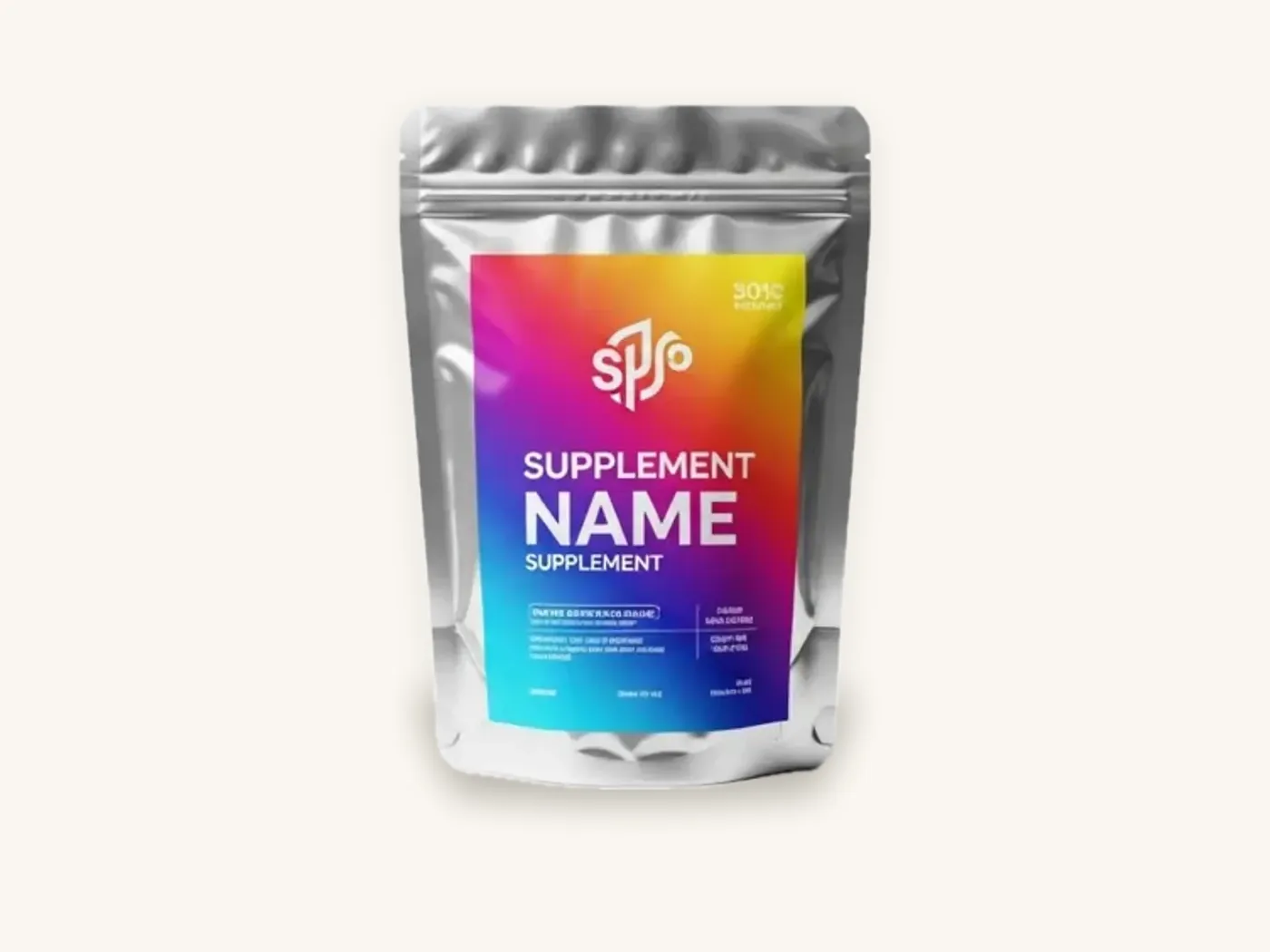
Stand-up pouches carry the label on the pouch itself, usually with the Supplement Facts panel on the back face. Curved bottles use custom labels and stickers, where the wrap limits how much of the label is visible at once. Keep the PDP elements within the front-facing arc of a round bottle.
For container choices, moisture protection and design systems across a range, see our supplement packaging guide. Tamper-evident features are covered in the tamper-evident packaging guide.
A preflight checklist for supplement label artwork
Run this before you approve any proof. It will not replace a regulatory review, but it catches the errors that most often force a reprint.
- Statement of identity includes "dietary supplement" or a descriptive variant and is prominent on the PDP.
- Net quantity sits in the bottom 30% of the PDP, meets the minimum type height for the PDP area and uses the correct units.
- Supplement Facts panel matches the current formula specification, serving size and servings per container.
- Every ingredient in the formula appears either in the panel or in "Other ingredients".
- Allergens are declared in the list or in a "Contains:" statement.
- Required warnings, such as an iron warning, are present and correctly placed.
- Name and place of business is complete, with a qualifying phrase if you are not the manufacturer.
- Domestic address or phone number for adverse event reports is present.
- Every claim is on the claims sheet, substantiated, marked with a symbol if needed and paired with the disclaimer on the same panel.
- Physical proof has been read at arm's length for legibility of small type.
Ordering supplement boxes and labels from Box Sense
Box Sense manufactures and prints supplement cartons, labels and pouches to the artwork you supply. We check files for print issues such as bleed, resolution, safe zones and type that is too small to reproduce cleanly. We do not review or approve regulatory content, so have your label reviewed before you sign off the proof.
What to send
- Bottle, jar or pouch dimensions, and whether the carton needs an insert
- Carton style preference, or a request for a recommendation
- Final, reviewer-approved label copy with Supplement Facts panel
- Board preference, typically white SBS for crisp small type
- Finishes such as matte or gloss lamination, spot UV or foil, keeping the facts panel on an uncoated or aqueous area
- Quantities to price per SKU
- Artwork files, or a request for our design services team to set up your files on the dieline
Timeline and pricing
We confirm quotes within 24 hours and provide a dieline, artwork setup and a 3D digital proof with two revision rounds at no cost. Production takes 8–12 business days after proof approval as standard, with rush in 5 business days on most paperboard styles, and shipping is free on every US order.
For reference, a straight tuck end carton on 18 pt SBS at 3x2x5 in, printed full color with aqueous coating, is about $1.15 per unit at 100 and about $0.51 at 1,000. Use the price estimator for your size. The minimum order is 10 boxes, which makes it practical to print a small run while a new formula is validated. A printed sample of approved artwork is free on orders of 100 or more; see samples. Our health and wellness packaging page and sports nutrition boxes cover related formats.
Frequently asked questions
What must be on a dietary supplement label?
A dietary supplement label generally needs a statement of identity using the term "dietary supplement", the net quantity of contents, a Supplement Facts panel, an "Other ingredients" list, the name and place of business of the manufacturer, packer or distributor, and a domestic address or phone number for serious adverse event reports. Allergen declarations, warnings and the DSHEA disclaimer apply when relevant.
Where does the Supplement Facts panel go on a box?
The Supplement Facts panel can appear on the principal display panel or on the information panel, which is typically the panel immediately to the right of the front as you face the package. On slim cartons, brands often run it vertically on a side panel. Keep it off folds and glue flaps and print it on a plain, light background.
Do supplement labels need FDA approval?
No. FDA does not approve dietary supplement labels or products before they are sold. The company is responsible for making sure the label complies with the regulations and that claims are truthful and substantiated. FDA can take action after products reach the market, which is why brands commonly have labels reviewed by a regulatory specialist before printing.
What is the DSHEA disclaimer?
It is the statement required next to structure/function, general well-being and nutrient deficiency claims: "This statement has not been evaluated by the Food and Drug Administration. This product is not intended to diagnose, treat, cure, or prevent any disease." It appears in boldface on each panel carrying a claim and uses "These statements" when there are several claims.
Can a supplement box say it treats or prevents a disease?
No. Claims that a supplement diagnoses, treats, cures, mitigates or prevents a disease are disease claims, which are not permitted for dietary supplements. Such claims can cause FDA to treat the product as an unapproved drug. Images, product names and testimonials can imply disease claims too, so review the entire package, not just the written claims.
Does the outer carton or the bottle need the supplement label?
Generally, required information must be visible to shoppers at purchase, so a carton that conceals the bottle needs the mandatory elements. Most brands also fully label the bottle because consumers discard the carton but need the Supplement Facts panel, directions and warnings throughout use. Confirm the approach for your specific package with a regulatory reviewer or counsel.
What size must the net quantity be on a supplement box?
Minimum type height depends on the area of the principal display panel. It ranges from 1/16 inch for panels of 5 square inches or less up to 1/2 inch for panels over 400 square inches. A typical small carton front of 5 to 25 square inches needs at least 1/8 inch. The statement belongs in the bottom 30% of the front panel.
Next steps
Finalize your label copy with a regulatory reviewer, then place every element on the dieline using the checklist above. When artwork is ready, check unit costs in the instant price estimator and request a quote for supplement cartons, labels or pouches. We will send a dieline and a 3D proof so you can confirm every panel before production.
Boxes in this guide
Order the packaging we covered
Written by the Box Sense Packaging Team
Our structural designers, prepress technicians and production staff print and convert custom boxes every day for brands in the United States, United Kingdom and UAE. Questions about this guide? Talk to us.