Good packaging inventory management comes down to two questions: how many boxes to order so you never run out, and where to keep them so they are still square, dry and strong on the day you pack. The answer to the first is a reorder point built from your daily usage, your supplier's lead time and a safety buffer. The answer to the second is a dry, flat, off-the-floor space with steady temperature.
Brands usually miss in one of two directions. Some order a year of boxes for a low unit price, then need new artwork. Others order tight and run out during a promotion.
This guide gives you the arithmetic for how many boxes to order, a worked example you can copy, a comparison of what different quantities really cost in cash and space, and the storage rules that keep corrugated and paperboard performing.
Key takeaways
- Set a reorder point for each box: average daily usage multiplied by total replenishment time, plus safety stock.
- Total replenishment time is more than production. Count quote, proof approval, production (8–12 business days at Box Sense) and transit.
- The cheapest unit price is not the cheapest order. Weigh cash tied up, storage space and the risk that artwork or sizes change.
- Store corrugated flat, banded, on pallets or shelving, away from exterior walls and floors. Moisture is the main enemy of box strength.
- Fewer box sizes means less safety stock, fewer stockouts and simpler counts. Consolidate before you scale.
- Use a physical trigger, such as a reorder card on the last bundle, so reordering does not depend on someone remembering.
Why packaging inventory behaves differently from product inventory
Boxes look like a simple consumable, but they have quirks that make standard inventory habits misfire.
They are cheap per unit but bulky. A few hundred mailers barely register on a balance sheet and still fill a closet. Space, not cash, is often the first constraint.
Every order is a custom job. Custom printed boxes need artwork, a proof and a production slot, so your replenishment clock starts days before production begins.
They can go obsolete overnight. A new logo, a revised ingredient panel or a product that changes size can strand a whole pallet.
Demand is tied to orders, not units sold. One box may ship one item or five, so mailer usage can fall even as sales rise.
Several SKUs are consumed together. A shipment might pull a mailer, an insert, tissue, a sticker and tape. Running out of the cheapest component stops packing just as effectively as running out of boxes.
How many boxes to order: the four numbers that decide it
Before you pick a quantity, collect four figures for each box size you use. Pull them from your order history, not from a hopeful forecast.
1. Average daily usage
Count how many of this box you shipped over the last 8 to 12 weeks and divide by the number of shipping days. Use shipping days, not calendar days, if you do not pack on weekends. If a single promotion distorted the period, note it and calculate both with and without it.
2. Replenishment time
This is the full elapsed time from the moment you decide to reorder until usable boxes are on your shelf. For a repeat order of unchanged artwork, it usually includes:
- a day or so to send the reorder and confirm the quote (Box Sense confirms quotes within 24 hours)
- proof approval, which is fast on a repeat but slow if anyone edits artwork
- production, 8–12 business days as standard, or 5 business days on rush for most paperboard and corrugated styles
- transit to your door or your warehouse
- receiving time at a 3PL, which can add a few days during busy periods
3. Safety stock
Safety stock covers the gap between average and bad days: a sales spike, a delayed truck, a proof that needs another round. A simple, defensible version is your daily usage multiplied by the number of extra days of delay you want to absorb.
4. Order cycle
How often do you want to place an order? Monthly reorders keep cash and space low but create more admin. Quarterly reorders lower the unit price and admin but tie up more of both. Most growing DTC brands settle between six weeks and three months of cover per order.
The formula
Reorder point = (average daily usage x replenishment days) + safety stock
Order quantity = average daily usage x days in your order cycle, rounded to the nearest pricing tier that makes sense.
A worked reorder-point example you can copy
Say you run a hypothetical store selling ceramic pour-over coffee sets. Most orders ship in one 8x6x3 in E-flute mailer with a paperboard insert. Here is how you would set the reorder point.
- Measure usage. Over the last 10 weeks you shipped 1,600 mailers across 50 shipping days, so usage is 32 boxes a day.
- Add up replenishment time. One day to reorder and confirm, one day to approve an unchanged proof, 12 business days of production (use the top of the range), and three shipping days of transit. That is 17 shipping days.
- Pick a safety buffer. You want to survive a week-long delay or a strong promotion, so you add 6 shipping days of cover: 6 x 32 = 192 boxes.
- Calculate the reorder point. (32 x 17) + 192 = 736 boxes. When stock on hand falls to about 736 mailers, you place the next order.
- Choose the order quantity. You want roughly two months of cover per order. At about 40 shipping days, that is 1,280 boxes, so you look at the 1,000 and 2,500 pricing tiers and decide which fits your cash and space.
- Repeat for every component. The insert shares the mailer's usage, but tissue and stickers may have different lead times and pack sizes. Give each its own reorder point.
- Recheck every quarter. Usage changes as order mix changes. A reorder point set in spring can be badly wrong by November.
Tip: turn the reorder point into a physical signal. Count out enough bundles to equal your reorder point, put them at the back of the shelf, and tape a reorder card to the first bundle in that group. When a packer opens that bundle, the card goes to whoever places orders. It works even on the busiest day, when nobody is checking a spreadsheet.
Order quantity: unit price versus cash, space and risk
The unit price falls steeply as quantity rises, which tempts brands into orders far larger than their usage justifies. Look at total spend and months of cover side by side before choosing.
The table uses indicative per-unit prices for an 8x6x3 in E-flute mailer printed full color outside, with free US shipping included, and assumes a hypothetical usage of 800 boxes a month. Totals are rounded and shown in US dollars.
| Order quantity | Price per box | Approx. total (USD) | Months of cover at 800/month | What it means |
|---|---|---|---|---|
| 250 | about $1.88 | 470 | about 0.3 | Constant reordering; fine only for tests and launches |
| 500 | about $1.41 | 705 | about 0.6 | Still a rush every few weeks |
| 1,000 | about $1.17 | 1,170 | about 1.25 | Workable for a brand with little storage |
| 2,500 | about $1.00 | 2,500 | about 3 | A common sweet spot for steady sellers |
| 5,000 | about $0.83 | 4,150 | about 6 | Lowest unit cost, but high obsolescence and space risk |
Going from 1,000 to 2,500 boxes cuts roughly 17 cents off every box, which is a real saving at 800 boxes a month. Going from 2,500 to 5,000 saves another 17 cents a box but doubles the cash committed and the space consumed, and locks your artwork for half a year.
When a larger order is the right call
Choose the bigger tier when your artwork is stable, your box size fits your products for the foreseeable future, you have dry storage already paid for, and the cash would otherwise sit idle. Seasonal brands heading into their peak often fit this profile.
When a smaller, more frequent order wins
Choose the smaller tier when you expect a rebrand, are still testing sizes, are adding products that might need a different box, or are paying per pallet position at a 3PL. Short production times make frequent ordering much less risky than it used to be. Our custom packaging cost guide explains the other cost drivers, and the instant price estimator shows every tier for your exact size.
Watch out: the cost of scrapping obsolete packaging is rarely in the spreadsheet. If a label change forces you to discard 2,000 boxes, the "saving" from the bigger tier disappears several times over. Ask what is likely to change in the next six months before committing to a long run.
How much space packaging inventory really takes
Space is where packaging inventory surprises people. The numbers on a quote describe the assembled box, but what you store is a flat blank, a banded bundle or, for some styles, a fully built box full of air.
| Packaging type | How it is usually stored | What drives the space | Storage notes |
|---|---|---|---|
| Mailer boxes | Flat, in banded bundles or cartons | Flat blank size and flute thickness | B-flute stacks roughly twice as thick as E-flute |
| Shipping boxes (RSC) | Flat, banded, often on pallets | Panel length plus flap length | Large sizes are long and floppy; store on pallets, not leaning |
| Folding cartons | Flat, in shipping cartons | Blank size; very compact | Sensitive to crushing and scuffing if cartons are overstacked |
| Rigid boxes | Assembled, nested or in cartons | Full outer volume of each box | Can take many times the space of a flat style |
| Collapsible rigid boxes | Flat, in cartons | Folded board thickness | Rigid feel with flat storage |
| Inserts, tissue, stickers, tape | Cartons, reams and rolls | Pack size | Small but easy to lose track of; give them a location |
Estimating shelf space before the delivery arrives
Ask your supplier for the bundle count and the carton or bundle dimensions for your order. Multiply bundle length by width to get the footprint, multiply bundle height by the number of bundles you can safely stack, and compare that with your shelf or pallet. If you are receiving at a 3PL, send them the same figures so they can allocate the right number of positions.
Rigid and collapsible options
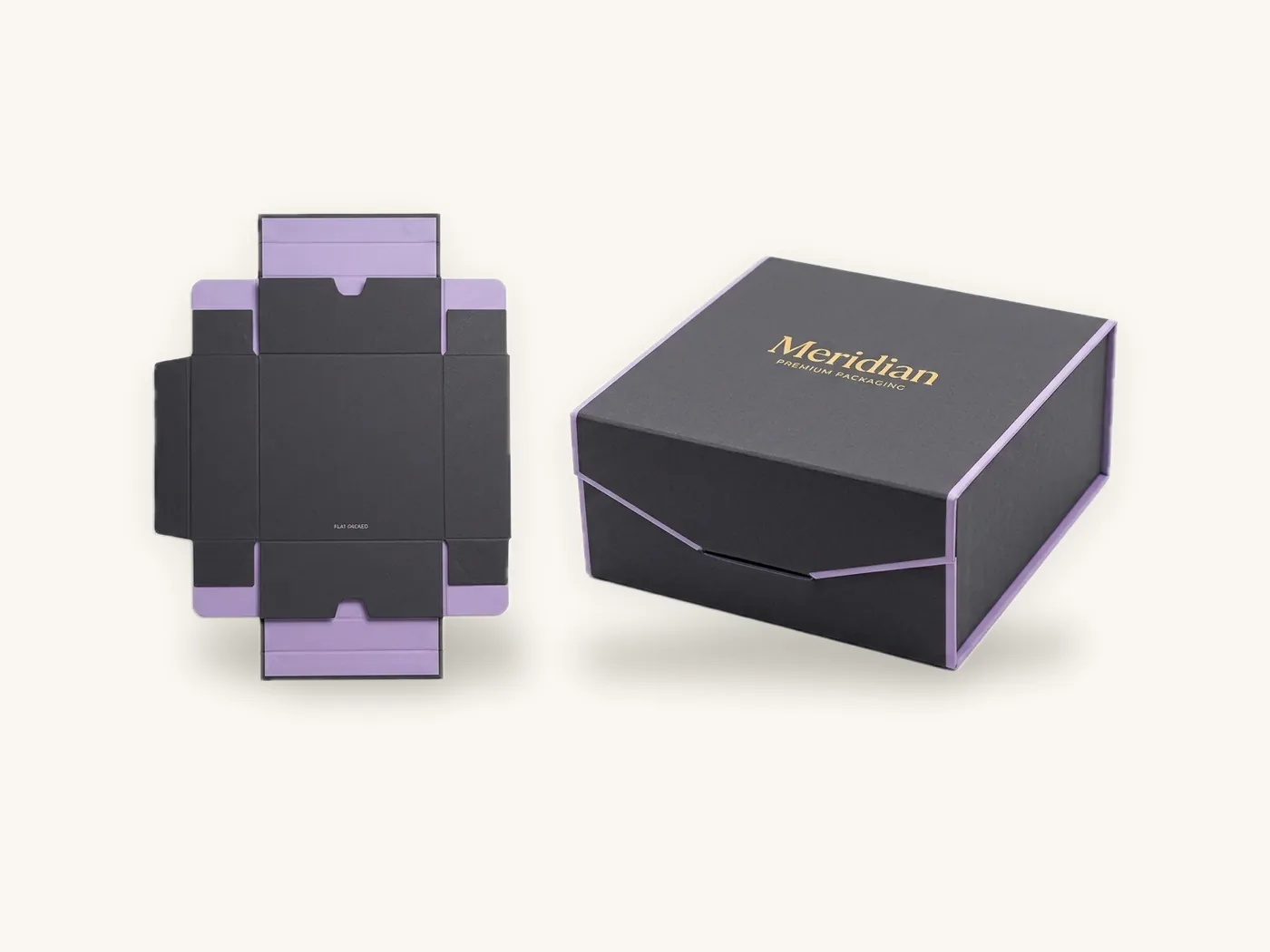
Traditional custom rigid boxes are built from glued greyboard and cannot be flattened, so storing a few thousand needs serious space. Collapsible rigid boxes keep the heavy board and premium wrap but fold flat, which can reduce the footprint dramatically. If your premium packaging program is outgrowing its room, that switch is often worth more than any unit price negotiation.
Packaging storage conditions that protect box strength
Corrugated board is paper, and paper absorbs moisture from the air. As board takes on moisture, its stiffness and stacking strength drop, flaps curl, glue lines weaken and printed surfaces can scuff more easily. Boxes that tested well at the factory can underperform in transit if they spent the summer in a damp space.
Rules that apply everywhere
- Keep boxes off the floor. Concrete wicks moisture and cold. Use pallets, shelving or at least a layer of empty pallets under bundles.
- Stay away from exterior walls, windows and dock doors. These are where condensation, temperature swings and rain blow-in happen.
- Keep them flat and banded until you need them. Bundles held square resist warping. Loose, leaning blanks bow.
- Leave stretch wrap on pallets until use. It slows moisture exchange and keeps dust off print surfaces.
- Avoid direct sunlight. UV can fade printed panels and yellow white liners over months.
- Don't overstack. Heavy stacks of flat bundles can crush the bottom layers, especially for folding cartons in thin shipping cartons.
- Acclimatize cold stock. If boxes arrive from a cold truck into a warm room, let them sit before packing so condensation can clear.
Garages, small units and warehouses
Garages and sheds are the riskiest option. If that is where stock lives, raise everything onto shelving, wrap bundles, run a dehumidifier in humid months and hold only a few weeks of cover. In a warehouse, keep packaging near packing stations but out of forklift paths, since a torn bundle corner can ruin dozens of blanks.
Adhesives, tissue and specialty items
Labels and tape have adhesives that prefer moderate temperatures; very hot or cold spaces can make them fail to stick. Printed tissue paper creases and absorbs odors, so keep it sealed. Soft-touch and laminated rigid boxes can pick up marks if cartons rub, so keep their inner packing until the day of use.
Organizing packaging stock so counts are fast and accurate
A tidy packaging area saves more time than any software. Aim for a setup where anyone can tell stock levels at a glance.
A packaging storage checklist
- One labeled location per packaging SKU, including inserts, tissue, stickers and tape
- Artwork version or date on every location label so old and new stock never mix
- First in, first out: new deliveries go behind existing stock
- A reorder card taped at the reorder point bundle
- Bundle counts written on each bundle so you count bundles, not boxes
- A cycle count of packaging every two to four weeks, on a fixed day
- A simple log of each order: date ordered, proof approved, shipped, received
- A spot for damaged or rejected boxes, so they are reported and not used
If your inventory tool supports supplies, add packaging so each order deducts boxes automatically, but still verify with physical counts. Damaged blanks and test packs quietly drain stock the system never sees.
Consolidating box sizes to simplify inventory
Every extra box size needs its own safety stock, its own location and its own reorder point. Three sizes that cover your catalog are far easier to manage than nine sizes that fit perfectly.
Start by listing every product and common bundle with its packed dimensions. Group items that fit the same box with modest clearance, then use inserts or tissue to handle the differences inside a shared outer. You trade a small amount of fit for much simpler stock and better quantity pricing, because volume concentrates on fewer SKUs.
There is a limit: oversized boxes waste board, let items shift and can raise parcel costs. Our guides to right-sized packaging and dimensional weight show how to find the balance, and the custom shipping boxes page lists common outer carton sizes.
Planning packaging inventory for peaks, launches and changes
Averages fail at exactly the moments that matter most. Plan these three situations separately.
Seasonal peaks
Plan from last year's peak weekly usage, not your average. Have peak stock arrive two to three weeks before the season starts, and place those orders earlier than usual, since production calendars fill ahead of holidays.
Product launches
With no usage history, order a smaller first run, then reorder once you have two to four weeks of real sales data. A short first run also lets you fix fit or artwork issues before committing to volume.
Artwork and size changes
Before changing artwork, check old stock on hand and plan a cut-over date, either timing the new order to land as old stock runs out or assigning old boxes to samples and internal shipments.
Packaging inventory at a 3PL
If a third-party logistics provider packs your orders, they usually store your packaging too, and they charge for it. That changes the math: storage becomes a monthly bill instead of free garage space, and receiving takes time.
- Ask how they charge for storage and add that to your order-quantity comparison.
- Label packaging clearly: item name, size, artwork version and quantity per bundle.
- Agree who watches packaging levels and who reorders; many stockouts happen because each side assumes the other is watching.
- Share reorder points, ask for a weekly packaging count and send inbound delivery dates.
Our guide to packaging for 3PLs covers carton labeling, pack-out instructions and receiving requirements in more detail.
Ordering and reordering packaging with Box Sense
A reliable supplier makes a lean inventory possible, because you can reorder smaller amounts more often without fear. Here is how ordering works with us.
What to send for a first order
- Box style and internal dimensions, or product dimensions if you want a recommendation
- Board grade, print sides and finishes
- Two or three quantities to compare, for example 1,000, 2,500 and 5,000
- Your target in-hand date and delivery address, including any 3PL receiving instructions
- Artwork, or a request for help from our design services team
What happens next
- Quote within 24 hours, confirmed for your spec and quantities.
- Free design support: dieline, artwork setup and a 3D digital proof, with two revision rounds.
- Optional samples: unprinted structural samples are free, and a printed sample of approved artwork is free on orders of 100 or more. See samples.
- Production takes 8–12 business days after proof approval, with rush in 5 business days on most paperboard and corrugated styles.
- Delivery is free on every US order; international shipping is quoted at cost.
Making reorders fast
Repeat orders of unchanged artwork skip most of the design steps, which shortens your replenishment time and lets you lower your reorder point. The minimum order is 10 boxes, and there are no die or plate charges, so a small top-up run to cover a surprise spike is practical. Defective boxes reported within 14 days are reprinted free, which is another reason to inspect deliveries on arrival instead of when you open the last bundle.
You can browse the styles we make most for stocking brands on the mailer boxes and e-commerce and subscription packaging pages, or see how production works on how it works.
Frequently asked questions
How many boxes should I order at once?
Order enough to cover your usage for one order cycle, typically six weeks to three months for a steady seller. Multiply average daily usage by the shipping days in that cycle, then round to a sensible pricing tier. Go larger only if your artwork and box size are stable and you have dry storage; go smaller if you expect changes or pay for storage by the pallet.
How do I calculate a reorder point for packaging?
Multiply your average daily box usage by the full replenishment time in days, then add safety stock. Replenishment time includes reordering, proof approval, production and transit, not just production. For example, using 32 boxes a day with a 17-day replenishment time and 192 boxes of safety stock gives a reorder point of 736 boxes.
Where is the best place to store cardboard boxes?
A dry, indoor space with steady temperature, away from exterior walls, windows and dock doors. Keep boxes flat and banded on pallets or shelving so they never touch a concrete floor. Leave stretch wrap or cartons on until you need the stock, and avoid direct sunlight, which can fade printed panels over time.
Does humidity damage corrugated boxes?
Yes. Corrugated board absorbs moisture from humid air, which reduces stiffness and stacking strength, weakens glue joints and can make flaps curl. Boxes stored in a damp garage or near a dock door may crush more easily in transit. Store stock off the floor, wrap it, and use a dehumidifier in humid spaces if needed.
How long can I store custom boxes before using them?
Corrugated and paperboard boxes stored flat in dry, stable conditions stay usable for a long time. The practical limit is usually not the board but change: new artwork, updated label text or a product size change can make stock obsolete. Plan orders around how long your design will stay current, and use first in, first out rotation.
How much safety stock should I keep for packaging?
Keep enough to cover the delays and spikes you realistically see. A common approach is daily usage multiplied by one to two weeks of extra days. Increase it before peak seasons or when deliveries go through a busy 3PL, and reduce it once production times prove short and predictable.
Should I store boxes flat or assembled?
Flat, whenever the style allows. Mailers, shipping boxes and folding cartons store as flat blanks and assemble at the packing bench, which saves a large amount of space and keeps them square. Traditional rigid boxes arrive assembled, so brands short on space often switch to collapsible rigid boxes, which fold flat but open into a rigid presentation box.
Next steps
Pull your last 10 weeks of shipments, work out daily usage per box size and set a reorder point for each. Then compare two or three order quantities in the packaging price estimator with your storage space in mind. When you are ready to stock up or set up a regular reorder rhythm, request a quote and we will confirm pricing within 24 hours.
Boxes in this guide
Order the packaging we covered
Written by the Box Sense Packaging Team
Our structural designers, prepress technicians and production staff print and convert custom boxes every day for brands in the United States, United Kingdom and UAE. Questions about this guide? Talk to us.