Here is how to measure a box for a custom order: measure the inside, and record it as length x width x depth. Length is the longer side of the opening, width is the shorter side of the opening, and depth is the distance from the opening to the bottom. Inside dimensions are what a manufacturer needs to make your product fit; outside dimensions are what carriers and pallets care about.
That short answer covers most orders, but the details are where custom box sizes go wrong: a bottle that is taller with its pump fitted, a board thickness nobody accounted for, or a "12x10x6" that one supplier reads as inside and another as outside. This guide covers how to measure products and existing boxes, how much clearance to leave, and how board thickness changes the numbers.
Key takeaways
- Write box dimensions as L x W x D, where L and W describe the opening and D runs perpendicular to it. This convention holds for cartons, mailers and shipping boxes.
- Order custom boxes by inside dimensions. The outside is larger by roughly two board thicknesses on length and width, and more on depth for flapped boxes.
- Clearance depends on the product: roughly 1/16 in for a rigid item in a paperboard carton, about 1/8 in in a mailer, and 1 to 2 in per side when cushioning goes in.
- Board thickness ranges from about 0.46 mm for 18 pt SBS to roughly 7 mm for BC double wall, and thicker board carries wider manufacturing tolerances.
- Measure three to five units of the product, packed the way they ship, and design around the largest reading.
- Always test fit a structural sample before a printed run. Box Sense sends unprinted structural samples free.
Inside vs outside box dimensions
Every box has two sets of dimensions, and confusing them is the single most common sizing error.
Inside dimensions (sometimes called ID) are the usable space: the distance between inner walls, from the floor to the underside of the closed lid or flaps. These are what determine whether your product fits.
Outside dimensions (OD) are the overall size of the closed box, including every layer of board. These determine shipping charges, how many boxes fit on a pallet, whether a box fits a retail shelf and what an overbox needs to be.
Why manufacturers work from the inside
Structural designers build a dieline outward from the inside space, adding allowances for the board at each fold, flap and glue joint. If you send outside dimensions without saying so, the finished box will come out smaller inside than you expect, by up to a quarter inch or more on corrugated.
When outside dimensions matter more
Use outside dimensions when you are fitting boxes into something fixed: a shelf, a display tray, a master carton, a locker, or a carrier's size limit. Carriers measure the outside of the parcel, and most price larger parcels partly on its volume; our dimensional weight guide explains how that works. If you need to hit a specific outside size, say so clearly on the quote request, and let the manufacturer calculate the inside.
Tip: label every number you send. Writing "inside 8 x 6 x 3 in" or "outside 305 x 254 x 152 mm" removes the guesswork, and it takes three seconds.
The L x W x D order and how it applies to each box style
The convention is simple once you tie it to the opening. Length is the longer dimension of the opening. Width is the shorter dimension of the opening. Depth (also called height) is the dimension perpendicular to the opening.
The trick is that "the opening" moves depending on the style, so the same product can be described with different numbers in different boxes.
| Box style | Where the opening is | Length | Width | Depth |
|---|---|---|---|---|
| Regular slotted shipping box | Top flaps | Longer side of the top | Shorter side of the top | Floor to top flaps |
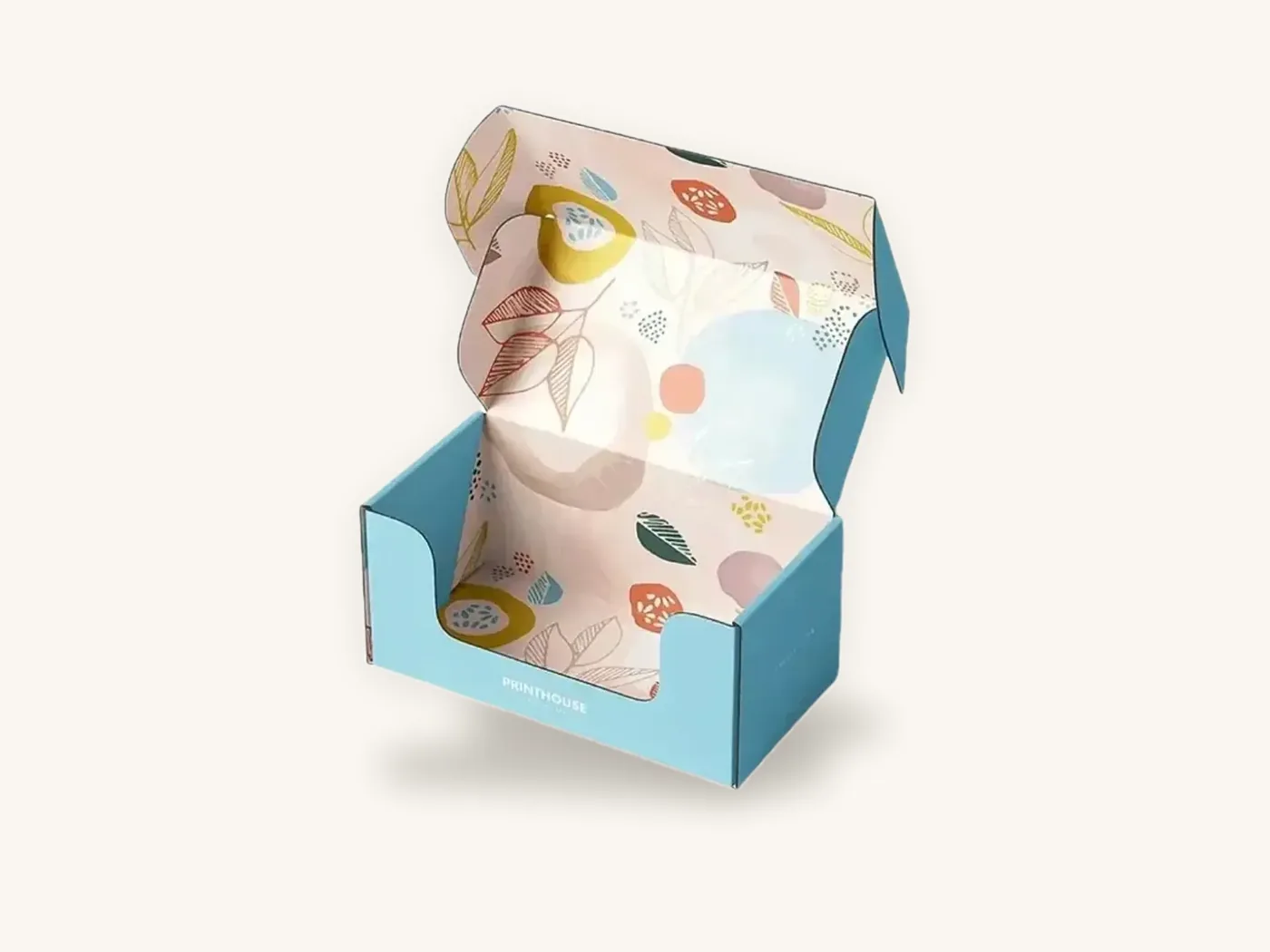
| Mailer box (roll-end tuck-front) | Lid on top, hinged at back | Left to right along the hinge | Front to back | Floor to underside of lid |
| Straight or reverse tuck end carton | Tuck flaps at the ends | Front panel width | Side panel width | Distance between the two tuck ends |
| Auto lock bottom carton | Tuck top, locked base | Front panel width | Side panel width | Base to tuck top |
| Two-piece or telescoping box | Lid lifts off | Longer side of the base | Shorter side of the base | Base wall height |
| Sleeve and tray | Tray slides from the end | Tray length | Tray width | Tray wall height |
Worked example of the same product in two styles
Say a boxed gift set lies flat and measures 7 in by 5 in by 2 in. In a mailer box with the lid on top, you would describe it as roughly 7 x 5 x 2 plus clearance. In a tuck end carton that opens at the short ends and stands upright on a shelf, the opening is 5 by 2, so the carton becomes roughly 5 x 2 x 7. The box volume is similar; the numbers read differently because the opening changed.
This is why "8x6x3" alone is not a complete spec. Pair the numbers with the style, and ideally a sketch showing which face opens.
How to measure a product for a custom box
The box is only as accurate as the measurements behind it. Get these right and the rest is arithmetic.
Tools that give reliable numbers
- Digital calipers for anything under about 6 in, especially bottles, jars and electronics
- A rigid steel rule for larger items; fabric tape measures stretch and bend around corners
- Two flat blocks or books to square against an irregular item, then measure between the blocks
- A kitchen or shipping scale for weight, which affects board choice
Step-by-step measuring process
- Assemble the product exactly as it ships. Fit the cap, pump, lid, hang tag, pouch, tissue wrap or protective sleeve. Measure the bundle, not the bare item.
- Find the longest dimension. Measure at the widest bulge, handle or protrusion, not the flat face.
- Measure the other two dimensions at their widest points. For round items, measure the diameter at the widest shoulder or lid.
- Repeat on three to five units. Glass, blow-molded bottles, candles and handmade goods vary. Record every reading.
- Use the largest reading of each dimension. A box sized to the average will not fit the largest unit.
- Note how the product sits. Upright, flat, on its side, or nested with other items changes which dimension becomes the depth.
- Record weight and fragility. A 3 lb glass item needs different board and clearance than a 3 lb sweater.
- Convert units once, carefully. One inch equals 25.4 mm. Pick one unit system for the whole spec.
Measuring multi-item kits
For kits, arrange the items on a table in the layout you want customers to see, then measure the footprint and the tallest item. If items will sit in a die-cut insert, the insert adds its own board around each cavity and often a raised floor. Size the box insert and the box together, never the box first.
How to measure an existing box you want to copy or improve
Sometimes the easiest starting point is a box you already have: a stock box that almost works, or a competitor-style reference. Measure it methodically.
Measuring an assembled box
- Measure inside, at the floor, from inner wall to inner wall. Walls often flare slightly at the top.
- Measure length and width at the opening, using the L and W convention above.
- Measure depth from the inside floor to the point where the lid or flaps close, not to the top of an open flap.
- On a mailer, close the lid and measure the outside too, so you know both numbers.
Measuring a flat, unfolded box
On a knocked-down box, the distance between parallel crease (score) lines on each panel approximates the inside dimension plus about one board thickness. Measure crease center to crease center. This is how structural designers read a sample, and it pairs well with the dieline guide, which explains the difference between cut, crease and bleed lines.
Watch out: a used box is not a spec. Boxes swell with humidity, flaps get crushed and corners round over. Treat measurements from an old box as a starting point, then confirm the fit with your real product and a new structural sample.

Board thickness, outside dimensions and manufacturing tolerances
Board has thickness, and thickness adds up at every wall. It also sets how precisely a box can be cut and folded, because thicker, more compressible board moves more at each crease.
Typical board thickness and allowances
The figures below are typical working values. Exact caliper varies by mill, liner weight and humidity, so treat them as planning numbers and confirm against your supplier's sample.
| Board | Approx. thickness | Outside vs inside (L and W) | Outside vs inside (depth) | Typical working tolerance |
|---|---|---|---|---|
| 14 pt SBS paperboard | about 0.36 mm | add about 1 mm | add about 1 mm | about ±1/32 in (0.8 mm) |
| 18 pt SBS or kraft paperboard | about 0.46 mm | add about 1 mm | add about 1 to 2 mm | about ±1/32 in (0.8 mm) |
| 24 pt paperboard | about 0.61 mm | add about 1.5 mm | add about 2 mm | about ±1/32 in (0.8 mm) |
| E-flute corrugated | about 1.5 mm | add about 3 mm | add about 3 to 6 mm | about ±1/16 in (1.5 mm) |
| B-flute corrugated | about 3 mm | add about 6 mm (1/4 in) | add about 6 to 12 mm | about ±1/8 in (3 mm) |
| C-flute corrugated | about 4 mm | add about 8 mm | add about 8 to 16 mm | about ±1/8 in (3 mm) |
| BC double wall | about 6.5 to 7 mm | add about 13 mm (1/2 in) | add about 13 to 28 mm | about ±3/16 in (5 mm) |
| 2 mm greyboard rigid box, wrapped | about 2.2 mm with wrap | add about 4.5 mm | add about 2 to 5 mm | about ±1 mm |
Depth varies more than length and width because flaps stack. On a regular slotted container, the top and bottom each have an inner and outer flap layer where they overlap, so outside depth can grow by up to four board thicknesses. On a mailer, the lid, tuck flap and rolled walls affect depth differently from length.
For more on board grades, see corrugated board and SBS paperboard, or the deeper paperboard thickness guide and corrugated flutes guide.
What tolerance means for your fit
Tolerance is the normal variation between the dimension on the spec and the dimension on a finished box. On an 18 pt carton, a variation under a millimeter is invisible. On a B-flute shipping box, an eighth of an inch either way is routine. Design your clearance so the product still fits at the tight end of the range, and still does not rattle at the loose end.
That is why a zero-clearance design is risky on corrugated. If the box comes out at the tight end of tolerance, the product will not go in.
Clearance: how much space to leave around the product
Clearance is the gap you add between the product's measured size and the box's inside size. Too little and the product binds, the lid bulges or packing slows down. Too much and the product slides, corners take impacts and you pay to ship air.
Clearance guide by product and box
| Product and packaging | Clearance per dimension | Reasoning |
|---|---|---|
| Rigid item in a paperboard tuck carton | about 1/16 in (1.5 mm) | Tight tolerance board, product slides in by hand or on a cartoner |
| Bottle or jar in a paperboard carton | about 1/16 to 1/8 in | Allows for bottle variation and cap height |
| Rigid item in an E-flute mailer | about 1/8 in (3 mm) | Covers corrugated tolerance and lets the lid close flat |
| Folded apparel in a mailer | 0 to 1/4 in | Soft goods compress; tissue fills small gaps |
| Item in a die-cut insert | insert cavity about 1/32 to 1/16 in over product | The insert, not the box, controls movement |
| Fragile item with wrap or void fill | 1 to 2 in on each side | Space for cushioning to absorb shock |
| Inner carton inside a shipping box (overbox) | about 2 in on each side with cushioning | Separates the inner box from outer impacts |
| Multiple units in a case pack | about 1/8 to 1/4 in total per dimension | Easy loading without units shifting |
Worked example: a candle jar in a carton
Say a candle jar measures 3.12 in across at the widest point and 3.58 in tall with its lid, across five units the largest readings. For an 18 pt SBS carton, add about 1/16 in to each: 3.19 x 3.19 x 3.64 in. Rounding up to a clean spec such as 3.25 x 3.25 x 3.75 in inside is sensible, and a paperboard insert can hold the jar centered if the fit feels loose.
Worked example: a fragile item in a shipping box
Say a ceramic piece packed in its own printed carton measures 9 x 7 x 3 in outside. You want 1 in of cushioning on every side. The inside of the shipping box becomes 11 x 9 x 5 in. In B-flute, the outside will land at roughly 11.25 x 9.25 x 5.5 in, which is the number to use for shipping estimates.

Standard vs custom box sizes
Stock boxes come in fixed sizes, usually whole inches. Custom box sizes can be made to any dimension your product needs, within a style's structural limits.
When a standard size works
Choose a standard size when your product fits one with sensible clearance, when you ship a wide mix of items, or when you need boxes tomorrow. Many brands keep a few stock-like sizes for mixed orders.
When a custom size pays for itself
Custom sizing earns its place when the product is a consistent shape, when rattling causes damage or returns, when the box is part of the brand experience, or when oversizing pushes parcels into a higher billing weight. Smaller boxes also use less board. For example, at 1,000 units a 1-color B-flute RSC at 12x10x6 in costs about $2.08 each, while the 16x12x8 in size costs about $3.32. The right-sized packaging guide covers how to rationalize box sizes across a whole catalog.
Sizing limits by style
- Tuck end cartons work best when depth is at least equal to width; very shallow, wide cartons tend to bow.
- Mailer boxes get floppy when very large and shallow; above roughly 18 in long, consider B-flute or a different style.
- Shipping boxes handle almost any proportion, but very long, narrow boxes may need heavier board to resist bending.
- Rigid boxes are built around the product and insert, and depth drives cost more than footprint.
Common box measuring mistakes and how to avoid them
Most sizing problems are preventable. Run through this list before you send dimensions.
- Measuring the bare product. Caps, pumps, hang tags, pouches and bubble wrap all add size.
- Sending outside dimensions without labeling them. The box will come back small inside.
- Swapping width and depth. A 3x2x5 carton and a 3x5x2 carton are completely different boxes.
- Designing to the average unit. Use the largest of several readings.
- Forgetting the insert. Inserts add board thickness and sometimes a raised floor.
- Mixing inches and millimeters. Convert once and state the unit on every number.
- Skipping the physical sample. A screen rendering will not show a lid that bulges by 2 mm.
- Rounding down. When a measurement lands between fractions, round the box up, not down.
How to order custom box sizes from Box Sense
We make every box to your dimensions, so there is no penalty for an unusual size. Getting the numbers right upfront simply makes the quote and the proof faster.
What to send
- Inside dimensions as L x W x D, labeled inside, in one unit system
- Box style, or the product and how it should sit, if you want a recommendation
- Product weight and whether it is fragile
- Whether an insert is needed, and what it holds
- Any outside-dimension limit you must hit, such as a shelf or carrier size
- Quantities to price and your target delivery date
If you only have product measurements, send those and a photo. Our structural team will propose box dimensions, and our design services team supplies the dieline, artwork setup and a 3D digital proof with two revision rounds, free.
Test fit, then produce
Unprinted structural samples are free, so you can check the fit on the real product before any printing. A printed sample of approved artwork is free on orders of 100 or more; the samples page has details. The minimum order is 10 boxes, and there are no die or plate charges on custom sizes.
After proof approval, standard production is 8–12 business days, and rush production in 5 business days is available on most paperboard and corrugated styles. US shipping is free, and boxes reported defective within 14 days are reprinted free. The how to design custom boxes guide covers the design choices that follow once the size is locked, and the packaging design process guide maps the full timeline.
Frequently asked questions
How do you measure a box, length, width or height first?
List length first, then width, then depth or height. Length and width describe the opening of the box, with length as the longer side and width as the shorter side. Depth is the dimension perpendicular to the opening. For a shipping box with top flaps, depth is the height; for an end-opening carton, depth is the tall dimension between the tuck ends.
Should I give inside or outside dimensions for a custom box?
Give inside dimensions, clearly labeled, because they control whether your product fits. Manufacturers build the dieline outward from the inside space and add allowances for board thickness. Only give outside dimensions when you must fit a fixed space, such as a shelf, display or overbox, and label them as outside so the inside can be calculated.
How much bigger is the outside of a box than the inside?
It depends on board thickness and style. An 18 pt paperboard carton is only about 1 mm larger outside. An E-flute mailer adds roughly 3 mm on length and width, B-flute adds about 1/4 in, and BC double wall adds about 1/2 in. Depth often grows more because top and bottom flaps overlap on slotted boxes.
How much space should I leave around a product in a box?
For a rigid item in a paperboard carton, about 1/16 in per dimension. In a corrugated mailer, about 1/8 in, which absorbs manufacturing tolerance and lets the lid close flat. Folded apparel needs little or none. Fragile items with wrap or void fill need roughly 1 to 2 in on each side so the cushioning can absorb impact.
What are the tolerances on custom box dimensions?
Typical working tolerances are about ±1/32 in on paperboard cartons, around ±1/16 in on E-flute mailers, about ±1/8 in on B-flute and C-flute boxes and somewhat more on double wall. Rigid boxes are built tighter, around a millimeter. Exact figures vary by supplier and board, so size your clearance to fit at the tight end.
How do I measure a round or irregular product for a box?
Measure the diameter at the widest point, including lids, shoulders or handles, and treat it as both length and width. For irregular shapes, stand the item between two flat blocks and measure the gap between them in each direction. Repeat on several units and use the largest reading. An insert often holds irregular items better than extra box clearance.
Can I get a sample to check box size before ordering?
Yes. Box Sense sends unprinted structural samples free, so you can test fit your real product, close the box and check for rattling before printing. A printed sample of approved artwork is free on orders of 100 or more. Testing a physical sample is the most reliable way to catch small sizing errors.
Next steps
Measure several packed units, write the inside dimensions as L x W x D, and plug them into the custom box price estimator to compare sizes and board grades. When the numbers look right, request a quote with your box dimensions and we will confirm pricing within 24 hours and send a free structural sample to test the fit.
Boxes in this guide
Order the packaging we covered
Written by the Box Sense Packaging Team
Our structural designers, prepress technicians and production staff print and convert custom boxes every day for brands in the United States, United Kingdom and UAE. Questions about this guide? Talk to us.