Good international shipping packaging has to survive more handling, longer dwell times and wider swings in humidity and temperature than a domestic parcel, and it has to clear customs at the other end. In practice that means a stronger outer box than you would use at home, inner packaging that keeps products secure if an inspector opens the carton, and paperwork that describes the contents accurately.
A parcel from the US to London or Dubai may pass through several sorting hubs, an aircraft container or an ocean container, a customs facility and a final-mile carrier. Each transfer is another drop, another stack and another chance for moisture to soften the board.
This guide covers how to specify export packaging for those conditions, what documents and codes customs expects, how to label the outer box, and how to test a pack before you send it overseas. It focuses on general principles; rules change and differ by country, so confirm current requirements with your carrier, customs broker and the destination's customs authority.
Key takeaways
- Plan for more drops, heavier stacking and longer transit than domestic shipping. Many brands step up one board grade, for example from single wall to double wall, for export.
- Humidity weakens corrugated board. Long sea transit and hot, humid destinations call for stronger board, moisture barriers on the product and dry storage before dispatch.
- Customs may open the box. Use inner packs and inserts so the contents stay organized and protected after inspection.
- Every commercial shipment needs an accurate description, value, country of origin and HS code. Vague descriptions cause delays.
- Carriers bill international parcels on volumetric weight as well as actual weight, so oversized boxes cost more on long routes.
- Box Sense ships worldwide from locations in the United States, United Kingdom and UAE, with international shipping quoted at cost.
Why international shipping is harder on packaging
A domestic parcel might be handled a handful of times. An international one is typically handled many more, with extra transfers between road, air or ocean legs, and consolidation into larger loads at each end.
The main stresses on export packaging
- Repeated handling: each hub adds drops onto conveyors, into cages and onto truck floors.
- Compression over time: boxes may sit under heavier freight in containers or warehouses for days or weeks, and corrugated board slowly loses strength under a sustained load.
- Humidity and condensation: ocean containers and tropical climates expose board to moist air, and temperature swings can cause condensation inside the container.
- Heat: parcels can sit on hot tarmacs or in un-air-conditioned depots, which matters for candles, cosmetics, chocolate and adhesives.
- Inspection: customs officers may open, examine and reseal a parcel, sometimes without the care the original packer took.
- Vibration: long road and sea legs shake contents loose, loosening caps and wearing through wraps.
Parcel vs palletized freight
The right packaging depends on how the goods travel. The table below outlines the differences.
| Shipping mode | How goods are handled | Packaging priorities |
|---|---|---|
| International express parcel | Individual boxes, sorted by machine and hand through several hubs | Strong single boxes, snug inner fit, drop resistance |
| International postal parcel | Similar to express, often with longer dwell times | Same as express, plus extra margin for slower transit |
| Air freight on pallets | Cartons stacked and wrapped on pallets, fewer individual touches | Stacking strength, consistent carton sizes, stretch wrap |
| Ocean freight (LCL or FCL) | Cartons in a container for weeks; humidity and heavy stacking | Double wall or stronger board, moisture protection, pallet stability |
Choosing the right box for export packaging
The outer carton does most of the work. Board grade, box style and sizing all change how well a shipment survives the trip.
Single wall or double wall
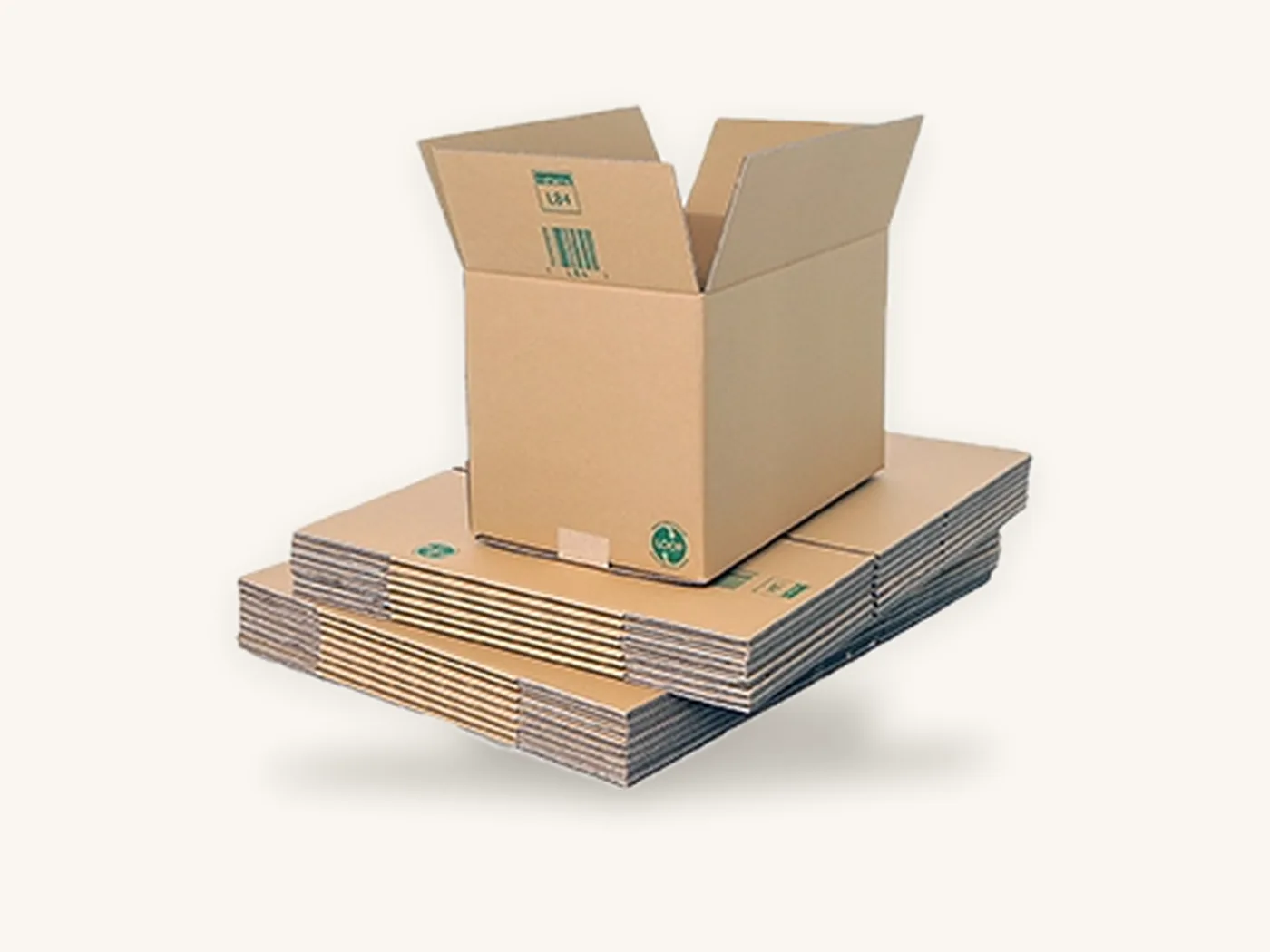
A single-wall box has one fluted layer between two liners. A double-wall box, typically BC-flute, adds a second fluted layer and liner, which greatly improves stacking strength and puncture resistance for a modest increase in thickness.
For light, compact parcels shipped by express, a well-fitted single-wall B-flute box is often enough. For heavy goods, fragile items, anything going by sea, and cartons that will be stacked on pallets, heavy duty double wall boxes are the safer default. Our corrugated board page lists the grades we run.
| Shipment | Suggested outer box | Why |
|---|---|---|
| Light DTC order by express (under about 5 lb) | Single-wall mailer or B-flute shipping box | Adequate for short express transit if the fit is snug |
| Mid-weight parcel, several hubs (about 5 to 20 lb) | B-flute or C-flute RSC | More crush resistance for repeated handling |
| Heavy or fragile parcel | BC-flute double wall shipper | Stacking strength and puncture resistance |
| Cartons stacked on pallets for air or sea | Double wall, consistent sizes | Holds compression over long dwell times |
| Master carton holding retail units | Double wall with dividers | Protects inner retail boxes from corner crush |
Box style for export
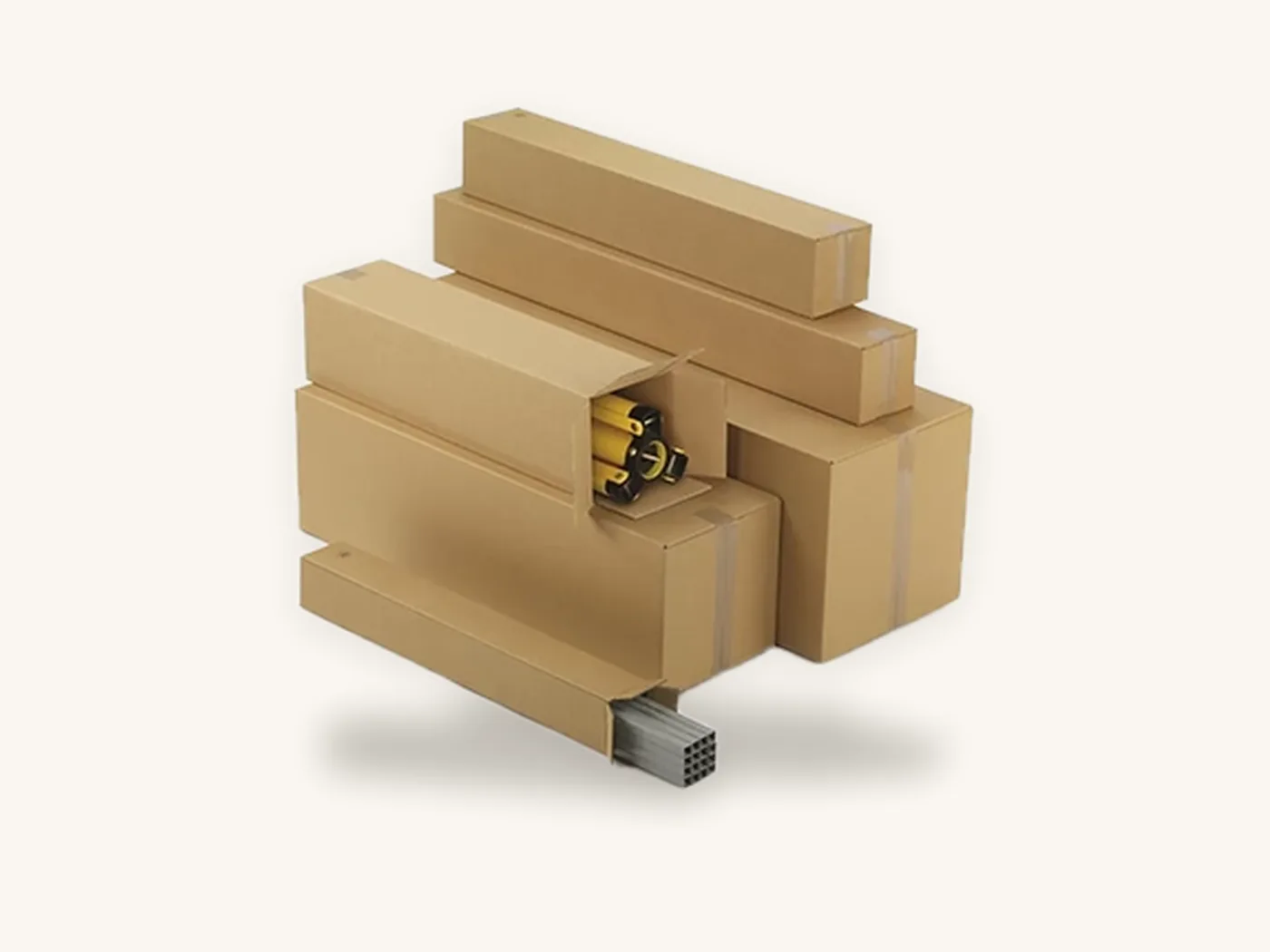
A regular slotted container is the standard export carton because it uses board efficiently, stacks squarely and tapes shut securely along both seams. Custom shipping boxes in this style can be made to exact internal dimensions and printed with handling marks. Die-cut mailer boxes work for express DTC parcels but are less suited to heavy stacked freight.
Size the box to the product, then to the pallet
An oversized box lets products shift, needs more fill and raises volumetric weight. Size from the packed product first, as described in our guide to right-sized packaging. If you ship on pallets, also check that your carton footprint fits common pallet sizes without overhang, because cartons that hang over the pallet edge lose much of their stacking strength.
Tip: if you ship to both the US and the UK or Europe, remember that pallet standards differ. Design carton footprints that tile efficiently on the pallets your freight forwarder actually uses at each end.
Protecting against moisture, heat and long transit
Moisture is the hazard most brands underestimate. Paper fiber absorbs water from humid air, and damp corrugated board loses a meaningful share of its compression strength. A box that stacks well in a dry warehouse can sag in a humid container.
Moisture protection measures
- Store boxes dry. Keep flat boxes and packed cartons off concrete floors and away from loading doors before dispatch.
- Bag the product. Seal moisture-sensitive products in a bag or liner inside the box, so the product stays dry even if the carton gets damp.
- Add desiccant where appropriate. Desiccant packs inside a sealed inner bag help with electronics, leather and metal parts on long sea routes.
- Choose stronger board. Extra board strength gives you margin for the strength lost to humidity.
- Use water-resistant tape. Some tapes lose adhesion in humidity and heat; test your tape in the conditions your parcels will see.
- Consider coatings. Moisture-resistant coatings on the outer liner help against surface water, though they may affect recyclability.

Heat-sensitive products
Candles, chocolate, cosmetics with waxes or oils, and some supplements can soften or separate in heat. Packaging alone cannot keep a product cool across a multi-day route, so choose faster services for these items, avoid shipping into peak summer heat where possible, and hold products in inserts so a softened product does not deform against the walls.
Packing for customs inspection
Customs authorities in any country can open a parcel to verify its contents. The packaging should make that easy to do without undoing all of your protection.
How to make inspection painless
- Group contents in inner packs. Put each product or set in its own retail box or bag, so an inspector can lift items out without loose parts spilling.
- Use inserts rather than loose fill. Box inserts and dividers keep items positioned even after the box is opened and repacked.
- Put a copy of the invoice inside. Place a copy of the commercial invoice or packing list on top of the contents, and attach the originals outside in a document pouch as your carrier requires.
- Tape neatly, not excessively. Seal both seams with an H-pattern of strong tape. Wrapping the entire box in tape makes inspection slower and resealing harder.
- Label inner packs. Match product names and quantities on inner packs to the invoice so the contents are easy to verify.
Customs documentation and HS codes
Packaging and paperwork go together. Even perfectly packed goods sit in a warehouse if the documents are incomplete or inconsistent. The details vary by carrier, service and destination, so use this as an overview and confirm specifics with your carrier or a licensed customs broker.
Core documents for commercial shipments
| Document | What it does | Notes |
|---|---|---|
| Commercial invoice | States seller, buyer, description, quantity, value, currency, origin and HS code for each item | Required for most commercial shipments; must match the contents |
| Packing list | Lists what is in each carton, with weights and dimensions | Helps inspection and receiving; essential for multi-carton shipments |
| Postal customs declaration | Customs form used for postal parcels | Your postal carrier supplies the correct form for the value and weight |
| Air waybill or bill of lading | Transport contract and receipt for air or ocean freight | Issued by the carrier or forwarder |
| Export filing | Electronic export information for certain US exports | Depends on value, destination and product; ask your carrier or forwarder |
| Certificates or permits | Origin certificates, product permits or licenses | Only for certain products or trade agreement claims |
What an HS code is
The Harmonized System is an international product classification used by customs authorities worldwide. The first six digits are shared internationally, and countries add further digits for their own tariff and statistics purposes. In the US, exports are classified under Schedule B numbers and imports under the Harmonized Tariff Schedule.
The code determines which duty rates, taxes and controls apply, so it matters to get it right. Classify by what the product is and what it is made of, not by how you market it. You can search the US Harmonized Tariff Schedule and the Census Bureau's Schedule B search as a starting point, and ask a customs broker for anything uncertain.
Descriptions that clear customs
- Write "cotton women's T-shirts, knitted," not "apparel" or "merchandise"
- Write "scented soy wax candles in glass jars," not "gifts" or "home goods"
- State the material, use and quantity for each line item
- Declare the actual transaction value, and do not mark sales as gifts
- Keep product names consistent across the invoice, packing list and inner labels
Duties, taxes and who pays
Import duties and sales taxes such as VAT are generally charged by the destination country. Your shipping terms decide whether you or the customer pays them. Delivered duty paid means you pay and the customer receives the parcel without extra charges; delivered at place means the customer may be asked to pay on delivery. For DTC brands, unexpected charges at the door often lead to refused parcels, so decide deliberately and state your policy at checkout.
Shipping to the UK, UAE and other markets
Every destination has its own customs procedures, tax rules, restricted items and product labeling requirements. The notes below cover general considerations only; check current rules with the destination's government and your carrier before shipping.
United Kingdom
Goods shipped from the US to the UK go through UK customs, and import VAT and any applicable duties are generally due. Carriers usually collect the information they need through the commercial invoice. Some product categories, such as cosmetics, toys, electrical goods and food, have UK-specific safety and labeling rules that apply to the product and its packaging, so review them before you print retail boxes for the UK market.
United Arab Emirates
Shipments to the UAE are cleared by UAE customs, with import duty and VAT applied according to current rules. Certain product categories may need registration, specific labeling or Arabic-language information on consumer packaging. The climate is hot for much of the year, so plan for heat exposure during final-mile delivery and storage, especially for wax, oil-based and chocolate products.
Other markets
For the EU, Canada, Australia and other destinations, the same framework applies: accurate commercial documents, correct classification, a decision on who pays duties and taxes, and product-specific rules for regulated categories. Some items, including batteries, aerosols, perfumes and other dangerous goods, face carrier restrictions regardless of destination; our guide to shipping hazmat packaging covers the basics.
Labeling the outer box for export
The outer box has to carry clear information that survives handling and makes sense to people who may not read English.
Outer carton labeling checklist
- Shipping label placed flat on the largest top surface, not across a seam or edge
- Customs documents in a clear adhesive pouch where the carrier requires it
- Carton numbering on multi-box shipments, such as "1 of 4"
- Gross weight and dimensions on freight cartons
- Internationally recognized handling symbols, such as "this way up," "fragile" and "keep dry," printed or labeled on at least two sides
- Country of origin marked where required, typically on the product or its retail packaging as well
- No old labels or barcodes left on reused boxes
- Hazard labels only where the contents actually require them, applied according to carrier rules
Printing handling marks directly on the box during production is cleaner and more durable than hand-applied stickers. For product-level origin marking rules, see our guide to country of origin labeling. For smaller runs or mixed destinations, custom labels and stickers let you add destination-specific information without reprinting boxes.
Wooden pallets and crates
If you ship on wooden pallets or in wooden crates, most countries require the wood to be treated and marked under the international ISPM 15 standard to prevent the spread of pests. Your freight forwarder can confirm this. Plastic pallets or corrugated pallet systems are alternatives in some cases.
Volumetric weight and the cost of export packaging
International carriers generally bill on the greater of actual weight and volumetric weight, which is calculated from the outer dimensions. Express carriers commonly use a metric formula based on centimeters and kilograms, but divisors and rules vary by carrier and service, so check your rate agreement.
Because international rates per kilogram are much higher than domestic rates, empty space in a box costs more overseas than at home. The principles in our dimensional weight packaging guide apply directly: trim the longest dimensions first and remove oversized fill.
What export-grade boxes cost
Stronger board costs more per box, but the difference is small next to international freight and the cost of a damaged parcel. Indicative per-unit prices from our current rates, including free US delivery of the boxes:
| Spec | 100 | 500 | 1,000 |
|---|---|---|---|
| Shipping box RSC, B-flute, 16x12x8 in, 1-color | $7.47 | $3.99 | $3.32 |
| Double wall shipper, BC flute, 18x14x12 in, 1-color | $17.97 | $9.58 | $7.98 |
A double wall shipper at 18x14x12 in costs about $9.58 each at 500 units. Size and print change the figure, so price your exact dimensions in the instant price estimator.

Testing export packaging before you ship
A pack that works domestically is not proven for export. Test with the added stresses in mind.
A practical test sequence
- Pack exactly as you will ship, including inner bags, inserts, invoice copy and tape.
- Drop test from about waist height onto each face, the critical edges and a corner. Repeat the sequence to simulate additional handling.
- Compression check: stack weight on the packed box for a day or more and look for bulging or sagging.
- Humidity exposure: store a packed box in a humid space, such as a bathroom after a shower, then repeat the compression check.
- Vibration: drive a packed box around in a vehicle for a few hours and check for loosened caps and worn wraps.
- Ship real test parcels to contacts or partners in your key destination countries and ask for photos on arrival.
For a formal protocol, the ISTA test procedures define drop, vibration and compression sequences for different shipping modes; our ISTA drop testing guide explains which ones fit parcels. If you ship glass, ceramics or electronics, our guide to shipping fragile items covers cushioning and suspension designs in more depth.
Ordering export packaging from Box Sense
Box Sense manufactures shipping and heavy-duty boxes with in-house printing, die-cutting and gluing, and has locations in the United States, United Kingdom and UAE. We ship worldwide.
What to send for an export packaging quote
- Packed product dimensions and weight, per carton
- Destination countries and shipping mode: express parcel, postal, air freight or ocean
- Whether cartons will be palletized, and the pallet size used
- Board preference, or a request for a recommendation: single wall, double wall or BC-flute
- Inserts or dividers needed for multi-unit cartons
- Print: brand marks, handling symbols, carton numbering areas
- Quantities to price and the date you need boxes in hand
- Delivery address for the boxes
Timeline and terms
- Quote within 24 hours. We confirm pricing for each size and grade.
- Free design support. Dielines, artwork setup and a 3D digital proof, with two revision rounds.
- Free structural samples. Test the fit, drop and humidity performance before printing. See samples.
- Production. 8–12 business days after proof approval; rush in 5 business days on most corrugated styles.
- Delivery. Free shipping on every US order. International shipping of the boxes is quoted at cost.
The minimum order is 10 boxes with no die or plate charges. Brands shipping heavy or industrial goods can also see common formats on our automotive and industrial packaging page, and the shipping boxes style page covers RSC variations.
Frequently asked questions
What is the best packaging for international shipping?
The best international shipping packaging is a corrugated box one grade stronger than you would use domestically, sized closely to the product, with inserts or inner packs that keep items secure if customs opens the box. Double wall board suits heavy, fragile and palletized goods. Add moisture protection for sea freight and humid destinations, and test a packed sample before shipping in volume.
Do I need double wall boxes to ship overseas?
Not always. Light, compact products shipped by international express often travel well in a snug single-wall B-flute box. Double wall boxes are the safer choice for heavy items, fragile goods, cartons stacked on pallets and anything shipped by sea, where boxes face long periods under compression in humid conditions. Test both options with drops and stacking before deciding.
What is an HS code and where do I put it?
An HS code is a standardized number that classifies a product for customs, with six digits shared internationally and extra digits added by individual countries. It goes on the commercial invoice or customs declaration next to each item's description. The code determines duty rates and controls, so classify carefully and ask a customs broker when a product could fall under more than one code.
Can customs open my package?
Yes. Customs authorities can open and inspect any international shipment to verify contents, value and compliance. Pack so inspection does not ruin your protection: group items in inner boxes or bags, use inserts instead of loose fill, include a copy of the invoice inside, and seal with neat, strong tape. Printed tape helps show whether a box was resealed later.
How do I protect cardboard boxes from humidity during shipping?
Store boxes and packed cartons dry and off the floor, seal moisture-sensitive products in inner bags, add desiccant for long sea routes, and choose stronger board to offset the strength corrugated loses in humid air. Moisture-resistant coatings help against surface water but may affect recyclability. Test a packed box after humidity exposure to see how it holds up.
Who pays duties and taxes on international orders?
It depends on the shipping terms you choose. Under delivered duty paid terms, the seller pays duties and import taxes and the customer receives the parcel with no extra charges. Under delivered at place terms, the customer may be asked to pay before delivery. Unexpected charges often lead to refused parcels, so state your policy clearly at checkout and confirm rules with your carrier.
Does Box Sense ship custom boxes internationally?
Yes. Box Sense has locations in the United States, United Kingdom and UAE and ships custom packaging worldwide. Shipping is free on every US order, and international shipping is quoted at cost. Standard production takes 8–12 business days after proof approval, and transit time depends on the destination and shipping method you choose.
Next steps
List your main export destinations, shipping modes and heaviest or most fragile products, then price export-grade cartons in the instant price estimator. When you are ready, request a quote with your packed dimensions and destinations, and ask for free structural samples so you can drop and humidity test the pack before your first overseas shipment.
Boxes in this guide
Order the packaging we covered

Written by the Box Sense Packaging Team
Our structural designers, prepress technicians and production staff print and convert custom boxes every day for brands in the United States, United Kingdom and UAE. Questions about this guide? Talk to us.