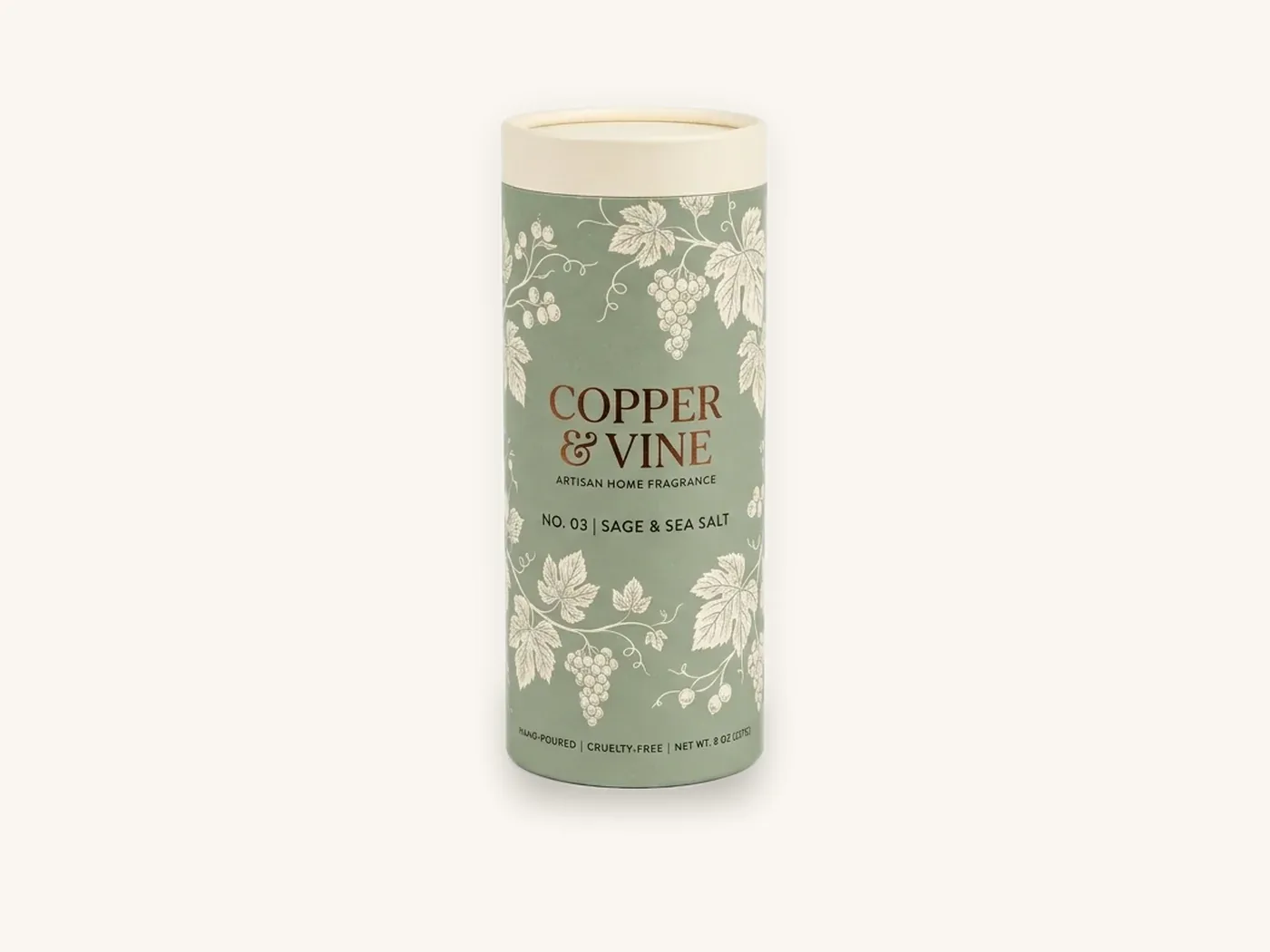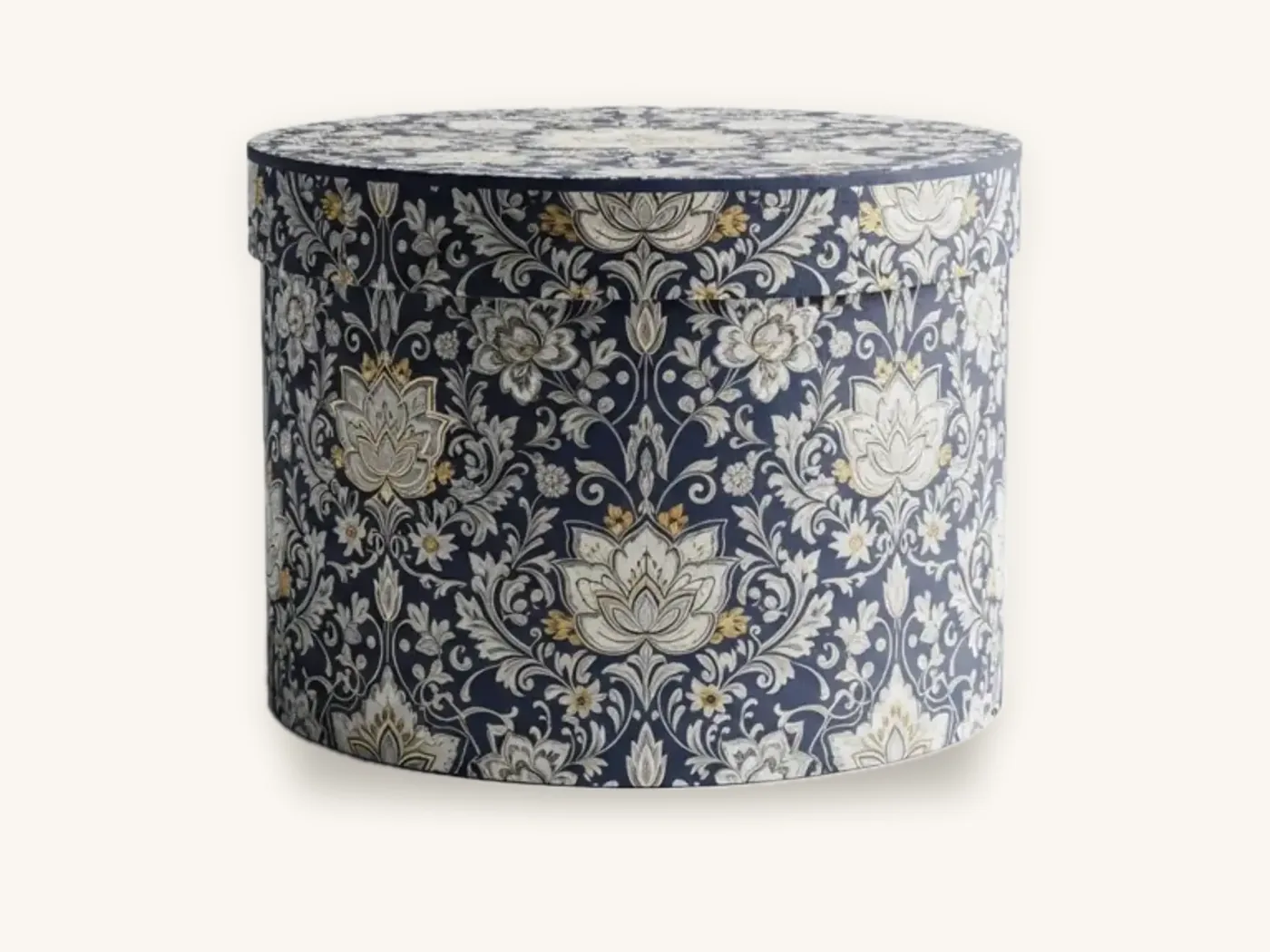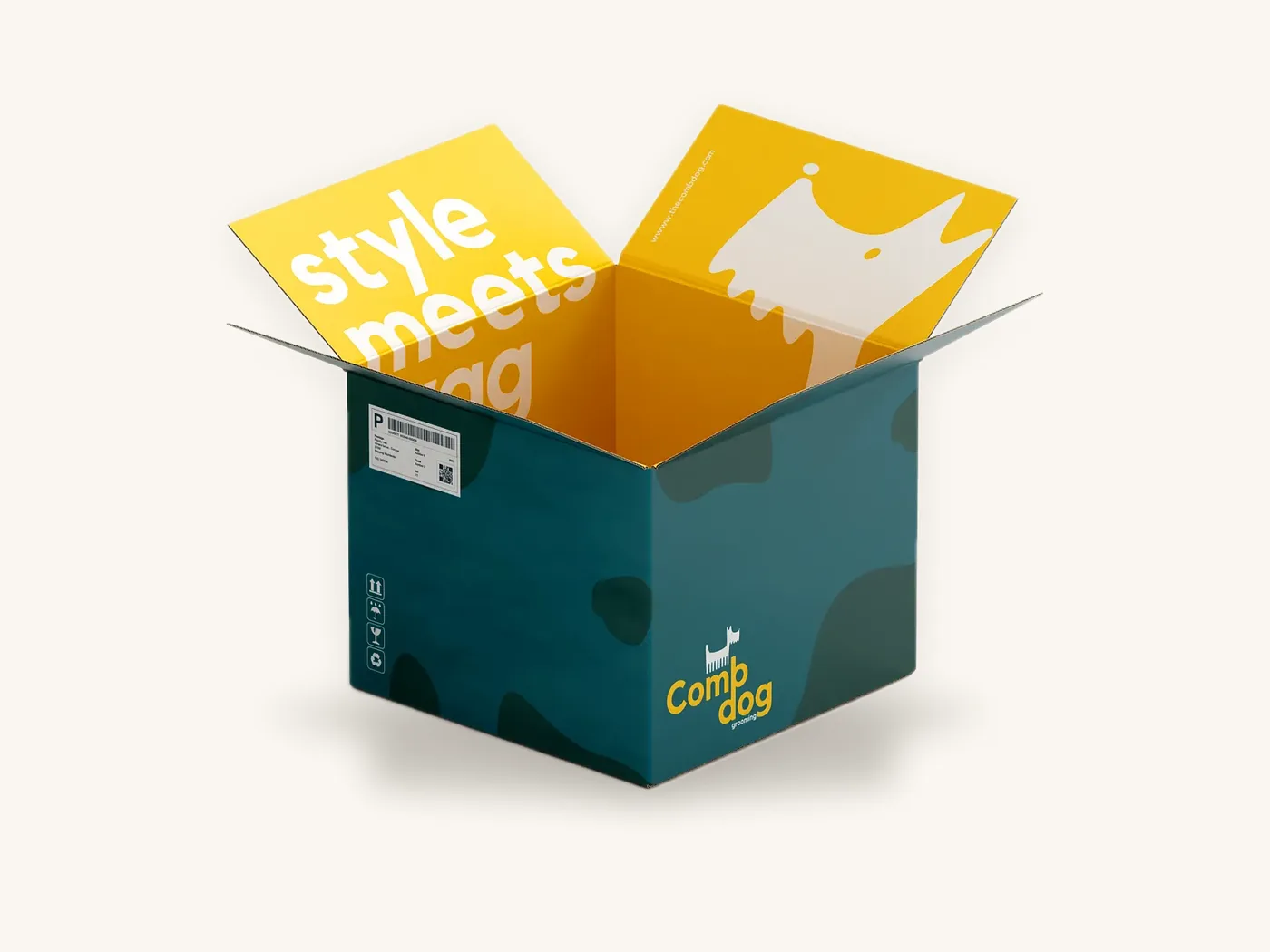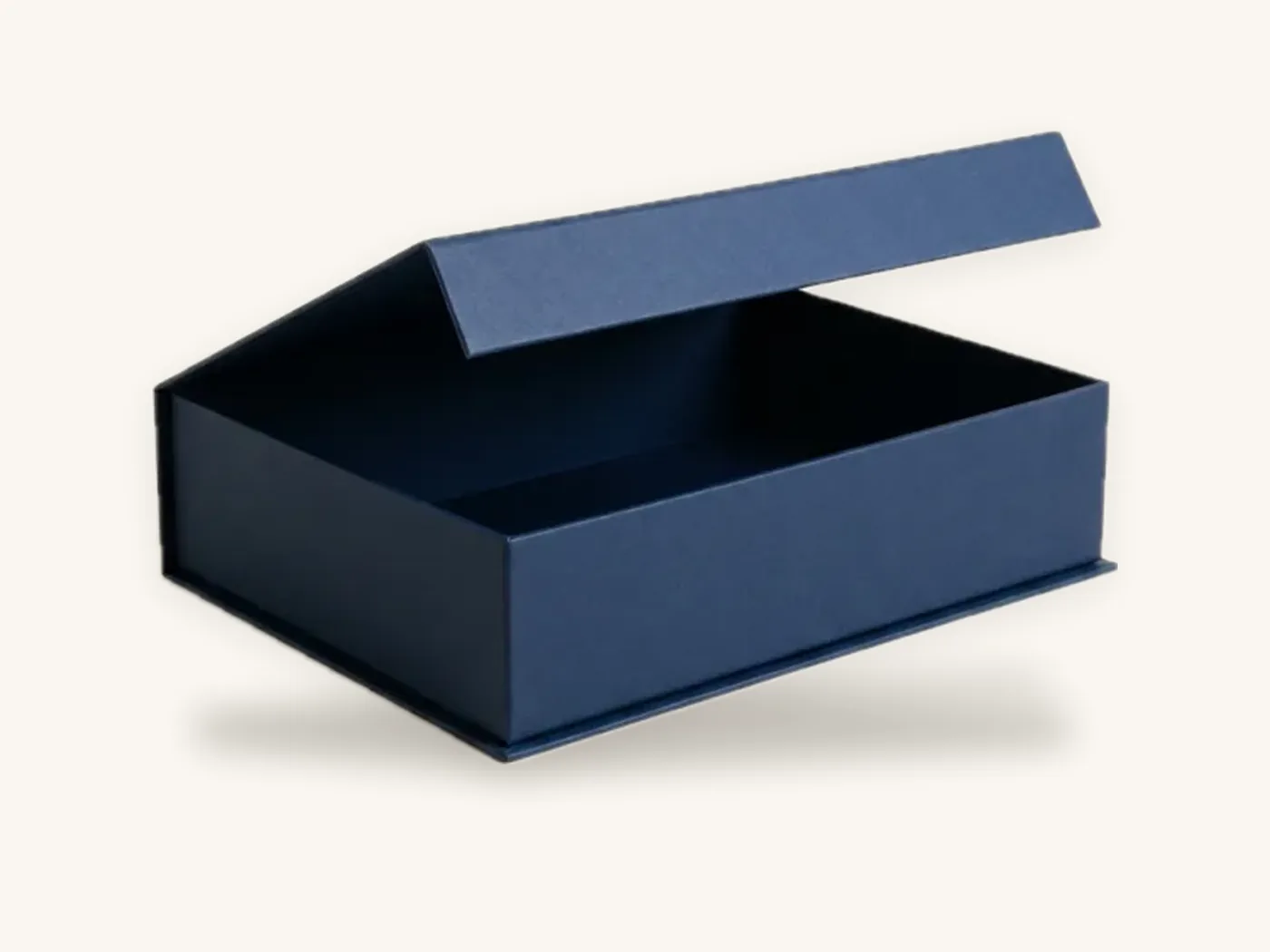
Magnetic closure boxes are rigid presentation boxes built from thick greyboard, wrapped in printed or specialty paper, with small magnets hidden under the wrap so the lid flap snaps shut. They open like a hardcover book, close with a soft click and can be reused for years, which is why they show up around watches, fragrance sets, premium apparel and corporate gifts.
A good one depends on getting a handful of details right: the construction style, the board thickness, the wrap paper and its finish, how many magnets sit where, and the insert that holds the product. This guide works through each of those, shows what custom magnetic boxes cost at real quantities, and lists the design mistakes that cause warped lids and weak closures.
Key takeaways
- A magnetic closure box is a rigid set-up box: greyboard walls, a paper wrap and concealed magnets in the flap and front wall. It does not fold flat unless you order a collapsible version.
- 2 mm greyboard is the common default; go thinner for small jewelry boxes and thicker for large or heavy sets.
- Most of the look comes from the wrap paper and finish: soft-touch lamination, foil and embossing are applied to the paper before it is wrapped.
- A 10x8x3 in rigid magnetic box with soft-touch, foil and an insert runs about $14.23 each at 100 units and about $6.32 at 1,000, with US shipping included.
- Collapsible magnetic boxes cut storage and freight volume, at the cost of a slightly less monolithic feel.
- Box Sense makes magnetic gift boxes from 10 units, with a free dieline, a 3D digital proof and standard production of 8–12 business days after proof approval.
How a magnetic closure box is built
Nearly every quality issue traces back to one of four layers.
The greyboard shell
The structure is cut from rigid greyboard, a dense, recycled chipboard that does not crease like paperboard. Panels are cut to size, V-grooved or stayed at the corners and glued into a base tray. The hinged lid is a separate board glued to a spine, so it behaves like the cover of a book.
Common thicknesses run from roughly 1.2 mm for small jewelry pieces to 2.5 mm or 3 mm for large hampers. The thicker the board, the more the box resists crushing and the more "weight" a customer feels in the hand.
The wrap
The shell is covered in a sheet of printed art paper or a textured specialty paper. The wrap is glued on, pulled around the edges and turned in along the inside rim, usually by about 15 mm, so no raw board shows when the lid opens. The inside of the tray and lid is then lined with a second sheet.
Because the wrap is a paper sheet, all the printing and finishing happens flat, before wrapping. That is why a magnetic box can carry the same soft-touch, foil or embossed detail as a luxury carton.
The magnets
Small, thin disc magnets are set into shallow pockets in the greyboard, one set in the lid flap and a matching set, or a steel plate, in the front wall of the tray. The wrap covers them completely. Two magnets are typical for small and mid-size boxes; wide flaps often use three or four so the whole edge closes evenly rather than just the center.
The insert
The product sits in a cavity cut into foam, paperboard or a covered platform, which controls how it is presented at the moment of opening.
Magnetic closure box styles compared
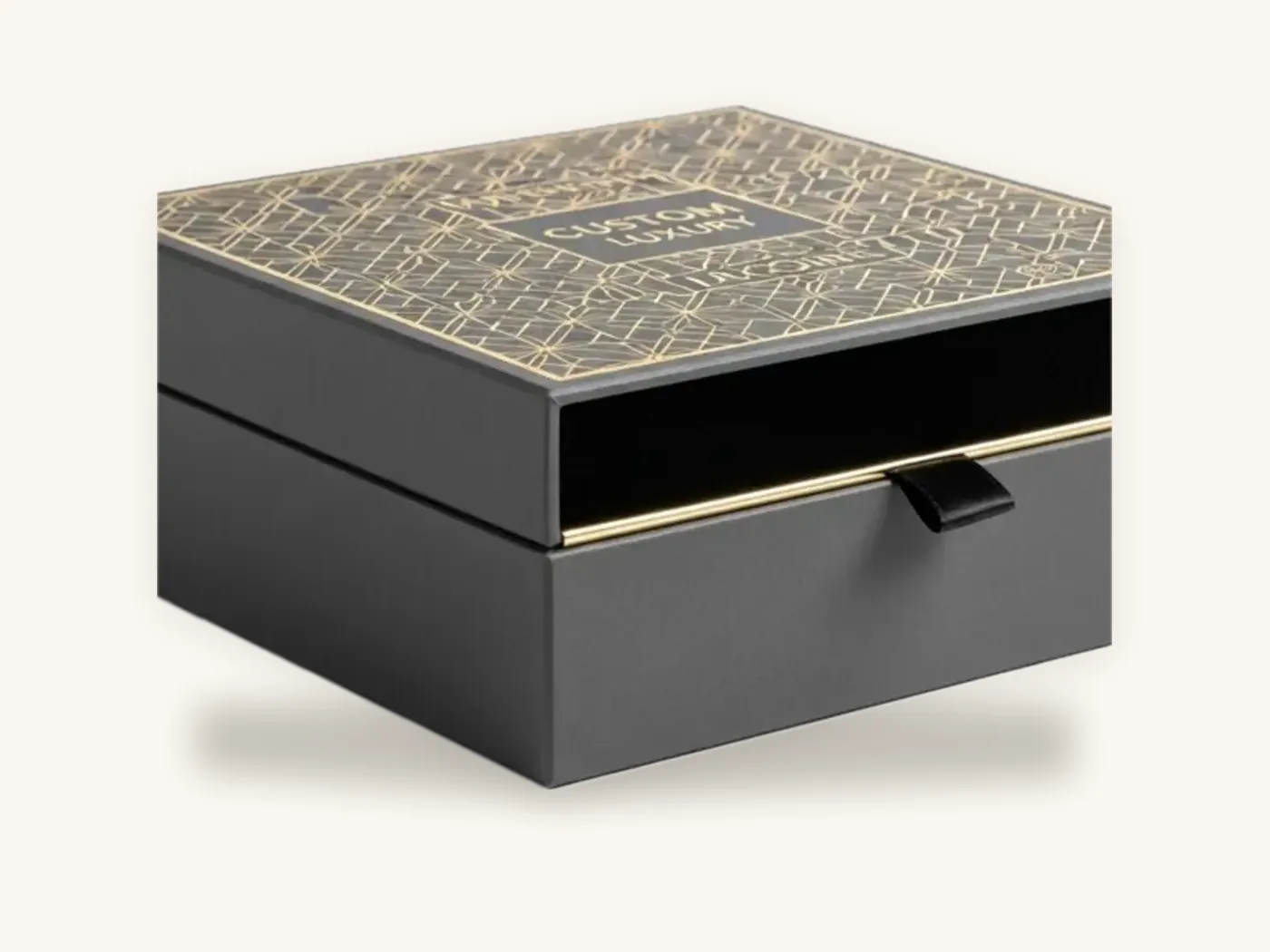
"Magnetic box" describes a closure, not a single structure. Here is how the common formats differ. The magnetic closure boxes style page shows each of them.
| Style | How it opens | Best for | Trade-offs |
|---|---|---|---|
| Book-style flap | One flap hinged at the back wraps over the top and down the front | Most gift sets, apparel, tech accessories | The most familiar format, so less distinctive on its own |
| Double-door (gate) | Two half-lids hinged on opposite sides meet in the middle | Bottles, fragrance, reveal-style launches | Two magnet sets and tighter tolerances add cost |
| Collapsible | Walls fold down flat; magnets or glued tabs lock them upright | E-commerce gifts, large boxes, brands with limited storage | Very slightly less rigid at the corners |
| Magnetic lid with drop front | Lid lifts and a front wall folds down | Display-style presentation, kits with many items | More complex hinge work |
| Magnetic box with ribbon | Book-style plus a ribbon pull or tie | Wedding, holiday and corporate gifts | Ribbon adds hand assembly |
Book-style or double-door
Pick book-style when the product is wider than it is tall and you want the first view to be the whole layout at once: a watch with its strap spread, a skincare set in a row, a folded shirt. Pick double-door when the product is tall or you want a deliberate two-step reveal, such as a spirits bottle standing in the center of the tray.
Fixed or collapsible
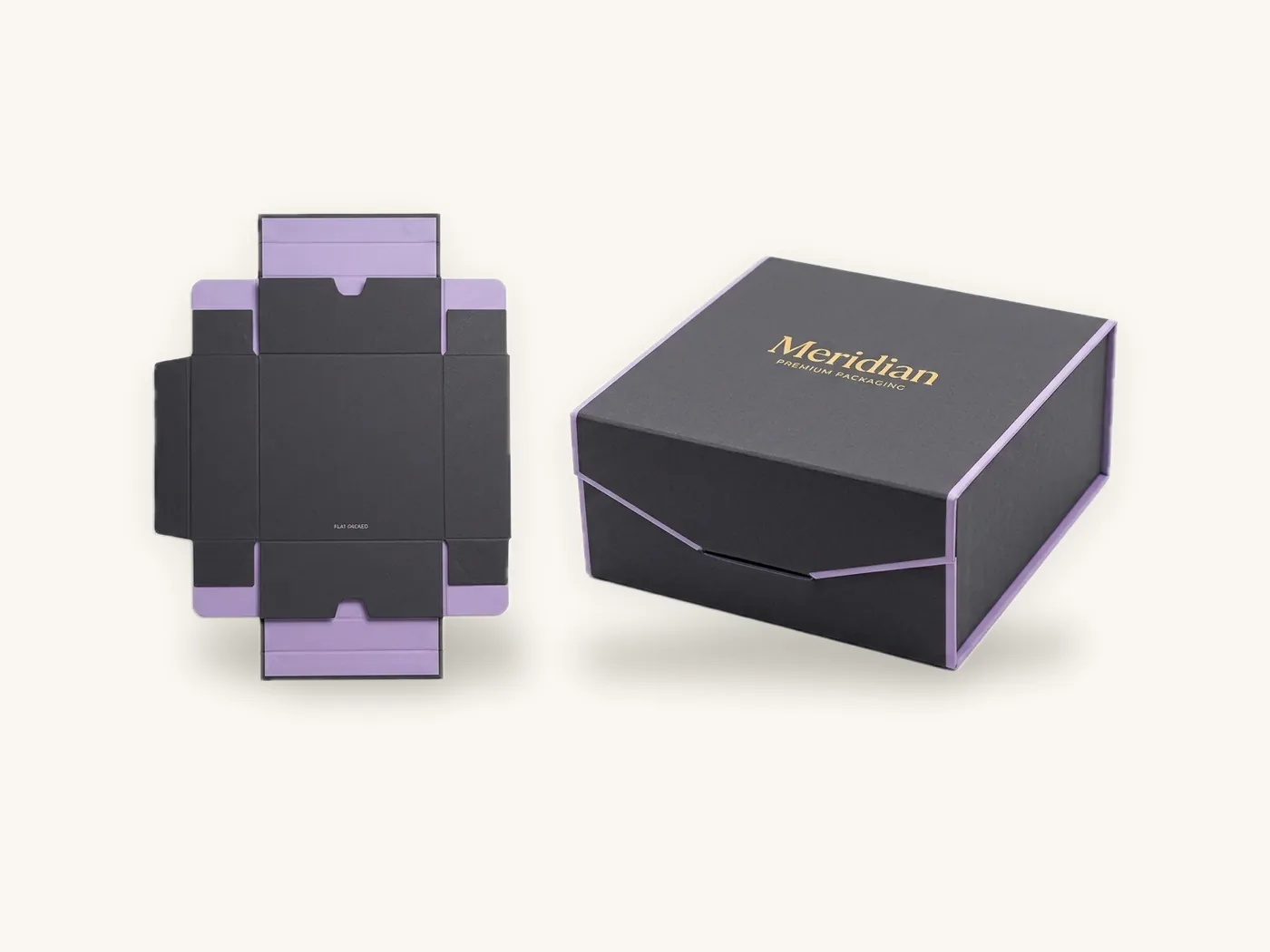
Standard magnetic closure boxes arrive fully assembled, which means every box takes up its full volume in cartons, on pallets and in your stockroom. Collapsible rigid boxes ship flat and are set up in a few seconds. If you store hundreds of units or ship them to a fulfillment center, the difference in freight and shelf space is significant. Our collapsible rigid boxes guide covers the folding mechanisms in detail.
Tip: if you choose collapsible, ask for a structural sample and set up ten boxes in a row. Whoever packs orders should find the fold sequence obvious without instructions; if they hesitate, add a small printed fold guide on the inside base.
Board thickness, wrap paper and finishes
The board decides how the box feels. The wrap decides how it looks. Get the pairing wrong and even a well-printed box will warp or crack at the corners.
Choosing board thickness
| Box size (longest side) | Typical greyboard | Why |
|---|---|---|
| Up to about 4 in (jewelry, lipstick, single serum) | 1.2–1.5 mm | Thick board looks clumsy on small boxes and eats internal space |
| About 4–10 in (most gift sets, apparel accessories) | 2 mm | Firm walls without excess weight; the most common spec |
| About 10–16 in (hampers, garments, multi-bottle kits) | 2.5 mm | Resists bowing on long lid panels |
| Over 16 in or heavy contents | 3 mm | Needed so the lid does not sag between the spine and the magnets |
Weight matters as much as size: a small box holding heavy glass may need the next grade up.
Wrap paper options
- Coated art paper: the default for full-color printing. It takes lamination well and reproduces photography and gradients accurately.
- Uncoated or textured paper: linen, felt and laid textures give a tactile, natural feel. Fine print and small type soften on heavy textures, so keep artwork bold. Our textured and specialty papers page shows the range.
- Metallic and holographic paper: striking under store lighting, often printed with white ink underneath colored areas.
- Kraft wrap: a natural look for eco-positioned or artisan brands, typically printed in one or two colors.
Finishes that work on rigid wraps
Rigid wraps take nearly every finish listed on our printing and finishes page. A few pairings are worth knowing:
- Soft-touch lamination plus foil: the classic premium combination. The matte, velvety surface makes a foil logo stand out sharply.
- Matte lamination plus spot UV: a gloss logo or pattern on a flat matte field, visible when the box catches light.
- Blind embossing or debossing: a logo with no ink, relying entirely on shadow. Works best on thicker, uncoated papers.
- Gloss lamination: saturated color, but it shows fingerprints and scuffs more on a box people handle.
Watch out: dark, full-coverage wraps without lamination can crack along the board edges, exposing white paper fibers. If your design is a deep black or navy all over, specify lamination or ask for a paper dyed through in that color.
Designing custom magnetic boxes that close cleanly
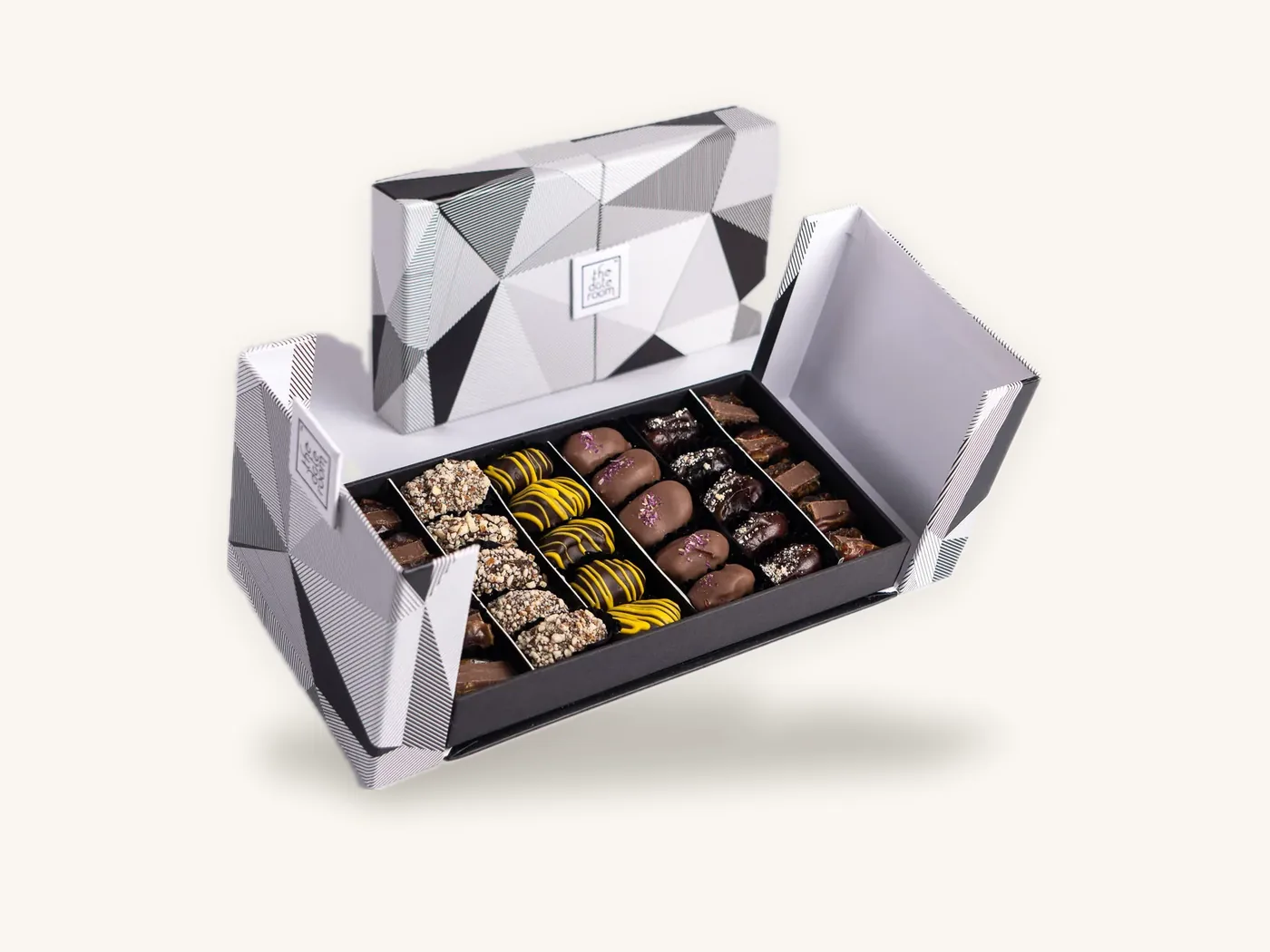
Magnetic gift boxes fail in a few predictable ways: the lid springs open, the flap does not sit flush, or the box warps after a few weeks. Each has a design cause.
Magnet placement and strength
The closure should hold the lid firmly when the box is carried by its sides, yet release with a light pull at the front edge. Too weak and the lid pops open in a tote bag; too strong and customers struggle to open it, or the pull strains the hinge.
Placement matters as much as strength. Magnets close to the front corners hold the whole edge flat. Magnets bunched in the center let the corners lift slightly, which looks cheap. For flaps wider than about 8 in, ask for a magnet near each corner rather than one large pair in the middle.
Hinge and spine allowance
The spine is the narrow strip that joins the lid to the back wall. If the spine is too tight, the lid will not close flat over a full tray; too loose and it sags. Your dieline needs a spine width that accounts for the thickness of both boards plus the wrap on each side. This is one reason to let the manufacturer build the dieline around your internal dimensions rather than drawing it yourself.
Preventing warping
Paper expands and contracts with humidity, and a wrap glued to only one face of a board pulls it into a curve. Lining the inside of the lid with a second sheet balances that tension. Specify inside lining on every panel that is visible or large, and let boxes acclimate in their outer cartons before unpacking them in a very dry or very humid space.
A design checklist for magnetic gift boxes
- Measure the product in its presentation position, including any pouch, card or ribbon, and set internal dimensions from that.
- Decide the opening direction and draw where the customer's eye lands first when the flap opens.
- Choose board thickness from size and weight, not appearance alone.
- Pick the wrap paper and finish together, confirming small type stays legible on textured stock.
- Specify magnet positions, especially on wide flaps.
- Design the inside lid: a message, pattern or foil mark here is seen at the best possible moment.
- Size the insert with the box, and decide whether the insert lifts out.
- Plan for shipping: will the box travel inside a mailer, and does that mailer need its own insert?
- Request a structural sample and test open-and-close at least fifty times before approving.
Inserts for magnetic closure boxes
The insert holds the product in place, frames it, and often carries a second layer of branding. Our box inserts and dividers page lists every option; these are the choices that matter most for rigid presentation boxes.
| Insert type | Look and feel | Best for | Notes |
|---|---|---|---|
| EVA foam, wrapped or flocked | Precise cavity, soft surface | Watches, electronics, glass bottles | Most protective; cavities are cut to the product shape |
| Paperboard or greyboard platform | Clean, paper-based, printable | Skincare sets, stationery, apparel accessories | Keeps the whole box paper-based for recycling |
| Satin or fabric-lined bed | Soft, traditional luxury | Jewelry, perfume, wedding gifts | Adds hand assembly |
| Molded pulp tray | Natural, textured, plastic-free | Eco-positioned brands, candles, ceramics | Shape is set by a mold, so plan it early |
| Lift-out tray with ribbon pull | Two-layer reveal | Multi-item kits with hidden contents underneath | Requires extra internal depth |
Paper-based and molded pulp inserts suit brands that want customers to recycle the packaging without separating foam. Our foam vs paperboard inserts comparison goes deeper on protection versus recyclability.
What magnetic closure boxes cost
Rigid boxes cost more than folding cartons because they use more material and far more assembly: every shell is glued, wrapped, lined and fitted with magnets. The best way to control cost is to understand which choices move the price.
Indicative prices
These per-unit prices come from our current rates, with free US shipping included. For your size and finishes, use the instant price estimator.
| Spec | 10 | 100 | 250 | 500 | 1,000 | 5,000 |
|---|---|---|---|---|---|---|
| Rigid magnetic box, 2 mm, 10x8x3 in, soft-touch, foil, insert | $21.50 | $14.23 | $10.12 | $7.59 | $6.32 | $4.49 |
| Rigid box (non-magnetic), 2 mm wrapped, 8x6x3 in, full color, matte | $13.76 | $9.10 | $6.47 | $4.85 | $4.05 | $2.87 |
| Jewelry rigid box, 2 mm, 3x3x1.5 in, matte, foil, insert | $5.06 | $3.35 | $2.38 | $1.79 | $1.49 | $1.06 |
The jump from 10 to 100 units cuts the magnetic box price by about a third, and from 100 to 1,000 by more than half. The curve flattens after a few thousand units because materials and hand assembly make up most of the cost.
What drives the price
- Size: larger boxes use more greyboard and wrap paper, and larger lids often need extra magnets.
- Construction: double-door and drop-front designs have more parts and more gluing than a single flap.
- Wrap paper: specialty and metallic papers cost more than coated art paper.
- Finishes: foil costs about $60 in one-time tooling, embossing about $60 and spot UV about $40. After tooling, the per-unit effect is small.
- Insert: a custom insert die is about $45 one time, plus the insert material per unit.
- Quantity: setup is shared across the run, so moving up a tier usually lowers the unit price noticeably.
Shipping magnetic boxes without damage
A rigid box is strong, but it is not a shipping container. The wrap scuffs on conveyor belts, corners dent under stacked parcels, and a carrier label stuck to soft-touch lamination leaves a mark when peeled.
Use an outer shipper
For direct-to-consumer orders, ship the magnetic box inside a printed or plain mailer sized to leave a small gap all around. Custom mailer boxes in E-flute are the usual choice; our custom mailer boxes guide explains how to size one around an inner box. For wholesale and bulk replenishment, pack the boxes in corrugated cartons, which the custom shipping boxes guide covers.
Protect the finish and the closure
Wrap each box in tissue or a paper sleeve so the lamination does not rub against corrugated flutes. The magnets are designed for customer handling, not a parcel dropped on its edge, so a small paper seal sticker across the flap keeps the lid shut in transit and doubles as a tamper indicator.
Where magnetic gift boxes fit, and where other formats work better
Magnetic boxes suit products where the package is kept, displayed or regifted. They are common in gifts and events, jewelry, fragrance, premium electronics accessories and executive gifting.
They are not always the right answer. If the product is cylindrical, such as a candle, spirits bottle or loose tea, a rigid tube often presents it better and uses less material; our paper tube packaging guide compares the two. For hat, flower and round gift presentations, the round boxes guide shows lift-off lid options. If you need a retail carton that sits on a shelf in quantity, a paperboard folding carton will cost far less per unit; the folding cartons guide explains the trade-offs.
A quick decision guide
- Choose a magnetic closure box when the packaging is part of the product's value, the unit price supports it, and customers are likely to keep the box.
- Choose a collapsible magnetic box when you want the same look but store or ship large quantities before assembly.
- Choose a folding carton or mailer when the box is mostly protective or will be discarded after opening.
How to order magnetic closure boxes from Box Sense
A few measurements and a clear idea of the presentation are enough for a quote.
What to include in your request
- Product dimensions and weight, measured as it will sit in the box
- Style: book-style, double-door, collapsible or a note that you want a recommendation
- Approximate board thickness, or let our team recommend from size and weight
- Wrap: printed art paper, textured, metallic or kraft
- Print coverage outside and inside, and any PMS colors
- Finishes: lamination type, foil, embossing, spot UV
- Insert type and whether the product must be held at an angle or lifted out
- Quantities to price, for example 100, 500 and 1,000
- Target in-hand date and delivery location
The process
- Quote confirmed within 24 hours. We confirm pricing for your spec and the quantities you ask about.
- Free design support. We build the dieline around your product, set up artwork on it and send a 3D digital proof, with two rounds of revisions included.
- Samples. Unprinted structural samples are free, so you can test fit, magnet strength and the insert. A printed sample of approved artwork is free on orders of 100 units or more. See samples for details.
- Production. Standard production takes 8–12 business days after proof approval.
- Delivery. Shipping is free on every US order; international shipping is quoted at cost.
The minimum order is 10 boxes. There are no die or plate charges; one-time tooling applies only if you choose foil, embossing, spot UV or a custom insert. Defective boxes reported within 14 days are reprinted free. If you need help with artwork, our design services team handles setup at no charge.
Frequently asked questions
What are magnetic closure boxes made of?
Magnetic closure boxes are made from rigid greyboard, a dense recycled chipboard, usually around 2 mm thick. The board is wrapped in printed art paper or specialty paper and lined on the inside. Small disc magnets sit in pockets under the wrap in the lid flap, with matching magnets or a steel plate in the front wall. An insert of foam, paperboard or molded pulp holds the product.
How much do custom magnetic boxes cost?
Price depends on size, style, wrap paper, finishes, insert and quantity. As a reference, a 10x8x3 in rigid magnetic box in 2 mm board with soft-touch lamination, foil and an insert runs about $14.23 per box at 100 units and about $6.32 at 1,000, with US shipping included. Small jewelry-size rigid boxes cost much less. Use the pricing estimator for your exact spec.
Are magnetic gift boxes recyclable?
The greyboard and paper wrap are paper-based, so many recycling programs accept them once inserts are removed. Plastic lamination, foam inserts and the magnets themselves complicate recycling. For the most recyclable version, choose an uncoated or aqueous-finished wrap, a paperboard or molded pulp insert, and confirm what your customers' local programs accept before printing any recycling claim.
Can magnetic closure boxes ship flat?
Standard magnetic boxes are fully assembled and cannot ship flat, because the walls are glued and wrapped as one rigid shell. Collapsible rigid boxes are the flat-shipping alternative: the walls fold down for storage and lock upright with magnets or tabs when set up. They look very similar when assembled and save significant storage and freight volume on larger orders.
What is the minimum order for magnetic closure boxes?
Box Sense makes magnetic closure boxes from a minimum of 10 units. That makes small runs practical for influencer kits, launch samples, corporate gifts and testing a design before a larger order. Unit prices fall substantially at higher quantities, so it is worth comparing 100, 500 and 1,000 units in the estimator before deciding.
How strong are the magnets in a magnetic box?
The magnets are chosen to keep the lid closed during normal handling while letting the customer open it with a light pull at the front edge. They are not intended to hold the box shut if it is dropped or carried by the lid. Wider lids use more magnets placed near the corners. A structural sample is the best way to judge the closure feel before production.
How long does it take to produce custom magnetic boxes?
Box Sense confirms quotes within 24 hours. After you approve the 3D digital proof, standard production takes 8–12 business days. Allow extra time if you want a structural or printed sample first, or if your artwork goes through revisions. US shipping is free, and international delivery time depends on the destination.
Do magnetic closure boxes need an outer shipping box?
For parcel shipping, yes. The wrap and finish can scuff, dent or pick up label marks in the carrier network. Place the magnetic box inside a mailer or corrugated shipper sized with a little clearance, and wrap it in tissue to protect the lamination. For retail delivery, pack boxes in corrugated cartons with dividers or paper between layers.
Next steps
Measure your product in its presentation position, decide between a fixed and collapsible build, then price your spec with the rigid box price estimator. When you are ready, request a magnetic closure box quote and we will confirm pricing within 24 hours, build the dieline around your product and send a 3D proof for your artwork.
Boxes in this guide
Order the packaging we covered
Written by the Box Sense Packaging Team
Our structural designers, prepress technicians and production staff print and convert custom boxes every day for brands in the United States, United Kingdom and UAE. Questions about this guide? Talk to us.