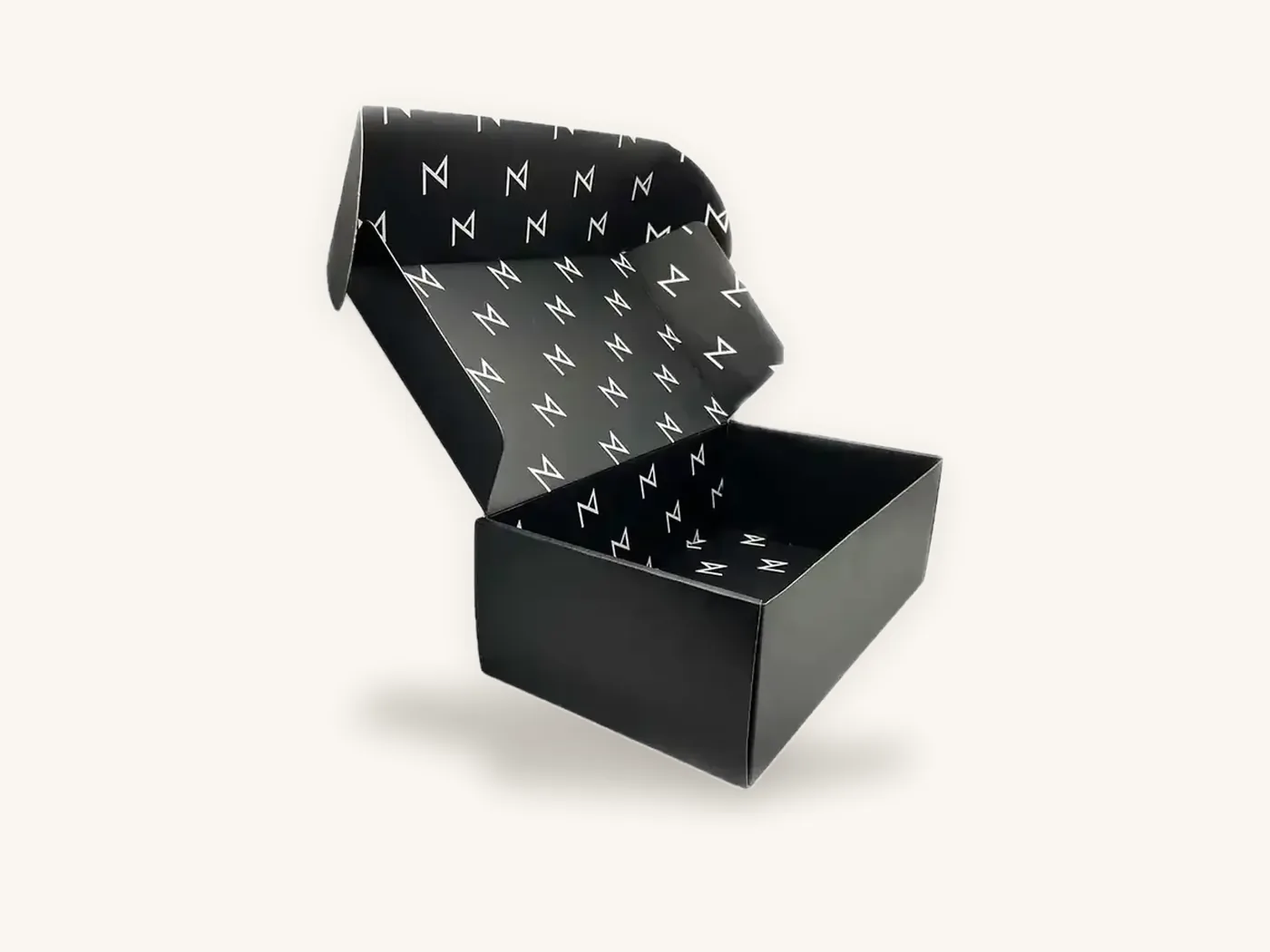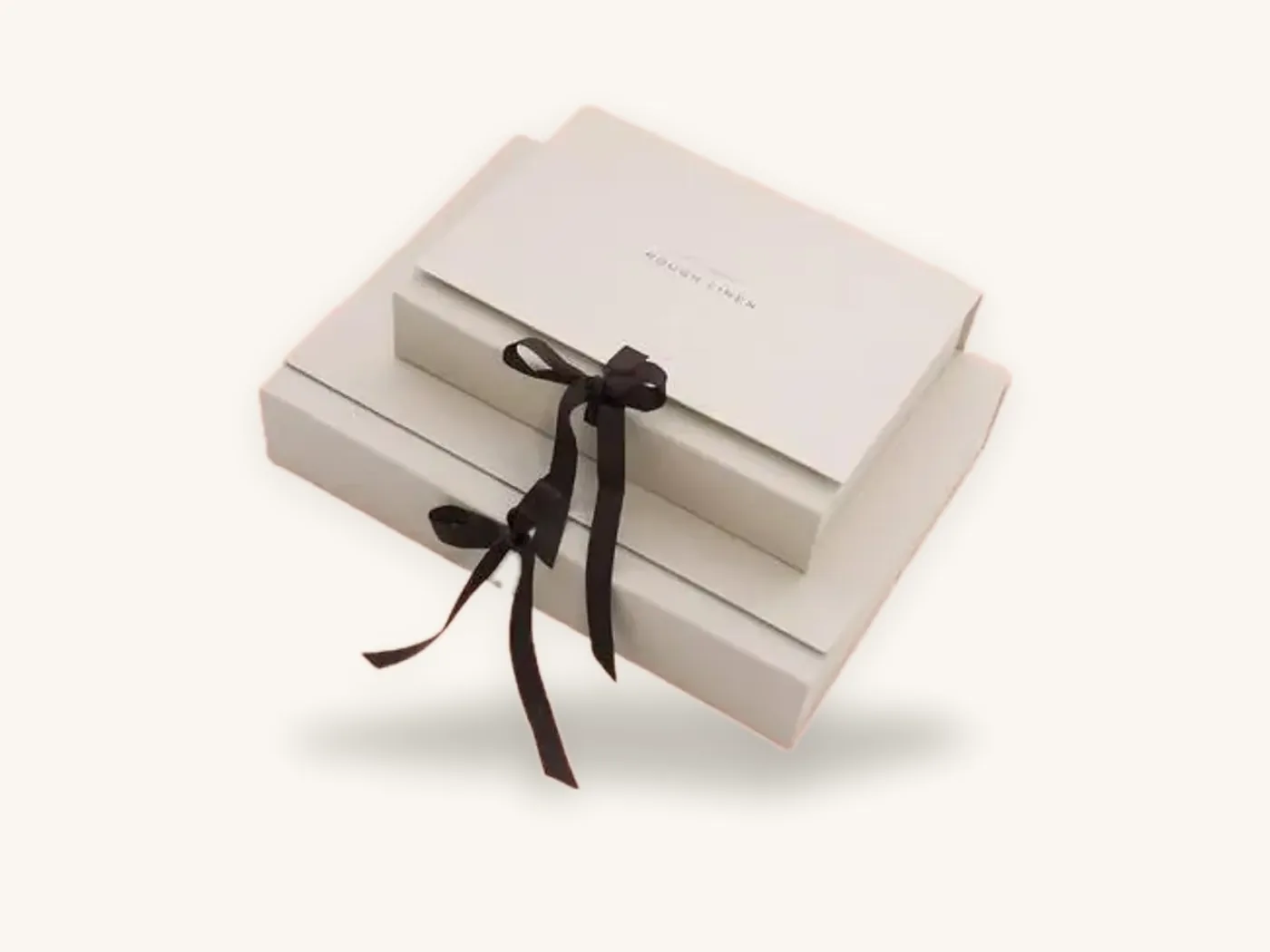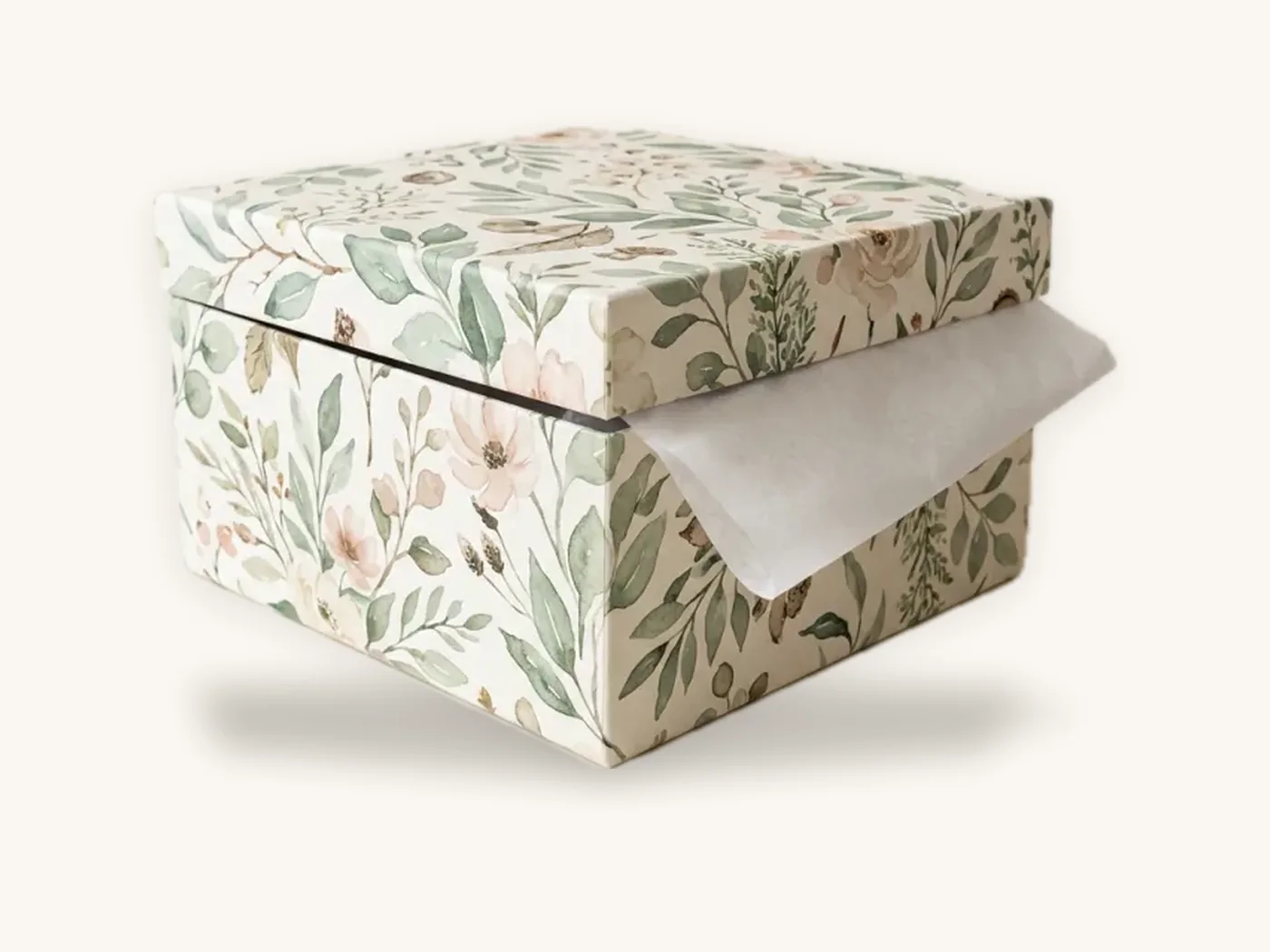
Apparel packaging for most clothing brands is a combination of three parts: an outer box or mailer sized to the folded garment, a layer of tissue that wraps and protects the fabric, and a small closure detail such as a sticker, card or hang tag. Get the proportions right and a folded shirt arrives flat, clean and ready to gift. Get them wrong and it arrives creased, crushed or swimming in an oversized box.
The best choice depends on your price point and how you sell. A basics brand shipping thousands of tees a month and a boutique label selling silk blouses need very different clothing boxes, even though both are folding a garment into a rectangle.
This guide sets out apparel packaging tiers, compares box styles, shows how to size clothing boxes around the fold, and covers tissue, stickers, returns, cost per order and how to order custom apparel boxes.
Key takeaways
- Build packaging in layers: outer box, tissue wrap, then one closure detail. Each layer should earn its cost.
- Printed E-flute mailers suit most direct-to-consumer clothing; slim folding cartons suit single tees; rigid or magnetic boxes suit gifts and premium pieces.
- Size the box around the folded garment in its tissue, not the garment's measurements on a hanger.
- Choose tissue and ink with the fabric in mind; strong dark colors can transfer onto light fabrics if packages get damp.
- Tuck-front mailers close again without tape, which makes returns easier for customers.
- A 10x8x4 in E-flute mailer printed inside and outside runs about $4.33 each at 100 units and about $1.92 at 1,000, with US shipping included.
Three tiers of apparel packaging
Most clothing brands fall into one of three tiers. The tier sets which components you need, and it stops you overspending on basics or underspending on pieces customers expect to feel special.
| Tier | Typical products | Outer packaging | Inside | Closure details |
|---|---|---|---|---|
| Essentials | Tees, socks, basics, multipacks | Kraft or one-color mailer, or slim folding carton | Plain or one-color tissue, or none | Logo sticker |
| Branded direct-to-consumer | Fashion collections, activewear, knitwear | Full-color printed mailer with inside print | Printed tissue | Sticker seal, thank-you or care card |
| Premium and gift | Silk, cashmere, outerwear, limited editions | Rigid two-piece or magnetic box, sometimes in a shipper | Printed tissue, dust bag or ribbon | Hang tag, ribbon, foil details |
Moving between tiers
You do not have to choose one tier for every order. Many brands ship standard orders in a printed mailer and reserve a magnetic gift box for orders above a set basket value or for holiday gift sets. Keeping the same tissue and sticker across both makes the upgrade feel consistent.
If you are just starting out, begin with a printed mailer and printed tissue. That combination delivers most of a premium feel at a moderate cost, and you can add a rigid box later for specific collections.
Clothing box styles compared
There are more options than "box or bag." Each style below changes protection, presentation and how much space your packing table and storeroom need.
| Style | Protection | Presentation | Ships flat | Choose it when |
|---|---|---|---|---|
| Poly mailer | Water resistant, no crush protection | Basic | Yes | Low-cost basics where unboxing matters little |
| Printed E-flute mailer | Good crush and corner protection | Strong, with inside print | Yes | Most branded online clothing orders |
| Slim folding carton or t-shirt box | Light, keeps a fold neat | Clean retail look | Yes | Single tees, gift sets, multipacks inside a shipper |
| Two-piece rigid box | Very good, holds shape | Premium lift-off lid | No | Knitwear, outerwear, boutique gifts |
| Magnetic closure box | Very good | Premium, reusable | No, unless collapsible | Limited editions, luxury gifts, VIP orders |
| Kraft mailer | Good, hides scuffs | Natural, understated | Yes | Eco-positioned and minimalist brands |
Printed mailers for most online orders
A roll-end tuck-front mailer in E-flute corrugated is the workhorse of branded clothing delivery. It survives parcel carriers without an outer box, assembles without tape and gives you three print surfaces: lid top, inside lid and base. Our custom apparel boxes come in mailer, rigid and magnetic formats, and the mailer boxes page shows the structure. For the trade-offs against bags, see poly mailer vs mailer box.
Slim boxes for tees
A folded tee is thin, so a standard mailer often leaves too much air. T-shirt boxes are slim mailers or folding cartons around 1 to 2 in deep that hold a single folded shirt flat. They are also useful for multipacks sold as gift sets. The t-shirt packaging guide goes deeper on folds and single-garment formats.
Rigid and magnetic boxes for premium pieces
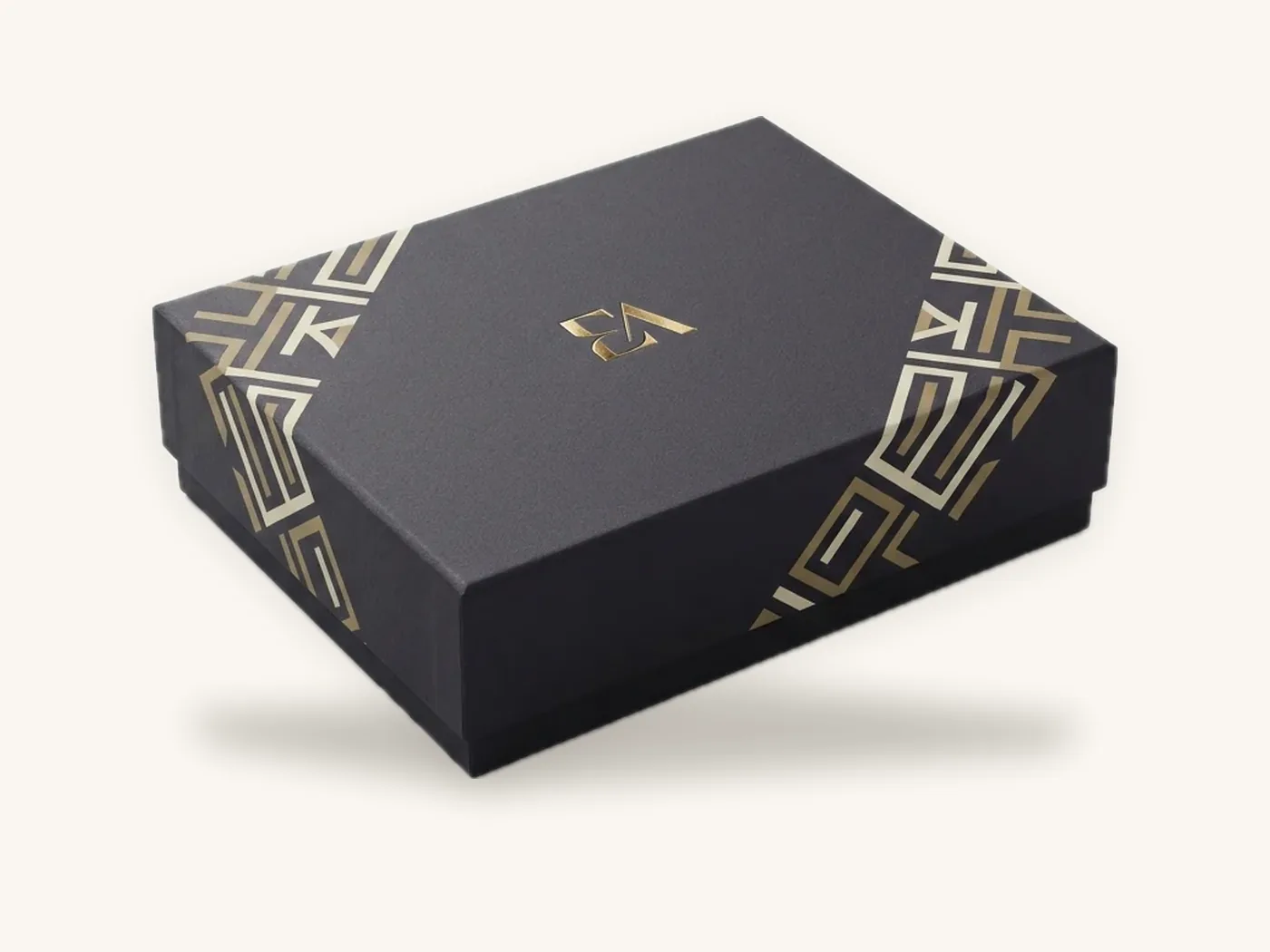
For garments where the box is part of the purchase, a two-piece box with a lift-off lid or a magnetic closure box signals value before the tissue is opened. These do not fold flat and cost more to store and ship. For direct delivery, place them in a plain shipper so the wrap paper arrives unscuffed.
Kraft for understated brands
Kraft mailer boxes use a natural brown liner that hides scuffs from the carrier network. One strong color or white ink on kraft reads well; full-color photography looks muted. Kraft pairs naturally with white or kraft tissue and a simple black sticker.
Sizing clothing boxes around the fold
The most common apparel packaging mistake is sizing a box from a size chart instead of a folded, wrapped garment. The fold decides the footprint, the fabric weight decides the depth, and tissue adds a little to both.
Typical folded footprints
These are practical starting ranges for garments folded on a standard retail fold. Your fold, fabric and sizes will differ, so treat them as a starting point and always measure a real wrapped garment.
| Garment | Typical folded footprint | Typical folded depth | Box to test first |
|---|---|---|---|
| T-shirt, single | roughly 9x12 in | roughly 3/4 to 1 in | Slim t-shirt box or shallow mailer |
| Long-sleeve top or light knit | roughly 10x13 in | roughly 1 to 2 in | Shallow mailer |
| Hoodie or sweatshirt | roughly 11x14 in | roughly 2 to 4 in | Mid-depth mailer |
| Jeans or trousers | roughly 10x14 in | roughly 2 to 3 in | Mid-depth mailer |
| Dress, light fabric | roughly 10x13 in | roughly 1 to 2 in | Shallow mailer or two-piece box |
| Knitwear, chunky | roughly 12x14 in | roughly 3 to 5 in | Deep mailer or rigid box |
| Socks, underwear, accessories | roughly 6x8 in | roughly 1 to 3 in | Small mailer or folding carton |
| Outfit bundle, two to three pieces | footprint of the largest item | sum of depths, compressed slightly | Deep mailer |
A sizing process that works
- Fold with a folding board. Use the same board your packers will use, so every garment lands on the same footprint.
- Wrap it in tissue. Wrap as it will ship, with sticker applied.
- Measure length, width and depth. Measure depth lightly pressed, since soft goods compress a little in a closed box.
- Add little or no clearance for soft goods. Unlike rigid products, folded fabric can go close to zero clearance on length and width; add roughly 1/4 in on depth if a card sits on top.
- Group your range into as few sizes as possible. Two or three box sizes usually cover a full clothing line. Fewer sizes lower unit costs and simplify storage.
- Check the biggest size in each group. Make sure an XXL hoodie still closes without bulging the lid.
- Test a structural sample. Pack it, close it, shake it and ship it to yourself.
Tip: design your box sizes around your best-selling multi-item order, not just single garments. If a tee plus a pair of joggers is your most common basket, one mailer that fits both neatly can replace two sizes.
Dimensional weight and oversized boxes
Carriers price larger parcels partly by outer volume, known as dimensional weight. Lightweight clothing in an oversized box can end up billed for space rather than weight. Right-sizing is usually the single biggest shipping saving available to apparel brands. Confirm current dimensional weight rules with your carrier for your service level.
Tissue paper, stickers and the reveal layer
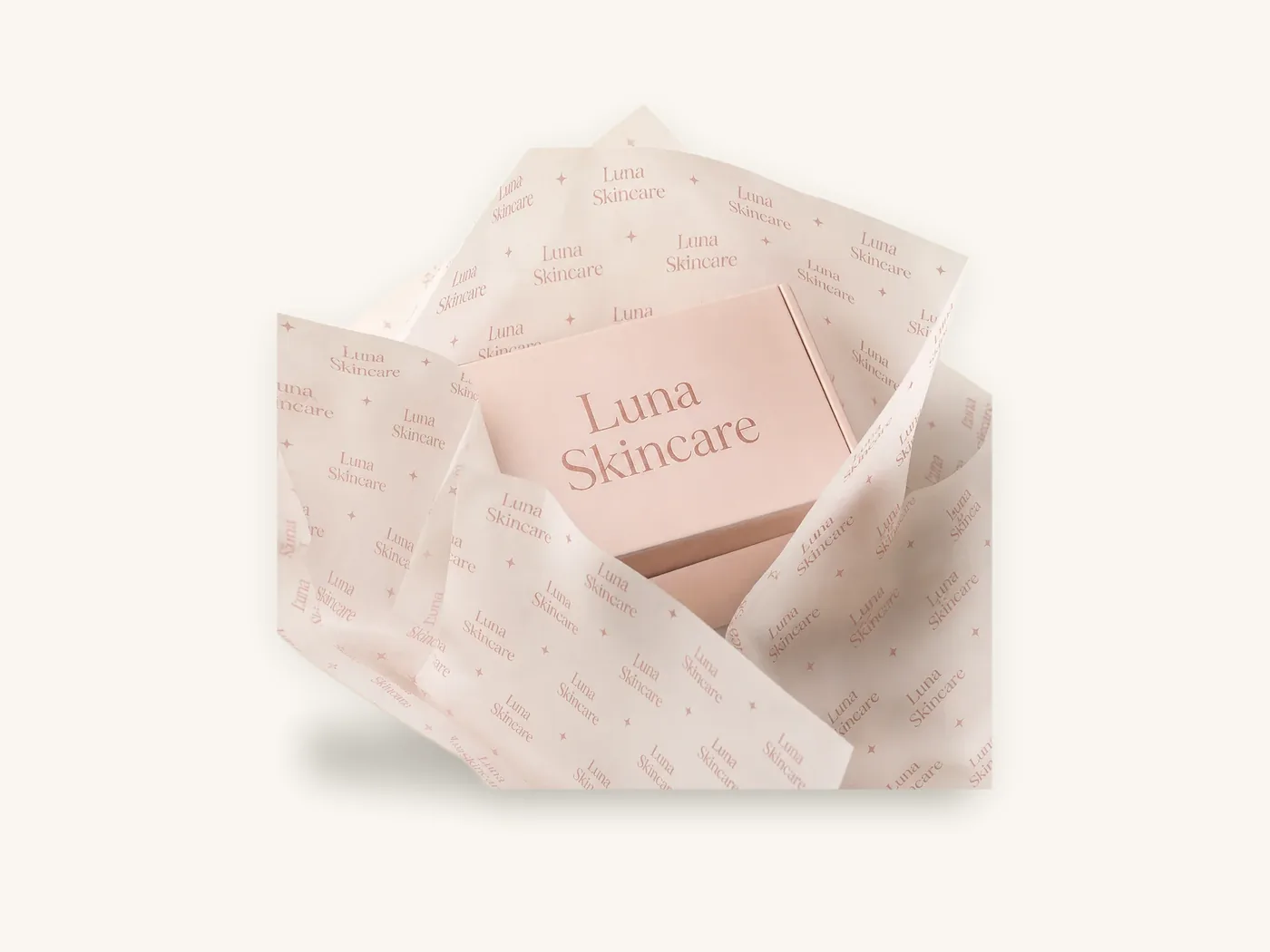
The inside of an apparel box is where the brand experience actually happens. A customer lifts the lid, sees tissue folded with a sticker seal, and opens it to find the garment. That sequence costs little per order and is often remembered more than the box exterior.
Printed tissue
Printed tissue paper is printed in one or two colors on white, kraft or colored stock. A small repeating logo pattern hides fold creases and looks deliberate from any angle. The custom tissue paper guide covers sheet sizes and pattern design.
- Wrap method. Lay two sheets crosswise in the box, place the folded garment, fold the sheets over and seal where they meet.
- Sheet size. Choose a sheet large enough to fully wrap your biggest folded item with overlap; one standard size across your range simplifies packing.
- Color choice. Light or white tissue with a darker print is the safe default for light garments.
Stickers, cards and hang tags
A logo sticker from our custom labels and stickers range seals the tissue and doubles as a brand mark. A printed card in the lid can carry care instructions, a fit guide or a discount for the next order. Hang tags belong on the garment itself and carry size, price and brand story for retail and resale.
Resist adding everything at once. One sticker and one card, both well designed, look more intentional than a pile of inserts.
Protecting garments in transit
Clothing is not fragile, but it is easy to damage in ways customers notice immediately: creases, crushed collars, marks and moisture.
Creases and crushed shape
A box that is too deep lets garments shift and bunch into creases. A box that is too shallow presses structured items flat. Tight sizing matters more than board grade here. For structured pieces like blazers or shirts with stiff collars, a shirt board or folding card inside the tissue holds the shape.
Moisture and color transfer
Parcels can sit on wet doorsteps. Corrugated board absorbs some moisture before fabric does, but a wet box can transfer dye from heavily printed tissue or inside print onto light garments. For white and pale fabrics, use light tissue as the layer that touches fabric and keep heavy ink coverage on the outside of the box. Some brands also place garments in a thin inner bag; if you do, choose one that matches your sustainability position.
Marks and scuffs
Kraft liners and matte or aqueous coatings hide carrier scuffs better than dark gloss floods. If your brand color is a dark solid, consider a matte lamination on the outside of the mailer.
Watch out: perfumed inserts, scented tissue and some inks can leave odor or residue on delicate fabrics. Test any scented or strongly colored component with a garment sealed in a box for a few days before rolling it out.
Returns-friendly apparel packaging
Clothing sees more returns than most product categories, largely because of fit. Packaging cannot fix fit, but it can make returns simpler and cheaper.
- Choose a closure that reopens cleanly. A tuck-front mailer can be closed again without tape, so customers can reuse the same box with a return label.
- Think twice before tear strips. A tear strip makes opening satisfying and tamper evident, but once torn, the box needs tape to close for a return.
- Put return instructions inside. A printed card or inside-lid message explaining how to return saves support messages.
- Leave label space. A clear, flat panel on the outside gives customers somewhere obvious to stick a return label without covering your artwork.
- Keep packaging reusable, not precious. If the box is too beautiful to reuse, customers may keep it and find another box for the return, which can arrive damaged.
Sustainable clothing boxes
Apparel shoppers often notice packaging waste. Corrugated mailers made with recycled content are widely recyclable in curbside programs. To keep the whole package recyclable, choose aqueous coating over plastic lamination, paper stickers and paper tissue, and avoid plastic inner bags where a tissue wrap does the job.
FSC-certified boards, soy or water-based inks and kraft liners are available; see our sustainability page for the full list. Any recyclability or compostability claim printed on the box should be accurate and qualified; the FTC's Green Guides describe how environmental claims should be made in the US, so check current guidance or counsel before printing one.
What apparel packaging costs per order
Think in cost per order rather than cost per box. A typical branded order stacks a box, tissue, a sticker and perhaps a card. The box is usually the largest part, so start there. These indicative per-unit box prices come from our current rates with US shipping included; use the instant price estimator for your exact size.
| Spec | 10 | 100 | 500 | 1,000 | 5,000 |
|---|---|---|---|---|---|
| Mailer box, E-flute, 8x6x3 in, full color outside | about $3.99 | about $2.64 | about $1.41 | about $1.17 | about $0.83 |
| Mailer box, E-flute, 10x8x4 in, full color inside and outside | about $6.54 | about $4.33 | about $2.31 | about $1.92 | about $1.36 |
| Subscription mailer, E-flute, 12x9x4 in, full color both sides, insert and tear strip | about $8.83 | about $5.85 | about $3.12 | about $2.60 | about $1.84 |
| Rigid magnetic box, 2 mm, 10x8x3 in, soft-touch, foil, insert | about $21.50 | about $14.23 | about $7.59 | about $6.32 | about $4.49 |
Tissue, stickers and cards add cost depending on size, colors and quantity; request them on the same quote so the order is priced together. Foil stamping carries one-time tooling of about $60 and spot UV about $40. There are no die or plate charges on standard boxes.
Ways to lower cost per order
- Consolidate sizes. Two well-chosen mailer sizes usually cost less overall than five barely different ones.
- Print the inside lid only. You keep the reveal message and save on full interior coverage.
- Use tissue to carry the branding. A one-color mailer with printed tissue can feel as branded as a full-color box.
- Reserve rigid boxes for gifts. Offer premium packaging as an upgrade or for high-value orders.
How to order custom apparel boxes from Box Sense
Our apparel and fashion packaging range covers mailers, t-shirt boxes, rigid and magnetic boxes, tissue, stickers and hang tags, all quoted together.
What to send
- Folded and wrapped dimensions of your largest and most common garments or bundles
- Preferred style: printed mailer, t-shirt box, two-piece, magnetic or kraft
- Print: outside only or inside and outside, full color, one color or PMS
- Tissue, sticker and card requirements, if you want them on the same order
- Quantities per size, for example 250 of one and 1,000 of another
- Target in-hand date, especially for a collection launch or holiday drop
- Artwork files, or a request for help from our design services team
Timeline and terms
Quotes are confirmed within 24 hours. We supply the dieline, set up artwork and send a 3D digital proof with two revision rounds included. Unprinted structural samples are free, which is the best way to test your fold and box size, and a printed sample of approved artwork is free on orders of 100 or more.
Standard production takes 8–12 business days after proof approval, with rush production in 5 business days on most corrugated and paperboard styles. The minimum order is 10 boxes, US shipping is free, and defective boxes reported within 14 days are reprinted free. If you also sell footwear, the custom shoe boxes guide covers lid-and-base and drawer shoe packaging, and the corporate gift packaging guide covers branded merchandise kits.
Frequently asked questions
What is the best packaging for clothing?
For most online clothing orders, a printed E-flute mailer box with tissue wrap offers the best mix of protection, presentation and cost. Poly mailers are cheaper and lighter but give no crush protection or unboxing experience. For premium garments and gifts, a two-piece or magnetic rigid box inside a shipper creates the strongest impression.
What size box do I need for a t-shirt?
A single folded t-shirt usually lands at roughly 9x12 in and under 1 in deep, but folds and sizes vary. Fold the shirt on the board your packers use, wrap it in tissue and measure. A slim t-shirt box or shallow mailer with minimal clearance keeps the shirt flat without extra air that raises shipping costs.
Are mailer boxes better than poly mailers for apparel?
Mailer boxes protect shape, prevent crushed collars and create a branded unboxing, and corrugated board is widely recyclable. Poly mailers cost less and weigh less, which suits basics and very high volumes. Many brands use poly mailers for everyday basics and printed mailer boxes for full-price collections, gifts and first orders.
Can custom clothing boxes be printed inside?
Yes. Inside printing is one of the most effective upgrades for clothing boxes, because the inside lid is the first thing seen on opening. You can print the full interior or only the inside lid to control cost. Keep heavy dark ink away from surfaces that touch light fabric if a package could get damp.
How do I make apparel packaging easier for returns?
Use a tuck-front mailer that closes again without tape, include a return instruction card, and leave a clear flat panel for a return label. Tear strips look great on opening but need tape for reuse. Keeping packaging sturdy and reusable encourages customers to send items back in the original box.
How much do custom apparel boxes cost?
It depends on size, print coverage, finishes and quantity. An 8x6x3 in E-flute mailer printed outside is about $1.17 each at 1,000 units, and a 10x8x4 in mailer printed inside and outside is about $1.92. A 10x8x3 in magnetic rigid box with foil and insert is about $6.32 at 1,000. Use the estimator for exact pricing.
What is the minimum order for custom apparel boxes?
Box Sense produces custom apparel boxes from 10 units, which suits new labels, capsule collections and sample runs for wholesale buyers. Short runs are printed digitally, so small quantities do not carry plate costs. Unit prices fall steeply as quantity rises, so compare a few tiers before choosing an order size.
Next steps
Fold and wrap your best-selling garments, measure them and group them into as few box sizes as possible. Then compare box options in the packaging price estimator and request an apparel packaging quote with tissue and stickers included, so we can confirm pricing within 24 hours and send dielines for your artwork.
Boxes in this guide
Order the packaging we covered
Written by the Box Sense Packaging Team
Our structural designers, prepress technicians and production staff print and convert custom boxes every day for brands in the United States, United Kingdom and UAE. Questions about this guide? Talk to us.