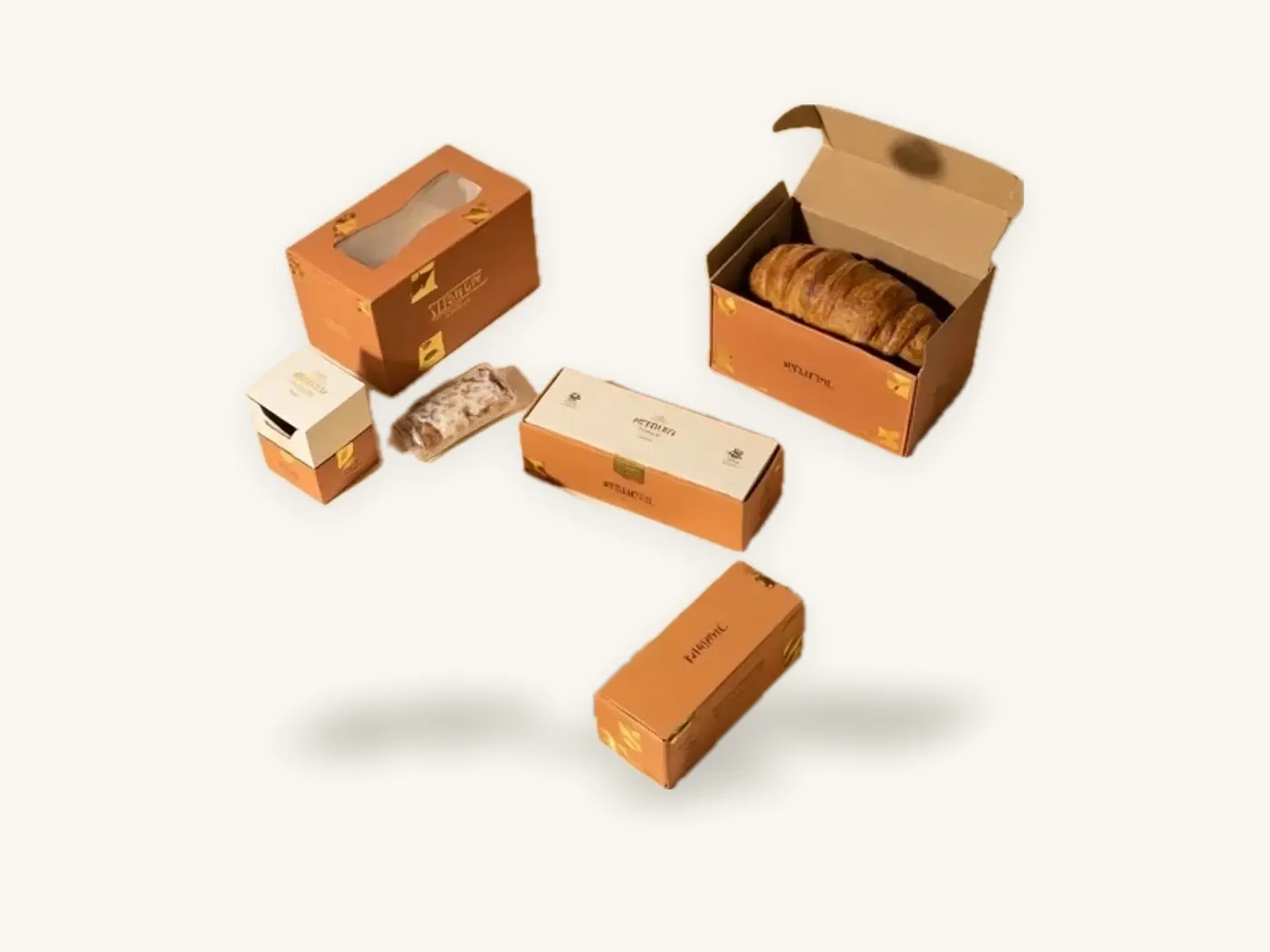
Custom donut boxes have two jobs most bakery boxes do not: they must hold oily, glazed product without soaking through, and they get stacked, often five or six high, on the way to an office. The practical answer is a grease-resistant paperboard with a coated or lined interior, a dozen box sized for a single layer with enough lid clearance for glaze and toppings, and a lock or tuck that keeps the lid flat when another box sits on top.
This guide starts with grease, because it is the failure that customers notice first, then moves through donut box sizes from singles to two dozen, stacking strength, windows, counter operations and branding. It finishes with a spec checklist for ordering doughnut packaging with Box Sense.
Key takeaways
- Grease is the main enemy. Fried dough and glaze migrate oil into uncoated board within minutes, leaving translucent spots and weakening the box.
- Grease resistance comes from the board, an interior coating, or a liner sheet; each has different effects on cost, print and recyclability.
- A single-layer dozen box is roughly 14 x 11 in inside for standard ring donuts; a half dozen is roughly 11 x 7.5 in.
- Lid clearance of about 1/2 in above the tallest topping keeps glaze and sprinkles off the lid, which usually means a 3 to 3.5 in deep box.
- For stacking, a stiffer board, a lid that locks into the front wall and panels without large windows matter more than anything printed on the box.
- Box Sense makes donut boxes from 10 units, with standard production of 8–12 business days after proof approval and free US shipping.
Why donuts are hard on paperboard
Paperboard is a mat of cellulose fibers. Oil wicks between those fibers by capillary action, the same way it spreads through a paper napkin. Warm donuts make it faster, because heat thins the oil, and glaze adds sugar syrup that softens the board surface.
The visible result is translucent grease spots that show through to the printed outside, usually in the shape of the donuts. The invisible result is a weaker board: a grease-soaked base sags when lifted and the lid bows.
Where grease shows up first
- The base under each donut, where contact is heaviest.
- Fold lines, because creasing cracks the board surface and exposes fibers.
- Corners and glue flaps, where oil can travel into the joint.
- The underside of the lid, if toppings or glaze touch it.
Warm donuts and steam
Boxing donuts straight from the fryer or the glazing rack adds steam to grease. Condensation softens the lid and can cause glaze to go tacky. Letting donuts cool until the glaze sets before boxing is the single cheapest improvement most shops can make.
Grease resistance options compared
There is no single right barrier. The right choice depends on how long donuts sit in the box, how oily your product is and how much you care about recyclability and print quality. Discuss the options with us at the quote stage; the table below explains the trade-offs.
| Barrier approach | How it works | Grease holdout | Effect on print and look | Recyclability notes |
|---|---|---|---|---|
| Uncoated SBS | Nothing between board and donut | Poor; spots within minutes | Best print surface outside | Widely recyclable, but greasy boxes are often rejected |
| Aqueous or water-based barrier coating inside | Thin coating slows oil wicking | Good for short hold times | No visible change outside | Generally compatible with paper recycling; confirm with local programs |
| Grease-resistant board grade | Board treated for oil resistance through the sheet | Good to very good | Slightly different surface; test print | Check the specific grade's recycling guidance |
| Glassine or bakery liner sheet | Separate sheet under the donuts | Very good at the base | Adds a visual layer inside | Liner and box can be separated |
| Plastic lamination inside | Film layer blocks oil | Excellent | Adds shine inside | Harder to recycle; avoid if sustainability matters |
Choosing by hold time
- Eaten within an hour (walk-in, coffee pairings): an interior barrier coating usually does the job.
- Morning office orders held for several hours: combine a coated interior with a liner sheet under the donuts.
- Filled, cream or heavily glazed donuts: add a liner and consider a grease-resistant board grade.
- Shipped or delivered long distances: rethink the format, often individual wrapping inside a corrugated outer.
Food contact in general terms
Anything touching food should use materials and coatings suitable for food contact. In the US, the FDA regulates substances that contact food, and suppliers should be able to tell you which of their coatings are intended for that use. Our guide to food-safe inks and coatings covers the general principles; confirm specifics with your packaging supplier and regulator guidance for your product. A practical rule is to keep printed inks on the outside of the box and let the coated interior or liner be the contact surface.
Watch out: heavy ink coverage on the outside does not stop grease. It just hides spots for a while and then shows them as darker blotches. Solve grease inside the box, not with a darker exterior design.
Donut box sizes: singles, half dozen, dozen and more
Donut sizes vary by shop, so measure your own. A standard yeast-raised ring donut is roughly 3.5 to 4 in across and 1.25 to 1.75 in tall; filled and topped donuts run taller, and specialty donuts can reach 5 in across.
The sizes below assume standard ring donuts laid flat in a single layer with a small gap between them. They are approximate starting points, not stock sizes.
| Pack | Layout | Approx. internal size | Typical depth | Notes |
|---|---|---|---|---|
| Single | 1 | 4.5 x 4.5 in | 2.5 to 3 in | Gift, sample or premium donut; often windowed |
| Two-pack | 1x2 | 8.5 x 4.5 in | 2.5 to 3 in | Coffee-and-donut offers |
| Three or four-pack | 1x3 or 2x2 | 12 x 4.5 in or 8.5 x 8.5 in | 3 in | 2x2 stacks better than a long 1x3 |
| Half dozen | 2x3 | about 11 x 7.5 in | 3 in | Everyday takeaway size |
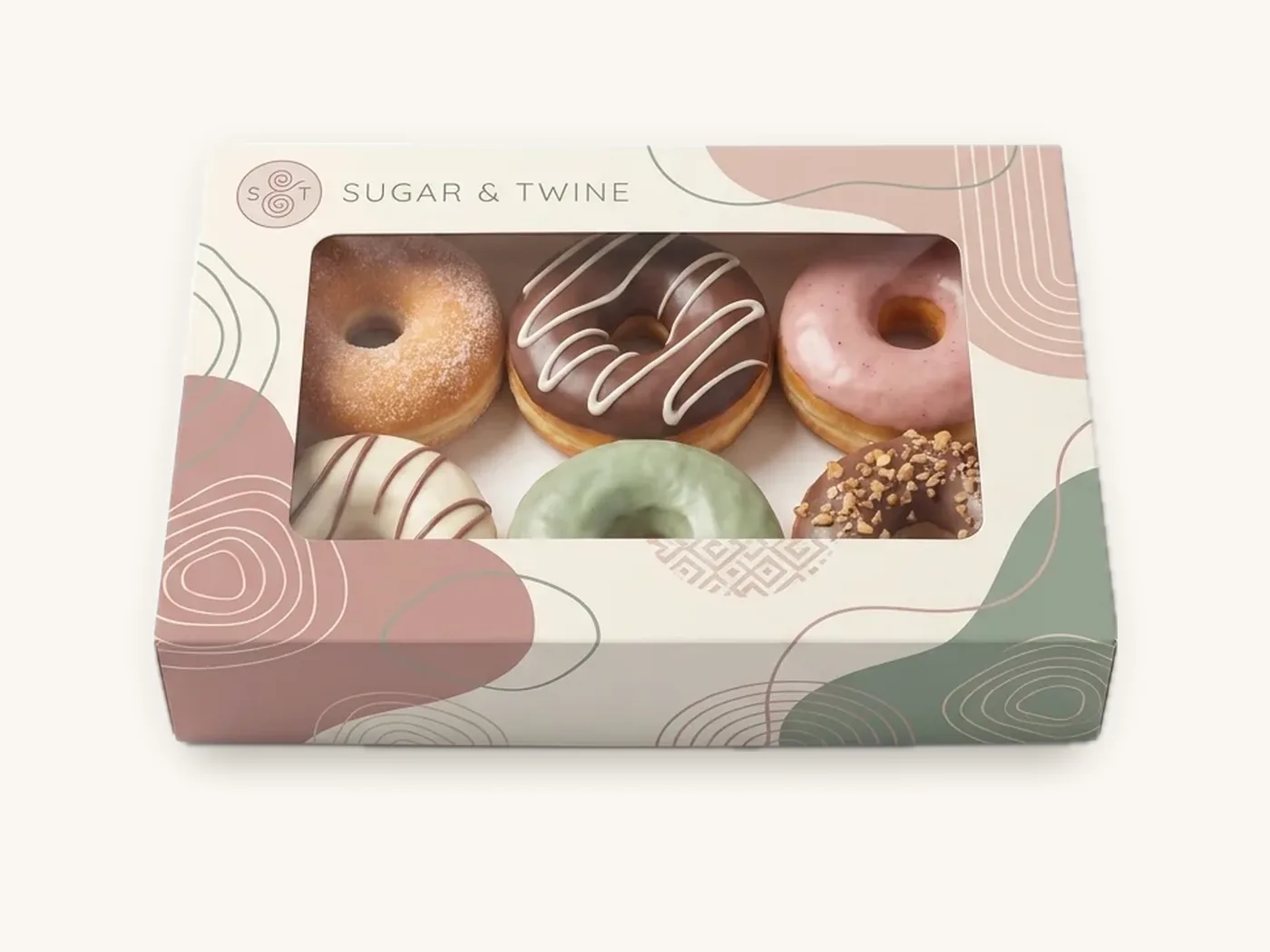
| Dozen | 3x4 | about 14 x 11 in | 3 to 3.5 in | The office standard |
| Two dozen | two dozen boxes, or 4x6 in corrugated | about 22 x 14 in | 3.5 in | Large paperboard boxes sag; see below |
| Donut holes | Loose, by volume | 6 x 4 in to 8 x 6 in | 3 to 4 in | A gable carrier or small tuck box works well |
Why a dozen box is not square
Twelve donuts fit a 3x4 grid, and a rectangle keeps the box within the width of a car seat, an office counter or a delivery bag. A square 12-count layout would need a staggered pattern or wasted space.
Single layer or two layers
Some shops stack a second layer on a divider to halve the footprint. It saves counter space but crushes glaze and sprinkles on the bottom layer. For glazed or topped donuts, stay single layer. For plain cake donuts or donut holes, a two-layer box with a paperboard divider can work.
Two dozen and larger orders
A 22 in paperboard box flexes badly when carried by one end, and the middle donuts slide into the corners. Two dozen boxes carried together are easier to handle, easier to fit in a fridge and stack better. If you do want a single 24-count box, make it from E-flute corrugated. The cake boxes product page shows the heavier structures we also use for large bakery orders.
Lid clearance for glaze, sprinkles and toppings
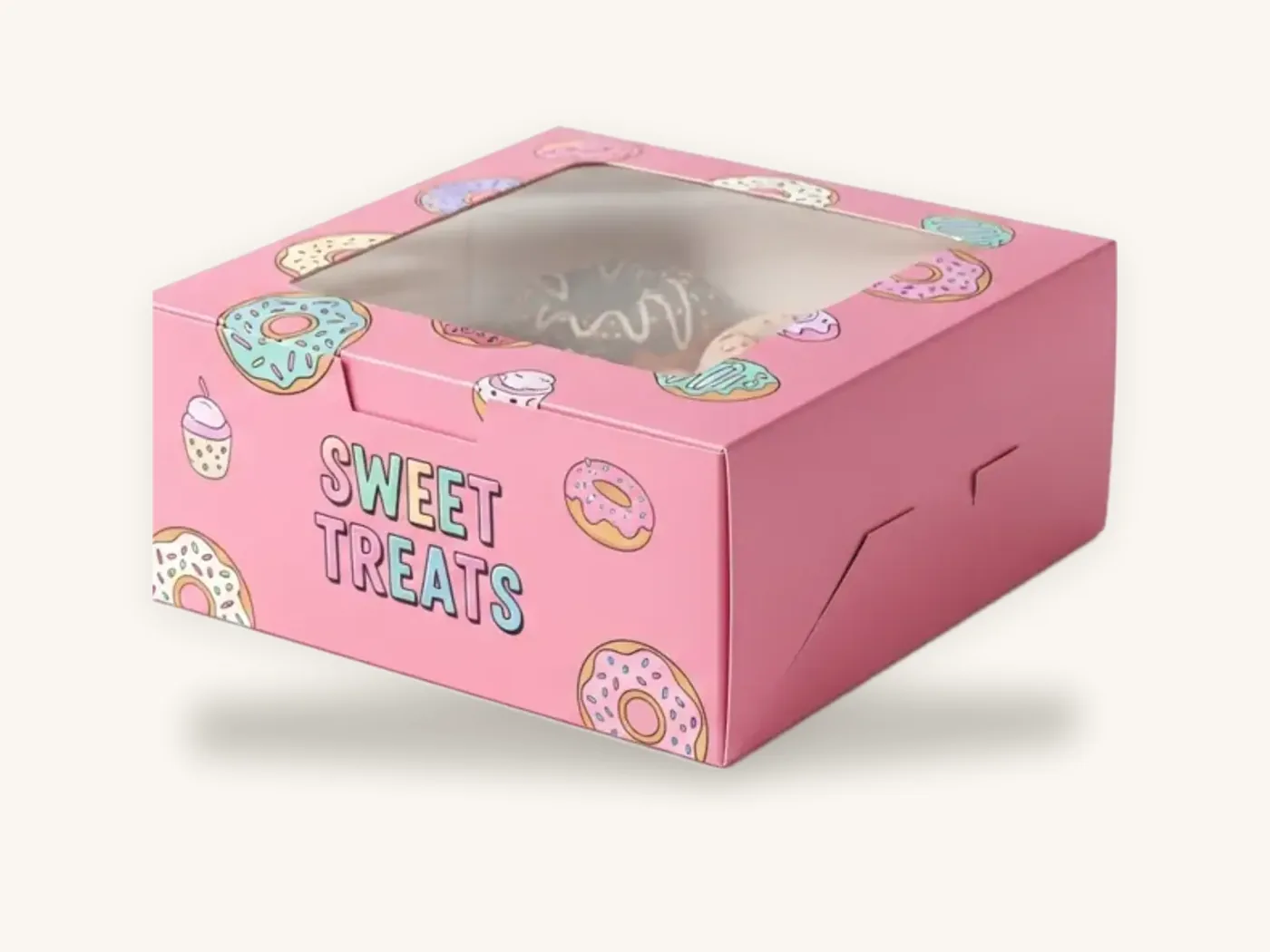
A lid that touches the donuts peels the glaze off and leaves a sticky print on the underside. The fix is simple arithmetic, but most shops use one depth for everything.
- Measure the tallest donut you put in that box, including toppings such as cereal, cookie pieces or piped cream.
- Add about 1/2 in so the lid clears when the box flexes during carrying.
- If you use a liner sheet, add its thickness (small, but it adds up with a thick pad).
- Round up to the nearest quarter inch.
Standard glazed ring donuts at around 1.5 in tall need a 2.5 in box at minimum; most shops choose 3 in to cover taller filled donuts too. Loaded specialty donuts with stacked toppings often need 3.5 to 4 in. If your menu covers both, consider two depths on the same footprint rather than one tall box that lets plain donuts slide around.
Stacking strength: the office order test
Donut boxes are carried in stacks, from counter to car and car to break room. The bottom box carries the weight of every box above it plus whatever the carrier's hands press down. That load goes into the lid and the side walls.
What makes a donut box stack well
- Board caliper. 18 pt SBS is enough for a half dozen; 20 to 24 pt is a better choice for dozen boxes that will be stacked. E-flute corrugated is the strongest option.
- A lid that locks. A tuck flap that slides inside the front wall, or tabs that lock into slots, keeps the lid flat. A lid that simply rests on top pops up at the front and lets the next box slide off.
- Short, stiff side walls. A 3 in wall resists buckling far better than a 5 in wall made of the same board.
- No large windows on the lid. A big window turns the lid into a frame with a soft film in the middle. Under a stack, the film sags onto the glaze.
- Dry board. Grease and steam weaken paperboard. A box with a good interior barrier stacks better at the end of the morning than one without.
Lock-corner or tuck-front
A lock-corner box, with pre-glued corners that pop up, assembles fastest and has strong corners, which are where stacking loads concentrate. A self-locking tuck-front box ships flat, needs no glue, and suits shorter runs and custom sizes but takes staff longer to fold.
Carry advice worth printing
A short line on the side panel, such as "Carry flat, max 6 high", helps customers and staff. Keeping the heaviest boxes, usually two dozen or filled donuts, at the bottom of a stack also prevents the classic crushed-middle-box problem.
Tip: test stacking before you approve a board. Put six filled dozen boxes on top of each other, lift the stack from the bottom, walk thirty steps and set it down. Then open the bottom box. It is an informal test, but it reflects real use better than any spec sheet.
Windows on donut boxes: yes, no or small
Windows are common on donut boxes because donuts are colorful and customers like to see them. For doughnut packaging, though, the benefits and costs are sharper than for other bakery items.
When a window helps
- Grab-and-go singles and two-packs sold from a display case
- Premium or seasonal donuts where the decoration is the product
- Gift boxes where the recipient sees the box before opening it
When to skip or shrink it
- Dozen boxes that will be stacked for office orders
- Very oily or heavily glazed donuts, where grease spots on the inside of the film look unappetizing
- Delivery-only orders where nobody sees the box before opening
A good middle ground is a smaller lid window over the center row, with at least 1.5 in of board around it on all sides. It shows the product while keeping a strong frame. The window boxes style page shows window shapes, and our comparison of PET vs PLA window film covers the film choice.
Counter operations: storage, folding and speed
A donut shop's busiest hours are also its shortest. A box that takes fifteen seconds to fold costs real money at 7 am. Packaging decisions should start with how your team works.
Operational checklist
- Pre-fold at night. If you use tuck-front boxes, fold the next morning's dozen boxes at close and store them nested.
- Choose lock-corner for volume. Pre-glued corners cut assembly to a couple of seconds.
- Store flat boxes dry and away from the fryer. Humid, oily air softens board before it is used.
- Keep sizes few. Most shops need a single, a half dozen and a dozen; each extra size adds shelf space and ordering complexity.
- Stock liners next to the boxes. A liner sheet is only useful if staff do not have to walk to get one.
- Label the stack. Mark each flat stack with its size and depth so new staff grab the right box.
- Plan reorder points. Standard production takes 8–12 business days after proof approval, plus shipping time; reorder before you drop below about three weeks of stock.
For multi-location operations, keeping identical box specs across stores simplifies reorders and ensures every store's boxes stack the same way in a customer's car.
Branding a donut box that travels
The donut box is the most visible bakery package in an office. It sits open on a break-room counter for hours with the lid standing up. That makes the inside of the lid the most viewed surface, not the outside.
Where to put what
| Surface | Who sees it | What works |
|---|---|---|
| Outside lid | People on the street and in the car park | Large logo, simple pattern, one clear color |
| Inside lid | Everyone who takes a donut in the break room | Social handle, ordering website, a short line of personality |
| Front panel | Customers at the counter and in stacks | Shop name, location, flavor checkbox list |
| Side panels | Stacks in cars and on shelves | Logo repeated so the brand shows in any orientation |
| Base | Almost nobody | Leave unprinted to save cost |
Print methods
Digital printing handles short runs of roughly 10 to 500 without plates, so you can print a seasonal design or a limited event run. Offset suits larger runs with consistent color. A flavor checkbox list printed on the front panel is a practical detail that staff use to mark contents and customers use to pick. Aqueous coating on the outside resists fingerprints and small grease smudges from hands. See the printing and finishes page for all options.
Donuts sit beside coffee more often than not. If you also sell drinks, the coffee packaging guide covers cups and bags that match your donut boxes, and the tea packaging guide covers the tea side of a café menu.
What donut boxes cost
Donut box pricing depends on size, board caliper, interior barrier, windows, print coverage and quantity. Quantity has the biggest effect.
We do not publish a separate donut box price row, but a close reference is our windowed bakery box: 10x10x5 in in 18 pt SBS, printed full color with a window. It runs about $4.09 each at 100, about $2.91 at 250 and about $1.82 at 1,000, with US shipping included. A half dozen box uses a little less board than that reference; a dozen box uses more, and grease barriers and heavier calipers add to the price.
Use the instant price estimator with your own dimensions for an exact figure.
How to order custom donut boxes from Box Sense
Send what you know and our team will recommend the rest.
Spec checklist
- Pack sizes (single, two, half dozen, dozen, two dozen) and your largest donut's diameter and height
- Grease approach: interior coating, liner sheet, grease-resistant board, or ask for advice
- Structure: lock-corner or self-locking tuck-front
- Board: 18 pt, 20 to 24 pt SBS or E-flute corrugated
- Window: none, small lid window or full lid window
- Print: surfaces to print, full color or one color, flavor checklist
- Quantity per size and your target in-hand date
- Artwork files, or a request for help from our design services team
What happens next
We confirm pricing within 24 hours. Design support is free, including the dieline, artwork setup and a 3D digital proof with two revision rounds. Unprinted structural samples are free, which lets you run your own grease and stacking tests before committing, and a printed sample of approved artwork is free on orders of 100 or more; see samples.
Standard production is 8–12 business days after proof approval, with rush in 5 business days on most paperboard styles. The minimum order is 10 boxes, there are no die or plate charges, US shipping is free, and defective boxes reported within 14 days are reprinted free. Browse the donut boxes product page, the wider bakery and confectionery range, and the bakery packaging guide for the rest of your menu.
Frequently asked questions
What size is a dozen donut box?
For standard ring donuts about 3.5 to 4 in across, a single-layer dozen box is roughly 14 x 11 in inside and 3 to 3.5 in deep. Larger specialty donuts need more space, and taller toppings need more depth. Measure your biggest donut and add a small gap between donuts plus about 1/2 in of clearance above the tallest topping.
How do you stop grease from soaking through donut boxes?
Use an interior barrier: a grease-resistant coating on the inside surface, a grease-resistant board grade, a glassine or bakery liner sheet under the donuts, or a combination. Let donuts cool until glaze sets before boxing, and store flat boxes away from fryer steam. Darker exterior printing only hides grease temporarily; the fix has to be inside the box.
Are donut boxes recyclable?
Clean paperboard donut boxes with water-based coatings are generally accepted by paper recycling programs, but many programs reject boxes heavily soiled with grease. Plastic laminated interiors are harder to recycle. Using a removable liner sheet can keep the box itself cleaner. Check current guidance from your local recycling program before printing any recyclability claim.
What is the best material for donut boxes?
For half dozen and smaller boxes, 18 pt SBS paperboard with a grease-resistant interior works well. For dozen boxes that will be stacked, 20 to 24 pt SBS gives a stiffer lid and walls. For two dozen boxes or delivery, E-flute corrugated is the strongest choice. Keep ink on the outside and let the coated interior or liner touch the food.
Should donut boxes have a window?
Windows suit single and two-pack boxes, premium donuts and gift boxes where the decoration sells the product. For stacked dozen boxes and very greasy donuts, skip the window or use a small lid window with a wide board frame around it. Large lid windows weaken stacking and show grease spots from the inside.
How many donut boxes can you stack?
It depends on board caliper, box structure and how much grease has softened the board. A well-made dozen box in stiff paperboard with a locking lid typically handles a short stack carried by hand, often around six boxes. Test your own boxes with full, real product before relying on a number, and put heavier boxes at the bottom.
How much do custom donut boxes cost?
Price depends on size, board, grease barrier, window, print and quantity. As a reference, a 10x10x5 in windowed bakery box in 18 pt SBS printed full color is about $4.09 per box at 100 and about $1.82 at 1,000, including US shipping. Use the Box Sense pricing estimator with your donut box sizes for exact figures.
Next steps
Measure your largest donuts, decide how long boxes hold product before it is eaten, and choose your core pack sizes. Price them in the donut box price estimator, then request a custom donut box quote; we confirm pricing within 24 hours and can send free unprinted samples for your grease and stacking tests.
Boxes in this guide
Order the packaging we covered
Written by the Box Sense Packaging Team
Our structural designers, prepress technicians and production staff print and convert custom boxes every day for brands in the United States, United Kingdom and UAE. Questions about this guide? Talk to us.