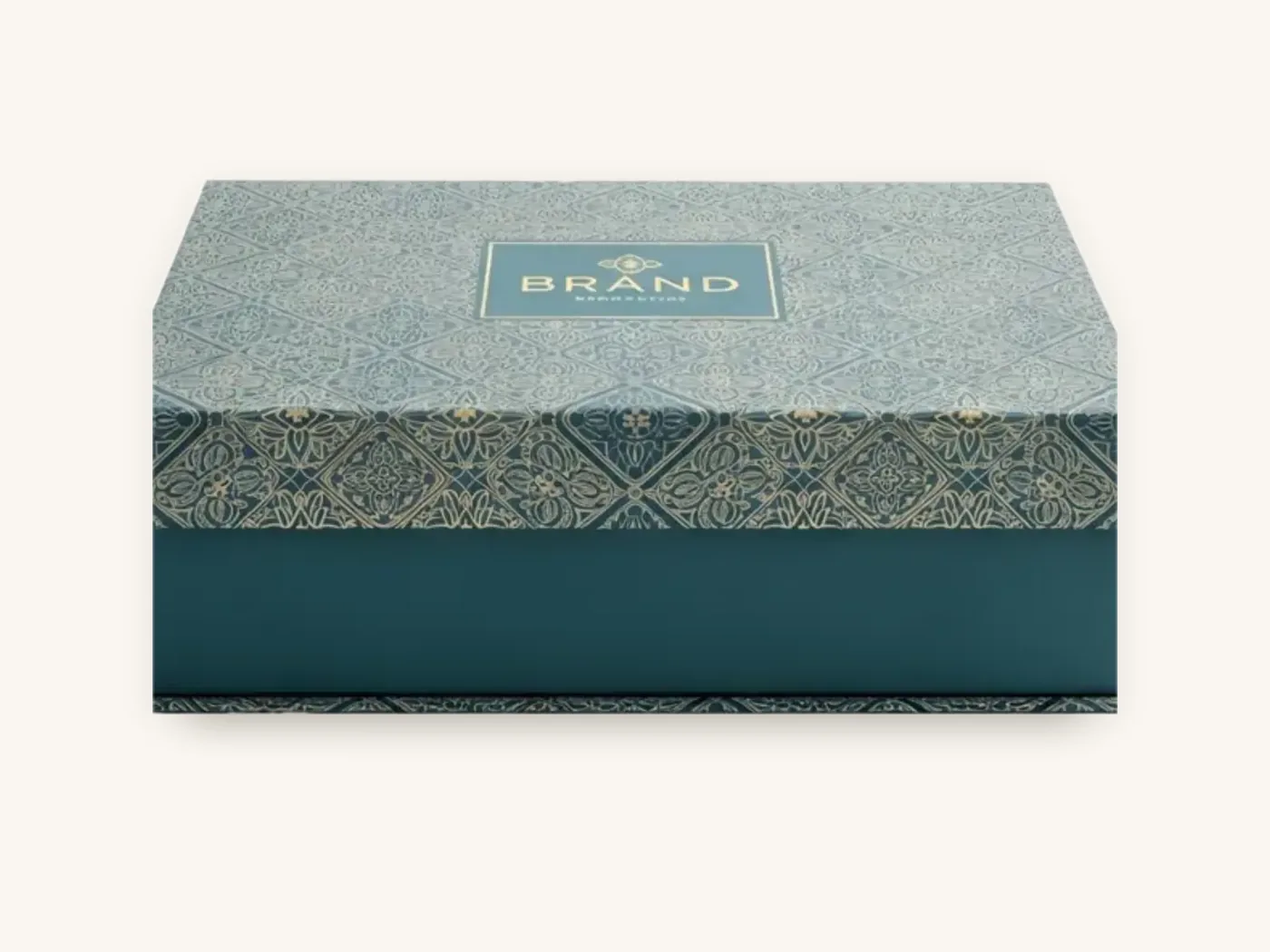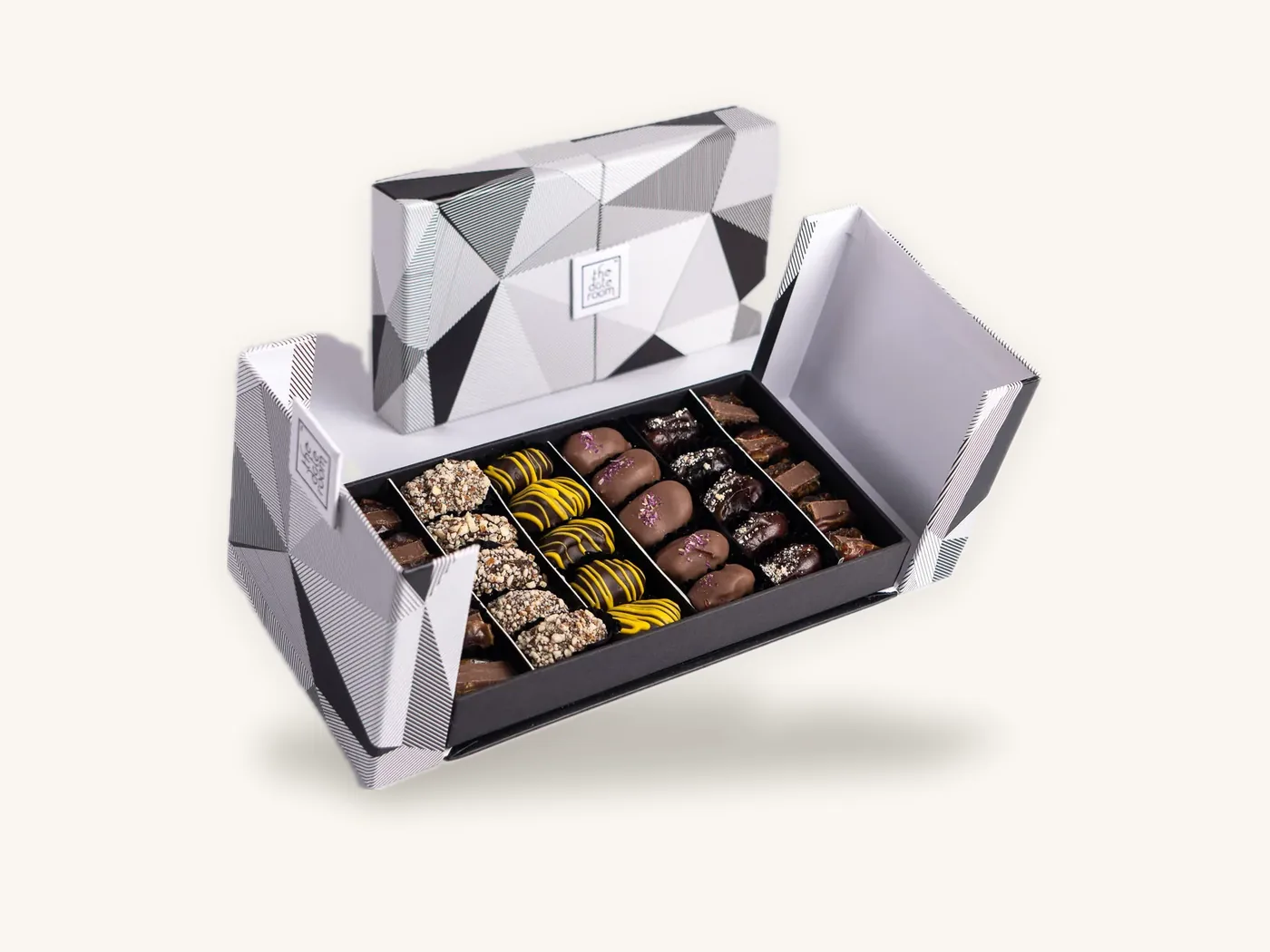
Foil stamping packaging uses heat, pressure and a custom metal die to transfer a thin metallic or pigmented film onto a box, so a logo or pattern reads as real metal rather than printed ink. It is the most common way to make a gold, silver, rose gold or holographic mark on a carton or rigid box, and no CMYK ink can imitate the way it catches light as the box turns in your hand.
Foil works best on smooth, coated or laminated boards, with bold vector artwork and a small number of foiled elements. It carries a one-time tooling charge for the die and a modest per-unit cost. This guide explains how the process works, which foil to choose, how to set up files so the foil stamps cleanly, and when foil earns its place on the box.
Key takeaways
- Hot foil stamping presses a heated die through a foil carrier onto the board; it gives the crispest, brightest metallic result and is the standard for boxes.
- "Gold foil" is almost always a metallized film with a tinted lacquer, not real gold, so matte gold, champagne, rose gold and bright yellow gold are all separate foils.
- Foil stamps best on soft-touch, matte or gloss lamination and smooth SBS board; natural kraft and corrugated need bolder, simpler shapes.
- Plan artwork as 100% solid vector shapes with typical minimum line weights around 0.25–0.3 mm and gaps of at least 0.3–0.5 mm; exact limits are confirmed at proofing.
- At Box Sense, foil carries a one-time tooling charge of about $60, and a cosmetic carton with soft-touch and foil runs about $1.93 each at 100 units.
How hot foil stamping works on a box
Hot foil stamping happens after printing and coating, and before the sheet is die-cut and glued. The press holds a metal die engraved with your artwork, a roll of foil film, and the printed sheet. The die heats up, drops through the foil onto the sheet, and the foil releases only where the raised artwork touched.
Foil film is a sandwich of layers. From the top down there is a polyester carrier, a release layer, a colored lacquer, a vacuum-metallized aluminum layer (for metallic foils), and a heat-activated adhesive. Heat melts the adhesive and weakens the release layer; pressure bonds the metal to the board; the carrier peels away with the unused foil.
The three variables operators balance
Every foil job is tuned by adjusting three settings on press:
- Temperature: typically somewhere around 100–150°C (roughly 210–300°F), depending on the foil and the surface. Too cool and the foil does not release fully; too hot and fine lines fill in or the foil loses brightness.
- Pressure: enough to bond the foil across the whole image without crushing the board or leaving a visible dent on the reverse.
- Dwell time: how long the die stays in contact. Heavier boards and textured papers need more.
That tuning is why a new foil and board combination is tested at proof stage.
Die materials
The die is the reason foil has tooling cost. Magnesium dies are etched quickly and suit most short and medium runs. Copper dies hold finer detail and transfer heat more evenly, which helps on long runs and intricate type. Brass dies are machine-engraved, last the longest, and are used when foil is combined with embossing in a single sculpted stroke.
Foil colors and effects: which foil to choose
The word "foil" covers far more than gold and silver. Choosing the right one is partly about brand color and partly about how the foil behaves on your chosen surface.
| Foil type | What it looks like | Works best on | Good for |
|---|---|---|---|
| Bright gold | Mirror-like warm yellow metal | Soft-touch, matte lamination, black or deep print | Classic luxury, fragrance, spirits |
| Matte or satin gold | Softer, brushed-metal glow | Uncoated and textured papers, soft-touch | Understated premium, skincare |
| Rose gold and champagne | Pink or pale warm metallic | White, blush and neutral backgrounds | Beauty, bridal, jewelry |
| Bright silver | Cool chrome reflection | Dark backgrounds, gloss or matte film | Tech, men's grooming, winter seasonal |
| Holographic | Rainbow diffraction pattern that shifts with angle | Smooth laminated board | Cosmetics, youth brands, limited editions |
| Colored metallic | Blue, red, green or copper with metallic sheen | Neutral or dark backgrounds | Brand-color accents that still shine |
| Pigment (non-metallic) | Flat opaque color, often white or black | Kraft, dark stocks, textured paper | Clean opaque marks where ink looks weak |
Gold foil boxes: picking the right gold
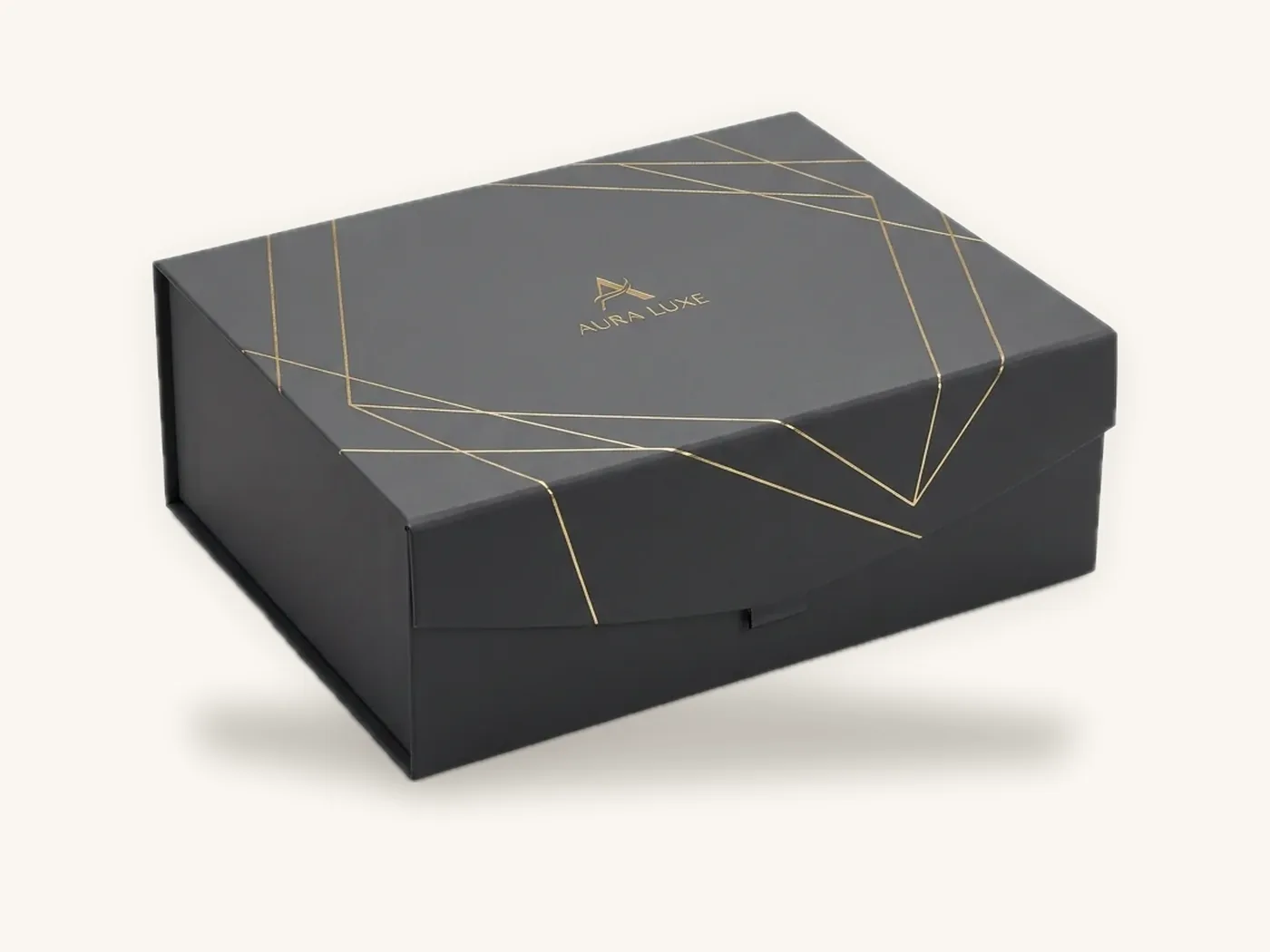
Gold foil boxes are the most requested foil finish, and the biggest mistake is assuming there is one gold. A bright yellow gold on a white carton can look loud; the same foil on a black soft-touch rigid box looks restrained. Pale champagne gold reads elegant on cream and blush tones but nearly disappears on white.
Hold your printed background color next to physical foil swatches, not a screen. Metallics cannot be shown accurately in a PDF or a 3D render, because the effect depends on light reflecting off the surface. Our printing and finishes page lists the foil families we run, and a printed sample is the only way to judge a foil against your real print.
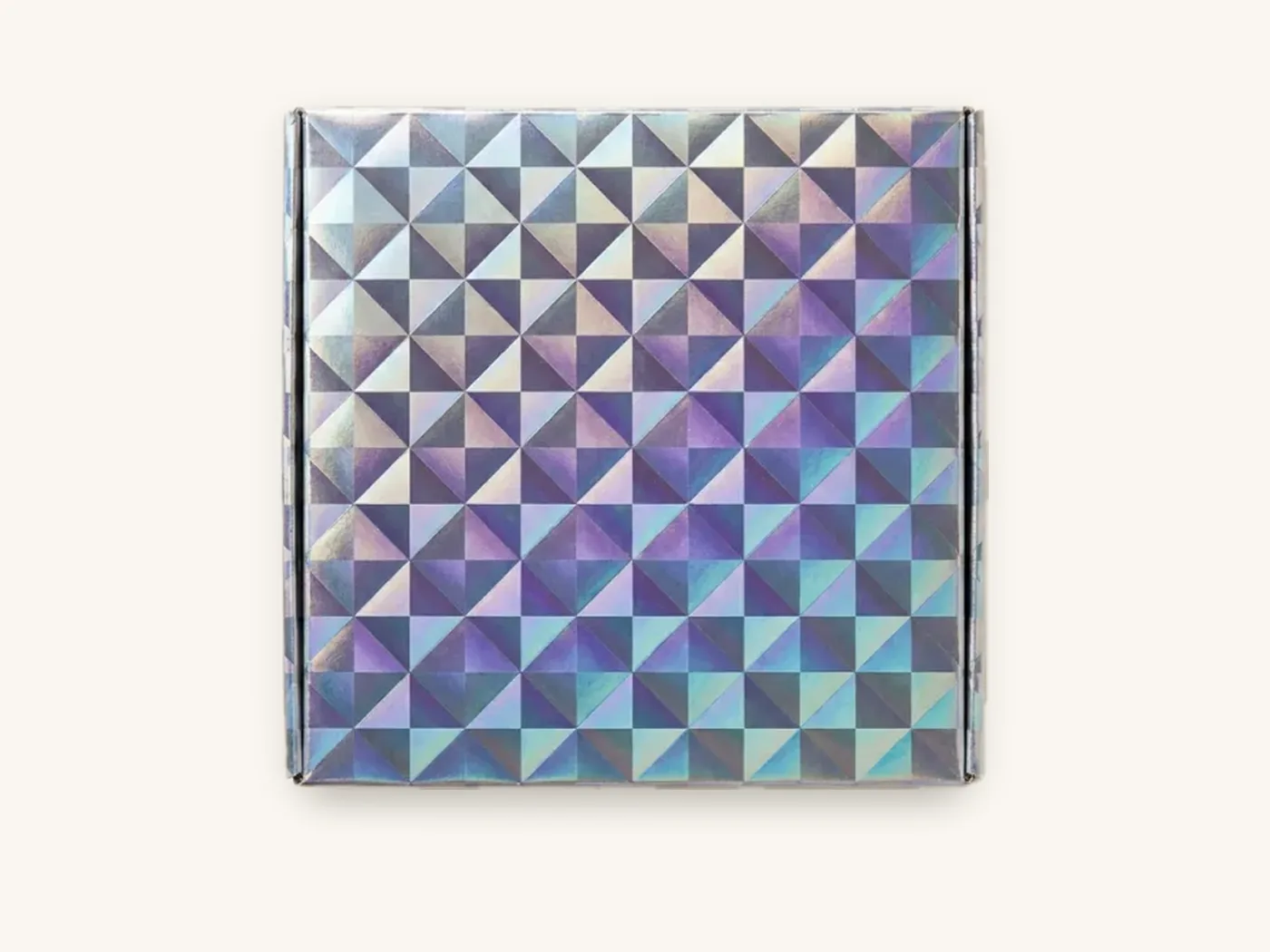
Holographic foils
Holographic foil diffracts light into a rainbow that moves as the box tilts. Most holographic foils are "seamless" patterns (fine lines, pillars, sparkle or a smooth rainbow) that simply fill whatever shape the die stamps. Registered holograms, where a specific image sits in a specific spot, are a different and far more specialized process.
If you want the whole box to shimmer rather than one logo, a metallic and holographic board printed with opaque white and CMYK is often better value than a large holographic stamp.
Hot foil vs cold foil vs digital foil
Three processes put metallic film on packaging. They produce different looks and suit different run lengths, so it helps to know which one a supplier means.
| Process | How it works | Look and feel | Typical use | Tooling |
|---|---|---|---|---|
| Hot foil stamping | Heated metal die presses foil onto the board | Brightest, crispest, can be slightly debossed | Folding cartons, rigid boxes, bags | Custom die per design |
| Cold foil | Adhesive printed on press, foil laminated to it and cured, then overprinted | Flatter, can be overprinted with CMYK for any metallic color | Long-run labels and flexible packaging | Printing plate, no heated die |
| Digital foil | Toner or digital polymer laid down, foil applied to it | Good shine, sometimes raised, softer edges | Short runs, personalized pieces | None |
Why boxes usually use hot foil
Hot foil gives the sharpest edge and the most reflective finish, and it can be stamped onto laminated and soft-touch surfaces that cold foil adhesives struggle with. The die also presses the foil very slightly into the board, which gives a subtle tactile edge customers notice when they run a thumb over the logo.
Cold foil earns its place on long runs that need metallic gradients or many metallic colors made by overprinting CMYK on silver. For most box orders, hot foil stamping is the better tool.
Which boards and coatings take foil well
Foil is only as good as the surface under it. The adhesive needs a smooth, consistent surface to grip, and the die needs even support so the pressure is uniform across the image.
Laminated and coated paperboard
Smooth SBS paperboard with matte, gloss or soft-touch lamination is the easiest surface for foil. Soft-touch in particular makes foil look richer, because the velvety matte film around the logo contrasts with the mirror finish. Our soft-touch lamination guide covers that film in detail, including scuffing and how it pairs with other effects.
Aqueous-coated board also accepts foil in most cases, though the foil and coating combination should be tested. If you are weighing coatings first, the packaging finishes guide compares them side by side.
Rigid boxes
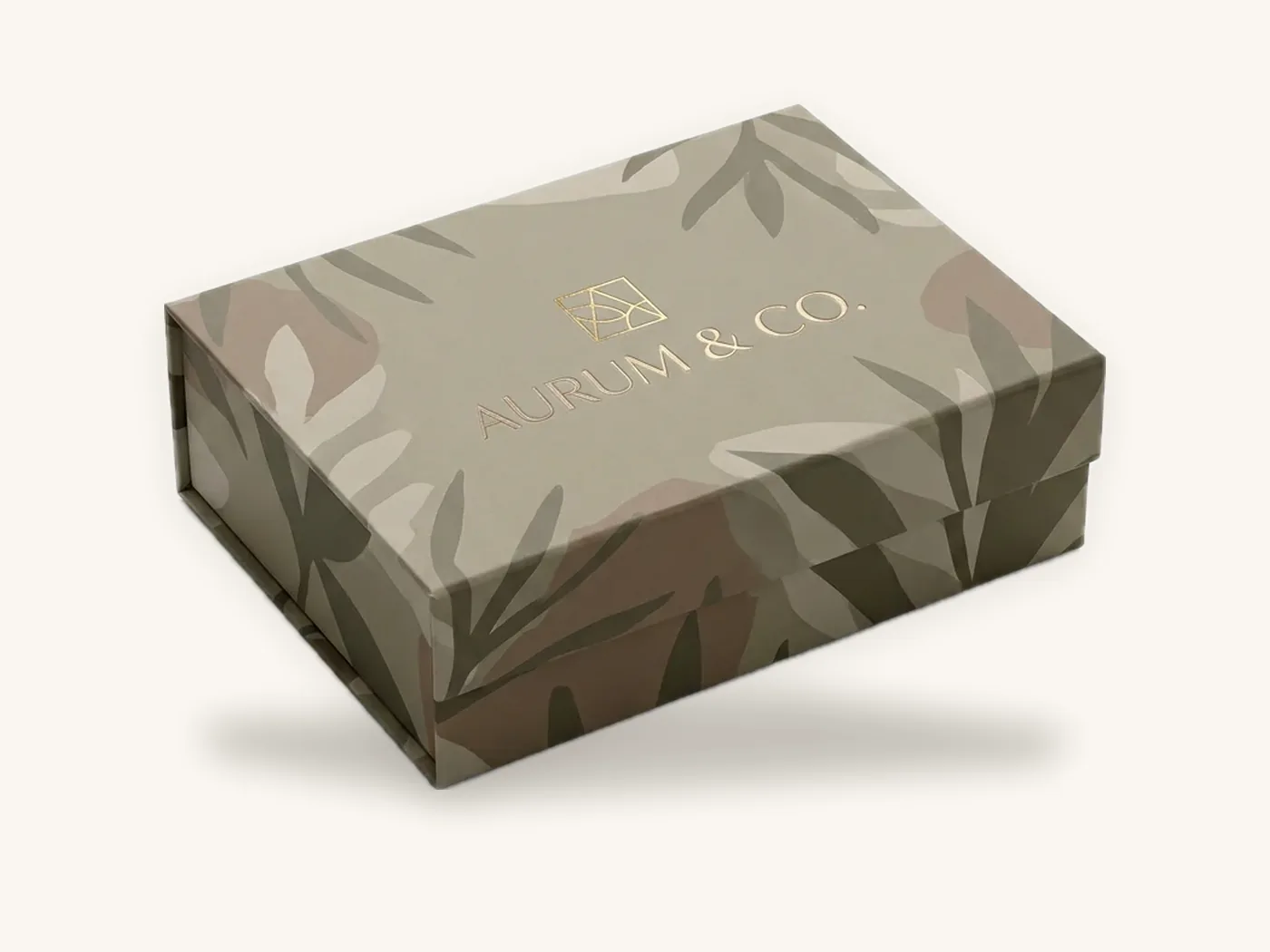
On rigid boxes, the wrap paper is printed, laminated and foil-stamped flat, then wrapped around greyboard. Foil on a luxury gift box or magnetic lid therefore sits on a stable, smooth sheet and stamps beautifully. Foil placed near the lid edge must allow for the wrap turn-in, which is why we keep logos well inside the top panel. For budgets, see our breakdown of rigid box cost.

Kraft, textured and corrugated boards
Uncoated kraft and textured papers have fibers and a tooth that break up fine detail. Foil still works, and matte gold or opaque pigment foils can look excellent on kraft, but lines need to be heavier and small type should be avoided. Textured and specialty papers often show a slight grain through the foil, which many brands like.
Corrugated board is the hardest surface, because the flutes underneath give uneven support and can crush under pressure. On E-flute mailers, keep foil to a bold logo on the lid. For fine foil work on a shipper, a printed top sheet laminated to the corrugated board gives a smoother base.
File setup rules for foil stamping
Most foil problems start in the artwork file. The ranges below are typical industry guidance for hot foil on smooth laminated board; texture, foil type and die material shift them, and exact limits are confirmed at proofing.
| Element | Typical minimum | Safer target | Why it matters |
|---|---|---|---|
| Positive line weight | 0.25–0.3 mm (about 0.75 pt) | 0.4 mm or more | Thin lines break or stamp incompletely |
| Negative space (gaps, counters) | 0.3–0.5 mm | 0.6 mm or more | Small gaps fill in with foil |
| Positive text | 6–7 pt sans serif | 8 pt or larger | Serifs and hairlines disappear |
| Reversed text (knocked out of a foil area) | 8–9 pt | 10 pt or larger, bold weight | Counters close up |
| Distance from creases and cut lines | 1/8 in (3 mm) | 3/16 in (5 mm) | Foil can crack over a fold or chip at a cut |
| Registration to printed artwork | about ±0.5–1 mm movement | Design so a small shift is invisible | Foil is a separate pass from the print |
A foil artwork checklist
- Put all foil artwork on its own layer, as vector shapes, colored with a spot swatch named for the foil (for example "FOIL_GOLD").
- Set foil elements to 100% solid. Remove gradients, tints, halftones, drop shadows and transparency from the foil layer.
- Convert text to outlines, and check that the thinnest stroke meets the minimums above at final size.
- Use one separate spot layer per foil color if you have two foils, because each needs its own die and pass.
- Decide whether printed ink should sit under the foil or be knocked out. Foil is opaque, so both work, but a knockout avoids ink ridges on large areas.
- Avoid butting foil tightly against a printed outline. Either leave a visible gap or overlap by a hair so a small registration shift is not noticed.
- Keep large solid foil areas modest. Big floods, roughly beyond 2–3 in across, are more prone to pinholes and uneven shine; a pattern or matte foil hides that.
- Keep foil away from glue flaps and the manufacturer's joint, where adhesive will not bond well to foil.
Tip: if a logo has a very fine tagline, foil the logo mark and print the tagline. You keep the metallic impact where it counts and avoid the most common reason a foil proof fails.
For general dieline and bleed rules, our guide to preparing artwork for custom box printing covers the rest of the file.
What foil stamping adds to packaging cost
Foil adds two kinds of cost: a one-time charge for the die, and a per-unit charge for the extra press pass, the foil film itself and setup time. Size of the foiled area matters less than people expect; the number of separate foil colors and locations matters more.
At Box Sense, one-time foil tooling is about $60. Spread over 100 boxes that is roughly 60 cents a box; over 1,000 boxes it is a few cents. Reorders of the same artwork reuse the die, so the tooling does not repeat unless the foil design changes.
| Spec (indicative, US shipping included) | 100 units | 500 units | 1,000 units | 5,000 units |
|---|---|---|---|---|
| Cosmetic carton, 18 pt SBS, 2.5x2.5x6 in, full color, soft-touch + foil | $1.93 | $1.03 | $0.86 | $0.61 |
| Candle box, 18 pt SBS, 3.5x3.5x4 in, full color, matte + foil + insert | $2.33 | $1.24 | $1.03 | $0.73 |
| Jewelry rigid box, 2 mm, 3x3x1.5 in, matte, foil, insert | $3.35 | $1.79 | $1.49 | $1.06 |
| Rigid magnetic box, 2 mm, 10x8x3 in, soft-touch, foil, insert | $14.23 | $7.59 | $6.32 | $4.49 |
Those per-unit figures exclude the one-time tooling. For your own size, board and quantity, the instant price estimator shows how the total changes with and without foil.
How to keep foil affordable
- One foil, one location. A single gold logo on the lid gives most of the impact. A second foil color means a second die and a second pass.
- Foil the brand mark, print the rest. Ingredients, legal copy and small text belong in ink.
- Reuse a die across a range. If several candle boxes in a collection share the same foiled logo in the same position, one die can serve all of them.
Pairing foil with embossing, spot UV and soft-touch
Foil rarely appears alone on premium packaging. Knowing how it combines with other finishes helps you avoid paying for effects that compete with each other.
Foil plus embossing
Foil stamped on top of a raised emboss gives a sculpted, coin-like logo. It can be done in two passes with separate dies, or in one pass with a combination brass die that stamps and embosses at once, which keeps foil and relief in perfect register. Our embossing vs debossing guide explains depths and die types.
Foil plus spot UV
Spot UV adds clear gloss to chosen areas. On a matte or soft-touch box, a spot UV pattern with a foil logo creates three visible textures: matte background, glossy pattern and metallic mark. Keep the two apart rather than layering them; UV coating over foil can dull it or crack. The spot UV guide covers the setup for that finish.
Foil on soft-touch or matte lamination
This is the most popular premium pairing, used across perfume boxes, cosmetics and gift packaging. The matte vs gloss lamination guide explains why foil reads more luxurious against a low-sheen film than against gloss.
Common foil defects and how to prevent them
- Fill-in: counters and gaps flood with foil. Fix by opening up spacing in the artwork.
- Broken lines: hairlines stamp in pieces. Fix with heavier strokes and smoother board.
- Pinholing: tiny unfoiled dots in large solids. Fix with smaller or patterned foil areas.
- Flaking or rub-off: usually an adhesive mismatch with the coating. Fix by testing foil on the exact lamination.
- Cracking at folds: keep foil at least 1/8 in from creases.
- Visible misregister: design with gaps or overlaps instead of tight fits.
Watch out: a PDF proof cannot show foil. On the digital proof, foil appears as a flat spot color. Approve position and size from the proof, then judge shine and color from a physical swatch or printed sample.
Where foil stamping makes sense, by product
Foil is not a universal upgrade. It rewards products bought partly on appearance and sold at a price where a few cents of finish shows up in perceived value.
- Fragrance and cosmetics: foil on dark soft-touch cartons is category standard. See fragrance and perfume packaging for common structures.
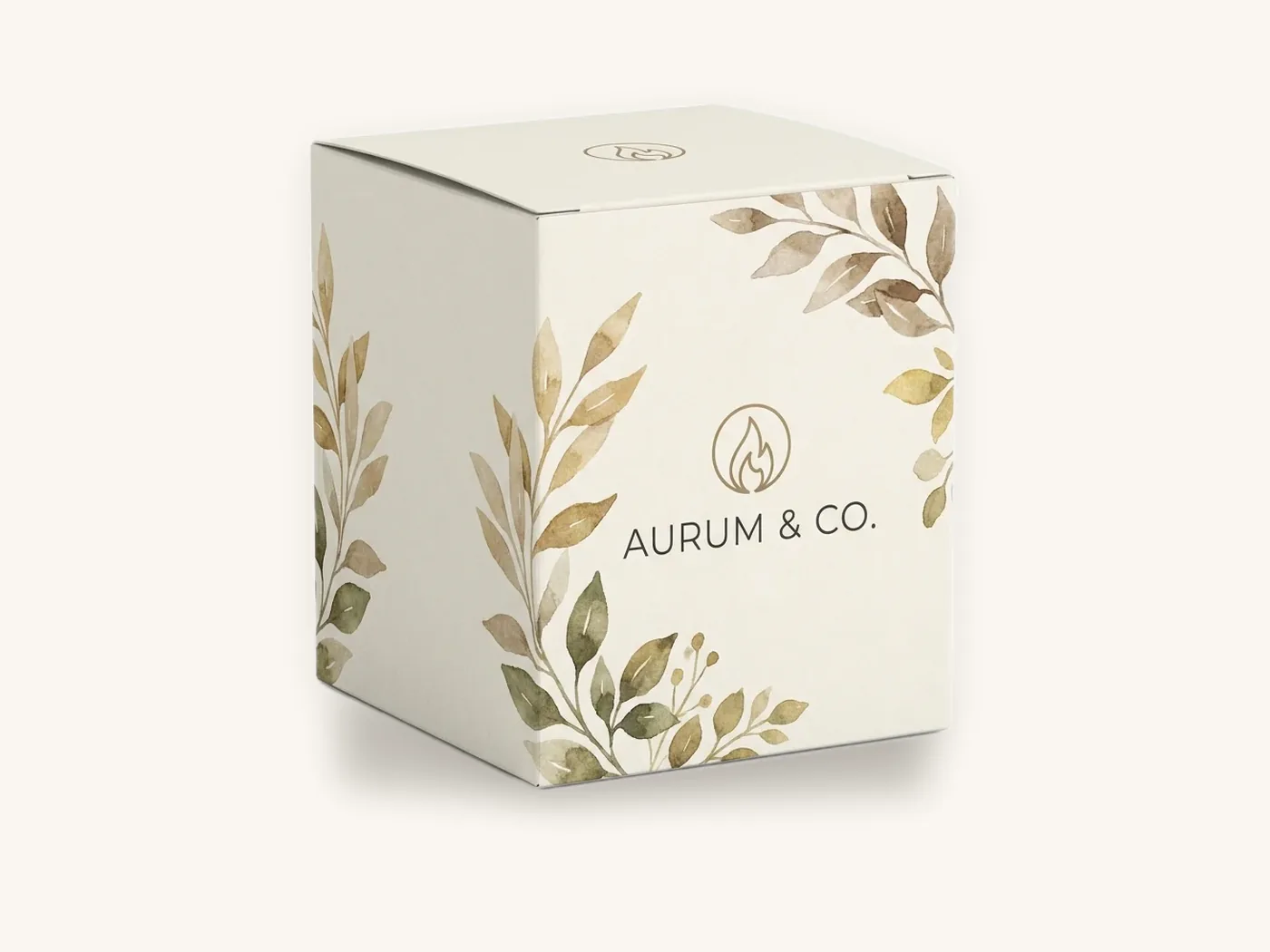
- Candles and home fragrance: a foiled logo on a matte carton lifts a simple design. The candles and home fragrance page shows typical formats.
- Rigid gift and presentation boxes: foil on a magnetic closure box or custom rigid box is expected at higher price points; our magnetic closure boxes guide covers the structure.
- Seasonal and limited editions: a holographic or colored foil on an existing carton design signals something new without redesigning the whole box.
Foil makes less sense on shipping boxes that get scuffed in transit and on very small cartons where the logo would fall below safe line weights.
How to order foil-stamped boxes from Box Sense
Foil adds a few decisions to a normal box order. Sending them upfront shortens the proofing cycle.
What to include in your request
- Box style, internal dimensions and board (for example 18 pt SBS carton or 2 mm rigid)
- Coating or lamination, since foil choice depends on it
- Foil color or effect, and how many separate foil colors
- Where the foil goes (lid, front panel, sides) and its approximate size
- Whether you also want embossing, debossing or spot UV
- Quantities to price, such as 100, 500 and 1,000
- Vector artwork with foil on its own spot layer, or a request for help from our design services team
What happens next
- Quote within 24 hours, including the one-time foil tooling.
- Free design support: we supply the dieline, check foil line weights and spacing against our press, and send a 3D digital proof with two revision rounds included.
- Samples: unprinted structural samples are free, and a printed sample of approved artwork is free on orders of 100 or more, which is the best way to see the foil on your real board.
- Production: standard production takes 8–12 business days after proof approval; rush in 5 business days is available on most paperboard and corrugated styles.
- Delivery: free shipping on every US order, with international shipping quoted at cost.
The minimum order is 10 boxes. There are no die or plate charges for printing; tooling applies only for foil, embossing, spot UV and custom inserts. Defective boxes reported within 14 days are reprinted free.
Frequently asked questions
What is foil stamping on packaging?
Foil stamping is a finishing process that uses a heated metal die to press a thin metallic or pigmented film onto a box. The foil bonds only where the die's artwork touches, leaving a crisp, reflective logo, border or pattern. It is applied after printing and coating, and before die-cutting, so it can sit on laminated, soft-touch or coated board as well as rigid box wrap paper.
Is gold foil real gold?
No. Gold foil used on packaging is a vacuum-metallized aluminum layer under a tinted lacquer that gives the gold color. That is why several golds exist, from bright yellow gold to champagne, matte gold and rose gold. The metal layer is extremely thin, so foil adds shine without adding noticeable weight or material to the box.
What is the difference between hot foil stamping and cold foil?
Hot foil stamping uses a heated die to press foil onto the board, giving the brightest, sharpest result and a slight tactile edge. Cold foil prints an adhesive on press, laminates foil to it and cures it, which suits long-run labels and allows overprinting CMYK for colored metallics. For folding cartons and rigid boxes, hot foil is usually the better choice.
How much does foil stamping add to the cost of a box?
At Box Sense, foil adds a one-time tooling charge of about $60 plus a per-unit charge that depends on quantity. As a reference, a 2.5x2.5x6 in cosmetic carton with soft-touch lamination and foil is about $1.93 each at 100 units and about $0.86 at 1,000. Use the pricing estimator to compare your spec with and without foil.
Can you foil stamp kraft or corrugated boxes?
Yes, with limits. Kraft and textured papers break up fine detail, so use bold shapes, heavier lines and larger type, and consider matte gold or opaque pigment foils. Corrugated flutes give uneven support, so keep foil to a simple logo on E-flute. Exact line weights and pressure are confirmed at proofing on your actual board.
What is the smallest text you can foil stamp?
As a typical industry range, positive sans serif text around 6–7 pt is the practical minimum on smooth laminated board, with 8 pt or larger recommended. Reversed text knocked out of a foil area needs to be bigger, around 10 pt and bold, because small counters fill in. Textured and uncoated boards need larger sizes, and exact limits are confirmed at proofing.
Can foil be combined with embossing?
Yes. Foil and embossing can be applied in two separate passes or in one pass with a combination brass die that stamps foil and raises the image at the same time. The single-pass method keeps foil and relief perfectly aligned. Combined foil and embossing works best on rigid box wrap paper and thicker paperboard with enough caliper to hold the shape.
Next steps
Decide where the foil goes and which foil suits your background, then check the numbers in the price estimator with and without the finish. When you are ready, request a foil-stamped box quote with your artwork and quantities, and we will confirm pricing within 24 hours and check your foil file setup before the proof.
Boxes in this guide
Order the packaging we covered

Written by the Box Sense Packaging Team
Our structural designers, prepress technicians and production staff print and convert custom boxes every day for brands in the United States, United Kingdom and UAE. Questions about this guide? Talk to us.