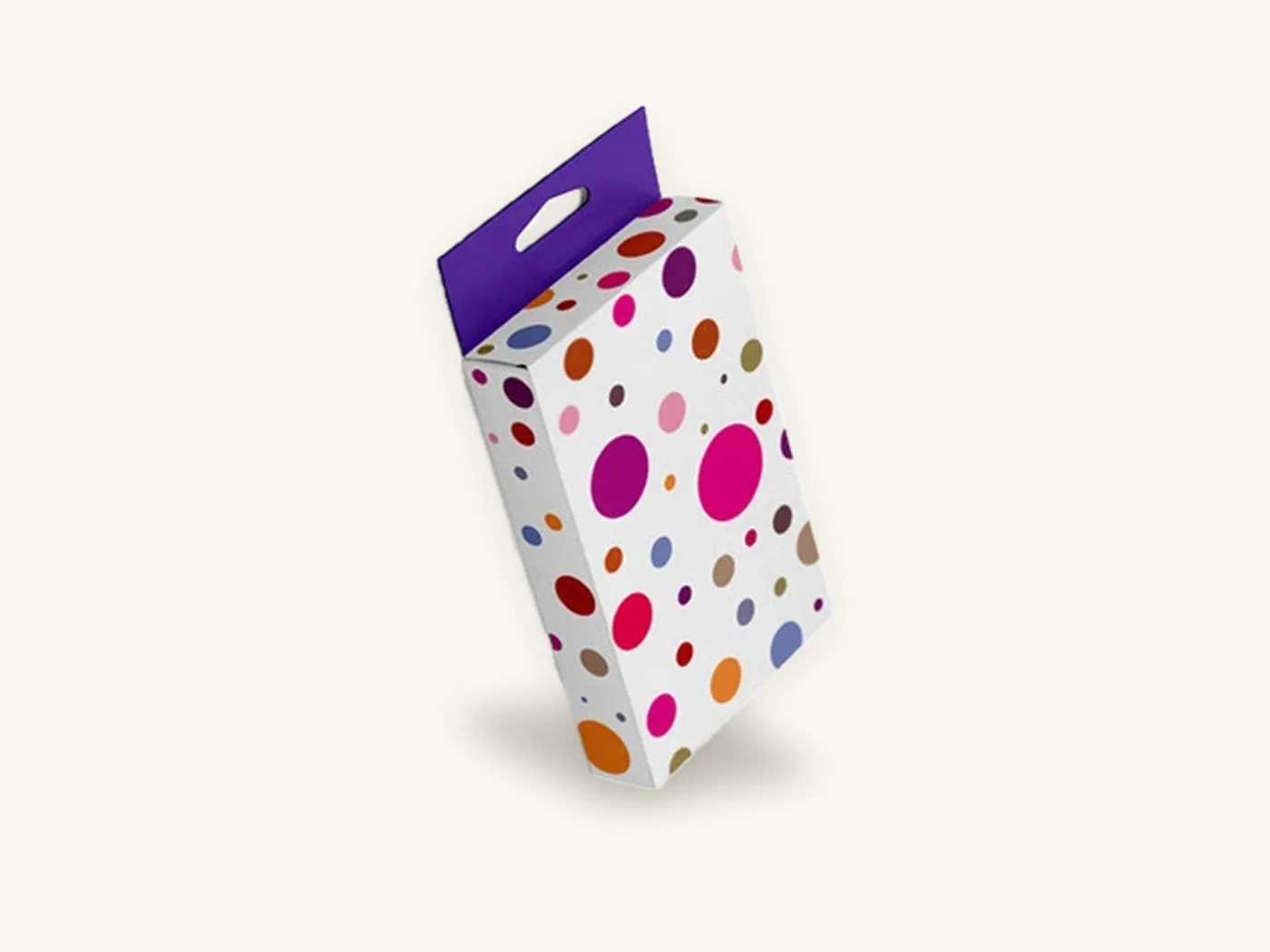
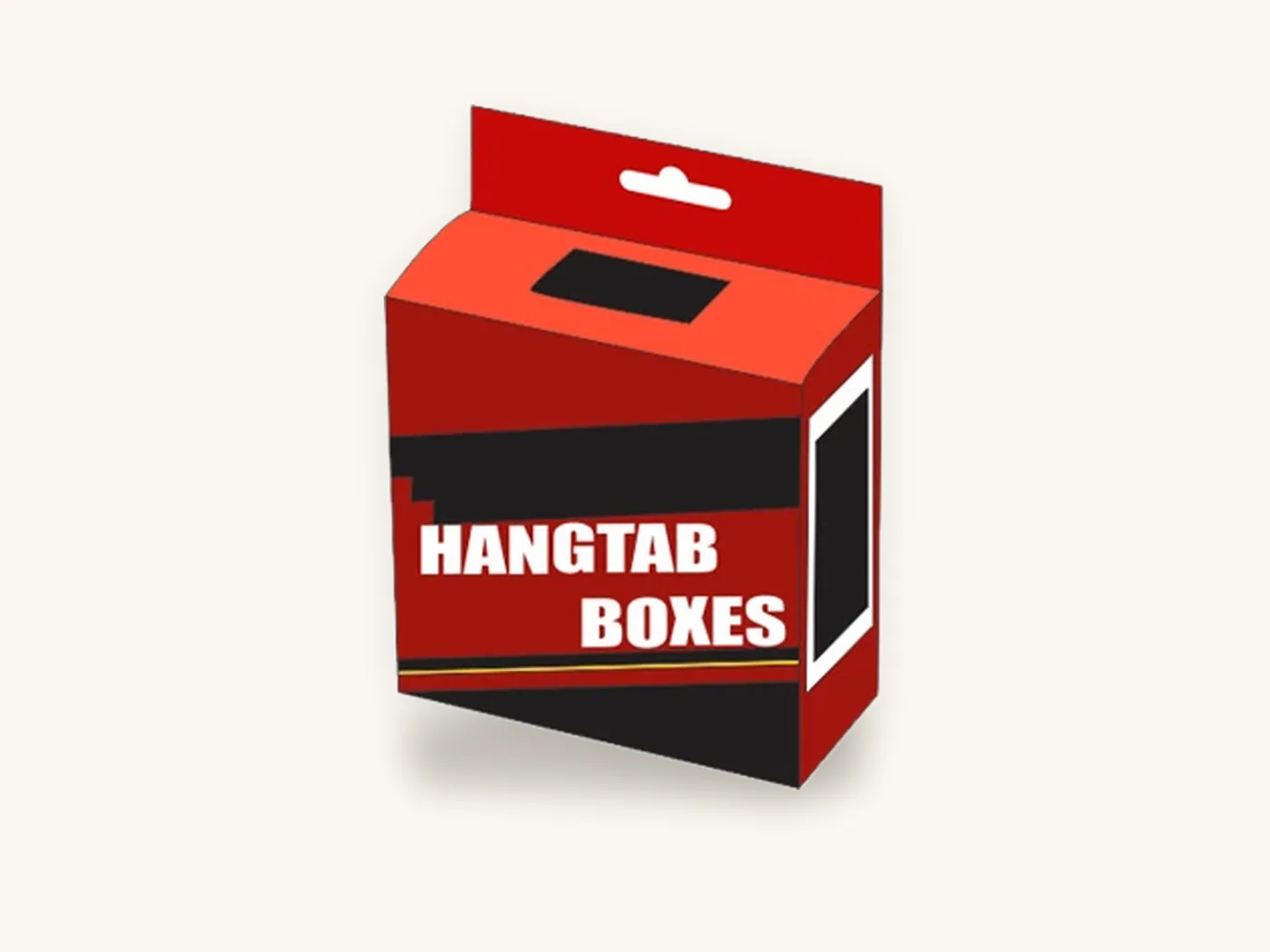
Hang tab boxes are folding cartons with an extended panel at the top, punched with a slot or hole, so the box hangs from a peg hook on a retail wall instead of sitting on a shelf. They are the standard format for phone accessories, earbuds, cables, small toys, cosmetics and hardware, because peg walls let a store show many small products at eye level in very little floor space.
There are two main builds. A hang tab box extends one of the existing top panels upward into a tab. A hanger box, often called a five-panel hanger box, adds a separate fifth panel that folds up behind the box and doubles the thickness where the hole is punched. This guide covers how each works, how to keep a tab from tearing, how to design a carton that sells from a peg, and what retailers usually check before your product goes on the wall.
Key takeaways
- Peg hook packaging must hang straight, resist tearing and show its front while several units hang one behind another.
- The main hole styles are the Euro slot (also called a sombrero slot), the round hole and the delta or triangle hole. Match the one your retailer uses.
- A five-panel hanger box doubles the board at the tab, so it carries more weight and resists tearing better than a single-thickness hang tab.
- Place the hole on the line through the product's center of gravity, or the box will hang crooked and look unkempt on the wall.
- Put the barcode where a cashier can scan it without unfolding a flap, and check your retailer's vendor guide for placement rules.
- Box Sense makes hang tab boxes from 10 units, with no die or plate charges, free dielines and standard production of 8–12 business days after proof approval.
How peg-hook retail works
A peg wall is a grid of perforated board or slatwall with metal hooks that stick out horizontally. Each hook holds a row of identical products, one behind another. A shopper sees the front face of the first box and the tops of the boxes behind it, pulls one off, and the next slides forward.
That setup puts unusual demands on packaging. The box is supported at a single point, so the tab carries the entire product weight, and it takes extra load every time a shopper yanks a box off the hook. The front face is the only full surface anyone sees. And because hooks are spaced for many products, a carton that hangs at an angle or rotates on its hook bumps into its neighbors and looks messy.
Why brands choose hang tab packaging
Peg placement puts small products at eye level, where they would otherwise be lost on a low shelf. It lets retailers merchandise many variants, like phone case sizes or cable lengths, in a tight vertical block. And for brands, a carton with a hang tab can also sit on a shelf or in a counter display, so one package works for several retail channels.
Hang tab styles compared
The tab design is determined partly by the product weight and partly by the retailer's hook type. Many stores use standard pegs that accept both a round hole and a Euro slot, but some use specific hardware, so always confirm.
| Style | How it is built | Load capacity | Best for | Watch for |
|---|---|---|---|---|
| Integrated hang tab, Euro slot | Top dust flap or back panel extends into a single-thickness tab with a sombrero-shaped slot | Light | Earbuds, cosmetics, small accessories | Can tear if the product is heavy or shoppers pull hard |
| Integrated hang tab, round hole | Same construction with a circular punch | Light | Very light items, hooks with thin wire | Round holes let the box spin on the hook |
| Five-panel hanger box | A fifth panel folds up behind the back panel and is glued, doubling the tab | Medium | Phone cases, cables, chargers, toys | Uses more board; slightly taller blank |
| Double-wall reinforced tab | Tab folds over on itself and is glued, doubling thickness in a single panel | Medium | Heavier accessories where a clean back is needed | Adds a gluing step |
| Delta (triangle) hole | Triangular punch that self-centers on the hook | Light to medium | Products that must hang perfectly square | Less common; confirm hook compatibility |
| Adhesive hang tab | Separate plastic or paper tab stuck onto an existing carton | Light | Converting existing stock to peg retail | Can peel off under heat or heavy pulling |
Integrated hang tab boxes
The simplest hang tab box is a reverse tuck end or straight tuck carton with one top panel extended. It uses almost no extra board, adds no assembly step, and prints as part of the same sheet. Its limit is strength: the tab is only one layer of paperboard, so it suits products of a few ounces.
Five-panel hanger boxes
A five panel hanger box adds a fifth panel to the side of the blank. When the carton is folded and glued, that panel lies against the back and extends above the top, where it is punched together with the back panel's own tab. The result is a two-layer hanger with a glued bond, which spreads the load and resists tearing from the slot outward. For most accessory brands, this is the default recommendation.
Hang tab box vs header card vs blister pack
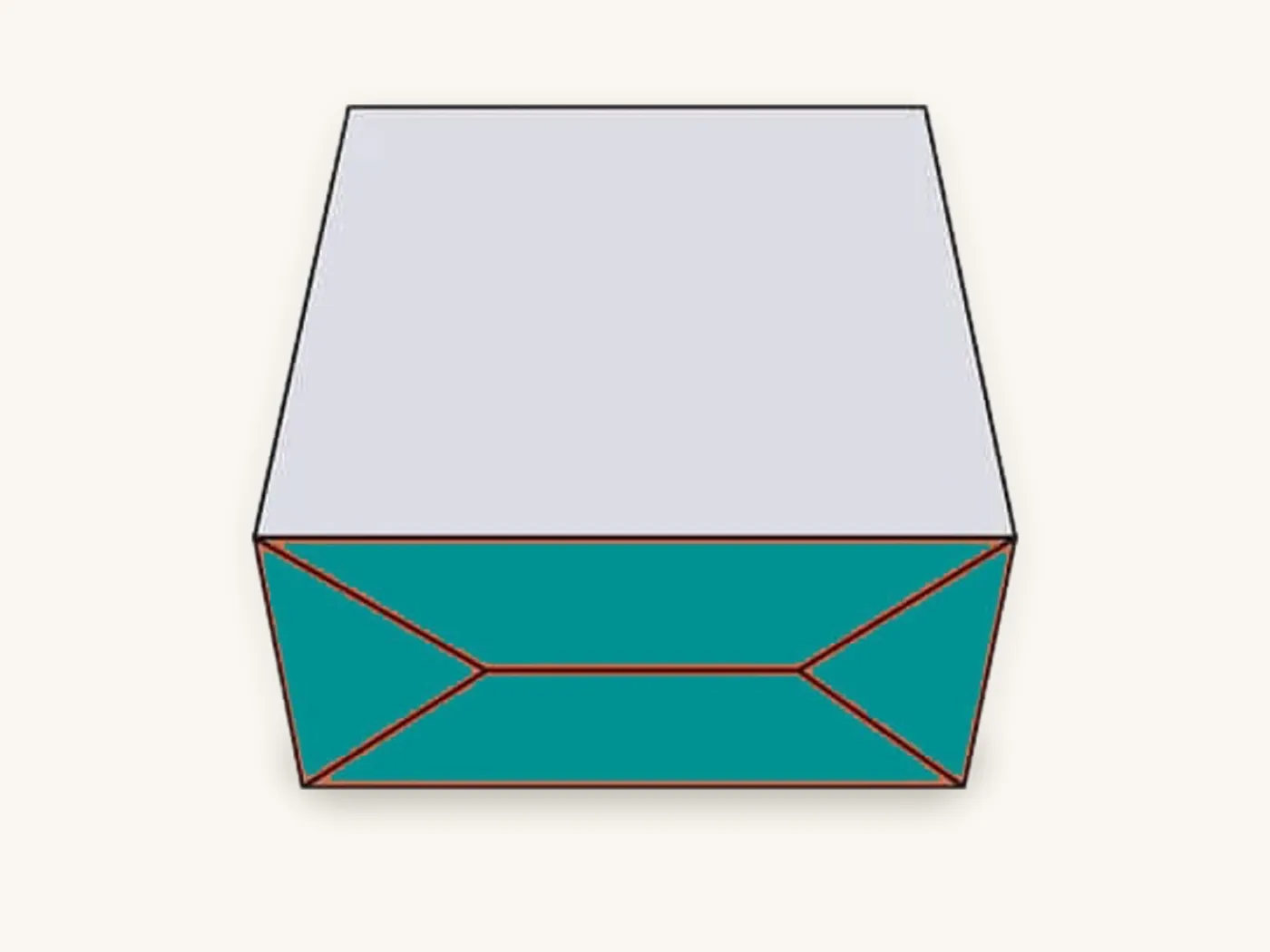
Hang tab boxes are not the only peg hook packaging. Choosing between them is mostly about product protection, print area and how you feel about plastic.
| Format | What it is | Protects the product | Print area | Plastic-free option | Choose it when |
|---|---|---|---|---|---|
| Hang tab box | Folding carton with a tab | Good, fully enclosed | All six faces | Yes | The product needs a real box, instructions or premium feel |
| Five-panel hanger box | Carton with a reinforced fifth panel | Good, fully enclosed | All faces plus the hanger | Yes | Medium-weight products or aggressive shopper handling |
| Header card on a bag | A folded printed card stapled over a poly or paper bag | Minimal | Front and back of the card | Only with a paper bag | Soft goods, hardware, low-cost items |
| Blister or clamshell | Plastic shell sealed to a card | High visibility, theft resistance | Card only | No | Shoppers must see the exact item and theft is a concern |
| Window hang tab box | Carton with a PET or PLA window | Good | Most faces | Yes, with PLA film | Shoppers want to see color or design before buying |
Header cards are the lowest-cost route for bagged items. For small products that need a moisture or odor barrier, a printed pouch with a hang hole is another option; the custom mylar bags guide covers that format. A windowed hang tab box is often the most balanced answer for brands moving away from blisters.
Engineering a hang tab that does not tear
A torn tab means a box on the floor, and a box on the floor usually means a damaged product and an unhappy store manager. Three things determine whether a tab holds: board, reinforcement and geometry.
Board and reinforcement by product weight
As a working guide, 14 to 18 pt SBS paperboard in a single-thickness tab suits products up to a few ounces, such as lip balm, earbuds or a charging cable. For heavier items, such as a boxed phone case with accessories or a small toy, move to a five-panel hanger or a folded double-wall tab. Beyond roughly a pound, consider 24 pt board with a reinforced tab, or ask whether peg retail is right for the product at all.
Coatings matter too. Lamination films add tear resistance at the slot edge, which helps a tab that shoppers pull repeatedly.
Hole geometry
- Distance from hole to top edge. Leave a generous band of board above the slot. If the slot sits too close to the edge, it tears out upward on the first hard pull.
- Rounded slot ends. Sharp corners at the ends of a Euro slot concentrate stress; small radii spread it.
- Tab width. A tab much narrower than the carton flexes and lets the box swing forward. A wider tab keeps the face vertical.
- Crease below the tab. The fold line between the tab and the top of the box should be positioned so the tab stands straight up, not tipped backward.
Center of gravity
The hole must sit on the vertical line through the product's center of gravity. For a symmetrical product, that is the center of the carton width. For a product that is heavier at one end, such as a headphone case with a charging dock on one side, the hole moves toward the heavy side. If it does not, the box hangs at an angle and every unit on the hook tilts the same way.
The easiest test is also the most reliable. Put the real product in an unprinted structural sample, hang it on a pencil through the slot, and look at it from the front.
Tip: test the hang with the product, the insert and any accessories inside, not the empty box. A cable wrap or a folded instruction leaflet can shift the center of gravity enough to tilt the carton.
Designing peg hook packaging that sells from the wall
A carton that looks balanced on a desk can disappear on a peg wall. Design from the shopper's point of view: standing a few feet away, looking at a row of hooks with several boxes on each.
Artwork checklist for hang tab boxes
- Put the product name and key benefit in the upper half of the front panel. The lower half is often hidden behind the hook's price label or the box in front on the next hook down.
- Print the tab. It is the one surface visible on every box in the row. A logo or model name on the tab helps shoppers find the variant they want.
- Use the top panel. Shoppers see the tops of the boxes behind the first one, so a short variant name there helps.
- Differentiate variants by color block. Size, color or compatibility variants hang side by side; a strong color band makes them easy to tell apart.
- Keep the barcode off the tab and away from folds. Place it on the back or a bottom side panel where a cashier can scan it flat.
- Put instructions and compliance text on the back. It is only seen once the box is in hand.
- Extend bleed 1/8 in past every cut, including around the slot.
- Keep text 1/8 in clear of the slot and creases, so nothing is punched away or folded out of view.
Windows and product visibility
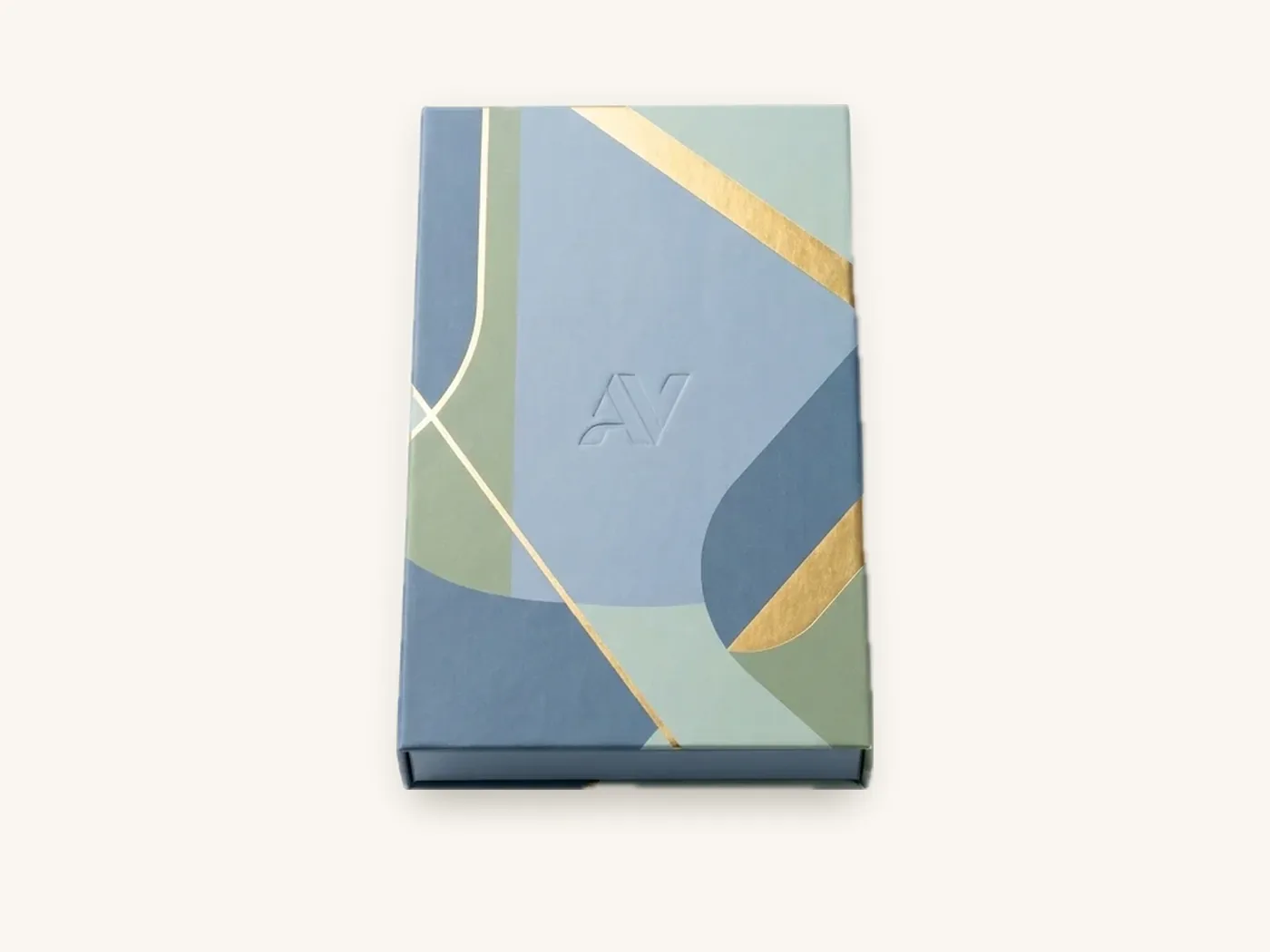
Accessory shoppers often want to see the exact color or design. A die-cut window on the front panel, filled with clear PET or compostable PLA film, lets them do that without a plastic blister. Keep the window below the upper band where your brand and product name sit, and leave enough board around it to keep the carton from buckling under the hanging load.
Products that suit hang tab boxes
Peg hook packaging works best for small, relatively light products that are bought in variants and benefit from eye-level placement.

- Phone and tablet accessories. Cases, screen protectors and chargers are the classic peg product. See phone case boxes.
- Audio. Earbuds and compact headphones in headphone boxes with a hang tab and a fitted insert.
- Electronics and cables. The electronics and tech packaging page covers related formats.
- Toys and collectibles. Small figures, blind boxes and card packs; see toy boxes.
- Beauty. Lip products, nail tools, lash kits and travel sizes.
- Hardware and automotive. Small parts, fuses and accessories; see auto parts boxes.
For the wider picture of shelf, peg and counter formats, the retail and consumer goods page shows how brands combine them.
Retailer and labeling checks before you print
Big-box retailers typically publish vendor packaging guides. Requirements differ by retailer and category, so get the guide from your buyer and check it against your dieline before approving a proof. Common items include:
- Barcode. Most US retailers require a UPC barcode issued through GS1 US, printed at a scannable size with a clear quiet zone around it.
- Hole type and position. Some specify Euro slot, round hole or both, and a position relative to the top edge.
- Maximum hanging weight and a reinforced tab above a certain weight.
- Country of origin marking. US Customs and Border Protection rules generally require imported goods to be marked with their country of origin; confirm how that applies to your product and packaging.
- Category rules. Children's products, electronics and cosmetics each carry their own labeling requirements from agencies such as the CPSC, FCC and FDA. Confirm current requirements with the regulator or counsel.
- Shipping case pack. How many units per inner and outer carton, and the case label format.
If you need extra compliance information after printing, a small printed label on the back panel is a practical fix. The custom labels and stickers guide covers label materials, and custom labels and stickers can be ordered alongside the boxes.
What hang tab boxes cost
A hang tab adds a small amount of board to a standard carton, and a five-panel hanger adds a little more plus a gluing step. The base carton, print and finishes drive most of the price.
For reference, a reverse tuck end carton in 14 pt SBS at 2x2x6 in, full color with gloss lamination, is about $1.17 each at 100 units, about $0.63 at 500 and about $0.52 at 1,000. A straight tuck end carton in 18 pt SBS at 3x2x5 in, full color with aqueous coating, is about $1.15 at 100 and about $0.51 at 1,000. Expect a hang tab or hanger version of a similar carton to price somewhat above those figures, depending on tab size and reinforcement.
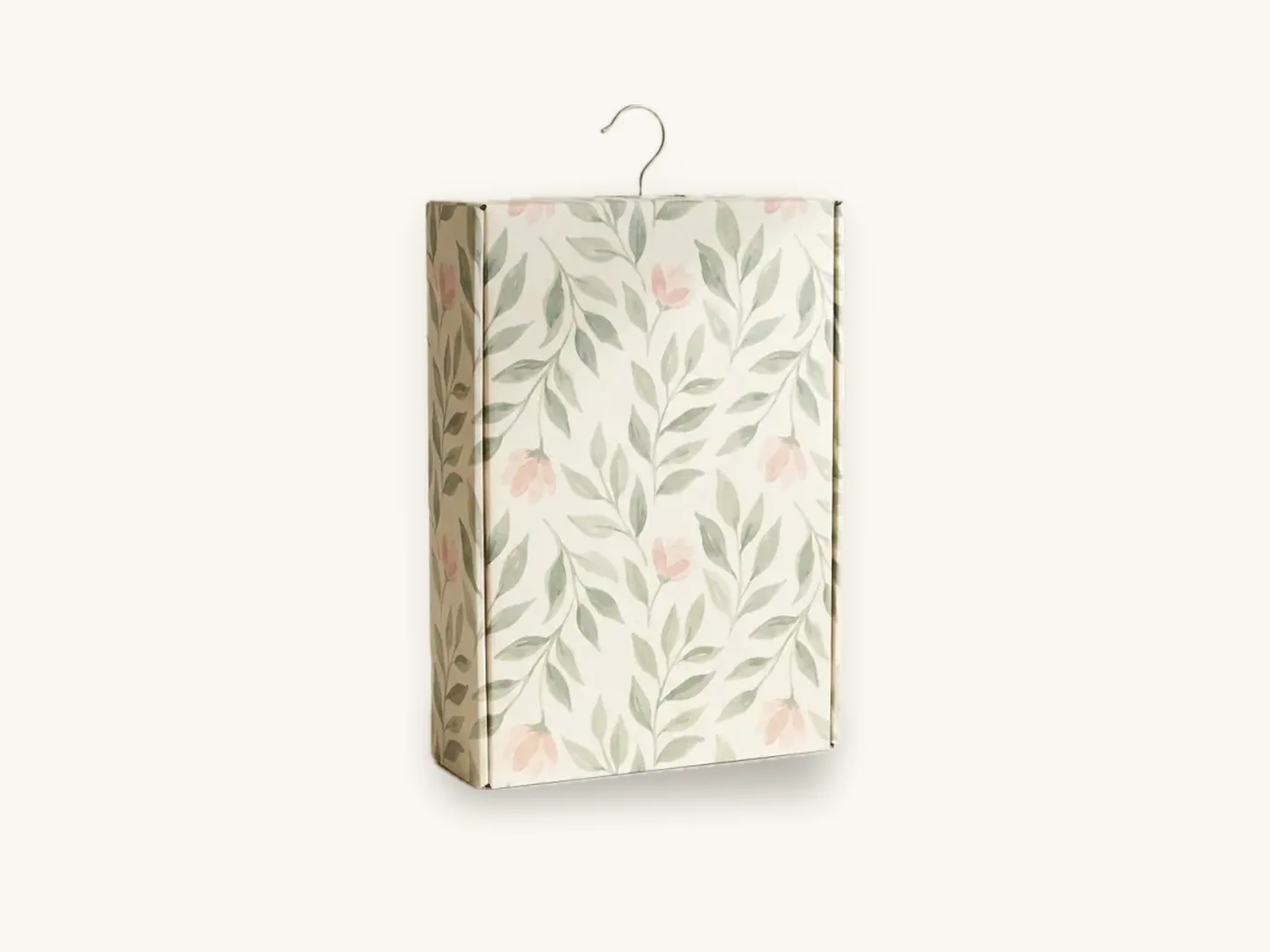
What moves the price:
- Tab style: integrated tab, five-panel hanger or folded double wall
- Board: 14, 18 or 24 pt, SBS or kraft
- Window: film and the extra die-cut
- Inserts: a paperboard cradle for earbuds or a case, with a one-time insert die
- Finishes: lamination adds no tooling; foil, embossing and spot UV do
- Quantity: the unit price falls steeply from 100 to 1,000
Run your spec through the instant price estimator for a baseline.
How to order hang tab boxes from Box Sense
Specs to send
- Product dimensions and weight, including any insert or accessories
- Tab style: integrated, five-panel hanger or reinforced double wall, or ask us to recommend one
- Hole type: Euro slot, round hole, delta or retailer-specified
- The retailer's vendor guide, if you have one
- Board, print coverage, finishes and window
- Barcode and compliance text you need placed
- Quantities to compare and the date you need boxes in hand
- Artwork, or a request for our design services team
Timeline and process
- Quote confirmed within 24 hours.
- Free dieline and 3D proof, with the slot, tab and barcode area marked, plus two revision rounds.
- Free unprinted structural sample to test the hang and center of gravity; a printed sample of approved artwork is free on orders of 100 or more. See samples.
- Production in 8–12 business days after proof approval; rush in 5 business days on most paperboard styles.
- Free shipping on every US order; international shipping quoted at cost.
The minimum is 10 boxes, with no die or plate charges, and defective boxes reported within 14 days are reprinted free. The hang tab boxes product page and the hang tab boxes style page show the standard builds.
Shipping cases of hang tab boxes to stores or a distribution center need their own outer cartons; the custom shipping boxes guide covers case sizing, and the custom mailer boxes guide covers the direct-to-consumer side of the same product line. If your product needs a shape no standard carton offers, the die cut boxes guide explains custom structures, and if it runs through an automated cartoner, see the seal end boxes guide.
Frequently asked questions
What is a hang tab box?
A hang tab box is a folding carton with an extended panel at the top that has a slot or hole punched through it, so the box can hang from a peg hook on a retail wall. It is widely used for phone accessories, earbuds, cables, cosmetics, small toys and hardware. The tab is either part of an existing panel or a separate reinforced fifth panel.
What is the difference between a hang tab box and a five panel hanger box?
A standard hang tab box extends one existing panel into a single-thickness tab. A five panel hanger box adds an extra panel to the blank that folds up behind the carton and is glued in place, so the hanging area is two layers thick. The five-panel version holds more weight and resists tearing, which suits heavier accessories and busy stores.
What is a Euro slot hang hole?
A Euro slot, also called a sombrero slot, is a hang hole shaped like a wide slot with a raised center, resembling a hat outline. It fits standard retail peg hooks and holds the carton more steadily than a plain round hole, which lets a box spin. Many retailers accept both styles, but some specify one, so check your retailer's vendor guide first.
How much weight can a hang tab hold?
It depends on board thickness, reinforcement and hole placement. A single-thickness tab in 14 to 18 pt paperboard suits products up to a few ounces. Five-panel hangers and folded double-wall tabs handle heavier accessories. Beyond roughly a pound, use thicker board with reinforcement and test a structural sample, pulling it off a hook repeatedly, before committing to production.
Why does my hang tab box hang crooked?
A crooked box almost always means the hang hole is not on the vertical line through the product's center of gravity. Products heavier on one side, or inserts that shift weight, pull the box sideways. Hang an unprinted sample with the real product inside on a pencil through the slot, then move the hole toward the heavier side on the dieline until it hangs square.
Where should the barcode go on peg hook packaging?
Place the barcode on the back panel or a bottom side panel, on a flat surface away from creases, the tab and the slot, so a cashier can scan it without unfolding anything. Leave a clear quiet zone around it and print it at a scannable size. Many retailers specify placement in their vendor packaging guides, so confirm before approving the proof.
Can hang tab boxes also sit on a shelf?
Yes. A hang tab box is still a complete carton, so it can stand on a shelf or sit in a counter display with the tab upright or folded down behind the back panel, depending on the design. That flexibility lets one package serve peg walls, shelves and online orders, which reduces the number of packaging versions a brand has to manage.
Next steps
Weigh your product with its insert, confirm your retailer's hole style, and decide between an integrated tab and a five-panel hanger. Then check indicative costs in the hang tab box price estimator and request a hang tab box quote. We will confirm pricing within 24 hours and send a dieline with the tab and slot marked.
Boxes in this guide
Order the packaging we covered
Written by the Box Sense Packaging Team
Our structural designers, prepress technicians and production staff print and convert custom boxes every day for brands in the United States, United Kingdom and UAE. Questions about this guide? Talk to us.