The cheapest shipping box sizes are the smallest boxes that protect your product once you measure them the way carriers do: on the outside, rounded up, and priced by whichever is greater of actual weight and dimensional weight. USPS, UPS and FedEx all publish maximum sizes and surcharge triggers, but for most e-commerce parcels the real cost difference comes from an inch or two of unnecessary box.
That makes box size a pricing decision, not just a packing one. A box labeled 12x10x6 can bill like a much bigger parcel once you add the board thickness and the carrier's rounding. Trimming it to fit can drop your billable weight by a pound or more on every order.
This guide explains how each carrier measures and limits parcels, lists common box sizes with their volume and illustrative dimensional weight, walks through a worked example, and shows when a custom size pays for itself.
Key takeaways
- Carriers bill on outside dimensions. Board thickness adds to every side, and most carriers round fractions up.
- Billable weight is the greater of actual weight and dimensional weight (outer volume divided by the carrier's divisor).
- USPS Flat Rate pricing requires USPS-supplied boxes, so custom printed boxes are priced by weight, zone and, for many services, size.
- UPS and FedEx add surcharges for long, heavy, or non-corrugated packages. Stay well under those triggers unless your product truly needs the size.
- An internal size chosen to fit your packed product, not the nearest stock size, is often a full pound or more cheaper to ship.
- Carrier rules and divisors change. Treat the figures here as a guide and confirm current rules in each carrier's service guide before you finalize a size.
How carriers measure a box
Every carrier uses the same basic vocabulary, and getting it right is the first step to picking a cheap size.
Length, width, height and girth
Length is always the longest side. Width and height are the two shorter sides. Girth is the distance around the box at its thickest point, calculated as 2 x (width + height). Many size limits are expressed as length plus girth.
For a 16x12x8 in box, girth is 2 x (12 + 8) = 40 in, so length plus girth is 56 in.
Outside, not inside
Box manufacturers quote internal dimensions, because that is what your product has to fit into. Carriers measure the outside. The difference is the board thickness on both walls in each direction, plus a little for folds and bulging.
Actual weight versus dimensional weight
Dimensional weight (often called DIM weight) converts a box's size into a notional weight. The general formula is length x width x height in inches, divided by a divisor the carrier sets. A light, bulky box is billed on its size; a small, dense box is billed on its scale weight. You pay whichever is higher.
At the time of writing, UPS and FedEx commonly use a divisor of 139 for daily commercial rates, and USPS uses 166 for its dimensional pricing on larger parcels. Divisors differ by service, account and contract, and have changed before, so check the current figure for your account. Our dimensional weight guide covers the calculation in depth.
Rounding
UPS and FedEx generally round each measured dimension up to the next whole inch before calculating dimensional weight, and round the result up to the next whole pound. USPS applies its own rounding rules, which differ between its dimensional and cubic pricing. A box that measures 11.6 in long is billed as 12 in; one that measures 12.1 in is billed as 13 in.
USPS box sizes: limits, Flat Rate and cubic pricing
USPS is often the cheapest carrier for light residential parcels, and its box rules work a little differently from the private carriers.
USPS size limits
USPS limits parcels by weight and by combined length and girth. For many years, services such as Priority Mail have capped parcels at 70 lb and 108 in in combined length and girth, and some ground services accept longer parcels at oversized pricing. Parcels above set size thresholds can attract non-standard fees. Check the USPS Domestic Mail Manual or the current price list for the exact limits of your service.
USPS Flat Rate boxes
Flat Rate pricing means one price per box regardless of weight or distance, within the weight limit. The catch for brands is that Flat Rate only applies to USPS-supplied Flat Rate packaging. You cannot print your own box and claim Flat Rate pricing. Flat Rate can make sense for heavy, compact items going to distant zones, but custom packaging is priced by weight, zone and dimensions instead.
USPS cubic pricing
For small, heavy parcels, USPS offers cubic pricing through commercial shipping platforms. Instead of weight, the price is based on the box's outer volume in tiers of a fraction of a cubic foot, along with the zone. Dense products such as supplements, cosmetics or hardware in a compact box can ship very economically under cubic pricing, which makes a tight custom size especially valuable.
When USPS dimensional weight applies
USPS generally applies dimensional weight only to larger parcels, above a set volume, and to parcels going to more distant zones depending on the service. Most small e-commerce mailers fall below that point and are billed on actual weight, so for USPS the bigger gains come from cubic tiers and avoiding oversize fees.
UPS box sizes and FedEx box sizes: limits and surcharges
UPS and FedEx publish very similar rules for their ground and express parcel networks, and both apply dimensional weight to essentially every package.
Maximum sizes
Both carriers have long capped standard parcels at 150 lb, 108 in in length and 165 in in combined length and girth. Parcels beyond those limits move into freight services. Few e-commerce shipments come near those numbers, but surcharge triggers sit far below them.
Additional handling and large package surcharges
Both carriers add an additional handling charge to parcels that are awkward to move through automated sorting. Common triggers include:
- a longest side beyond roughly four feet, or a second-longest side beyond roughly 30 in
- actual weight above a set threshold
- packages not fully enclosed in corrugated, such as items in bags, wrapped in film or in cylindrical tubes
- packages with metal or wooden exteriors
Larger parcels, based on length or on length plus girth, move into a large package surcharge, which is significantly more expensive and usually carries a minimum billable weight. Thresholds and fees are updated regularly, so review the current UPS and FedEx rate and service guides before designing any large box.
Carrier-supplied flat-rate options
FedEx and UPS both offer some simplified pricing options tied to their own branded packaging or specific account programs. As with USPS Flat Rate, those generally do not apply to your custom printed box.
USPS, UPS and FedEx rules compared
This table summarizes how the three carriers treat box size. It deliberately avoids specific prices and exact thresholds, which change often.
| What matters | USPS | UPS | FedEx |
|---|---|---|---|
| How size is limited | Weight plus combined length and girth | Weight, length and length plus girth | Weight, length and length plus girth |
| Dimensional weight | Mainly larger parcels, service dependent | Applies to virtually all packages | Applies to virtually all packages |
| Flat rate with your own box | No; Flat Rate needs USPS boxes | No; carrier programs use their packaging | No; carrier programs use their packaging |
| Volume-based pricing for small parcels | Cubic pricing tiers via commercial platforms | Not a standard option | Not a standard option |
| Main size-related surcharges | Non-standard and oversize fees | Additional handling, large package | Additional handling, oversize |
| Best fit | Light residential parcels, dense small items | Heavier parcels, B2B, time-definite | Heavier parcels, B2B, time-definite |
Common shipping box sizes and their dimensional weight
These are sizes you will see in most stock catalogs. The dimensional weight column is illustrative, calculated with a divisor of 139 on the listed dimensions and rounded up to the next pound. Real billing uses the outside dimensions and your account's divisor.
| Box size (in) | Volume (cu in) | Volume (cu ft) | Illustrative DIM weight | Typical contents |
|---|---|---|---|---|
| 6x6x6 | 216 | 0.13 | 2 lb | Candles, mugs, small gift sets |
| 8x6x4 | 192 | 0.11 | 2 lb | Skincare, accessories, small electronics |
| 10x8x6 | 480 | 0.28 | 4 lb | Shoes for children, kits, bundles |
| 12x9x4 | 432 | 0.25 | 4 lb | Apparel, subscription kits, books |
| 12x10x6 | 720 | 0.42 | 6 lb | Folded apparel sets, multi-item orders |
| 14x10x8 | 1,120 | 0.65 | 9 lb | Adult shoes, small appliances |
| 12x12x12 | 1,728 | 1.00 | 13 lb | Bulky light items, hampers |
| 16x12x8 | 1,536 | 0.89 | 12 lb | Wholesale packs, larger bundles |
| 18x14x12 | 3,024 | 1.75 | 22 lb | Bulk shipments, heavy multi-packs |
Two patterns stand out. A cube is the least efficient shape for billing, because it adds volume in every direction; 12x12x12 bills heavier than the longer, flatter 16x12x8. And height is often the easiest dimension to cut, because products are packed with empty space above them.

A worked example: stock size versus custom fit
Say you sell a hypothetical boxed set of two throw pillows that packs into a bundle measuring 11.2 x 9.2 x 4.5 in and weighs 2.5 lb. You ship with a carrier using a 139 divisor.
Option A: nearest stock box
The nearest stock box is 12x10x6 in internal, made from B-flute. B-flute is about 3 mm thick, so the outer box measures roughly 12.25 x 10.25 x 6.25 in. With each dimension rounded up, the carrier bills it as 13 x 11 x 7 = 1,001 cu in. Divided by 139, that is 7.2, so billable weight is 8 lb.
Option B: custom size in E-flute
A custom box with an internal size of 11.4 x 9.4 x 4.7 in leaves a little clearance for the bundle. In E-flute, about 1.5 mm thick, the outside is roughly 11.5 x 9.5 x 4.8 in, which rounds up to 12 x 10 x 5 = 600 cu in. Divided by 139, that is 4.3, so billable weight is 5 lb.
What changed
The product did not change, and the box still protects it. But the billable weight dropped from 8 lb to 5 lb because of three things: less empty height, thinner board that did not push dimensions over the next whole inch, and a size designed around rounding. Multiply a three-pound difference by every order in a year, and a custom box often pays for itself quickly.
Tip: when choosing a custom size, calculate the outside dimensions first, then check which whole inch they round up to. If an outer dimension lands just over a whole number, such as 10.1 in, trimming a fraction of an inch off the inside can save you a full inch of billed size.
How to choose the cheapest box size, step by step
Use this process for each product or common order bundle.
- Pack the product for real. Include any pouch, tissue, insert or protective wrap, then measure the bundle at its widest points.
- Decide on protection. Fragile items need inserts or cushioning space; soft goods can go nearly tight. Our guide to right-sized packaging explains how much clearance different products need.
- Choose the board. E-flute for most mailers under a few pounds, B-flute for heavier or sharper items, double wall for dense or high-value loads. Read ECT vs burst strength if you are unsure.
- Set internal dimensions from the bundle plus clearance.
- Calculate outside dimensions by adding roughly twice the board thickness in each direction.
- Apply carrier rounding and calculate dimensional weight with your account's divisor.
- Compare billable weight with actual weight; if the box is dense, dimensional weight may not matter and actual weight dominates.
- Check surcharge triggers. Make sure no side approaches the additional handling thresholds.
- Test the rate in your shipping software for your most common zones before ordering.
- Order a structural sample and ship it to a distant address before committing to a large run.
How board thickness and box style change outside dimensions
The same internal size can produce very different outer sizes depending on board and construction. These figures are approximate and vary with the specific grade.
| Board | Approx. thickness | Added to each outer dimension | Where it fits |
|---|---|---|---|
| E-flute single wall | about 1.5 mm | about 1/8 in | Mailers and lighter parcels |
| B-flute single wall | about 3 mm | about 1/4 in | Most RSC shipping boxes |
| C-flute single wall | about 4 mm | about 5/16 in | Heavier cartons, stacking strength |
| BC double wall | about 6.5 mm | about 1/2 in | Heavy, dense or valuable shipments |
Mailer boxes versus RSC shipping boxes
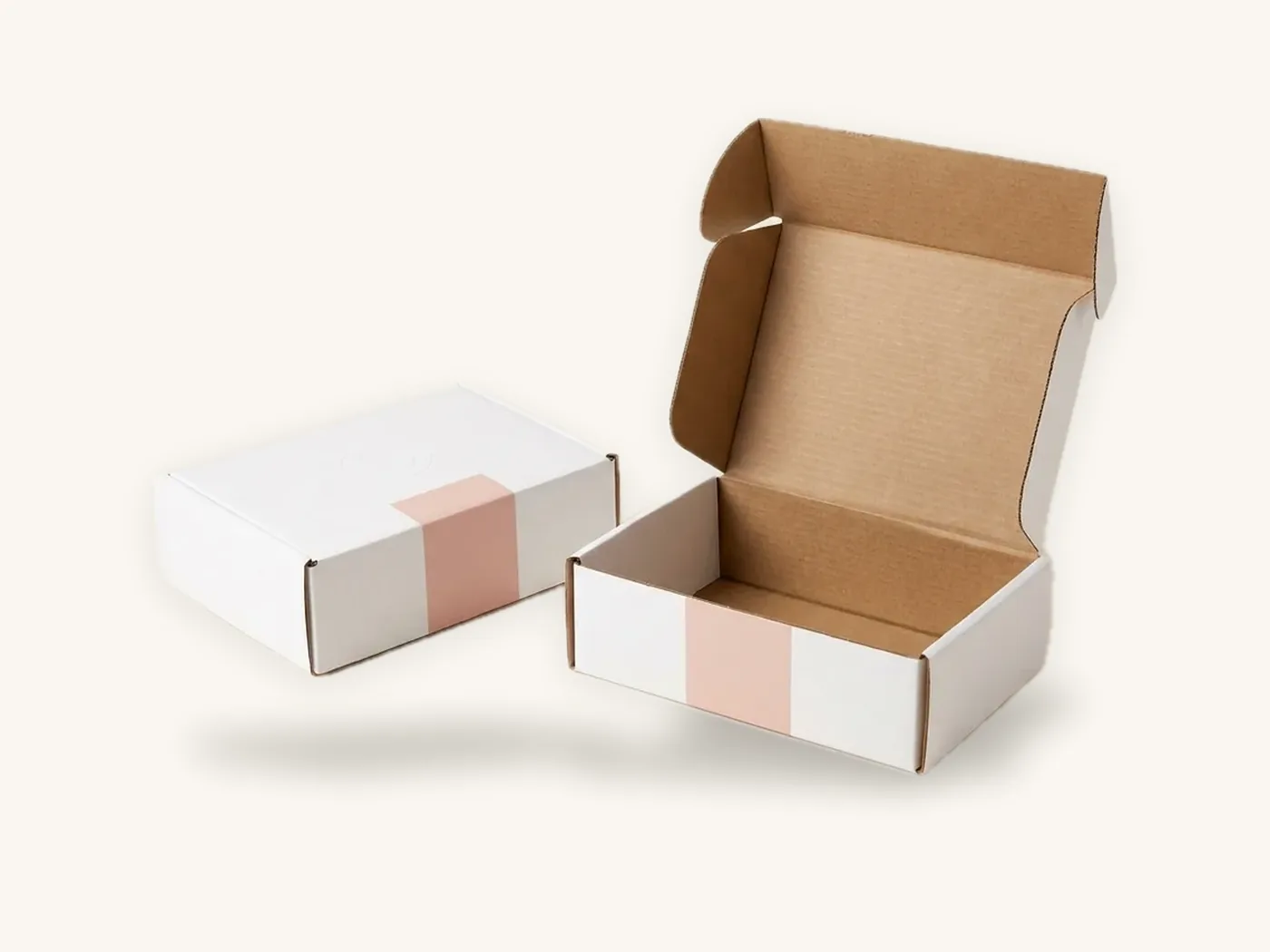
Custom mailer boxes have rolled double-thickness side walls, which add a little more to the outside than a plain slotted box of the same board. In exchange, they need no tape and double as a presentation box. Custom shipping boxes in the regular slotted container style are the most material-efficient way to enclose a given volume, and they are easy to size in quarter-inch steps.
For heavy loads, heavy duty double wall boxes add thickness but prevent crushing, which is cheaper than a damage claim. The corrugated flutes guide goes deeper on each flute profile, and our corrugated board page lists every grade we run.
Watch out: never size a box from a spec sheet's internal dimensions when you are calculating shipping cost. Carriers see the outside, and they will re-measure parcels on their equipment. If your shipping software uses the internal size, you may receive adjustment charges after the fact.
When a custom box size pays for itself
Stock boxes are cheap and immediately available, and for some brands they are the right answer. Custom sizes earn their place in these situations.
Choose a stock size when
- your products vary widely and no single size fits a majority of orders
- you ship low volumes and the shipping savings per year are small
- your items are dense, so actual weight already exceeds dimensional weight
Choose a custom size when
- one product or bundle accounts for a large share of orders
- your current stock box leaves an inch or more of empty space in any direction
- your parcels are light and bulky, so dimensional weight sets the price
- you want printing and a better unboxing experience in the same box
What custom shipping boxes cost
Price depends on size, board, print coverage and quantity. These indicative per-unit prices include free US shipping; use the instant price estimator for your own dimensions.
| Spec | 100 | 500 | 1,000 | 5,000 |
|---|---|---|---|---|
| Mailer box, E-flute, 8x6x3 in, full color outside | about $2.64 | about $1.41 | about $1.17 | about $0.83 |
| Mailer box, E-flute, 10x8x4 in, full color inside and outside | about $4.33 | about $2.31 | about $1.92 | about $1.36 |
| Shipping box RSC, B-flute, 12x10x6 in, 1-color | about $4.69 | about $2.50 | about $2.08 | about $1.48 |
| Shipping box RSC, B-flute, 16x12x8 in, 1-color | about $7.47 | about $3.99 | about $3.32 | about $2.36 |
| Double wall shipper, BC flute, 18x14x12 in, 1-color | about $17.97 | about $9.58 | about $7.98 | about $5.67 |
For a full breakdown of what moves box pricing, see how much custom boxes cost.
Ordering custom-sized shipping boxes from Box Sense
Because every Box Sense order is cut to your dimensions, you can size boxes to your products and to carrier rounding rather than to a catalog.
What to send for an accurate quote
- Packed product dimensions and weight, or the internal box size you want
- Style: mailer box, regular slotted container or double wall shipper
- Board preference, or a note on product weight and fragility so we can recommend one
- Print: plain, one color or full color, and which sides
- Quantities to compare
- Your main carrier and whether you want help checking outer dimensions against billing rules
What to expect
- A quote confirmed within 24 hours.
- Free design support, including the dieline, artwork setup and a 3D digital proof with two revision rounds.
- Free structural samples so you can test fit and ship a trial parcel. A printed sample of approved artwork is free on orders of 100 or more; see samples.
- Production in 8–12 business days after proof approval, or 5 business days on rush for most corrugated styles.
- Free shipping on every US order, with international shipping quoted at cost.
The minimum order is 10 boxes and there are no die or plate charges, so testing a new size costs very little. The shipping boxes style page shows the constructions we make.
Frequently asked questions
What size box is cheapest to ship?
The cheapest box is the smallest one that protects your product, measured from the outside and rounded the way your carrier rounds. Light, bulky parcels are billed by dimensional weight, so cutting empty height or length lowers cost. Dense parcels are billed by actual weight, so size matters less. Compare billable weight for your top zones in your shipping software before choosing.
Can I use my own box for USPS Flat Rate?
No. USPS Flat Rate pricing only applies to USPS-supplied Flat Rate boxes and envelopes. If you ship in a custom printed box, the parcel is priced by weight, zone and, depending on the service, its dimensions or cubic volume. For small, dense items, USPS cubic pricing through a commercial shipping platform can be competitive with Flat Rate.
How do UPS and FedEx measure box size?
Both measure the outside of the package, with the longest side as length. Girth is twice the sum of width and height. For dimensional weight, they generally round each dimension up to the next whole inch, multiply them, divide by the account's divisor and round up to the next pound. You pay the greater of actual and dimensional weight.
What are the most common shipping box sizes?
Common stock sizes include 6x6x6, 8x6x4, 10x8x6, 12x9x4, 12x10x6, 12x12x12, 16x12x8 and 18x14x12 in. They are popular because they suit many products, not because they are efficient for yours. If one product makes up a large share of orders, a custom internal size often lowers dimensional weight and reduces movement inside the box.
Do carriers use inside or outside box dimensions?
Outside. Board thickness adds to every dimension, so a box with 12x10x6 in internal dimensions in B-flute measures closer to 12.25 x 10.25 x 6.25 in outside. After rounding, that can bill as 13 x 11 x 7 in. Always enter outside dimensions in your shipping software to avoid adjustment charges.
What triggers an additional handling surcharge?
UPS and FedEx apply additional handling charges to packages that are hard to sort automatically. Typical triggers are a longest side of roughly four feet or more, a long second side, weight above a set threshold, or packaging that is not fully enclosed in corrugated. Thresholds change, so check the carrier's current service guide before designing a large box.
Is a mailer box or a shipping box better for dimensional weight?
For the same internal size, a plain regular slotted shipping box usually has slightly smaller outer dimensions, because mailers have rolled double walls. The difference is small. Mailers make sense when presentation matters and the product is light; RSC shipping boxes suit heavier items, multi-packs and orders that are overboxed or palletized.
Next steps
Measure your top three products packed for shipping, work out outside dimensions and billable weight, and see which sizes cross a rounding line. Then price a right-sized box in the shipping box price estimator, or request a custom quote with your dimensions and main carrier, and we will confirm pricing within 24 hours.
Boxes in this guide
Order the packaging we covered

Written by the Box Sense Packaging Team
Our structural designers, prepress technicians and production staff print and convert custom boxes every day for brands in the United States, United Kingdom and UAE. Questions about this guide? Talk to us.