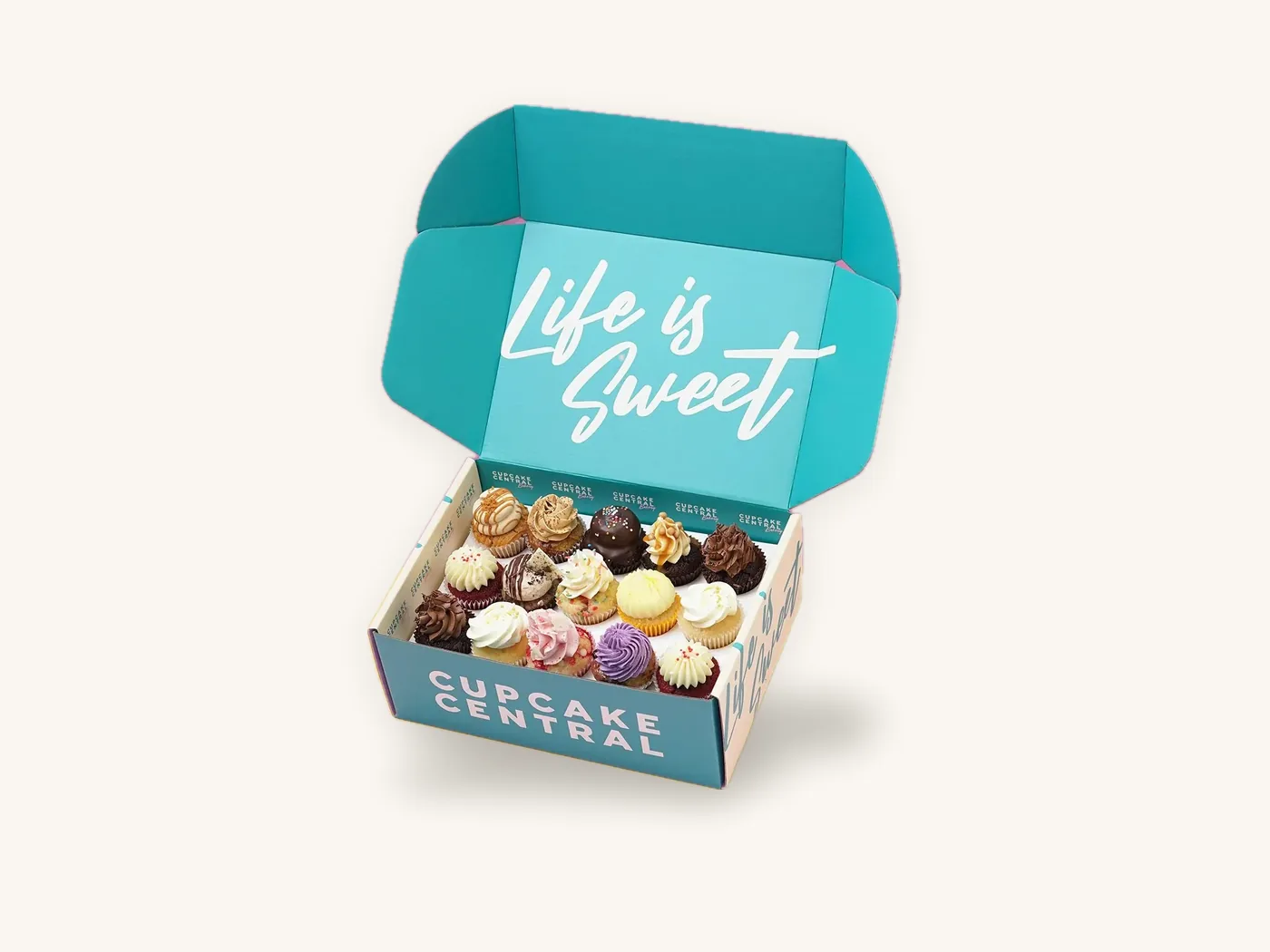
Custom cupcake boxes live or die by the insert. The box itself is a simple window carton; the insert is what stops six frosted cupcakes from sliding into each other the first time the box tilts. Size the insert holes to the bottom of the liner, space them by the widest point of the frosting, and the box footprint almost calculates itself.
This guide works from the cupcake outward. It covers how to measure mini, standard and jumbo cupcakes, the geometry of insert holes and spacing, box layouts from a single cupcake up to two dozen, box depth for tall swirls, window choices and how to order cupcake boxes with inserts that fit the first time.
Key takeaways
- Hole diameter follows the liner base; hole spacing follows the frosting top. Most fit problems come from confusing the two.
- A standard cupcake needs a hole of roughly 2 in and a center-to-center pitch of roughly 3 to 3.25 in; minis and jumbos scale from there.
- Common counts are 1, 2, 4, 6, 12 and 24. Grids of 2x2, 2x3 and 3x4 keep boxes close to square and easy to carry.
- Box depth should clear the tallest swirl by about 1/2 to 3/4 in, which is usually 3.5 to 4.5 in for standard cupcakes.
- Reversible or dual-size inserts let one box hold standard or jumbo cupcakes, which simplifies inventory.
- Box Sense makes cupcake packaging from 10 units, with insert tooling as a one-time charge and free 3D proofs before production.
Measure the cupcake before you design the box
Cupcake sizes vary more than bakers expect, because the same liner can produce very different finished cupcakes depending on batter fill and frosting style. Measure a finished, frosted cupcake from your own kitchen, not the liner package.
The four measurements that matter
- Liner base diameter: the flat bottom of the paper liner. This sets the insert hole.
- Liner top diameter: where the liner flares out at its rim. This is usually the widest part of the cake itself.
- Frosting diameter: the widest point of the frosting or any decoration that overhangs the liner. This sets spacing.
- Total height: from the base of the liner to the top of the frosting swirl or topper. This sets box depth.
Take each measurement on three or four cupcakes from a normal batch and use the largest. A box sized to your neatest cupcake fails on your busiest day.
Typical US cupcake dimensions
Use these as rough starting points only; your recipe and piping will shift them.
| Size | Liner base | Liner top | Typical frosting width | Typical frosted height |
|---|---|---|---|---|
| Mini | about 1.25 in | about 1.75 in | about 2 in | 1.75 to 2.25 in |
| Standard | about 2 in | about 2.75 in | 2.75 to 3 in | 3 to 3.75 in |
| Jumbo (Texas) | about 2.5 in | about 3.5 in | 3.5 to 4 in | 3.75 to 4.5 in |
| Wide or "bakery" style liner | about 2.25 in | about 3 in | 3 to 3.5 in | 3.5 to 4 in |
If you sell both standard and wide-liner cupcakes, measure both. The difference is small on paper but enough to make a standard insert grip too tightly.
Insert geometry: holes, pitch and margins
An insert is a flat or raised sheet of paperboard with die-cut openings. The cupcake liner drops through the opening until the liner's sloped wall catches on the edge. Get the three dimensions below right and every cupcake sits upright and apart.
Hole diameter
The hole should be slightly larger than the liner base and smaller than the liner top, so the liner wedges part way down. A useful rule is liner base plus about 1/8 in. For a standard cupcake with a 2 in base, that is a hole of roughly 2 1/8 in.
Make it too small and the cupcake perches on top and tips. Make it too big and the cupcake drops to the floor of the box and the frosting sits lower than the insert can protect.
Star cuts and tabs
Instead of a clean circle, many inserts use a circle with small radial slits or four flexible tabs. The tabs bend to grip slightly different liner sizes, which is valuable because liners crumple and batches vary. Star cuts also leave a cleaner release, so the cupcake lifts out without tearing its liner.
Pitch: center-to-center spacing
Pitch is the distance from the center of one hole to the center of the next. It must be greater than the frosting diameter, or neighboring swirls touch. Take the widest frosting measurement and add about 1/4 in of air.
For standard cupcakes with 2.75 to 3 in of frosting, that gives a pitch of about 3 to 3.25 in. Ruffled buttercream flowers and piped roses spread wider, so measure them separately.
Edge margin
The outer holes need space between the frosting and the box wall. A margin of about 1/4 in from the widest frosting point to the inside wall is enough. Put another way, the distance from the center of an outer hole to the wall is half the frosting diameter plus about 1/4 in.
The footprint formula
Once you have pitch and margin, the internal box size follows:
- Length = (number of columns - 1) x pitch + frosting diameter + 2 x margin
- Width = (number of rows - 1) x pitch + frosting diameter + 2 x margin
For six standard cupcakes in a 2x3 grid, with a 3.25 in pitch, 3 in frosting and 1/4 in margins, the length is 2 x 3.25 + 3 + 0.5 = 10 in, and the width is 1 x 3.25 + 3 + 0.5 = 6.75 in. That is why a 6-count cupcake box sits at roughly 10 x 7 in inside.
Tip: draw the grid at full size on paper, cut the circles with scissors and set real cupcakes on it before you approve a dieline. It takes ten minutes and catches almost every spacing error.
Cupcake box layouts from 1 to 24
Once the geometry is set, counts and layouts are a planning exercise. Grids that keep the box close to square are easier to carry level; long single rows tip.
| Count | Layout | Approx. internal footprint (standard cupcakes) | Notes |
|---|---|---|---|
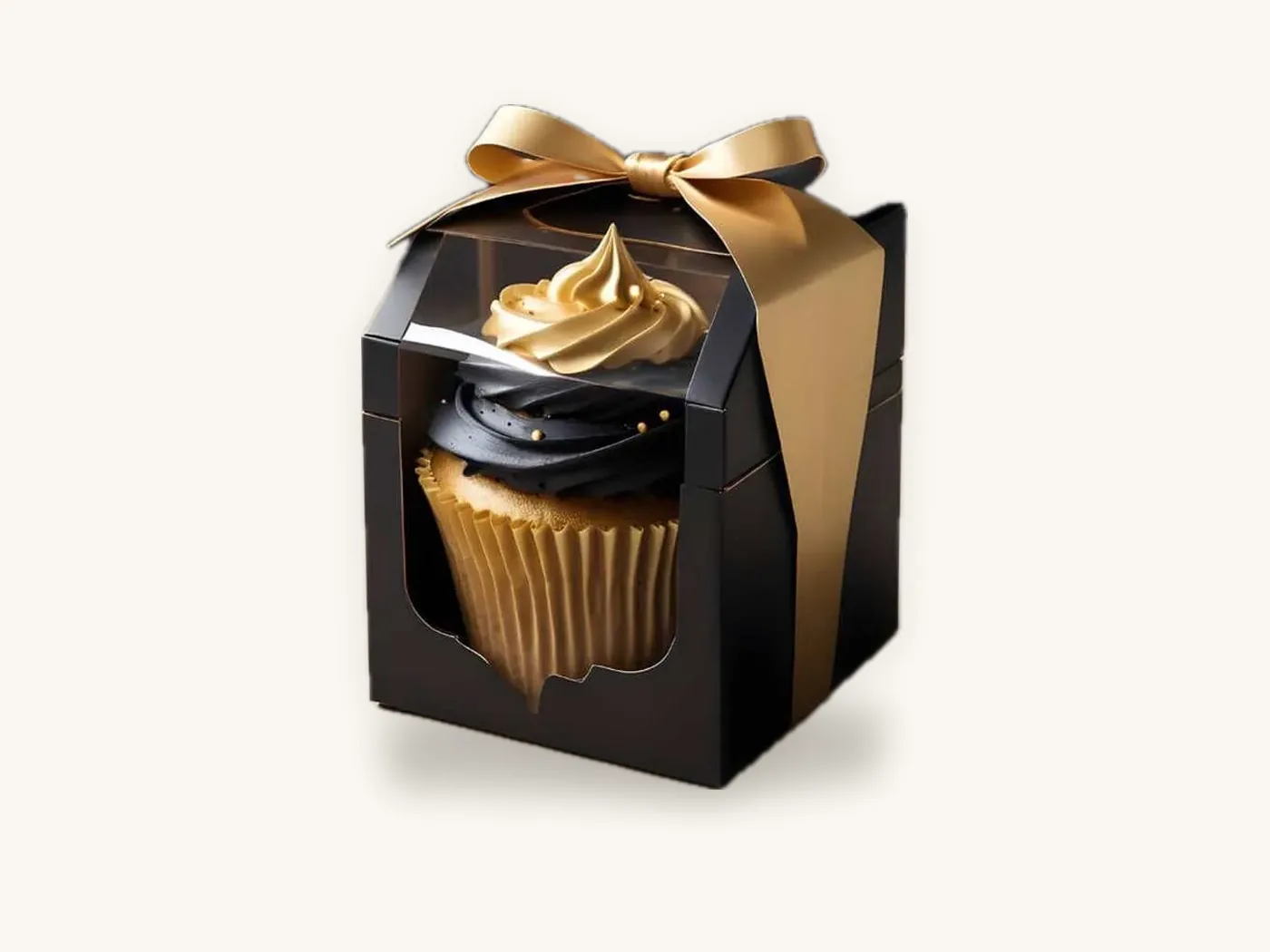
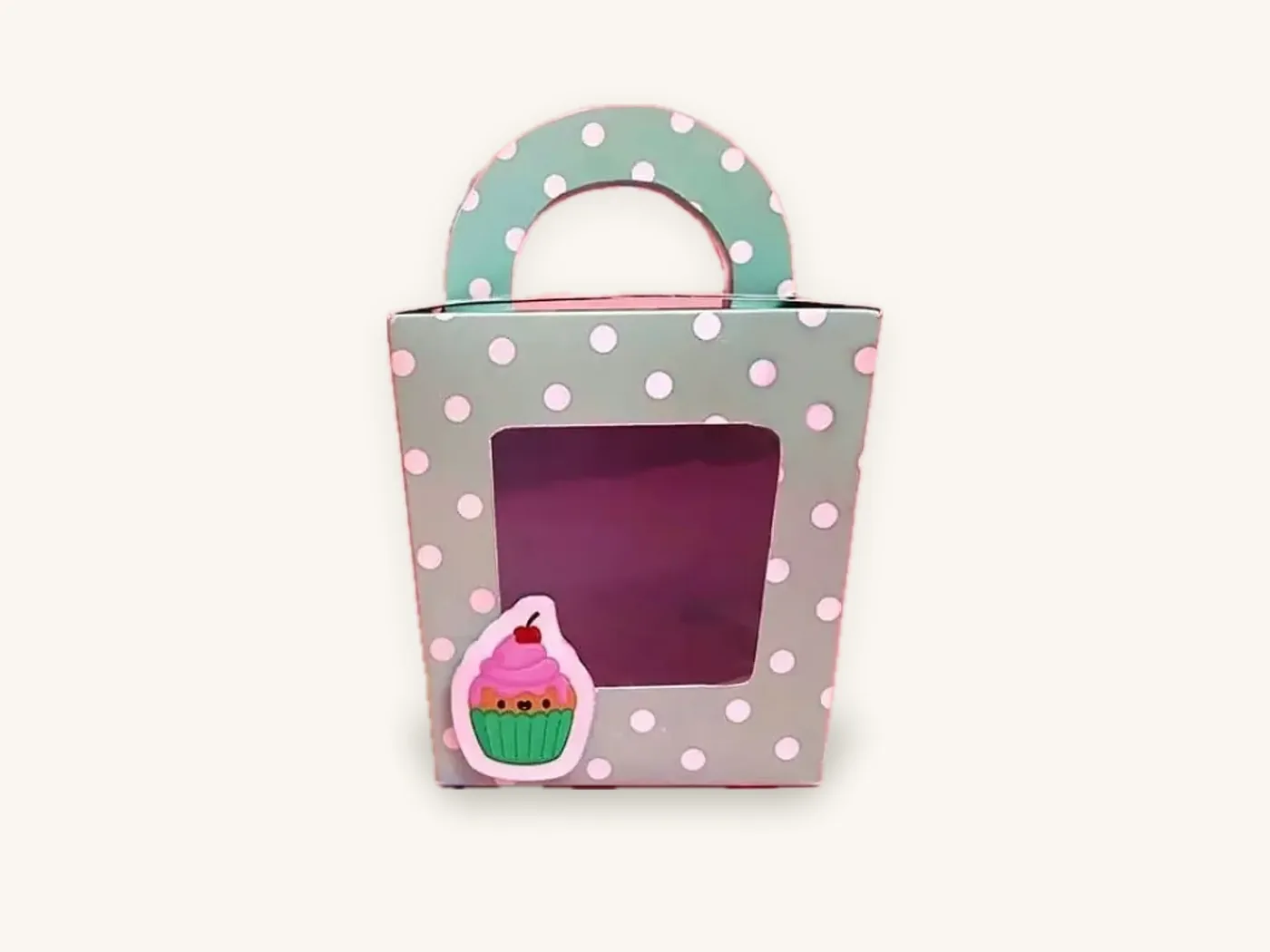
| 1 | Single hole | 3.5 x 3.5 in | Gift and favor size; often sold with a handle or window |
| 2 | 1x2 | 7 x 3.5 in | Popular for pairs and "treat for two" offers |
| 4 | 2x2 | 7 x 7 in | Square, stable, easy to stack |
| 6 | 2x3 | 10 x 7 in | The most common retail pack |
| 12 | 3x4 | 13 x 10 in | Party and office orders; carry from underneath |
| 24 | 4x6 | 20 x 13 in | Heavy; consider corrugated board or two 12-packs |
| 12 mini | 3x4 | 8.5 x 6.5 in | Minis need a much tighter pitch of about 2.25 in |
| 24 mini | 4x6 | 13 x 8.5 in | Good sampler size for events and tastings |
These are approximate and assume the pitch and margins described above. Wide frosting, toppers or wide liners push them out by half an inch or more per side.
Offset (staggered) grids
A staggered layout, where alternate rows shift by half a pitch, packs round objects more tightly. It can save roughly an inch on a 12-count box. The trade-off is a less symmetrical look through the window and a slightly harder assembly for staff, so most bakeries stay with straight grids for standard packs and use staggered layouts only when box size is critical.
24-packs and larger orders
Two dozen standard cupcakes are heavy enough that a 20 in paperboard box flexes badly when lifted. Two better approaches: a 24-count box in E-flute corrugated, or two 12-count boxes carried together. For catering orders, stackable 12-packs are usually easier for customers to handle and fit in more refrigerators.
Insert types: flat, raised, reversible and mixed
Not every insert is a flat sheet with holes. The right format depends on how tall your cupcakes are and how many sizes you sell. Our box inserts and dividers page shows the range, and the box inserts guide explains insert materials in more depth.
| Insert type | How it works | Best for | Trade-offs |
|---|---|---|---|
| Flat drop-in insert | Sheet with holes sits on the box floor; liners pass through | Standard and mini cupcakes in shallow boxes | Cupcake sits low; tall swirls need more box depth |
| Raised platform insert | Folded legs lift the sheet so liners hang in the holes | Deep boxes, tall frosting, jumbo cupcakes | Uses more board; slightly slower to fold |
| Reversible insert | Different hole sizes printed or cut on each side or on a two-layer sheet | Bakeries selling standard and jumbo in the same box | Box footprint must fit the larger pitch |
| Mixed-count insert | Combination of cupcake holes and a flat bay | Cupcakes plus cookies or a slice | Needs careful testing for sliding |
| Corrugated insert | Fluted board, same geometry | 24-packs and delivery | Thicker; less crisp around holes |
Flat or raised
A flat insert is the simplest and cheapest. It works when the box is shallow enough that the cupcake cannot lift out of the hole. A raised platform insert suspends the liner so the cake sits higher, which gives tall frosting more space below the lid and keeps cupcakes from bouncing out on a bumpy drive.
One box, two sizes
If you sell standard and jumbo cupcakes, a single footprint with two insert options cuts storage space and minimum order waste. Size the box for the jumbo pitch, then use a standard-hole insert with slightly wider spacing for standard cupcakes. Customers rarely notice the extra space, but they do notice cupcakes that are crammed.
Material for inserts
Inserts are usually 14 pt to 18 pt paperboard. The insert touches the liner, not the cake, but crumbs and frosting still reach it. Choose materials and coatings suitable for food contact; our food-safe inks and coatings guide covers the general principles. Keep printed areas of the insert away from hole edges, or leave the insert unprinted.
Box depth and frosting clearance
Depth is where cupcake packaging gets squashed. The lid on a paperboard box flexes downward when the box is carried, so the gap above the tallest swirl needs a margin.
How to set depth
- Measure total frosted height on your tallest cupcake.
- Subtract how far the liner drops through the insert (usually 1/2 to 1 in with a flat insert).
- Add any raised platform height.
- Add 1/2 to 3/4 in of clearance above the frosting.
For a 3.5 in tall standard cupcake that drops 3/4 in into a flat insert, 2.75 in stands above the insert. Add 3/4 in clearance and you need about a 3.5 in deep box. With a 1 in raised platform, that becomes about 4.5 in.
Toppers and decorations
Fondant figures, chocolate shards and piped tall swirls can add an inch or more. If you sell a decorated premium range, give it a deeper box rather than risking your standard depth. Picks and flags that stick straight up are better added by the customer.
Windows for cupcake boxes
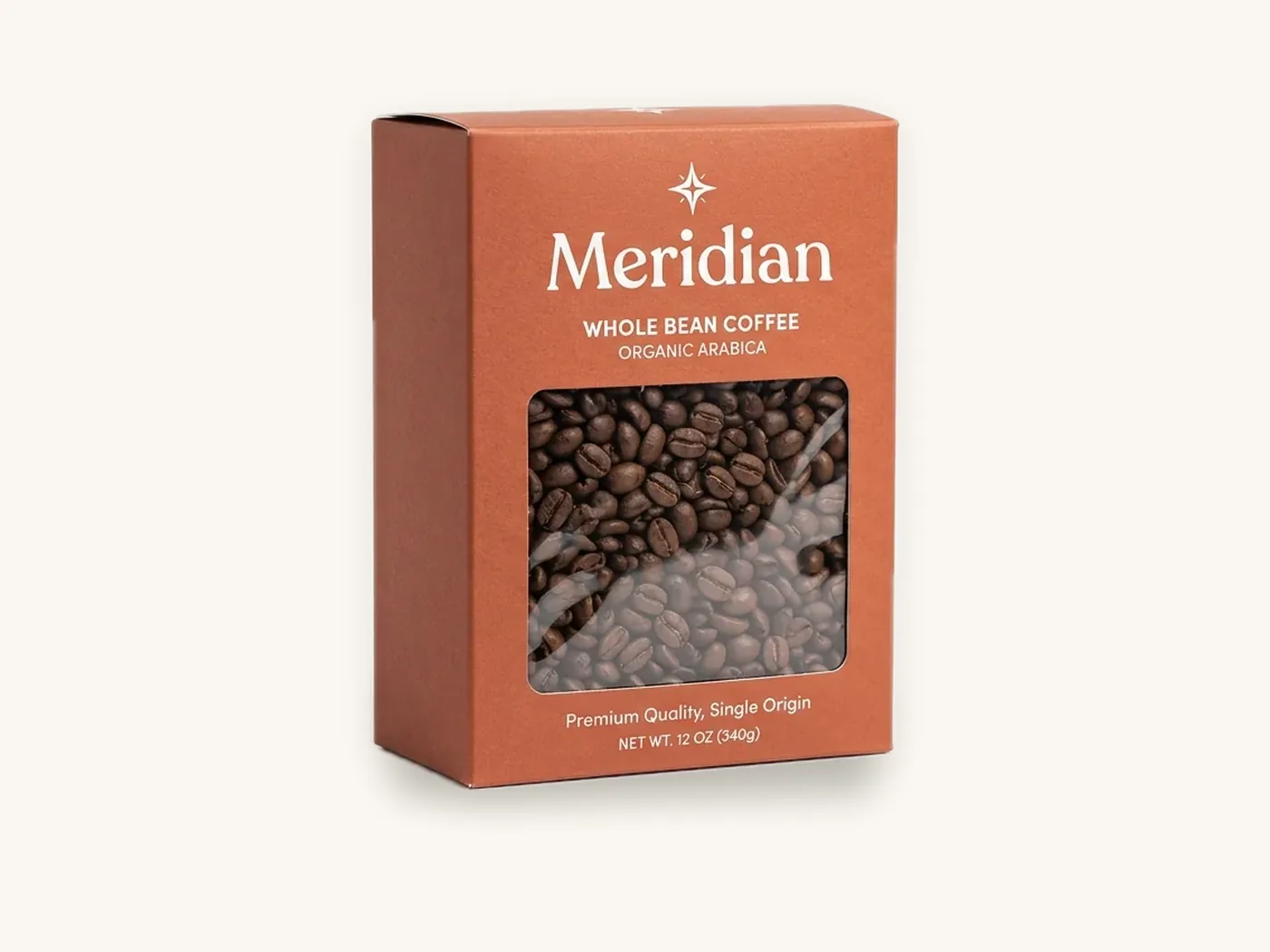
Frosting is the main selling point of a cupcake, so a window usually earns its place. The window boxes style page shows the structures, and our window boxes product page shows window shapes.
Top window or wraparound
A top window shows every cupcake's frosting at once and keeps the side walls strong. A wraparound window, from the lid down onto the front panel, shows the liner and the cake, which suits decorated liners and layered cupcakes. It reduces front panel stiffness, so avoid it on 12 and 24-packs.
Keep the window away from the insert edges
The window should sit over the cupcakes, not over the gaps. A window centered on a 2x3 grid with about 1/2 in of board inside each outer row looks tidy and hides the insert's edges.
Film choice
PET film is the standard; compostable PLA is available for brands focused on sustainability. Our comparison of PET vs PLA window film covers clarity, heat and disposal. Both fog when chilled cupcakes meet warm air, so let refrigerated cupcakes stand briefly before closing the lid.
Box styles for cupcake packaging
The structure affects assembly speed, carry comfort and presentation. For most bakeries the choice comes down to a few options.
- Window tuck-lid box with insert: the default for 4, 6 and 12-packs. Folds from one sheet and closes with a tuck flap.
- Lock-corner bakery box: pre-glued corners pop up in seconds, good for high-volume counters.
- Two-piece base and lid: a premium feel; the lid lifts straight up, so frosting is never swept by a flap.
- Single cupcake box with handle: a small gable-style carrier for gifting and favors; the handle is fine at this weight.
- Corrugated carrier: for 24-packs, delivery apps and events.
Cupcake boxes are part of a wider bakery range. If you also sell whole cakes, our cake boxes use the same board, print and window options, and the bakery packaging guide shows how to plan sizes across a full menu. The bakery and confectionery page shows the related formats.
Printing and branding cupcake boxes
A cupcake box is small, and the window takes some of the lid, so the design needs to be simple and bold.
- Put the logo on the lid border and front panel, both visible in a window design.
- Print the insert only if it shows. In a top-window box, a printed insert surface can frame the cupcakes, but keep ink clear of the hole edges.
- Inside lid printing gives space for flavor names or a social handle.
- Use a seal sticker across the tuck flap for tamper evidence and a second brand moment.
- Aqueous coating reduces scuffs and grease spots on the outside.
For seasonal ranges, a plain printed box plus a changing sticker or sleeve avoids reprinting boxes each holiday. See the printing and finishes page for coatings and foils.
What cupcake boxes cost
The price depends on box size, board grade, windows, print coverage, inserts and quantity. Custom inserts carry a one-time insert die charge of about $45, which covers all future reorders of the same insert.
A useful reference from our current rates is the windowed bakery box: a 10x10x5 in box in 18 pt SBS, printed full color with a window, runs about $4.09 each at 100 units, about $2.18 at 500 and about $1.82 at 1,000, with US shipping included. That footprint is close to what a 9-count or a generously spaced 6-count cupcake box needs; smaller 1, 2 and 4-count boxes cost less, and 24-packs cost more.
Use the instant price estimator for your exact counts and sizes.
How to order custom cupcake boxes from Box Sense
The most helpful thing you can send is real cupcake measurements. We design the insert and box together, so they arrive as a matched set.
Your spec checklist
- Liner base, liner top, frosting width and total height of your largest cupcake
- Counts you need (for example 1, 4, 6 and 12)
- Insert type: flat, raised, reversible, or ask us to recommend
- Box style: window tuck-lid, lock-corner, two-piece or single carrier
- Window: top or wraparound; PET or PLA
- Print: full color or one color, inside lid, coating
- Quantity per count and your target in-hand date
- Artwork, or a request for help from our design services team
How the process works
- Quote within 24 hours for each count and quantity.
- Dieline and 3D proof. We lay out insert holes and box panels, set up your artwork and send a digital proof, with two free revision rounds.
- Test the fit. Unprinted structural samples are free, so you can load real cupcakes before approving. A printed sample of approved artwork is free on orders of 100 or more. See samples.
- Production. Standard production takes 8–12 business days after proof approval; rush in 5 business days is available on most paperboard styles.
- Delivery. US shipping is free. Defective boxes reported within 14 days are reprinted free.
The minimum order is 10 boxes. Browse cupcake boxes for structure photos.
Frequently asked questions
What size box do I need for 6 cupcakes?
For six standard cupcakes in a 2x3 grid, an internal footprint of roughly 10 x 7 in works, with a depth of about 3.5 to 4.5 in depending on frosting height and insert type. That assumes about a 3 to 3.25 in center-to-center spacing. Wide frosting, wide liners or jumbo cupcakes need a larger box, so measure your own cupcakes first.
How big should the holes in a cupcake insert be?
Make each hole slightly larger than the liner base, roughly the base diameter plus 1/8 in. For a standard cupcake with a 2 in liner base, that is about 2 1/8 in. The liner should wedge partway down, held by its sloped wall. Star cuts or small tabs around the hole help grip slightly different liner sizes.
Can one cupcake box hold both standard and jumbo cupcakes?
Yes, if the box is sized for jumbo spacing and you use two insert options. A jumbo insert has larger holes; a standard insert uses smaller holes at the same wider pitch. Some bakeries use reversible inserts. This saves storage space and simplifies ordering, at the cost of slightly more space around standard cupcakes.
Do cupcake boxes need inserts?
For more than one cupcake, almost always. Without an insert, cupcakes slide as soon as the box tilts, and frosting smears against neighbors and walls. A single cupcake box can work without one if it is sized tightly, but an insert still keeps the cupcake centered under the window and makes the box look finished when opened.
How tall should a cupcake box be?
Measure your tallest frosted cupcake, subtract how far it drops into the insert, add any raised platform height, then add about 1/2 to 3/4 in of clearance. For standard cupcakes that usually means a 3.5 to 4.5 in deep box. Decorated cupcakes with toppers may need a deeper box of their own.
Are windows on cupcake boxes a good idea?
Usually, yes. Frosting is what sells cupcakes, and a top window shows it without opening the box. Top windows keep the side walls strong; wraparound windows show more but reduce stiffness. Expect fogging when chilled cupcakes meet warm air. PET film is standard, and compostable PLA film is available.
What is the minimum order for custom cupcake boxes?
Box Sense produces custom cupcake boxes from 10 units. Short runs are printed digitally without plates, so small batches are practical for launches, events and seasonal designs. Custom inserts carry a one-time insert die charge. Unit prices drop as quantity rises, so compare a few tiers in the estimator before choosing.
Next steps
Measure a few of your largest finished cupcakes, pick the counts you sell most, and sketch the grid at full size. Then price your sizes in the cupcake box price estimator and request a custom cupcake box quote; we will confirm pricing within 24 hours and design the box and insert together.
Boxes in this guide
Order the packaging we covered
Written by the Box Sense Packaging Team
Our structural designers, prepress technicians and production staff print and convert custom boxes every day for brands in the United States, United Kingdom and UAE. Questions about this guide? Talk to us.