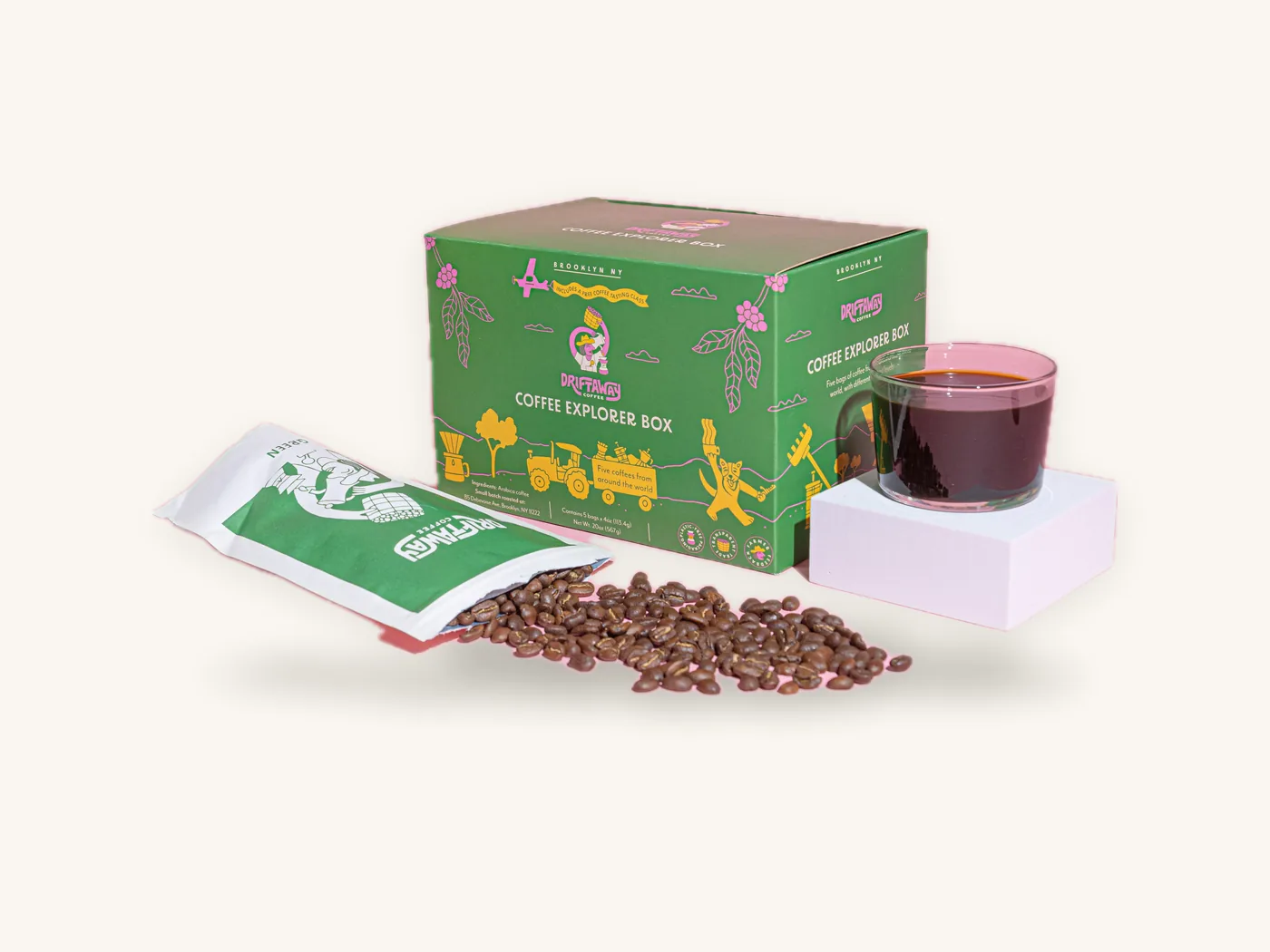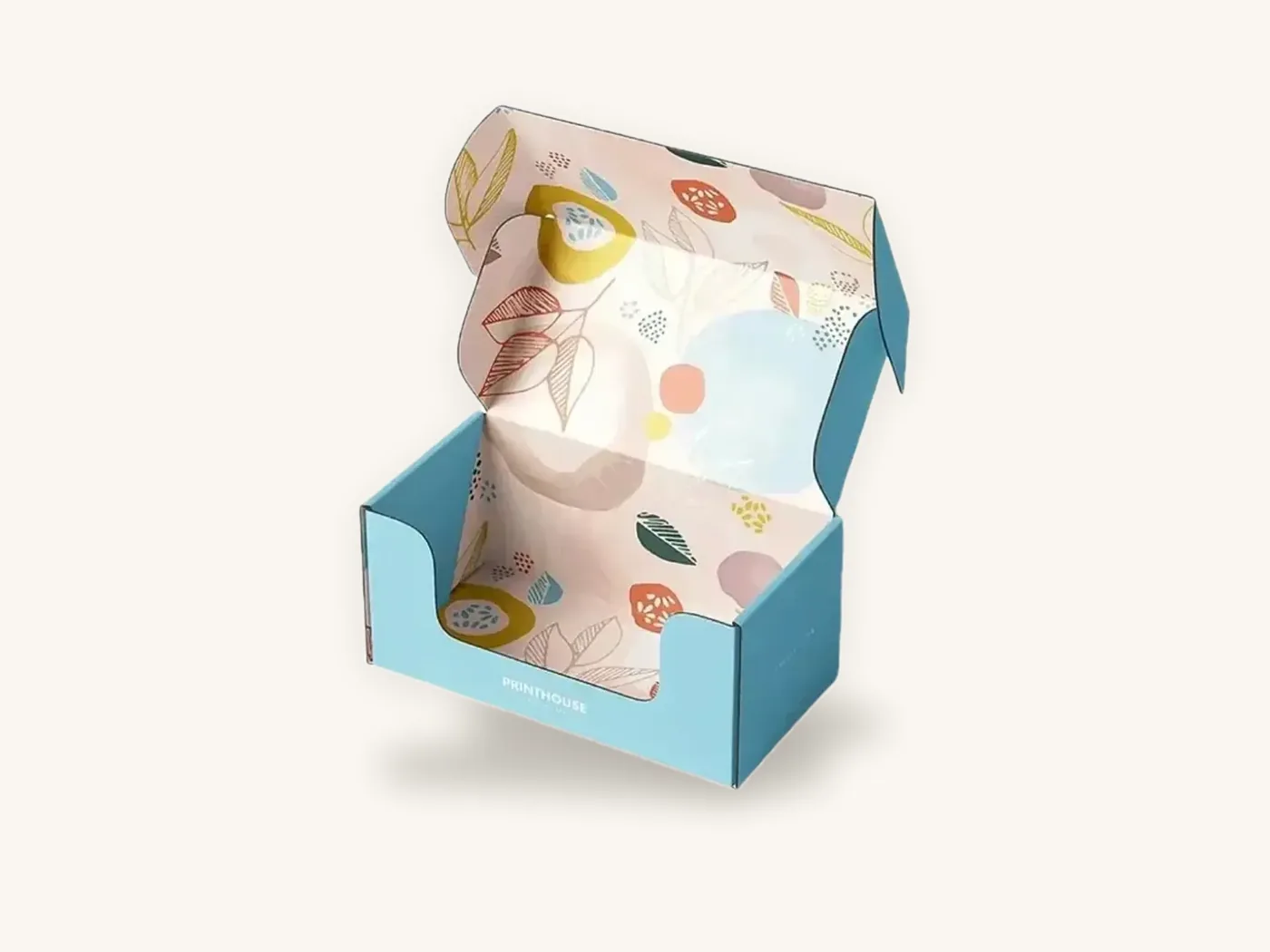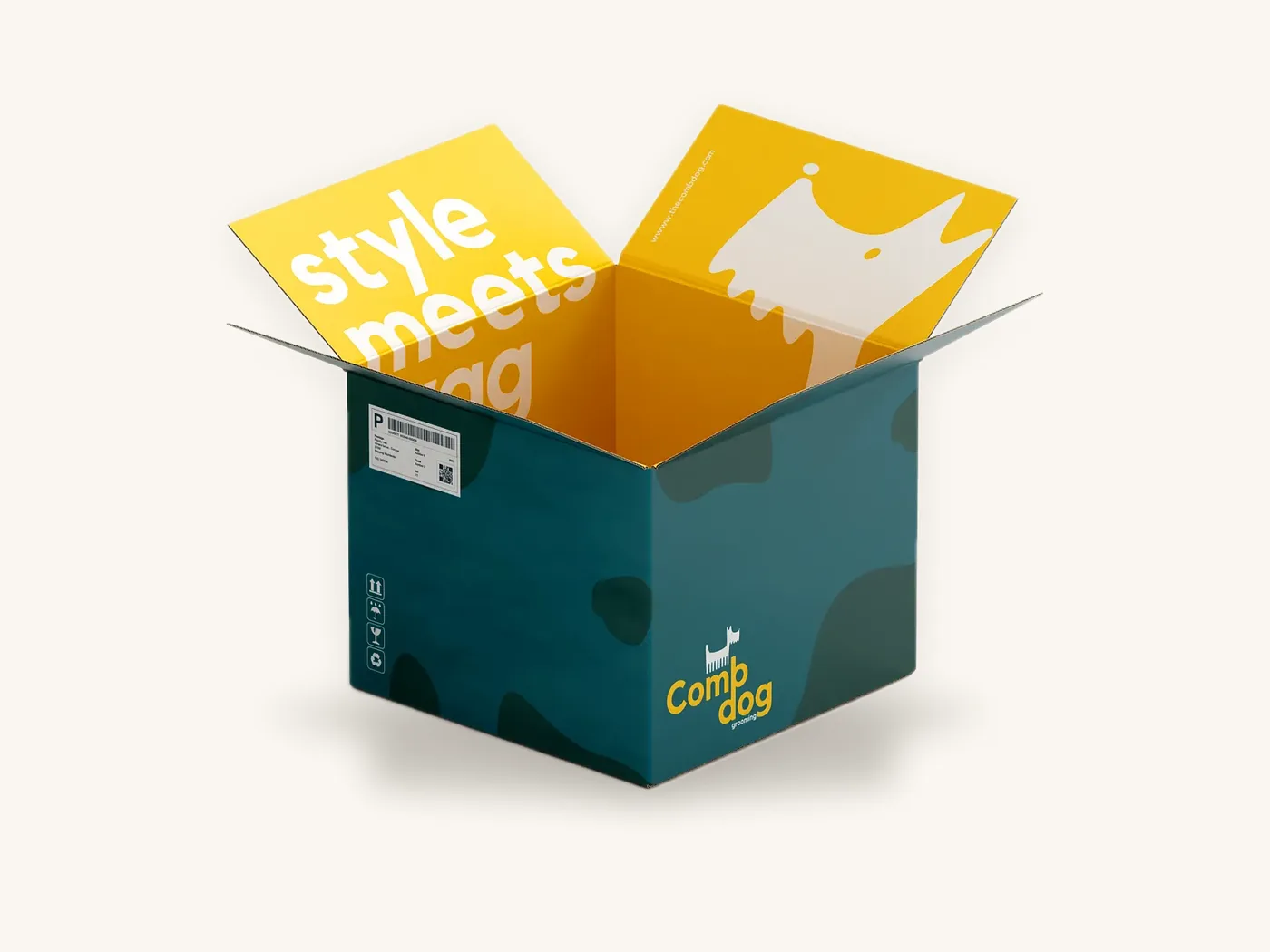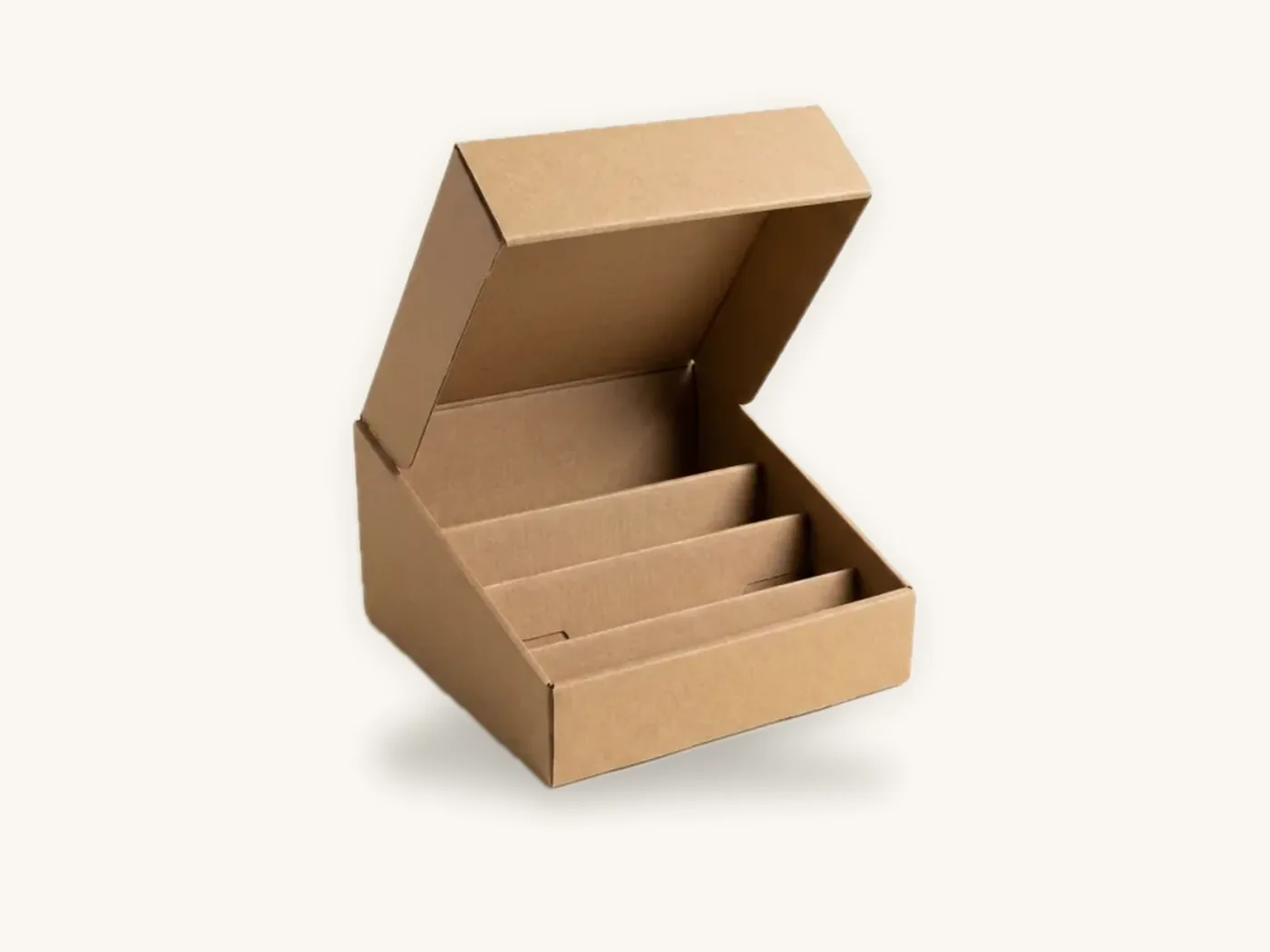
Custom display boxes are printed cartons that hold and present multiple units of a product right where shoppers decide, most often on a checkout counter. A typical counter display is an open-front E-flute tray with a raised header card, holding anywhere from 6 to 48 units, that ships to the store packed and ready to set down. The best ones turn small, easily overlooked items into impulse purchases.
A display only works if three things line up: the right format for the space the retailer gives you, a size built around your units, and a header that communicates in the second or two a shopper looks at it. This guide covers the main retail display packaging formats, walks through sizing a counter display step by step, explains header and graphic design, and shows what counter display boxes cost at real quantities.
Key takeaways
- Counter display boxes sit beside the register or on a shelf edge; floor display stands hold larger assortments in aisles; bins hold loose or bulk items.
- Most custom display boxes are made from E-flute corrugated, which stays rigid under a full load of product and prints cleanly.
- Size the display around your unit cartons, the number of facings and the counter space a retailer will realistically allow, not around a round number.
- The header card does most of the selling: brand, product and one reason to buy, readable from a few steps away.
- An E-flute counter display, 10x8x6 in, printed full color, runs about $5.08 per display at 100 units and about $2.26 at 1,000, with US shipping included.
- Box Sense makes display boxes from 10 units, with a free dieline and 3D proof, and rush production in 5 business days on most corrugated styles.
Types of retail display packaging
"Display box" covers several formats with very different footprints and jobs. Picking the wrong one is the most common mistake, because a floor stand pitched to a store that only offers a few inches beside the register never gets placed. The display boxes style page shows each format.
| Format | Where it goes | Typical capacity | Material | Best for |
|---|---|---|---|---|
| Counter display box | Checkout counter, shelf edge | 6–48 small units | E-flute corrugated or heavy SBS | Lip balm, snacks, pre-rolls, accessories, samples |
| Tear-away shipper display | Counter or shelf | 6–36 units | E-flute | Products shipped to stores in the display itself |
| Floor display stand | Aisle, endcap, entrance | Dozens to hundreds of units | Corrugated with shelves | Launches, seasonal promotions, assortments |
| Dump bin | Floor or large counter | Loose bulk units | Corrugated | Toys, candy, pet treats, discounted items |
| Cardboard bin box | Shelving, back room, bulk retail | Loose or bagged items | Corrugated | Hardware, spare parts, organized bulk stock |
| Dispenser carton | Counter | 12–50 single units | SBS paperboard | Sachets, gum, individually wrapped items |
| Header card | Peg hook | One bagged product | SBS paperboard | Small parts, jewelry, accessories on pegs |
Counter displays
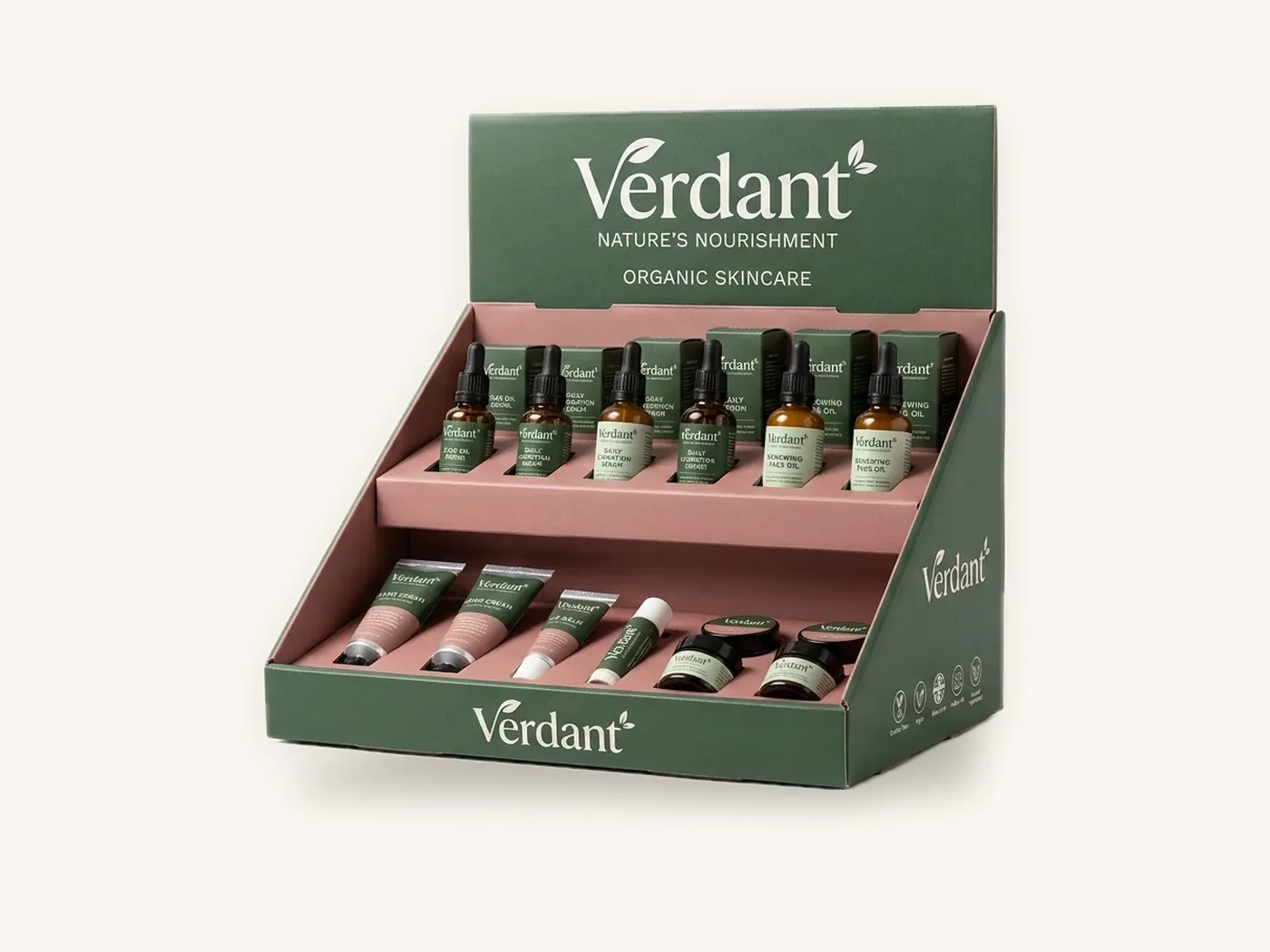
Counter display boxes are the workhorse of checkout selling. They take a small footprint, need no assembly skill from store staff, and put a low-price product where waiting customers look. They suit products that are small, familiar and bought on impulse.
Floor displays and bins
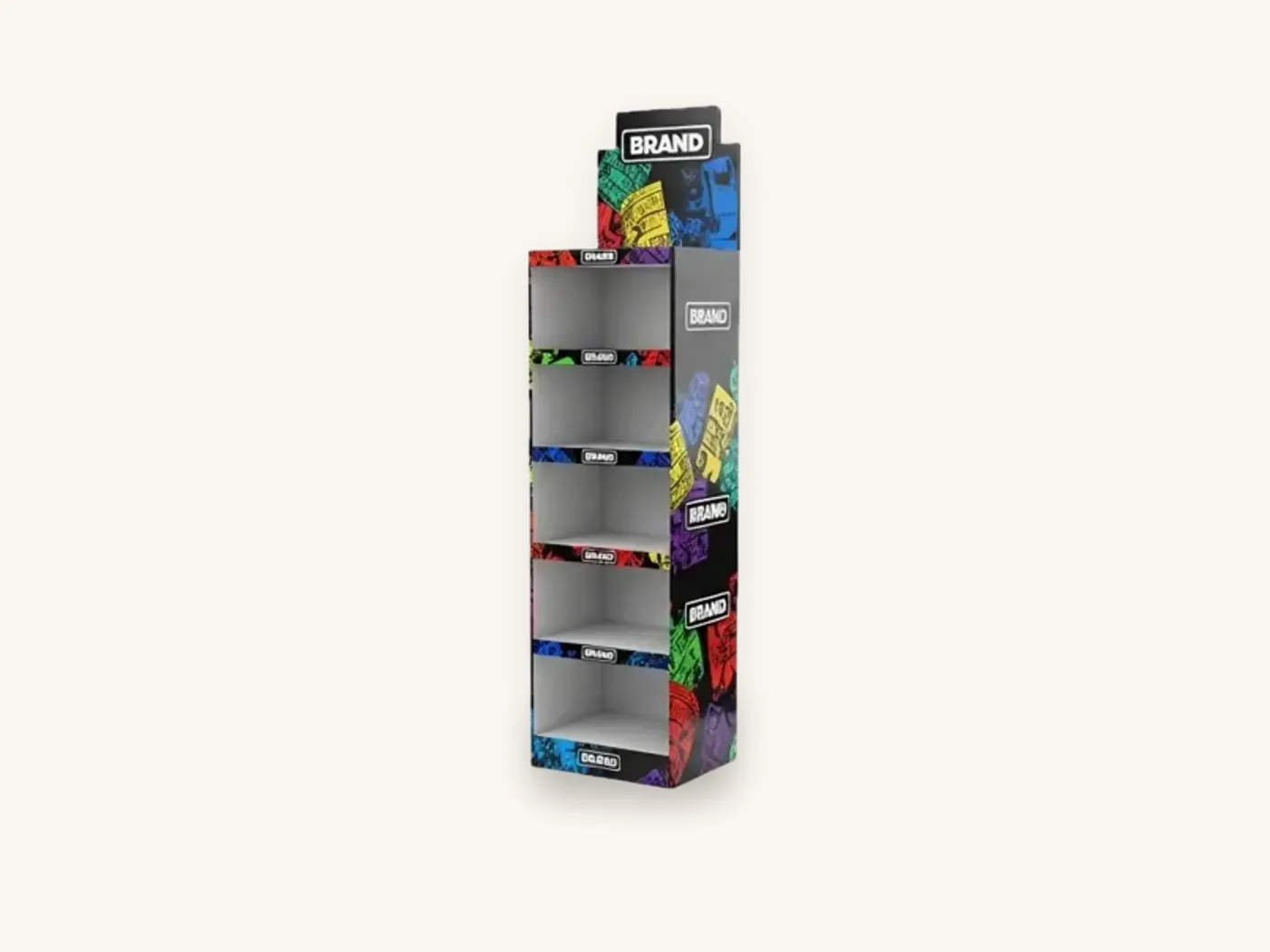
Floor display stands are free-standing units with shelves or pockets, used when a retailer allocates floor space for a promotion. Cardboard bin boxes are open-front bins for loose goods and organized shelving. Our floor display stands guide covers large-format displays in depth; the rest of this guide focuses on counter formats.
Why counter displays sell at checkout
Nothing about a display box is magic, but the mechanics are straightforward and worth understanding before you design one.
Proximity to the moment of payment
At the counter, shoppers are stationary and have already decided to spend. A low-price item within arm's reach asks for a small, easy decision rather than a trip down an aisle. That is why checkout displays suit products priced as add-ons rather than considered purchases.
Grouped facings create visibility
A single small carton on a shelf is easy to miss. Twelve or twenty-four identical units in a printed tray read as one large, deliberate block of color, with a header telling shoppers what it is. The display borrows visibility from repetition.
Staff can place it in seconds
Retail staff are busy. A display that arrives assembled, or unfolds in one step with the product already inside, is far more likely to be put out than one that needs sorting, loading and building. For brands selling through independent stores, ease of setup often decides whether a display is used at all.
It keeps the product organized
Loose small items on a counter get pushed around, fall over and look messy. Dividers or tight rows keep units upright and faced forward, which helps the display look full and cared for even as it empties.
Anatomy of a counter display box
A counter display has a few parts, each with a job. Knowing them makes proofs and quotes easier to follow.
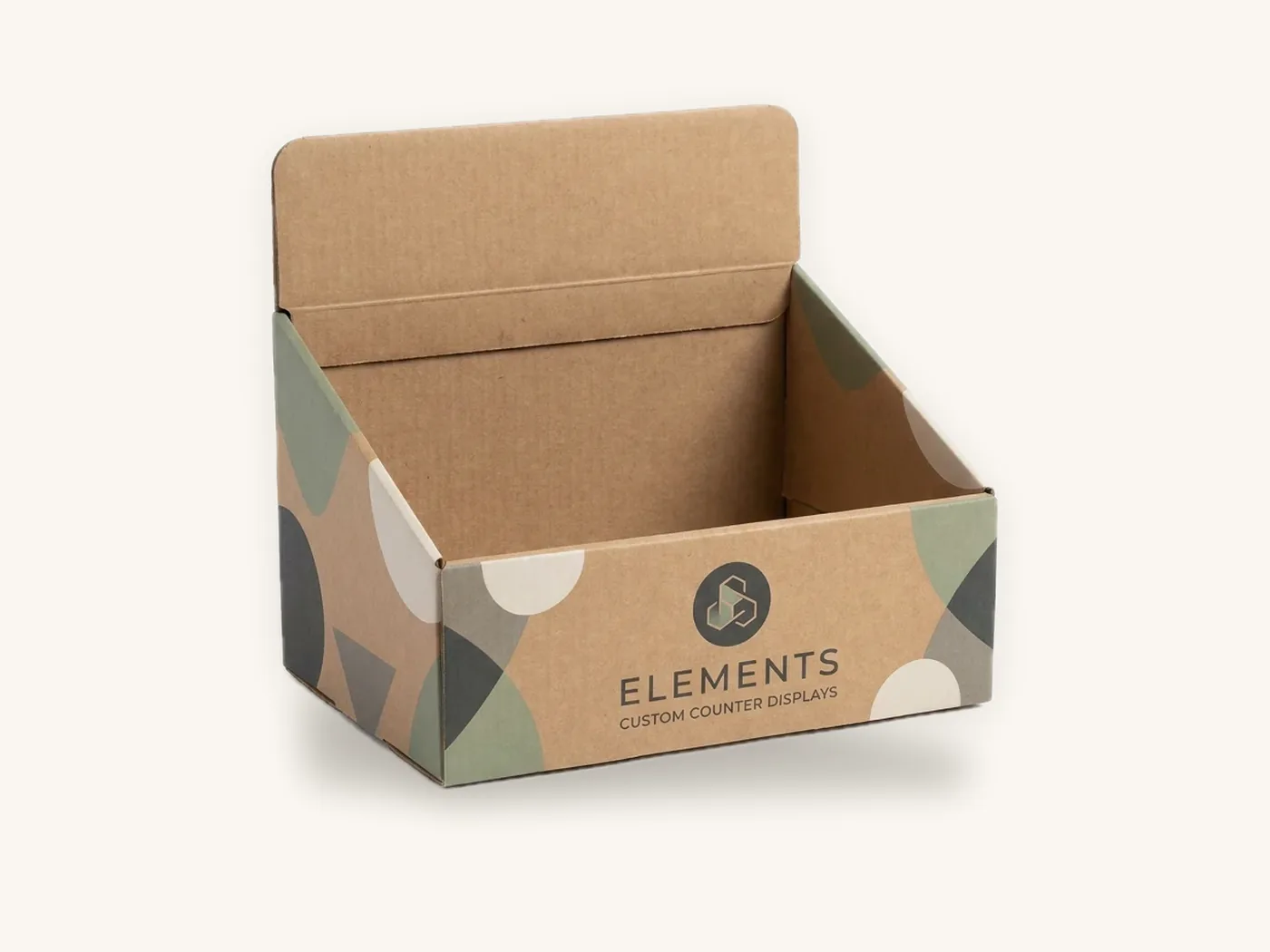
- Tray: the base that holds the product, usually with a sloped or cut-down front wall so shoppers can see and reach units.
- Front lip: the low printed front panel, often carrying the brand name or price point.
- Header card: the raised back panel that stands above the product. It can be part of the same dieline or a separate card that slots in.
- Side wings: the side walls, which can be shaped to follow the header's outline for a more custom look.
- Dividers or inserts: cells or rails that keep units upright and separated.
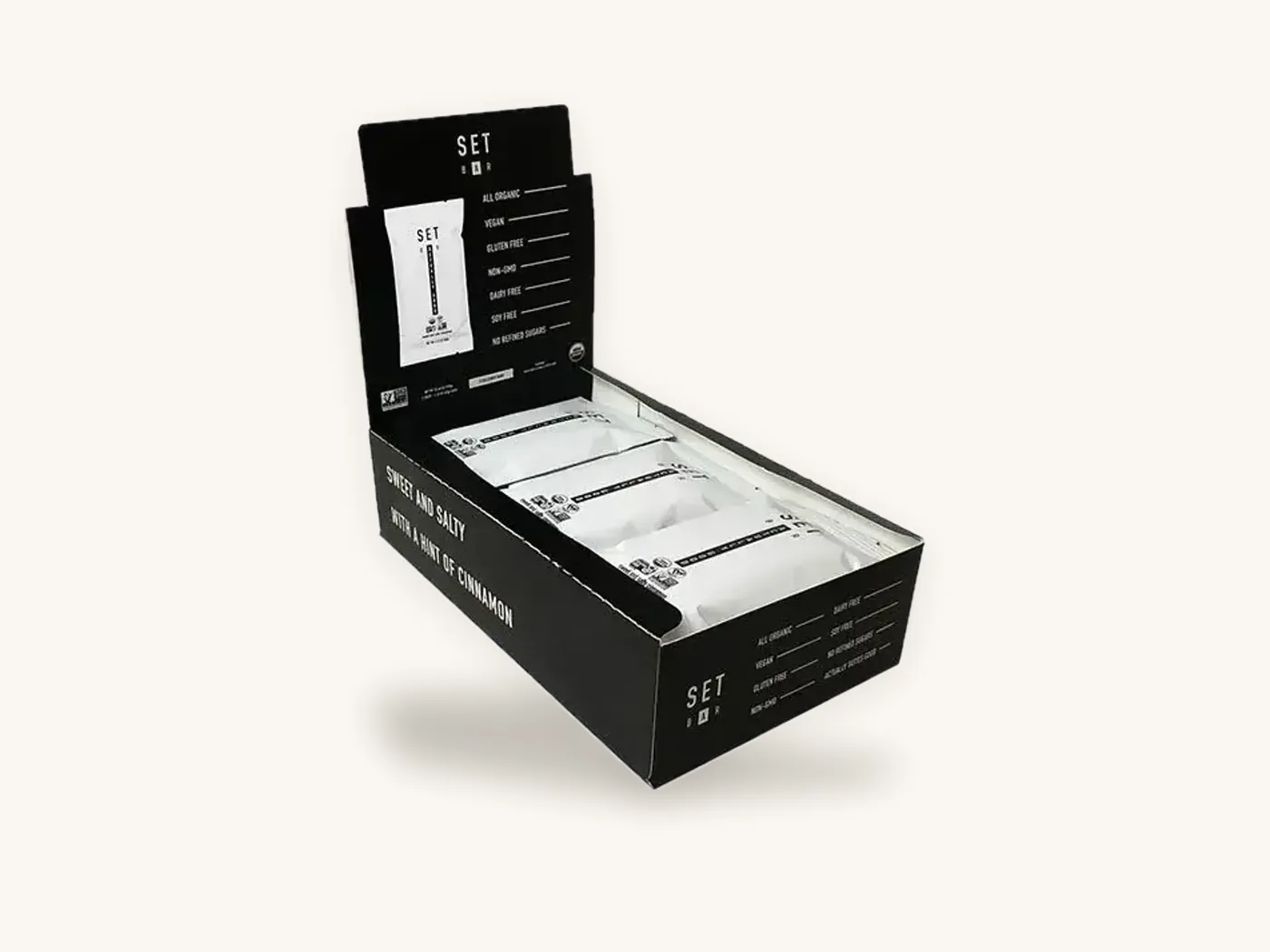
- Shipper lid: on tear-away displays, a lid or outer sleeve protects the product in transit and tears off along a perforation at the store.
One-piece or two-piece construction
A one-piece display folds from a single die-cut sheet, with the header formed by a raised back panel. It is quick to set up and ships flat. A two-piece display uses a separate header that slots into the tray, which allows a taller or more complex header shape and lets you swap headers for seasonal promotions without changing the tray.
How to size a counter display box
Size is where most display projects go wrong. A display designed around a neat number of units can end up too wide for the counter, too deep to reach into, or too tall to fit under a shelf.
A step-by-step sizing method
- Start with the unit. Measure one unit exactly as it will sit in the display: an individual carton, pouch, tube or bottle. Note which face should point toward the shopper.
- Decide the facings. Choose how many units sit side by side across the front (columns) and how many deep (rows). Four to six columns is common for small counter displays.
- Decide the orientation. Units can stand upright, lie flat or lean back against a sloped rail. Upright is most visible; lying flat suits pouches and very thin items.
- Calculate internal dimensions. Multiply unit width by columns and unit depth by rows, then add a small clearance, roughly 1/8 in total across the width, so units lift out easily.
- Add divider thickness. Each corrugated divider adds its own caliper, roughly 1.5 mm for E-flute. Ten dividers add about 15 mm of width.
- Set the front wall height. A front wall around one third to one half of the unit's height holds units upright while leaving the front face visible.
- Set the header height. Tall enough to be seen above the product and read at a distance, but not so tall that the display tips or hits a shelf above.
- Check the counter. Ask the retailer or buyer what footprint is available. Independent stores often offer only a small space beside the register.
- Sample it with real product. Load a structural sample fully, carry it by its base, and take units out one at a time to check the display does not tip as it empties.
A worked example
Say you sell lip balm in individual tuck cartons measuring 1 x 1 x 3.25 in, and you want 24 units standing upright, six across and four deep. Internal width is 6 in plus clearance, and internal depth is 4 in plus clearance. With no dividers, an internal footprint of about 6.25 x 4.25 in holds all 24. A front wall about 1.5 in high keeps the cartons upright while showing most of the front face, and a header rising several inches above the back wall gives space for the brand and a single message. The whole unit takes up less counter space than a sheet of letter paper folded in half.
Common layouts by product
| Product type | Typical unit orientation | Common layout | Divider needed? |
|---|---|---|---|
| Lip balm, small tuck cartons | Upright | 6 x 4 (24 units) | Usually no |
| Snack bars | Upright or leaning | 4 x 3 or 6 x 2 | Often a center rail |
| Pre-roll tubes or vape cartridges | Upright | 6 x 3 or 8 x 3 | Yes, to keep tubes vertical |
| Sachets and stick packs | Upright, loose | Single well | No |
| Small jars or tins | Upright | 4 x 3 | Yes, to stop rattling |
| Keychains or accessories on cards | Leaning | 3 x 4 | Rails or slots |
Materials and structure for display boxes
A display must carry a full load of product without bowing, look sharp under store lighting and survive being picked up and moved by staff.
E-flute corrugated
Corrugated board in E-flute, about 1.5 mm thick, is the standard for counter displays. It is rigid enough to keep the header upright and hold a tray of product, and its surface prints full color well. It also folds to crisp edges, which keeps the display looking tidy.
B-flute for heavy loads
For heavier products, such as jars, or larger counter displays, B-flute at about 3 mm adds strength. It prints slightly less crisply and has a thicker profile, so use it only when the load requires it.
Paperboard for light displays
Heavy SBS paperboard works for very light products and small dispensers. It gives the sharpest print but bends under weight and is more easily damaged in transit, so it is best for displays that ship inside a protective carton.
| Board | Thickness | Load capacity | Print quality | Best for |
|---|---|---|---|---|
| Heavy SBS paperboard | about 0.5–0.6 mm | Light | Excellent | Dispensers, sachets, very light items |
| E-flute corrugated | about 1.5 mm | Medium | Very good | Most counter displays |
| B-flute corrugated | about 3 mm | Medium to heavy | Good | Heavier products, larger counter units |
| Double-wall corrugated | about 6–7 mm | Heavy | Fair | Floor stands and bins |
Watch out: a tall header on a lightweight display can make it tip backward once the front rows are sold. Keep the header height in proportion to the base depth, or add a rear support tab, and always test a sample as it empties rather than only when it is full.
Designing the header and graphics
Shoppers do not read a display; they glance at it. Design for that glance.
What the header must say
A good header answers three questions in order: what brand this is, what the product is, and why someone should grab one now. Everything else belongs on the individual unit packaging. Keep the product name large, the brand prominent and the reason to buy short. A benefit phrase, a flavor range or a clear price point works better than a paragraph.
Legibility at distance
Customers see a counter display from a few steps back. Use bold typefaces, strong contrast between text and background and a limited number of elements. Fine script fonts, thin lines and low-contrast colors disappear at that distance.
Print the inside, too
As units sell, the inside base and back wall become visible. A printed interior, even a simple brand color or pattern, keeps a half-empty display looking intentional rather than neglected.
Match the unit packaging
The display and the individual cartons inside it should look like one system. If your units are tuck end cartons, our tuck end boxes guide explains how to lay out a front panel that faces shoppers cleanly. For heavier units such as jars or tins, the auto lock bottom boxes guide covers cartons that stay square in rows. Our custom product boxes guide shows how to design unit packaging from scratch.
Finishes that help at retail
- Aqueous coating protects print from handling at a low cost.
- Gloss lamination makes colors pop under store lighting and resists scuffs.
- Spot UV or foil on the logo draws the eye to the brand, with about $40 or $60 one-time tooling respectively.
Our printing and finishes page shows each option on corrugated board.
Shipping displays and working with retailers
A display that arrives crushed or confuses store staff never reaches the counter. Plan how it travels and how it is set up.
Ship-ready displays
The simplest option for small retailers is a display that ships already loaded, with a lid or outer sleeve protecting the product. Staff remove the lid or tear along a perforation, and the display is ready. For larger shipments, displays can be packed flat in corrugated cases and loaded in store. Our custom shipping boxes guide covers outer cases.
Retailer requirements
Larger retail chains often provide their own display specifications: maximum footprints, header heights, case barcodes, material rules and labeling on the outer shipper. Requirements differ from one retailer to the next, so ask your buyer for their current spec sheet before designing. Independent stores rarely have formal rules but have very limited counter space, so smaller is usually better.
Setup instructions
If the display needs any assembly, print a simple two or three step diagram on the inside of the lid or on a flap that is hidden once the display is set up. Our packaging for wholesale and retail guide goes deeper on selling into stores.
What counter display boxes cost
Display box pricing depends mostly on size, board grade, print coverage, dividers, headers and quantity. The table shows indicative per-display prices from our current rates for a common counter display, with free US shipping included. Try the instant price estimator for your size.
| Spec | 10 | 50 | 100 | 250 | 500 | 1,000 | 2,500 |
|---|---|---|---|---|---|---|---|
| Counter display box, E-flute, 10x8x6 in, full color | $7.68 | $5.87 | $5.08 | $3.61 | $2.71 | $2.26 | $1.92 |
Reading the numbers
Displays are ordered in far smaller quantities than the unit cartons they hold, because one display serves many units. Fifty displays at about $5.87 each can support a trial across fifty stores. At 1,000 displays the price per display falls to about $2.26, which is where national rollouts usually land.
It also helps to think in cost per unit sold. A display holding 24 units, at about $5.08 per display at 100, adds a fraction of the display price to each unit, and less again if the display is refilled.
Cost drivers
- Size and height: taller headers and wider trays use more board.
- Print coverage: full color on the inside as well as the outside adds cost.
- Separate headers and dividers: extra parts mean extra cutting and assembly.
- Board grade: B-flute and double wall cost more than E-flute.
- Finishes: lamination, spot UV and foil add unit cost and one-time tooling.
- Loading and kitting: displays shipped pre-loaded with product require packing time.
Checklist before approving a display proof
- Confirm the footprint fits the counter or shelf space the retailer offers.
- Load a structural sample fully with real product and check every unit fits and lifts out.
- Remove units row by row to confirm the display stays upright as it empties.
- Stand a few steps back and check the header reads in a glance.
- Check the front lip does not hide the product name on the unit packaging.
- Confirm the inside is printed or looks finished when half empty.
- Check any retailer requirements for barcodes, labels or maximum sizes.
- Confirm how the display ships and whether store staff need setup instructions.
How to order custom display boxes from Box Sense
We can design a display around your units from a single sample carton or accurate measurements.
Information to send
- Exact dimensions of one unit, and how it should face the shopper
- Units per display and preferred layout, or a note asking us to recommend
- Where the display will sit: counter, shelf edge or floor
- Any retailer footprint or header height limits
- Print coverage, finishes and whether you need dividers or a separate header
- Whether displays ship pre-loaded or flat
- Quantities to price, for example 50, 250 and 1,000
The process
- Quote confirmed within 24 hours.
- Free design support: a dieline built around your units, artwork setup and a 3D digital proof, with two revision rounds. Our design services team can also lay out the header.
- Free unprinted structural samples so you can test loading, setup and stability. A printed sample of approved artwork is free on orders of 100 or more; see samples.
- Production in 8–12 business days after proof approval, or rush in 5 business days on most corrugated styles.
- Free shipping on every US order; international shipping quoted at cost.
The minimum order is 10 displays, with no die or plate charges. Defective displays reported within 14 days are reprinted free. The retail and consumer goods page shows displays alongside the unit packaging they hold, and the custom cardboard boxes guide explains corrugated grades in more depth.
Frequently asked questions
What are custom display boxes?
Custom display boxes are printed cartons designed to hold and present multiple units of a product in a store. The most common type is a counter display: an open-front corrugated tray with a raised header card that sits beside the register. Other retail display packaging includes floor display stands, dump bins, dispenser cartons and shelf trays.
How many products should a counter display box hold?
Most counter display boxes hold between 6 and 48 units, depending on the size of each unit and the counter space available. Small items such as lip balm often sit 24 to a display, while larger jars or snack bars might use 12. Size the display so it looks full, stays stable as it empties and fits the space retailers realistically offer.
What material are counter display boxes made from?
Most counter display boxes are made from E-flute corrugated board, which is about 1.5 mm thick, rigid enough to hold a full tray of product and smooth enough for full-color printing. Heavier products may need B-flute. Very light displays such as dispensers can use heavy SBS paperboard, usually shipped inside a protective outer carton.
How much do custom display boxes cost?
It depends on size, board, print, dividers, headers and quantity. As a reference, an E-flute counter display measuring 10x8x6 in and printed full color costs about $5.08 per display at 100 units and about $2.26 at 1,000, with US shipping included. Separate headers, dividers and specialty finishes add to that. Use the pricing estimator for your spec.
Do display boxes ship assembled or flat?
Both options are common. Counter displays can ship flat and be set up in store, or ship pre-loaded with product under a tear-away lid so staff simply open and place them. Pre-loaded displays are easiest for retailers. Flat displays save space and freight when you are sending a large number to a distributor or warehouse.
What should a display box header say?
A display header should tell shoppers the brand, the product and one short reason to buy, readable from a few steps away. Use large, bold type and strong contrast. Detailed information such as ingredients and directions belongs on the individual unit packaging, not the header. A simple price point or flavor range can also work well.
What is the minimum order for counter display boxes?
Box Sense makes custom counter display boxes from a minimum of 10 units. That makes it practical to test a display in a handful of stores before a wider rollout. Free unprinted structural samples let you check loading and stability first, and unit prices drop significantly at higher quantities.
Next steps
Measure one of your units, decide how many belong in each display and check the space your retailers offer. Then compare quantities in the display box price estimator and request a custom display box quote. We will confirm pricing within 24 hours and build a dieline around your product.
Boxes in this guide
Order the packaging we covered
Written by the Box Sense Packaging Team
Our structural designers, prepress technicians and production staff print and convert custom boxes every day for brands in the United States, United Kingdom and UAE. Questions about this guide? Talk to us.