Retail ready packaging requirements are the rules a store or distributor sets for how your product arrives, sits on the shelf and moves through its supply chain. They usually cover four layers: the consumer unit (the box a shopper picks up), the inner pack or shelf ready tray, the master shipping case, and the pallet. Each layer has its own labeling, barcode and dimension rules.
There is no single national standard. Every retailer and distributor publishes its own vendor manual or supplier guide, and the details vary between chains, between categories and sometimes between regions of the same chain. What follows is the common ground most buyers expect, so you can design packaging that adapts quickly once you receive a specific manual. Always follow that manual over any general advice, including this article.
Key takeaways
- Ask for the vendor manual or supplier requirements as soon as a buyer shows interest. It overrides general best practice and often includes chargeback rules for noncompliance.
- Most retailers expect a GS1-issued barcode on each sellable unit and a case-level barcode on shipping cases. Buy barcodes through GS1 US, not from resellers, unless the buyer says otherwise.
- Shelf ready packaging (a case that opens into a display tray) saves store labor, and some buyers request it. Design it with the shelf depth and facing count in mind.
- Case packs, case dimensions, weight limits and pallet patterns are specified by the retailer. Build a spec sheet so you can answer these questions in one reply.
- Retail packaging needs more information printed on it than direct-to-consumer packaging: net quantity, company name and address, country of origin where required, and category-specific regulatory labeling.
- Box Sense makes retail cartons, counter displays and printed shipping cases from 10 units, so you can produce pilot-store quantities before committing to a chain-wide run.
Why retail buyers care so much about packaging
To a direct-to-consumer brand, packaging is mostly marketing. To a retail buyer, it is also a logistics object that affects labor, shrink, damage and shelf productivity. A box that looks great but will not fit the shelf, scans slowly at checkout or collapses on a pallet creates cost for the store.
Buyers evaluate packaging on questions like these:
- Can a shopper identify the product and brand from several feet away?
- Does the barcode scan on the first try?
- Does the case pack match how quickly the product sells, so stores are not overstocked or constantly reordering?
- Can a store associate get product from the case onto the shelf quickly?
- Will the product survive distribution center handling and stacking?
- Does the package carry all labeling the retailer and regulators require?
If your packaging answers these before the buyer asks, you look like a supplier who is ready for retail. Our retail packaging guide covers the shelf-appeal side in depth; this article focuses on the requirements side.
Start with the vendor manual
Vendor manuals are long, dense and specific. Read them fully before you design or order anything. The packaging-related sections usually cover the topics below.
| Manual section | What it typically specifies | Why it matters |
|---|---|---|
| Item setup | Barcode type, product dimensions and weight, images, case pack | Wrong data causes receiving and planogram errors |
| Consumer packaging | Required label content, placement of barcode, hang holes or peg requirements | Shelf placement and checkout scanning |
| Case and inner pack | Case markings, case barcode, maximum case weight, case dimensions | Distribution center handling and slotting |
| Shelf ready or display | Whether display-ready trays are required or preferred, tear-away designs | Store labor and speed to shelf |
| Pallet | Pallet type, maximum height and weight, overhang rules, stretch wrap, pallet labels | Safe storage and receiving |
| Routing and compliance | Delivery appointments, advance ship notices, chargeback schedule | Fees for noncompliance |
Ask these questions early
When a buyer expresses interest, request the manual and ask about anything that is not written down: preferred case pack, whether a display is expected, peg or shelf placement, and whether they accept stickered barcodes for the first order. Answers vary by chain and by buyer, and getting them early prevents a reprint.
Watch out: many retailers charge back suppliers for noncompliant shipments: wrong labels, unscannable barcodes, incorrect case counts or oversized pallets. Chargeback schedules are usually in the manual. Read them before your first shipment, not after your first deduction.
Consumer unit requirements: the box on the shelf
The consumer unit is the package the shopper buys. For most boxed products, it is a folding carton such as a straight tuck end box or an auto lock bottom box, or a hang-tab design for peg displays.
Barcode on every sellable unit
Retailers in the US generally expect a UPC-A barcode based on a GS1 Company Prefix licensed to your company. The barcode must be printed at an adequate size, with enough quiet zone (blank space) on either side, and in a color combination that scans reliably: dark bars on a light background. Avoid printing bars in red, which many scanners cannot read, and avoid placing the barcode across a fold or curved edge.
Our guide to UPC barcodes on packaging covers sizing, placement and print quality in detail. The official source for barcode issuance and specifications is GS1 US.
Required label content
What must appear depends on the category and the regulator. Common elements include:
- Product identity on the principal display panel
- Net quantity of contents, in the format required for the category
- Name and place of business of the manufacturer, packer or distributor
- Country of origin where applicable, especially for imported goods
- Category rules: FDA labeling for food, cosmetics and supplements; CPSC requirements for children's products; and state-specific rules in some categories
For the federal consumer packaging framework, the Fair Packaging and Labeling Act, administered by the Federal Trade Commission for many consumer commodities and by the FDA for food, drugs and cosmetics, is a starting point. Confirm current requirements for your category with the relevant agency or counsel.
Merchandising format
The buyer will tell you where the product sits: shelf, peg, endcap or checkout counter. Pegged products need a hang tab with a hole placed so the box hangs straight. Hang tab boxes and five panel hanger boxes are built for this. Shelf products need a stable base and a front panel that faces the aisle when the box stands in its natural orientation.
Protecting against shrink and tampering
Some categories and retailers expect tamper-evident closures, glue-sealed ends or sealed windows. A seal end box glues shut on both ends, which makes opening visible. See the tamper-evident packaging guide for options.

Shelf ready packaging and retail displays
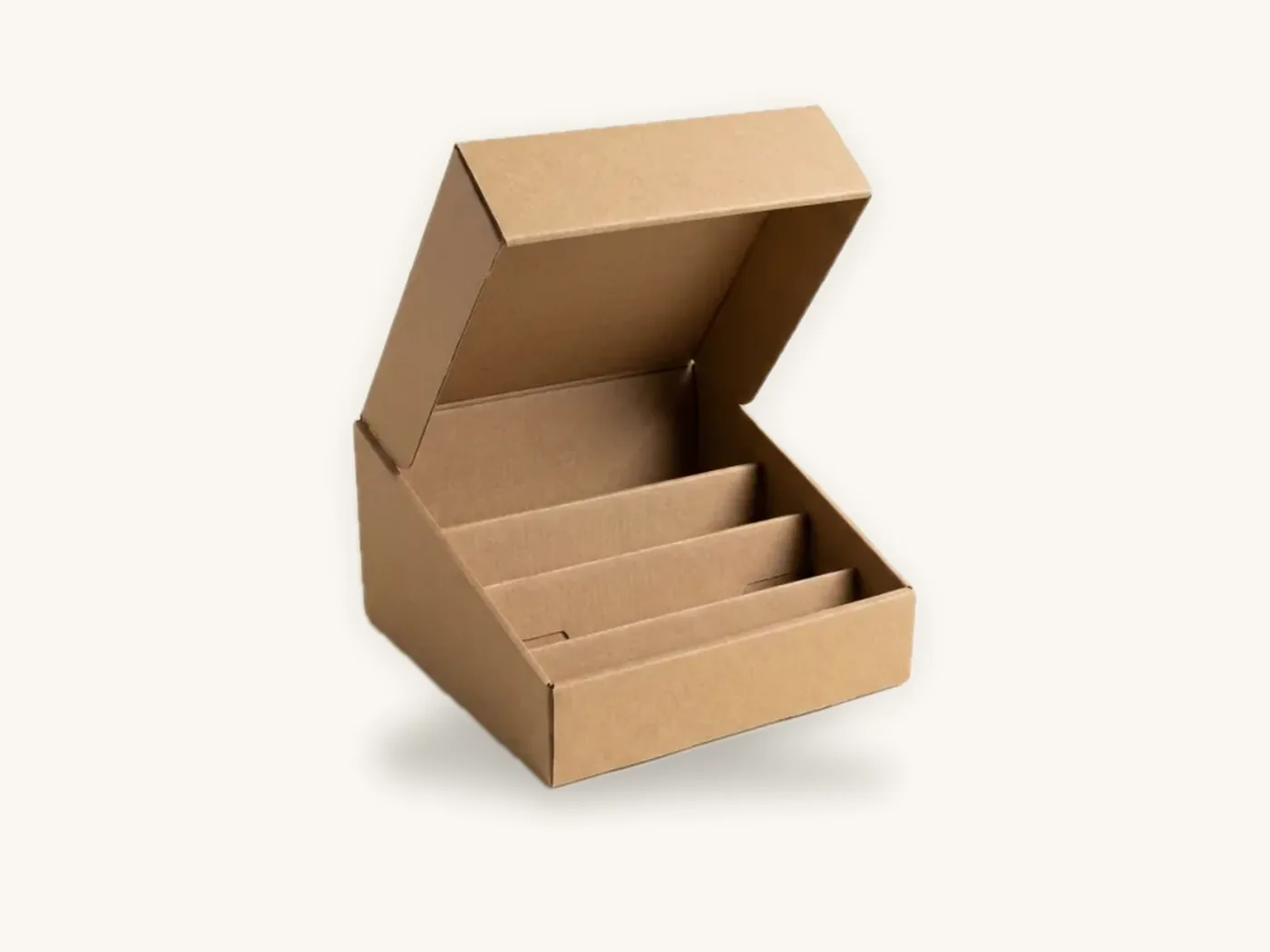
Shelf ready packaging, sometimes called retail ready packaging or SRP, is a case designed to go straight onto the shelf after a simple opening step. A perforated front tears away, leaving a tray that holds the units neatly with the brand visible.
Why buyers like it
Store associates do not unpack individual units, which cuts shelving time. The tray keeps facings neat, and when it empties, the associate replaces the whole tray. For fast-moving, small items, that saves meaningful labor across many stores.
Design rules for shelf ready trays
- Easy to identify: the case must be recognizable in the back room.
- Easy to open: a clear tear line or perforation that opens without a knife.
- Easy to shelve: the tray footprint matches shelf depth and the facing count the buyer expects.
- Easy to shop: the front lip is low enough for shoppers to see and take products.
- Easy to dispose: corrugated that goes into the store's cardboard recycling bale.
These principles are widely used across the industry, but the specific dimensions, tear direction and markings come from each retailer.
Counter displays and floor displays
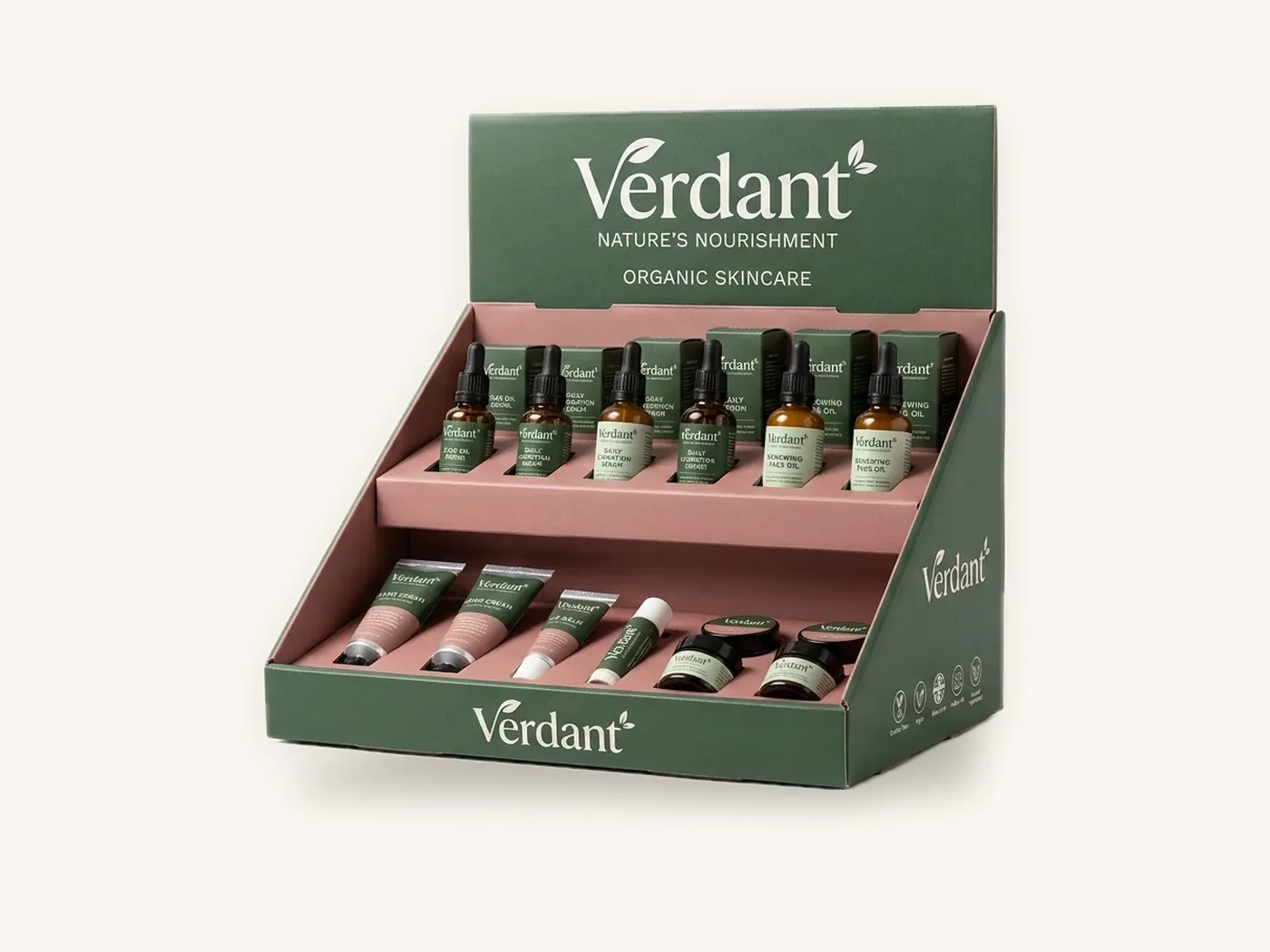
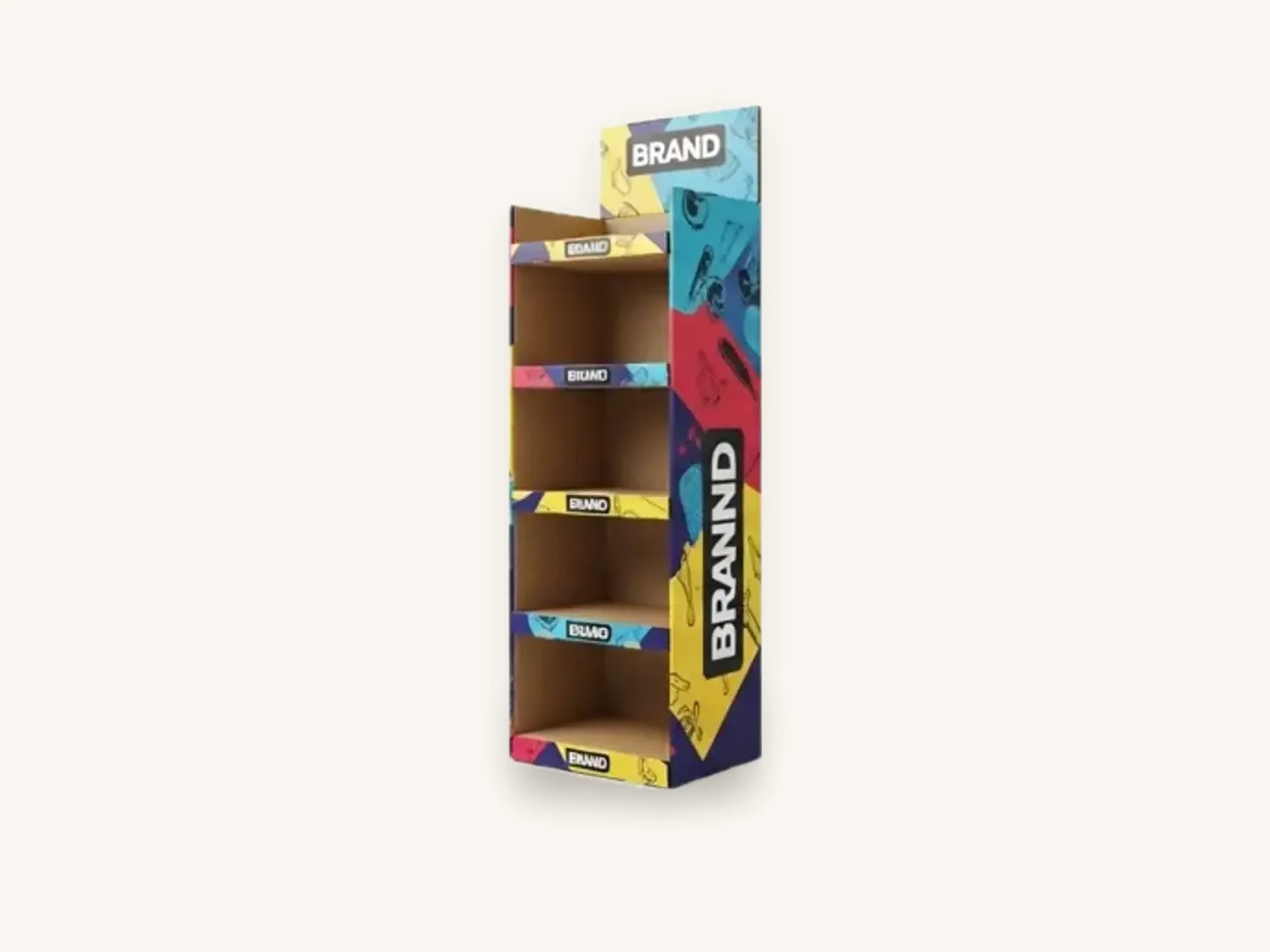
For impulse products near checkout, a buyer may ask for a counter display box that ships flat or pre-packed with units. For promotional placements, a floor display stand holds more product at eye level. Both require approval from the buyer and often have size limits set by store fixtures. The custom display boxes guide covers structures in depth.
| Format | Best for | Typical placement | What to confirm with the buyer |
|---|---|---|---|
| Shelf ready tray | Fast-moving small items sold in multiples | In-line shelf | Shelf depth, facings, tear-away design |
| Counter display box | Impulse items, samples, small accessories | Checkout counter | Counter footprint, units per display, pre-packed or not |
| Floor display stand | Promotions, seasonal, new launches | Endcap, aisle, front of store | Height limit, weight, assembly method, duration |
| Peg / hang tab box | Lightweight items on hooks | Peg wall | Hole type and position, peg length |
| Standard consumer carton | Most boxed products | Shelf | Facing orientation, barcode panel, stacking |
As a cost reference, a 10x8x6 in E-flute counter display box printed full color is about $3.61 each at 250 units and about $2.26 at 1,000, with free US shipping. Check the pricing estimator for other sizes.
Case packs, master cases and case markings
The master case, or shipping case, carries multiple consumer units from your facility to the retailer's distribution center. Retailers care about its size, strength, weight and markings.
Choosing a case pack
The case pack is how many units go into one shipping case. Retailers usually want case packs that match store sales velocity: a slow seller in a large case pack leaves excess inventory in the store; a fast seller in a small case pack needs constant replenishment. Common case packs are 6, 12, 24 and 48, but the buyer may set it. Inner packs, a smaller bundle within a case, are sometimes requested for items stores receive in partial cases.
Case construction
Most master cases are regular slotted containers in single-wall corrugated. Heavier or dense contents may need double-wall board. The custom shipping boxes page covers standard grades, and the ECT vs burst strength guide explains how to specify strength for stacking.
As a reference, a 12x10x6 in B-flute RSC with one-color print is about $2.50 each at 500 units, and a 16x12x8 in case is about $3.99 at 500.
Case markings
Case markings commonly required by retailers include:
- A case-level barcode, often a GTIN-14 in ITF-14 symbology or a GS1-128 label, depending on the retailer
- Product description and item number (yours and sometimes the retailer's)
- Case pack quantity
- Case dimensions and gross weight
- Country of origin where applicable
- Handling marks such as "This side up" when relevant
- Lot or date codes for dated products
Print static information directly on the case with one-color flexo or digital print, and apply variable information such as lot codes or purchase order numbers with labels. That way a single case design covers multiple shipments.
Tip: place case markings on at least two adjacent sides of the case. Distribution center workers see cases from different angles on racks and pallets, and a marking on one side only is easily hidden.
Pallet requirements
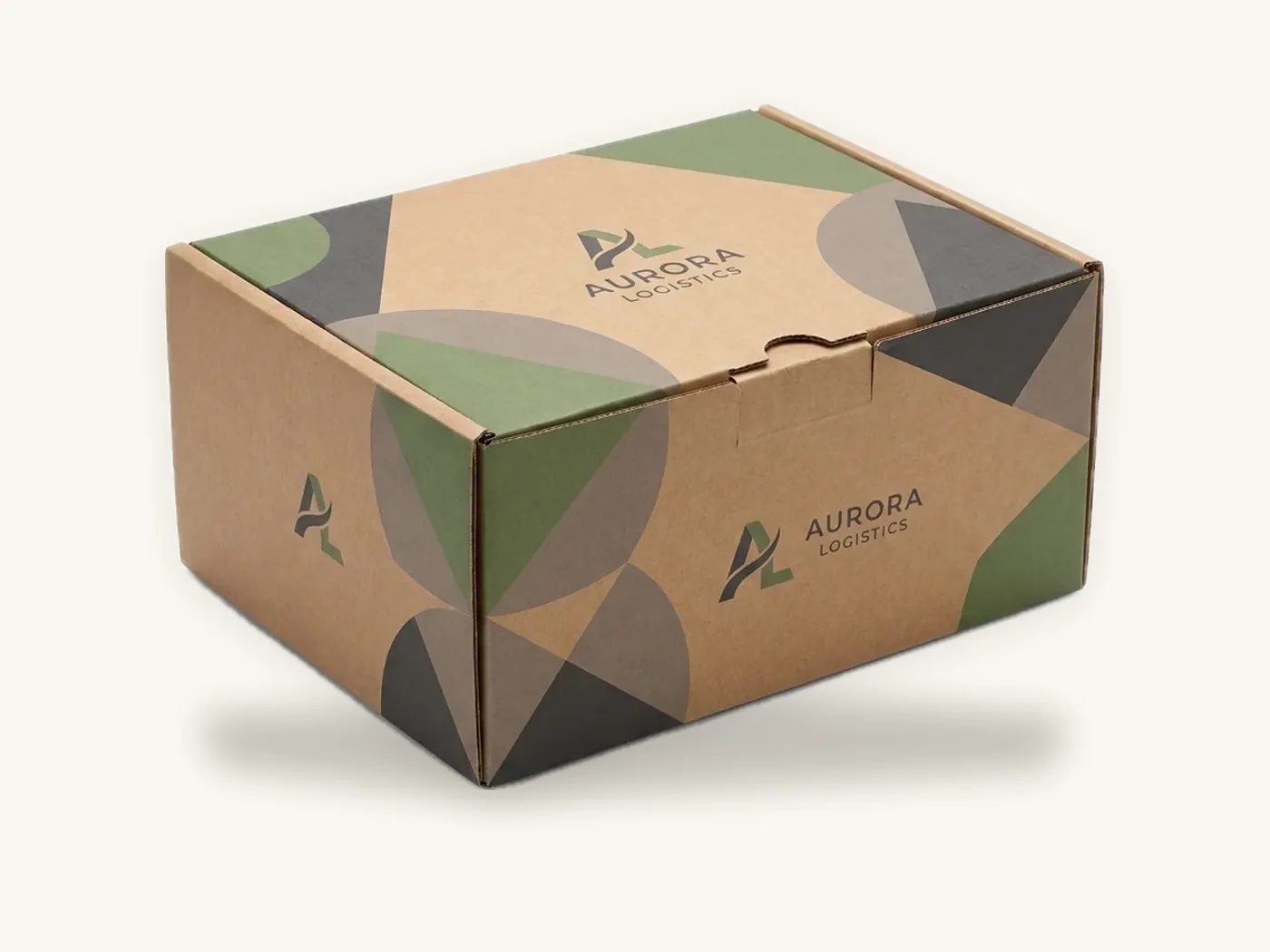
Retailers set pallet rules because their racking, forklifts and dock doors depend on them. Typical specifications include pallet type (often the 48x40 in pallet common in North America), maximum load height, maximum load weight, no overhang beyond the pallet edge, corner boards, stretch wrap and pallet labels.
Designing cases for the pallet
Case dimensions determine how many cases fit per layer and how many layers fit under the height limit. A case that is slightly too large might drop an entire row per layer. Before finalizing case size:
- Calculate how many cases fit on a 48x40 in footprint in a column or interlocked pattern
- Check the layers that fit under the retailer's height limit
- Check total pallet weight
- Confirm the bottom case can support the stack, allowing a safety margin for humidity and time in storage
Overhang is a common failure point. Cases that hang past the pallet edge lose much of their stacking strength and can get damaged by forklifts.
A retail readiness checklist before your first purchase order
Use this list before you submit item setup or ship a first order. Tick each item against the retailer's manual, not your assumptions.
- Vendor manual received and read, including chargeback schedule
- GS1 Company Prefix licensed and GTINs assigned for each item and case
- Consumer unit barcode printed at a scannable size with an adequate quiet zone
- Required label content confirmed for your category with the regulator or counsel
- Merchandising format confirmed: shelf, peg, counter or floor
- Case pack confirmed and case dimensions measured with product inside
- Case markings on at least two sides, with case barcode
- Pallet pattern calculated for the retailer's height and weight limits
- Drop and compression test of a packed case, following the retailer's or an industry test method
- Photos and dimensions of the consumer unit and case submitted as item data
- Samples of finished packaging approved by the buyer, if requested
- Reorder plan: how quickly you can replenish packaging when sales pick up
The ISTA drop testing guide explains common test procedures, and the packaging quote checklist helps you collect specs for suppliers.
From DTC or marketplace packaging to retail packaging
Many brands entering retail already sell online. Their existing packaging usually needs adjustments rather than a full redesign.
What typically changes
- Mailer to carton: a mailer that ships to consumers often becomes a folding carton inside a master case.
- More front-panel clarity: online, the product page explains the product. On a shelf, the front panel must do it in a glance.
- More regulatory text: retail packaging often needs full label content that an online listing previously carried.
- Barcodes: marketplace barcodes may not meet retailer requirements. Confirm with the buyer.
- Stacking strength: retail cases get stacked on pallets and racks, which is harder on packaging than a parcel network for some products.
If you started on marketplaces, our guides to packaging for Etsy sellers and packaging for startups cover earlier stages. When moving from pilot stores to a chain-wide rollout, the private label packaging guide is useful if a retailer asks you to produce under its brand.
Pilot orders
Buyers often start new suppliers in a limited number of stores. That is a good moment to order packaging in smaller quantities and fix issues before scaling. A short run of 250 or 500 cartons costs more per unit than 5,000, but it avoids a large reprint if the buyer asks for changes after the test. A 3x2x5 in straight tuck end carton in 18 pt SBS with full color print is about $0.61 each at 500 and about $0.36 at 5,000.
How to order retail packaging from Box Sense
Send the retailer's requirements along with your specs; we can build the dieline around them.
What to send
- Relevant pages from the vendor manual (packaging, case, pallet, labeling)
- Product dimensions and weight, and the merchandising format
- Consumer unit style preference, or a request for a recommendation
- Case pack, and whether a shelf ready tray or display is needed
- Barcodes as numbers or files, and any regulatory copy
- Quantities to price, ideally a pilot quantity and a rollout quantity
- The date packaging must arrive for packing before the first purchase order ships
What happens next
- Quote within 24 hours.
- Free design support: dieline, artwork setup and a 3D digital proof with two revision rounds. Our design services team can lay out required text and barcode panels.
- Samples: unprinted structural samples are free, so you can test fit, case pack and pallet patterns. A printed sample of approved artwork is free on orders of 100 or more.
- Production: standard 8–12 business days after proof approval; rush in 5 business days on most paperboard and corrugated styles.
- Delivery: free on every US order; international shipping quoted at cost.
The minimum is 10 boxes with no die or plate charges. The retail and consumer goods page shows common formats, and custom product boxes cover most consumer units.
Frequently asked questions
What are retail ready packaging requirements?
They are the rules a retailer or distributor sets for how products are packed, labeled and delivered. They usually cover the consumer unit barcode and labeling, case pack and case markings, shelf ready or display formats, and pallet specifications. Requirements differ between retailers, so always follow the specific vendor manual you receive from the buyer.
What is shelf ready packaging?
Shelf ready packaging is a shipping case designed to open into a display tray that goes directly onto the shelf. A perforated section tears away, leaving the units neatly faced with branding visible. It reduces store labor because associates shelve the whole tray instead of individual units. Retailers that request it usually specify dimensions and opening method.
Do I need a GS1 barcode to sell in retail stores?
Most US retailers require GS1-issued barcodes on each sellable unit, and often a case-level barcode on shipping cases. Barcodes bought from resellers may not be accepted because they are not registered to your company. Confirm with the buyer and license a GS1 Company Prefix directly from GS1 US if required.
How do I choose a case pack for a retailer?
Start with the buyer's preference, which is often stated in item setup forms. Otherwise, match case pack to expected store sales so stores receive enough to fill shelves without excess back-room stock. Common case packs are 6, 12, 24 and 48 units. Also check that case weight stays within the retailer's handling limit.
What happens if my packaging does not meet a retailer's requirements?
Retailers commonly issue chargebacks, which are deductions from your invoice for noncompliance such as wrong labels, unscannable barcodes, incorrect case quantities or noncompliant pallets. Repeated problems can affect your relationship with the buyer. Read the compliance and chargeback section of the vendor manual before your first shipment.
Can I test retail packaging in a few stores before a full rollout?
Yes, and it is a sensible approach. Order a pilot quantity of consumer cartons, cases or displays, gather store and buyer feedback, then adjust the design before a larger run. Box Sense produces from a minimum of 10 boxes, which makes small pilot runs and approval samples practical.
What should a retail display box include?
A retail display box should hold the agreed number of units securely, show the brand and product clearly from the aisle, and fit the fixture or counter space the store allows. It should ship flat or pre-packed as the buyer prefers, assemble without tools, and carry any required barcode or item number for store receiving.
Next steps
Collect the vendor manual sections that apply to packaging, then price your consumer units, cases and displays with the instant packaging estimator. When you are ready, request a retail packaging quote with the manual attached and we will build dielines around the retailer's requirements and send a free structural sample for fit and case pack testing.
Boxes in this guide
Order the packaging we covered
Written by the Box Sense Packaging Team
Our structural designers, prepress technicians and production staff print and convert custom boxes every day for brands in the United States, United Kingdom and UAE. Questions about this guide? Talk to us.