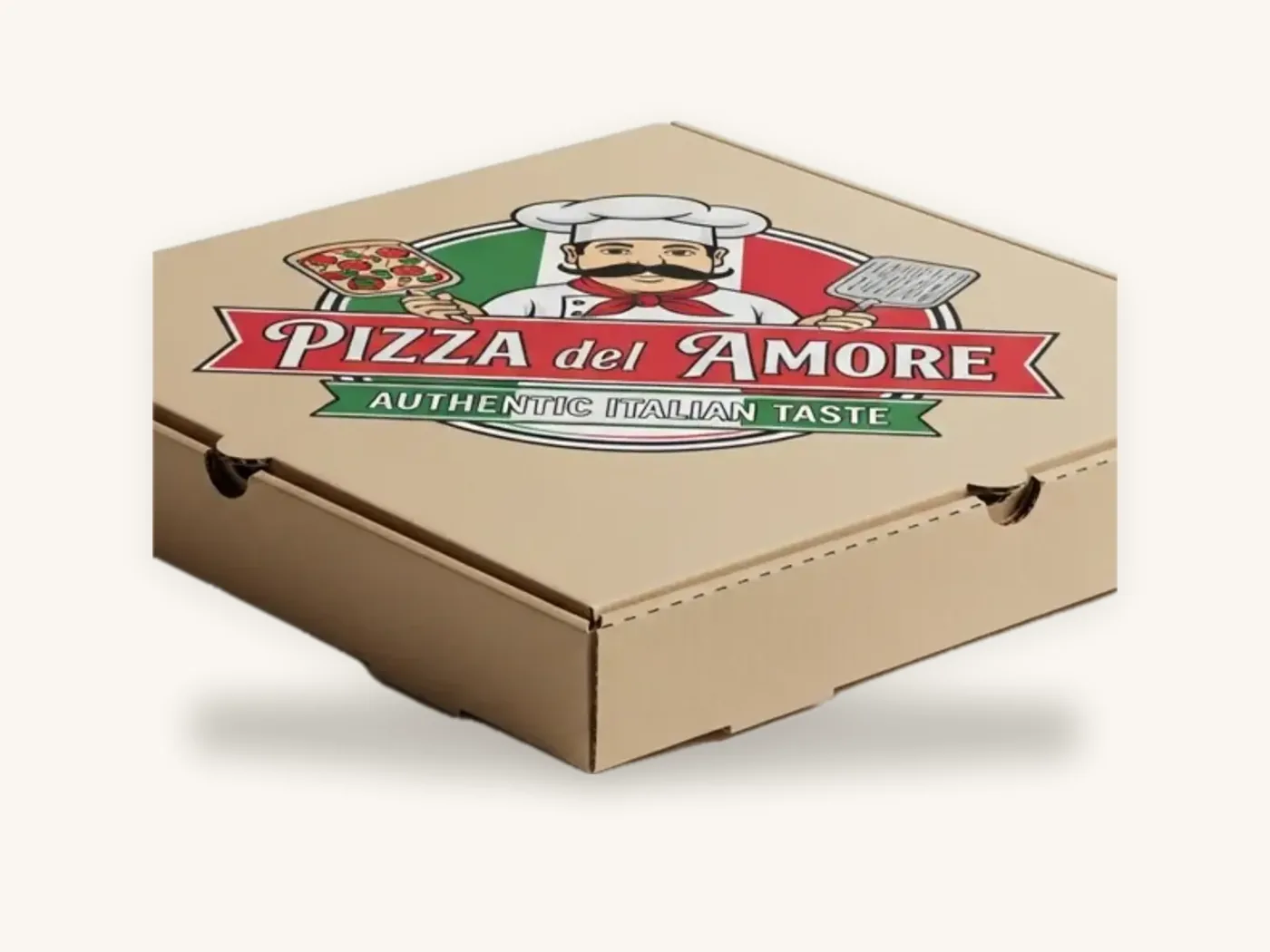
Custom pizza boxes are one-piece corrugated trays with a hinged lid, die-cut so they fold without glue or tape and printed with your brand on the lid. The three specs that decide whether a pie arrives hot and crisp are the flute (board thickness), the interior size and depth, and the venting. Printing and finish come after those.
A pizza box is a working tool before it is a billboard. It has to insulate, let steam escape, resist grease, stack in a hot kitchen and fold fast during a Friday rush. This guide covers each of those jobs with practical numbers, then explains what printed pizza boxes can and cannot do on corrugated board, what drives the cost, and how to order.
Key takeaways
- Most pizza boxes use E-flute (about 1.5 mm) for thin and standard pies or B-flute (about 3 mm) for larger, heavier and deep-dish pies that need more insulation and stacking strength.
- Pizza box sizes are named for the pie. Measure your real baked pies, which are often slightly under the menu size, and specify the interior.
- Depth follows the crust style: roughly 1.5 in for thin crust, 1.75 to 2 in for standard, and 2.5 in or more for deep dish and pan styles.
- Vents let steam escape so crusts stay crisp; place them high on the side walls or lid, away from where toppings touch.
- Printed pizza boxes work best with bold, simple artwork: one to four colors on kraft or white board.
- Box Sense makes custom pizza boxes from 10 units, with free dielines and proofs and 8–12 business day standard production.
Anatomy of a corrugated pizza box
Knowing the parts makes it easier to talk to a supplier and to spot why a box fails.
The tray and lid
The standard style is a single die-cut sheet. The base panel becomes the tray, the rear panel folds up into the hinge, and the lid panel folds over the top. Double-layered side walls fold inward and lock into the base, which gives the box its rigidity without glue.
The front lock
A tuck flap on the front of the lid slides into the tray, sometimes with small locking tabs at each side. A secure front lock keeps the lid from popping open when boxes are stacked in a delivery bag.
Side ears and corner posts
Folded ears at the corners stiffen the walls and help stacks resist crushing. On larger boxes, these reinforced corners carry most of the load when ten or more boxes sit on top of each other.
Vents and finger holes
Die-cut vents or perforated vent tabs let steam out. Some designs include a thumb notch on the front edge so the lid lifts easily without tearing.
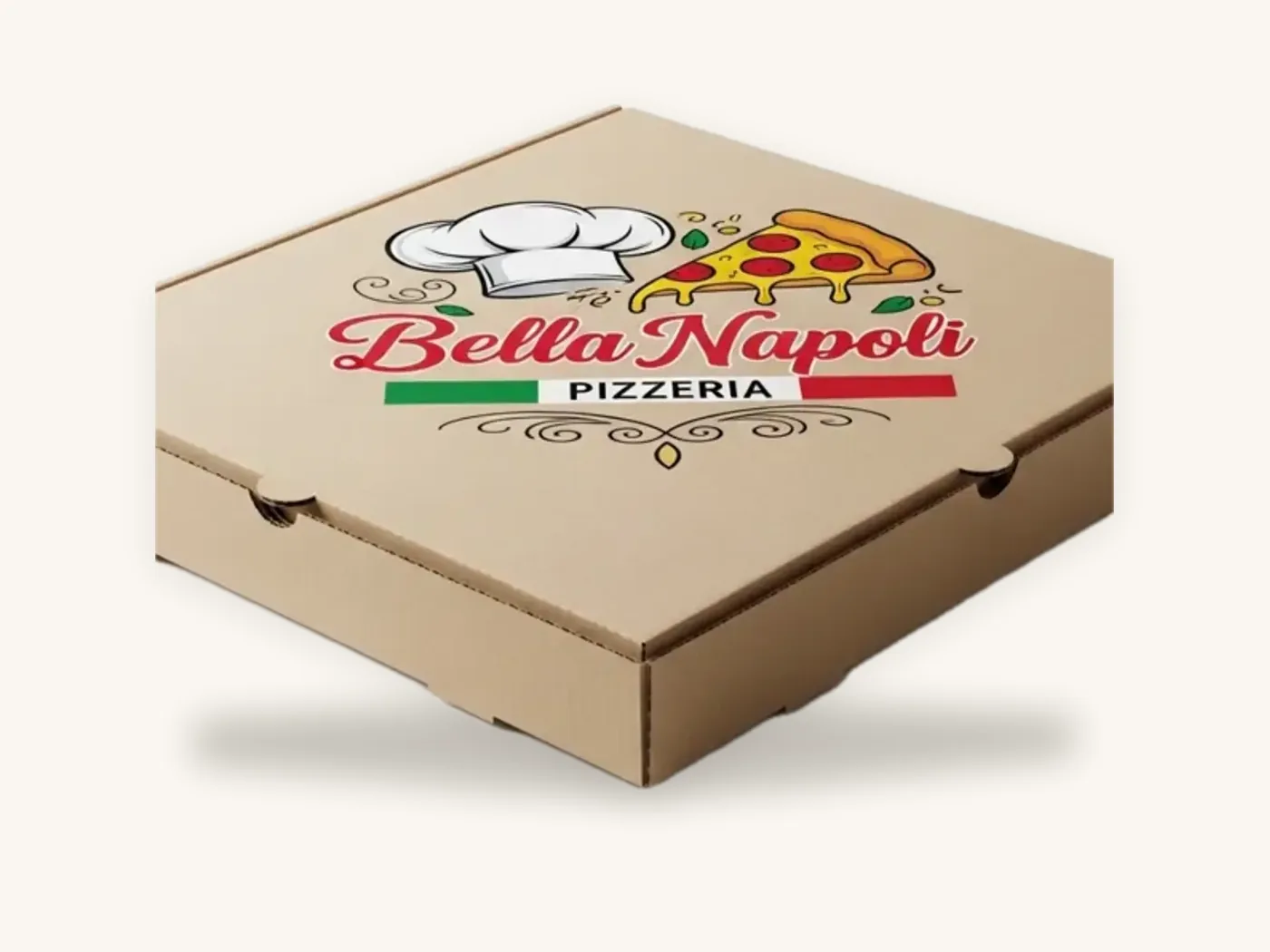
Pizza box sizes and depths
Pizza box sizes follow the pie diameter, but the box must be sized around the pie you actually bake, not the number on the menu. Hand-stretched dough varies, and a 14 in pie might come out anywhere from about 13 to 14.5 in.
Common round-pie sizes
| Menu pie size | Typical interior box size | Suggested depth, thin crust | Suggested depth, standard crust |
|---|---|---|---|
| 8 in personal | about 8 x 8 in | about 1.5 in | about 1.75 in |
| 10 in small | about 10 x 10 in | about 1.5 in | about 1.75 in |
| 12 in medium | about 12 x 12 in | about 1.5 in | about 1.75 to 2 in |
| 14 in large | about 14 x 14 in | about 1.5 in | about 2 in |
| 16 in extra large | about 16 x 16 in | about 1.75 in | about 2 in |
| 18 in party | about 18 x 18 in | about 1.75 in | about 2 in |
These are starting points. The right interior size lets the pie drop in with a little room so the edges do not touch the walls, but not so much that it slides in transit. A clearance of roughly 1/4 to 1/2 in beyond your largest typical pie is a common target.
Rectangular and specialty styles
Square pan, grandma, Sicilian and Detroit-style pizzas need rectangular boxes. Measure the pan interior, add clearance, and allow more depth: roughly 2.5 to 3 in for thick pan styles. Calzones and strombolis can share a small rectangular box, while slices often go into a triangular wedge box or a small clamshell.
Sizing process for a new menu
- Bake five of each size on a normal service day and measure the widest point of each.
- Take the largest measurement and add about 1/4 in for thin crust or 1/2 in for thick, cheesy edges.
- Measure the tallest point of your most loaded pie, including any toppings that rise during baking, then add about 1/4 in so the lid does not press on cheese.
- Check your pans and screens. If pies are served on a board or pizza saver, include that height.
- Consolidate sizes. If two menu items are within half an inch, one box size may serve both, which simplifies storage.
- Order structural samples and box a real pie at each size. Close the lid, stack three boxes and check the top box for crushing after five minutes.
Tip: the "pizza saver" plastic tripod exists because lids sag onto toppings. A slightly deeper box, B-flute board or a lid with embossed ribs can keep the lid clear without the plastic piece.
Flutes and board grades
Flute size decides insulation, stiffness and print quality. Corrugated board is a fluted medium between two flat liners, and the flute height is the biggest variable. The corrugated board materials page lists the grades we run, and the corrugated flutes explained guide covers flute profiles in depth.
| Board | Thickness | Strengths | Choose it for |
|---|---|---|---|
| E-flute | about 1.5 mm | Smooth print surface, crisp folds, compact storage | Thin and standard pies up to about 14 in, personal and slice boxes |
| B-flute | about 3 mm | More insulation, better stacking strength, resists lid sag | 16 in and larger pies, deep dish, heavy toppings, long delivery routes |
| Kraft liner | natural brown | Hides grease marks and scuffs, natural look | Most pizzerias, one or two color print |
| White liner | bleached white | Brightest full-color print | Brands with detailed or photographic artwork |
E-flute or B-flute
E-flute is thinner, so it folds faster and stores more boxes in the same shelf space. It also prints more precisely. For standard pies on shorter delivery routes, it is usually enough.
B-flute has roughly twice the thickness. The larger air pockets hold heat longer and resist crushing when large boxes are stacked. If you deliver 18 in pies, stack more than five boxes in a bag, or have routes longer than about 20 minutes, B-flute is worth testing.
Kraft or white
Kraft liners dominate pizza boxes for good reasons: they hide grease spots and bag scuffs, and a single dark ink looks strong on them. White liners make full-color artwork brighter, but grease marks show more clearly. See kraft paperboard for the natural board look.

Venting for crisp crusts
A hot pizza releases a lot of steam. Trapped inside a closed box, that steam condenses on the lid and walls and softens the crust within minutes. Vents trade a little heat for a lot of texture.
Where to put vents
- High on the side or front walls: the most common placement, letting steam escape without exposing the pie to cold air from above.
- On the lid near the edges: effective for very steamy, heavily topped pies, but keep vents away from the center so toppings do not stick to the edges of the holes.
- Fold-out vent tabs: perforated flaps that the kitchen pushes open for thin crust and leaves closed for thick pies that need heat retention.
How much venting
There is no universal number, because oven style, topping moisture and delivery time all change the answer. A practical approach is to start with two small vents on opposite walls, test a delivery-length hold, and then add or enlarge vents if the crust softens. Very thin, crisp pies generally want more venting; thick, bready crusts tolerate less.
Venting versus heat retention
More venting means faster cooling. If customers complain about lukewarm pizza, check route times and bag insulation before closing vents, because a soggy pie is harder to rescue than a slightly cooler one.
Grease resistance, liners and food contact
Oil from cheese and toppings soaks into untreated corrugated board, weakening the base and leaving marks on car seats and countertops. Pizza boxes manage this through board choice, coatings and optional liners.
Grease management options
- Grease-resistant board or coatings on the inner liner slow oil penetration into the flutes.
- Paper liners or circles under the pie absorb or block oil and are easy to replace per order.
- Heavier inner liners reduce the chance of oil reaching the fluting and weakening the base on long holds.
Many US states and cities have introduced restrictions on certain chemical treatments, such as intentionally added PFAS, in food packaging, so ask your supplier how grease resistance is achieved and confirm current rules in the states where you operate.
Food contact in general terms
The inner surface of a pizza box contacts hot, oily food directly, so materials, inks and coatings on that side need to be suitable for food contact. In the US, the FDA regulates food-contact materials. Most pizzerias print only the outside of the box and leave the inside unprinted, which keeps things simple. Our food-safe inks and coatings guide explains the terms, and you can review the FDA's overview of food contact substances.
Printed pizza boxes: what works on corrugated
The lid is the largest printed surface most restaurants own. It sits on a customer's table for the entire meal, so it is worth designing properly.
Print methods
For short runs of roughly 10 to 500 boxes, digital printing handles full-color artwork without plates, which suits new openings, pop-ups and limited promotions. Larger runs are printed with offset methods for better unit economics and color consistency. Our digital vs offset printing guide explains the tradeoffs.
Design rules for corrugated lids
- Go bold. Corrugated board is less smooth than paperboard, so fine lines and very small type can lose detail. Keep body text above roughly 8 pt.
- Use one to four colors. A single dark ink on kraft is classic and cost-effective; two or three flat colors add brand personality.
- Avoid large solid floods on E-flute if you can. Big flat colors may show faint flute lines under raking light.
- Keep artwork clear of fold lines, the front tuck and vents, where it will crease or be cut away.
- Mind the stack. Lids often get scuffed by bag straps and other boxes; patterns and textures hide wear better than one flat panel.
What to put on the lid
Your logo, phone number or ordering URL, and a single message. A QR code linking to your menu or loyalty program is useful if you keep it large and in a clear area. The QR codes on packaging guide covers minimum sizes. Some restaurants print reheating instructions on the inside of the lid; if you do, confirm your inks are suitable for that side.
Generic plus custom
A useful middle path is a printed lid design shared across all sizes, plus a size marker or stamp on the side so staff can pick the right box fast. One artwork file, one approval cycle and consistent branding across the menu.
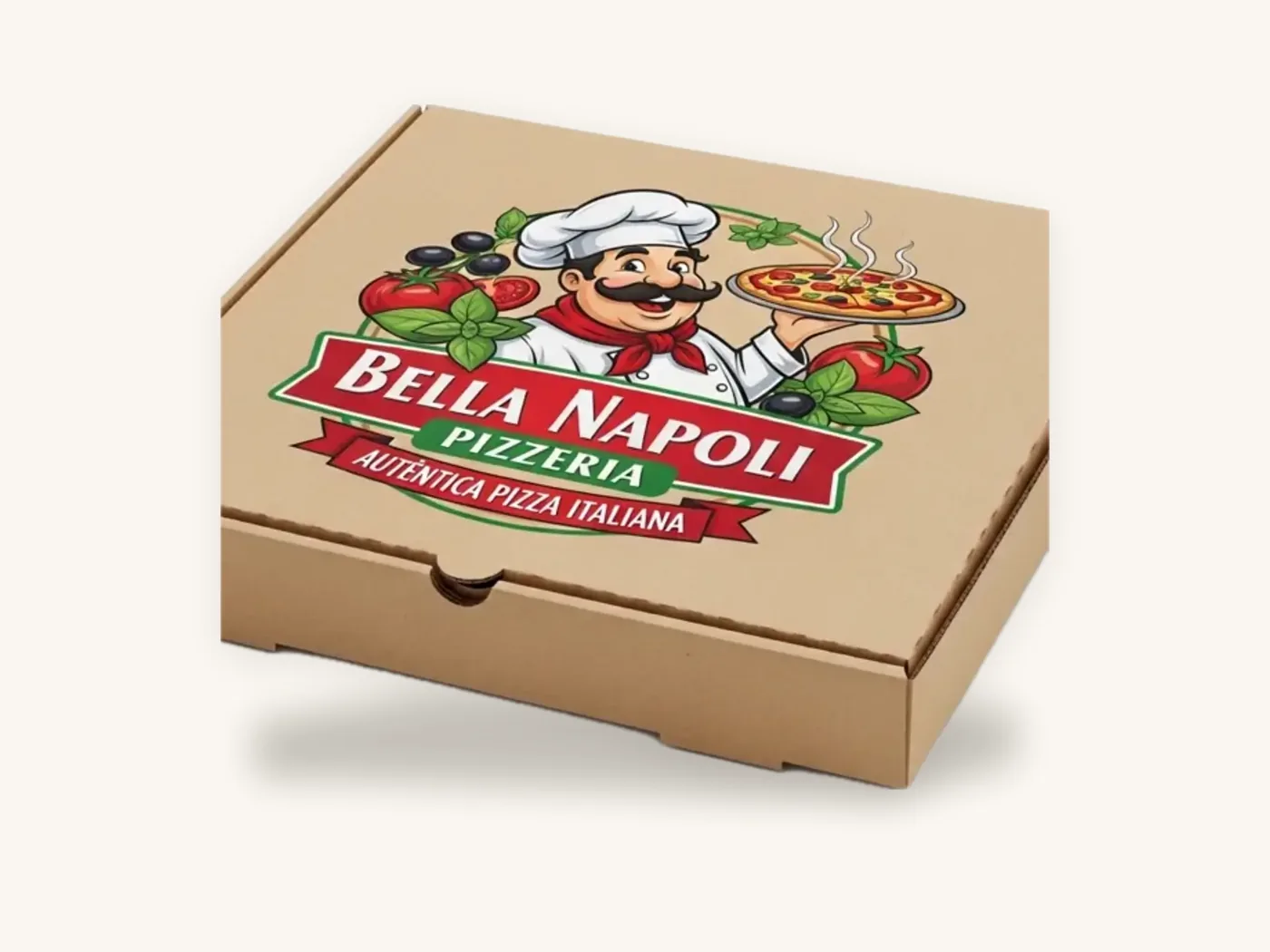
What drives the cost of custom pizza boxes
Pizza box pricing depends heavily on size and quantity, so we do not publish a single per-box figure. Use the instant price estimator with your sizes, or request a quote. Here is what moves the number.
| Cost driver | Effect on price | How to control it |
|---|---|---|
| Box size | Larger boxes use much more board per unit | Consolidate menu sizes where pies are close |
| Flute | B-flute uses more material than E-flute | Use B-flute only for sizes that need it |
| Liner color | White liners can cost more than kraft | Kraft with dark ink suits most brands |
| Print coverage and colors | Full-color flood coverage costs more than a one-color logo | Put design effort on the lid; leave sides simple |
| Inside printing | Adds a print pass and food-contact considerations | Keep the inside plain |
| Vents and special features | Extra die-cut features add complexity | Standardize vent patterns across sizes |
| Quantity | Setup spreads across more units, so unit price falls | Order your top-selling sizes in larger runs |
| Storage and freight | Bulky flat stacks take space and truck volume | Order in cycles that match your storage |
Budgeting across sizes
Most pizzerias sell far more of one or two sizes than the rest. Order those in larger quantities for a better unit price and keep smaller runs of slower sizes. Since the minimum order is 10 boxes, a new specialty size can be tested before committing.
Running pizza boxes in a busy kitchen
The best box on paper can still fail in a real kitchen if it is slow to fold or hard to store.
Storage and pre-folding
Flat stacks store best in a dry area away from ovens and dish pits, because corrugated board loses strength when it absorbs humidity. Many kitchens pre-fold a stack before service. E-flute boxes nest more compactly when folded, which helps in tight spaces.
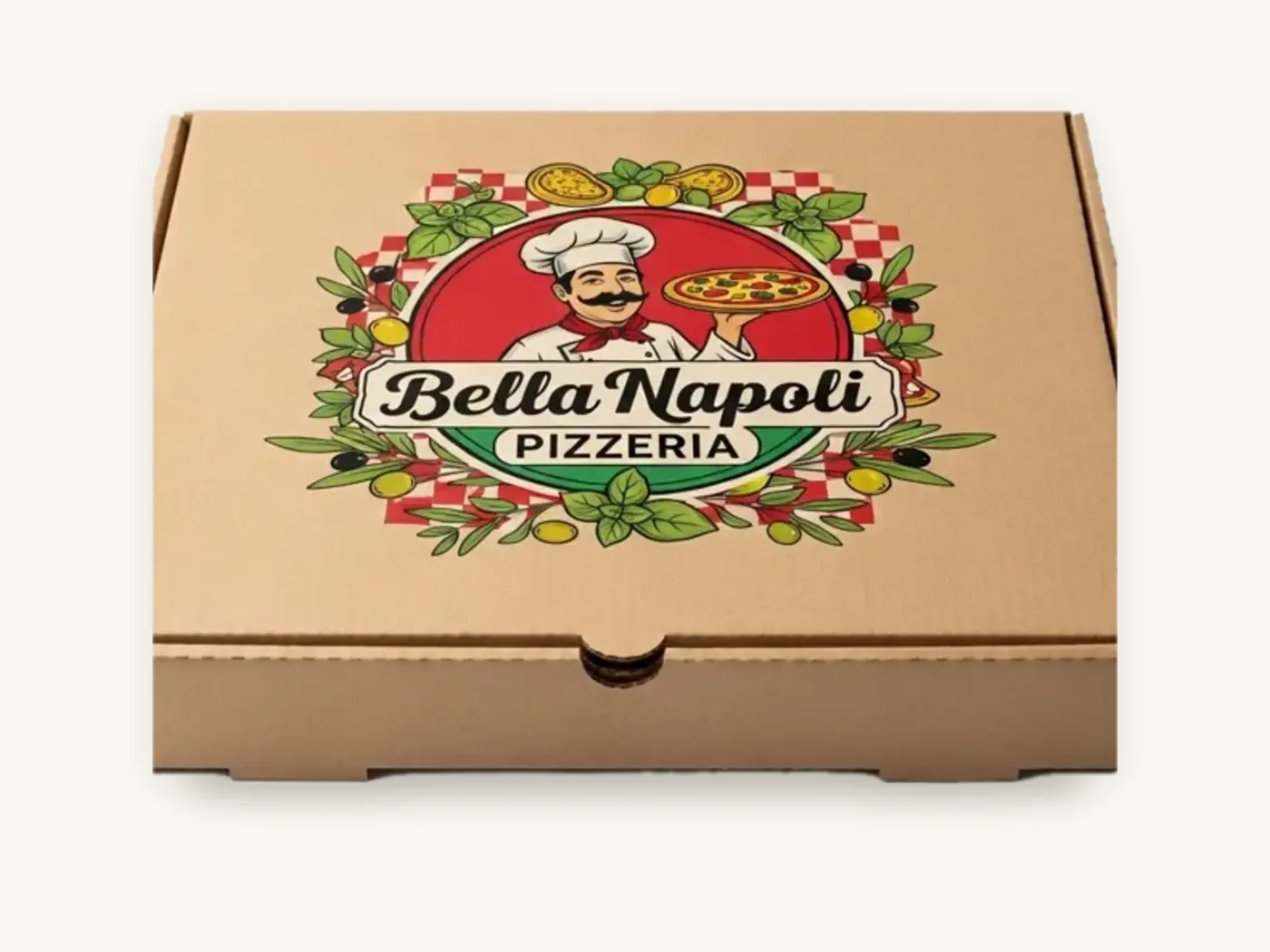
Labeling and order tickets
Leave a clear area on the side or lid for an order sticker. If you use custom labels and stickers as a seal across the front tuck, customers can see the box has not been opened since it left the kitchen.
Delivery bags and stacking
Measure your insulated bags. A box that is a quarter inch too large for the bag gets crushed at the corners every night. Standard bags are sized around common box sizes, so check both before choosing an unusual footprint.
Watch out: stacks of large pies in a hot delivery bag put steady weight on the bottom box. If the bottom lid sags into the cheese, switch that size to B-flute or reduce stack height rather than adding vents.
Recycling and sustainability messaging
Corrugated pizza boxes are made largely from paper fiber, and many recycling programs accept them, sometimes with the request that heavily soiled sections be removed. Acceptance varies by local program, so a general message such as "check your local recycling guidelines" is safer than a blanket "recyclable" claim.
If you print environmental claims, the FTC's Green Guides set out how such claims should be qualified in the US; review the current guidance or ask counsel. FSC-certified board and soy or water-based inks are available, and the sustainability page explains the options.
For restaurants with a wider menu, the takeout packaging guide covers sides, noodles and sandwich containers, and the custom food boxes page lists grease-resistant cartons that pair with pizza orders.
How to order custom pizza boxes from Box Sense
What to send
- Pie sizes and styles (round, square, pan, slice), with measured diameters and heights if you have them
- Estimated weekly usage per size, so we can suggest quantities
- Board preference: E-flute or B-flute, kraft or white
- Vent preference: fixed vents, fold-out tabs or a recommendation
- Print: number of colors, lid only or lid and sides
- Quantities to price per size
- Delivery location and storage limits
- Artwork, or a note that you want help from our design services team
What happens next
- Quote within 24 hours for each size and quantity.
- Free dieline and 3D proof, with two revision rounds.
- Structural samples are free, so you can box real pies before printing. A printed sample of approved artwork is free on orders of 100 or more. See samples.
- Production: standard production takes 8–12 business days after proof approval; rush in 5 business days on most corrugated styles.
- Delivery: free shipping on every US order; international shipping quoted at cost.
The minimum order is 10 boxes. There are no die or plate charges, and defective boxes reported within 14 days are reprinted free. Browse the pizza boxes product page for standard options, or the corrugated boxes page if you also need plain shipping cartons.
Frequently asked questions
What are standard pizza box sizes?
Common round-pie sizes are 8, 10, 12, 14, 16 and 18 in, with interior box dimensions close to those numbers. Depth is usually about 1.5 in for thin crust and 1.75 to 2 in for standard crust, with 2.5 in or more for deep dish. Measure your real baked pies, since they often vary from the menu size.
What flute is best for pizza boxes?
E-flute, about 1.5 mm thick, suits thin and standard pies up to roughly 14 in and prints crisply. B-flute, about 3 mm thick, gives better insulation and stacking strength for 16 in and larger pies, deep dish styles and longer delivery routes. Many pizzerias use E-flute for small sizes and B-flute for their largest.
Why do pizza boxes have holes?
The holes are vents that let steam escape. A closed box traps moisture from the hot pie, which condenses and softens the crust. Vents placed high on the walls or near the edges of the lid release steam while keeping most of the heat inside, so the pizza stays crisper during delivery.
How much do custom pizza boxes cost?
Pricing depends mainly on box size, flute, liner color, number of print colors and quantity. Larger boxes and B-flute use more board, and full-color flood print costs more than a one-color logo. Quantity has the biggest effect on unit price. Use the Box Sense instant estimator for your sizes, or request a quote confirmed within 24 hours.
Can I print full color on pizza boxes?
Yes. Digital printing handles full-color artwork on short runs, and larger runs use offset methods. Full color looks brightest on white liners. Many pizzerias still choose one or two bold colors on kraft because it hides grease and scuffs and keeps costs down. Avoid very fine detail, since corrugated board is less smooth than paperboard.
Are printed pizza boxes safe for food?
Most printed pizza boxes are printed only on the outside, with the food-contact interior left unprinted. Materials that touch food are regulated by the FDA in the US, so confirm with your supplier that the inner liner and any coatings are suitable for direct contact with hot, oily food, and check current state rules on grease-resistant treatments.
What is the minimum order for custom pizza boxes?
Box Sense makes custom pizza boxes from 10 units, which is useful for testing a new size, a pop-up or a limited promotion. Short runs are printed digitally with no plates. Unit prices drop considerably at higher quantities, so most restaurants order their best-selling sizes in larger runs and test new sizes in small batches.
Next steps
Measure your pies, count weekly usage per size and decide between E-flute and B-flute. Then enter your sizes in the pizza box price estimator and request a custom pizza box quote. We will confirm pricing within 24 hours and send free structural samples so you can box a real pie before you print.
Boxes in this guide
Order the packaging we covered
Written by the Box Sense Packaging Team
Our structural designers, prepress technicians and production staff print and convert custom boxes every day for brands in the United States, United Kingdom and UAE. Questions about this guide? Talk to us.