This packaging terms glossary defines 150 words you will meet when you buy custom boxes: structures, board grades, dieline marks, printing terminology, finishes and shipping tests. Each definition is short and practical, written for founders and buyers rather than press operators.
Terms are grouped by topic in the order a packaging project unfolds, and alphabetical within each group.
Key takeaways
- Most box terminology falls into seven buckets: structure, material, dieline, prepress, printing, finishing and shipping.
- Point (pt) measures paperboard thickness in thousandths of an inch; flute letters describe corrugated board thickness.
- A dieline is the flat template for a box; artwork must respect its bleed, safe zone, cut and crease lines.
- CMYK, PMS and Delta E are the three color words that matter most when approving a proof.
- ECT and burst strength rate corrugated board, but they measure different things.
Box styles and structures
For a style-by-style breakdown with photos, see the box styles glossary.
Paperboard and rigid structures
- Auto lock bottom: a carton base with interlocking glued flaps that snaps shut when the box is opened; also called a crash lock bottom.
- Collapsible rigid box: a rigid box engineered to fold flat for shipping and storage, then open into full rigid form.
- Drawer box: a sliding tray inside an open-ended sleeve, pulled out like a matchbox.
- Five panel hanger: a carton with an extra top panel that carries a hang hole for peg display.
- Folding carton: a box die-cut from paperboard, shipped flat and folded into shape by the packer.
- Gable box: a carton with a peaked top and built-in carry handle, common for food and gifts.
- Hang tab: a die-cut tab with a hole, often a euro slot, so a box can hang on a retail peg.
- Pillow box: a small curved carton with tucked ends that pops into a pillow shape.
- Reverse tuck end (RTE): a carton whose top and bottom tuck flaps close from opposite sides of the box.
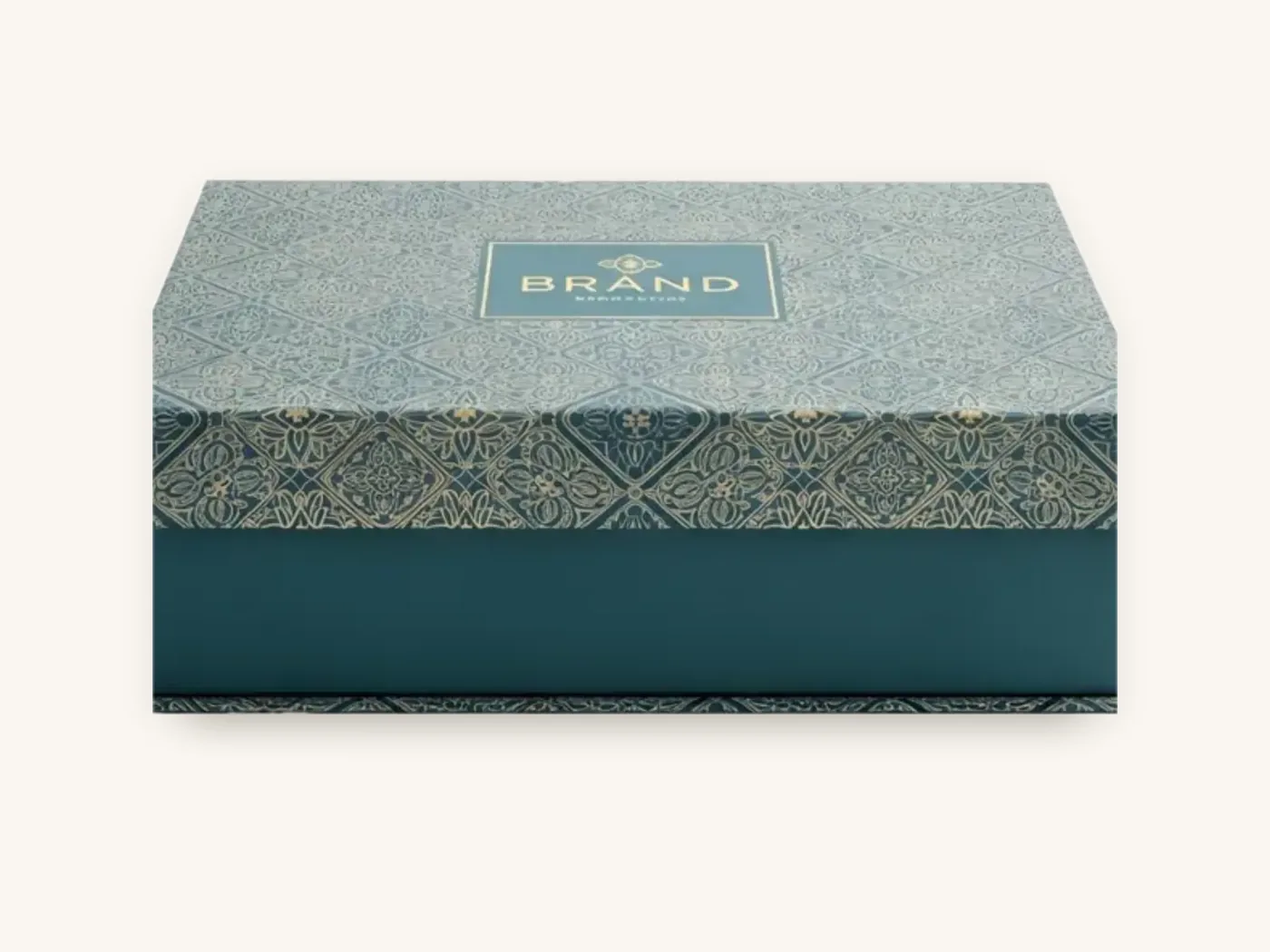
- Rigid box: a non-folding box of thick greyboard wrapped in printed or specialty paper; also called a set-up box.
- Seal end carton: a carton whose end flaps are glued shut on a packing line, as on cereal boxes.
- Shoulder neck box: a rigid box with an inner raised collar that the lid rests on.
- Sleeve and tray: an open-ended printed sleeve that slides over a separate tray.
- Straight tuck end (STE): a carton whose top and bottom tuck flaps both close from the same side.
- Two-piece box: a separate lid and base; called a telescope box when the lid covers most of the base.
- Window box: any box with a die-cut opening, usually covered with clear film.
Corrugated and display structures
- Counter display: a printed corrugated or paperboard tray that holds product at the checkout.
- Full overlap container (FOL): a slotted box whose outer flaps each span the full width, adding stacking strength.
- Half slotted container (HSC): a slotted box with bottom flaps but no top flaps, used with a separate lid.
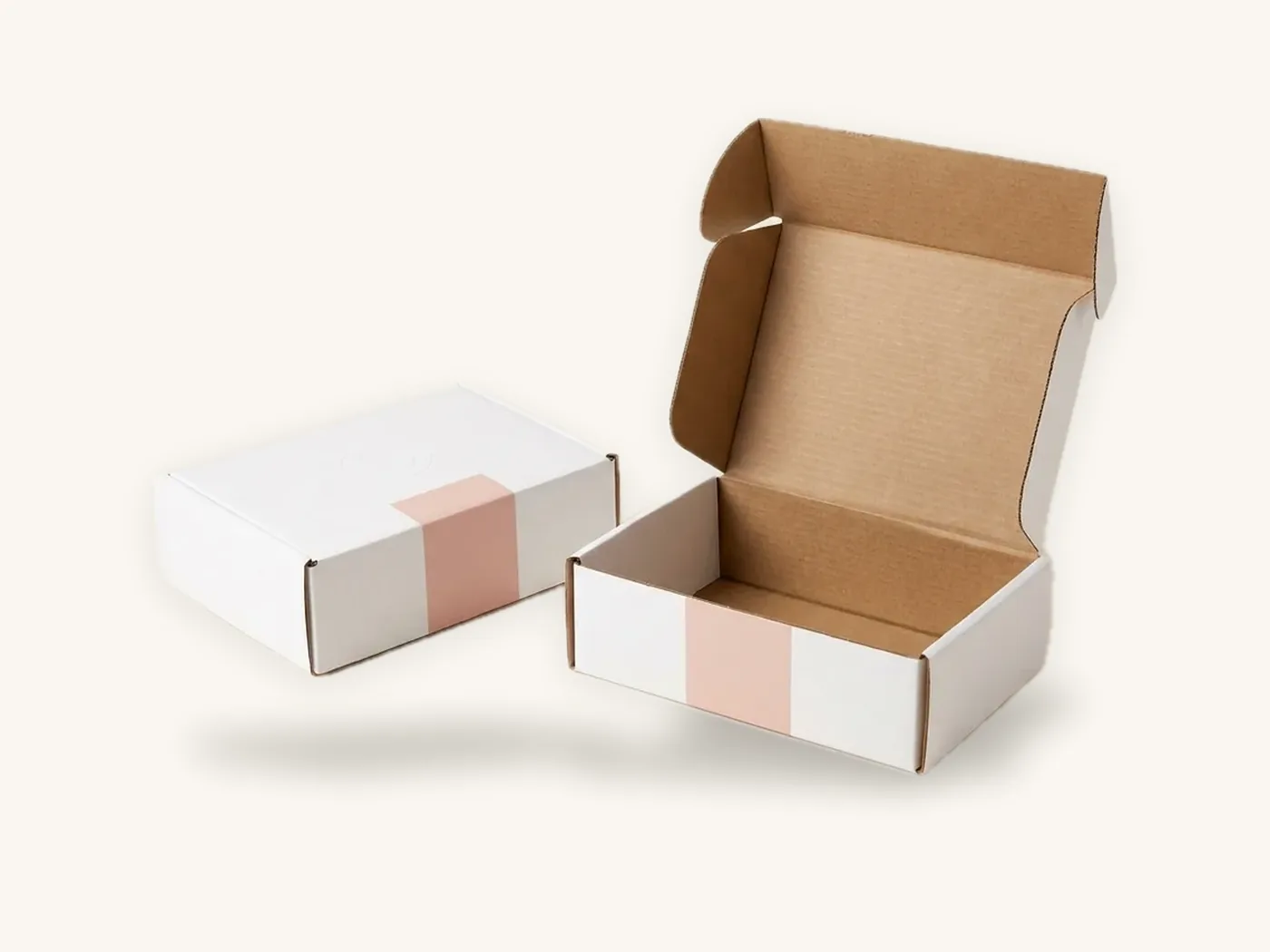
- Mailer box: a one-piece die-cut corrugated box with a hinged lid and locking ears, usually roll-end tuck-front.
- Regular slotted container (RSC): the standard shipping box, with flaps of equal length that meet at the center.
Board and paper materials
The materials page compares every board we run.
Paperboard and rigid board
- Bux board: an economical coated folding boxboard with a smooth print surface for medium-weight products.
- C1S / C2S: coated one side or coated two sides; tells you which faces take high-quality print.
- Coated recycled board (CRB): paperboard made from recycled fiber with a clay-coated print surface.
- Coated unbleached kraft (CUK): strong brown kraft board with a white coated face, common on beverage carriers.
- Greyboard: dense recycled board, usually 1.5 to 3 mm, that forms the walls of rigid boxes; also called chipboard.
- Kraft paperboard: unbleached board with a natural brown surface and good tear strength.
- Metallic board: paperboard laminated with a metallized film or paper for a mirror or brushed effect.
- Paperboard: paper-based sheet thick enough to fold into a carton, typically about 12 pt and up.
- Solid bleached sulfate (SBS): premium bright white virgin-fiber paperboard used for color-critical cartons. See SBS paperboard.
- Specialty paper: textured, linen, felt, leather-grain or pearlescent paper used to wrap rigid boxes.
- Wrap: the printed or specialty paper glued around greyboard to finish a rigid box.
Corrugated board
- Corrugated board: a fluted paper medium glued between flat liners, forming a stiff, cushioning sheet.
- Double wall: two fluted layers and three liners, used for heavy or high-stacking loads.
- Flute: the wave-shaped layer inside corrugated board; flute size sets thickness and strength.
- Linerboard: the flat outer and inner paper faces of corrugated board, in kraft or white.
- Medium: the paper that is formed into flutes between the liners.
- Single wall: one fluted layer between two liners; the most common corrugated construction.
- Triple wall: three fluted layers for industrial, very heavy or bulk shipments.
The flute letters are not in size order, which trips up almost everyone. Our corrugated board page and flute guide go further.
| Flute term | Approx. thickness | What it is used for |
|---|---|---|
| A-flute | about 4.8 mm | Cushioning and stacking for bulky, lighter goods |
| B-flute | about 3 mm | Shipping boxes, heavier mailers, good puncture resistance |
| C-flute | about 4 mm | General shipping cartons with strong stacking |
| E-flute | about 1.5 mm | Printed mailers and retail boxes with a smooth surface |
| F-flute | about 0.8 mm | Thin, carton-like corrugated for small retail packs |
| BC double wall | about 7 mm | Heavy, fragile or long-haul shipments |
Fiber and measurement units
| Unit or term | What it measures | How it is expressed |
|---|---|---|
| Basis weight | Weight of a standard area of paper or linerboard | Pounds per ream or per 1,000 sq ft |
| Caliper | Thickness of a sheet of board | Points, microns or millimeters |
| GSM | Weight per square meter of paper or board | Grams per square meter |
| Point (pt) | Paperboard thickness | One point equals 0.001 in, so 18 pt is 0.018 in |
| Post-consumer recycled (PCR) | Fiber recovered from used products | Percentage of total fiber |
| Virgin fiber | Fiber made directly from wood, not recycled | Often paired with FSC certification |
Dieline and structural design terms
These words appear on dieline files and structural drawings; the dieline guide walks through a real template.
Lines and zones on a dieline
- Bleed: artwork extended past the cut line, usually 1/8 in (3 mm), so no white edge shows after cutting.
- Crease line: a line pressed into the board so it folds cleanly; also called a score line.
- Cut line: the path where the die cuts through the board, usually shown as a solid line.
- Dieline: the flat vector template showing every cut, crease, panel and glue area of a box.
- Perforation: a line of small cuts that lets a panel tear away, as on dispenser boxes.
- Safe zone: the area inside cut and crease lines where text and logos will not be trimmed or folded; also called the live area.
Box parts
- Dust flap: a small side flap that folds under a tuck flap to keep dust out and square the end.
- Glue flap: the strip glued to the opposite panel to form a carton's tube; also called the manufacturer's joint.
- Lock tab: a small tab that slots into a cut to hold a flap closed without glue.
- Panel: any flat face of a box between creases, such as front, back, side or lid.
- Tuck flap: the flap that slides inside the box to close a carton end.
Structural manufacturing
- Cutting die: a steel-rule tool shaped to the dieline that cuts and creases sheets in one press.
- Die-cutting: the process of cutting and creasing printed sheets into flat box blanks.
- Grain direction: the direction fibers run in board; folding with the grain behaves differently than against it.
- Inside dimensions: the usable space inside a box, listed as length x width x depth. See the box measuring guide.
- Knocked-down flat (KDF): a box delivered folded flat and glued, ready to erect.
- Structural sample: an unprinted prototype used to check fit and function before printing.
- Tolerance: the acceptable variation between specified and finished dimensions.
Prepress and artwork terminology
Prepress covers everything between your design file and the press. The artwork preparation guide shows how to set files up correctly.
File and image terms
- ICC profile: a data file describing how a device or press reproduces color, used to convert files accurately.
- Outlined fonts: text converted to vector shapes so fonts cannot substitute on another computer.
- Preflight: an automated and manual check of a print file for resolution, fonts, bleed and color issues.
- Raster image: a pixel-based image, such as a photo, that blurs when enlarged.
- Resolution (dpi): dots per inch in an image; 300 dpi at final size is the usual minimum for print.
- RGB: the red, green, blue color model for screens; files must be converted before printing.
- Vector: artwork built from mathematical paths that scales to any size without losing sharpness.
Color and layer terms in prepress
- Finish layer: a separate artwork layer marking exactly where foil, spot UV or embossing goes.
- Knockout: an area where the top color removes the ink beneath it, so colors do not mix.
- Overprint: printing one ink directly on top of another without knocking out the lower color.
- Rich black: black built from CMYK plus black ink for a deeper tone on large solids.
- Trapping: slight overlaps between adjacent colors that hide tiny misregistration gaps.
Proofing terms
- 3D digital proof: a rendered model of the printed, folded box for approving layout and orientation.
- Contract proof: a color-accurate printed proof that the printer and buyer agree to match.
- Imposition: the arrangement of multiple dielines on one press sheet to use board efficiently.
- Mockup: a visual or physical representation of the finished box, used for review or marketing.
- Proof approval: your written sign-off that artwork, copy and structure are final; production starts after it.

Printing methods and color terms
The digital vs offset printing guide covers the choice between the two main methods.
Printing processes
- Digital printing: plateless printing directly from a file, practical for short runs and variable designs.
- Flexography: relief-plate printing with fast-drying inks, common on corrugated and flexible packaging.
- Inside printing: printing on the interior surfaces of a box, often the inside lid of a mailer.
- Litho-lamination: offset-printing a paper sheet and laminating it onto corrugated board for high-quality graphics.
- Offset lithography: printing from plates via a rubber blanket onto the sheet; the benchmark for detail and consistency on longer runs.
- Post-print: printing directly on finished corrugated board, by flexo or digital.
- Pre-print: printing the liner before it is combined into corrugated board.
- White ink underlay: an opaque white layer printed under colors on kraft or metallic board so they stay bright.
Color terms
- CMYK: cyan, magenta, yellow and black, the four process inks that combine to make full-color print.
- Delta E: a number describing how different two colors measure; smaller values mean a closer match.
- Dot gain: halftone dots printing larger than intended, which makes images look darker.
- Halftone: a pattern of tiny dots that simulates continuous tones with a limited number of inks.
- Pantone Matching System (PMS): a standardized color-numbering system used to specify exact ink colors.
- Process color: a color built from CMYK dots rather than a premixed ink.
- Registration: the alignment of colors and finishes with each other on the sheet.
- Spot color: a premixed ink printed as its own color, often specified as a PMS number.
On-press terms
- Make-ready: press setup work and sheets used to reach correct color and registration before the real run.
- Plate: the image carrier that transfers ink in offset or flexo printing.
- Press check: a buyer's in-person or remote review of sheets coming off press before the full run.
Coatings, finishes and embellishments
Our printing and finishes page shows each option, and the finishes guide compares cost and durability.
Coatings and laminations
- Aqueous coating: a water-based clear coat that resists scuffs and keeps boxes recyclable.
- Gloss lamination: a shiny film that deepens color and adds durability.
- Lamination: a thin plastic film bonded to the printed sheet for protection and feel.
- Matte lamination: a low-sheen film that reduces glare and fingerprints.
- Soft-touch lamination: a matte film with a velvety feel, popular in beauty and luxury packaging.
- UV coating: a clear coat cured instantly with ultraviolet light, usually high gloss.
- Varnish: a clear ink-like coating applied on press, flood or in selected areas.
Embellishments
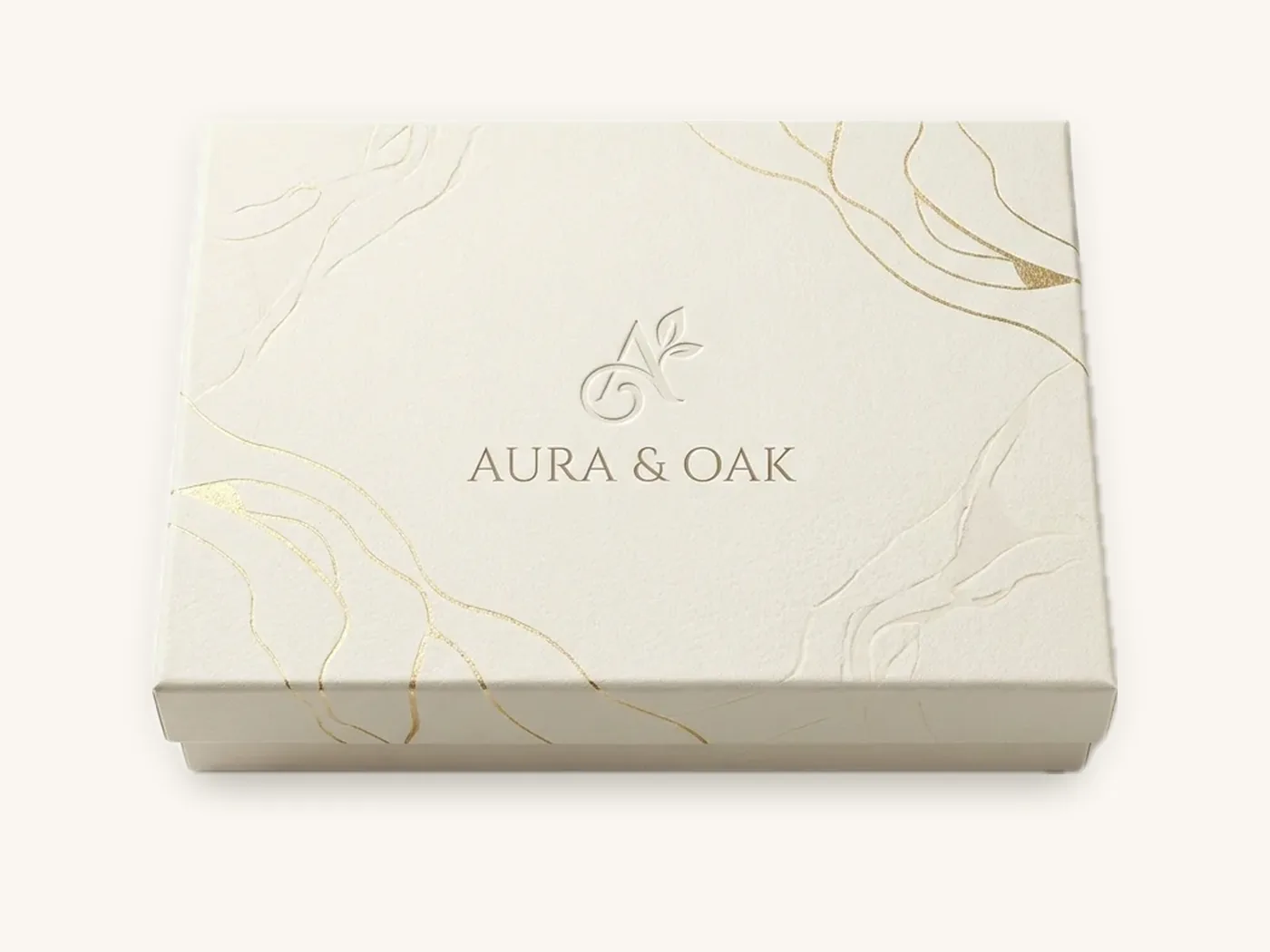
- Blind emboss: an embossed shape with no ink or foil, relying on shadow alone.
- Cold foil: foil applied with adhesive and UV curing, which can be overprinted with color.
- Debossing: pressing a design into the board so it sits below the surface.
- Embossing: raising a design above the board surface with matched male and female tools.
- Foil stamping: transferring metallic or pigmented foil with heat and pressure; also called hot foil.
- Spot UV: glossy UV coating applied only to selected areas for contrast with matte surroundings.
- Tooling: one-time plates or dies made for foil, embossing, spot UV or custom inserts.
Windows and films
- PET film: a clear, rigid polyester film used for durable box windows.
- PLA film: a clear film made from plant-based polylactic acid, used for windows where compostability matters.
- Window patching: gluing a film panel behind a die-cut window.
Inserts, closures and protective packaging
These terms describe what holds and protects the product inside the box. See box inserts and dividers for examples.
- EVA foam: dense, closed-cell foam cut into precise cavities for electronics or valuables.
- Insert: any die-cut paperboard, corrugated, foam or pulp piece that positions a product inside a box.
- Magnetic closure: hidden magnets in a rigid box lid flap that hold it shut.
- Molded pulp: fiber slurry pressed into protective trays; a plastic-free insert option.
- Partition: interlocking board dividers that separate bottles or items into cells.
- Tamper-evident seal: a feature that shows visibly if a package has been opened, such as a tear strip or seal label.
- Tear strip: a pull strip that opens a sealed box along a defined path.
- Void fill: paper, air pillows or other material filling empty space so items do not move.
Shipping, testing and logistics terms
These words appear when boxes leave the building. For the difference between the two board ratings, read ECT vs burst strength.
- Box compression test (BCT): a lab test measuring the load a finished box withstands before collapsing.
- Burst strength: the pressure corrugated board withstands before rupturing, measured by a Mullen test.
- Case pack: the number of units packed into one shipping carton.
- Dimensional weight: a billing weight carriers calculate from a parcel's volume; explained in the dimensional weight guide.
- Drop test: dropping a packed parcel from set heights and orientations to check protection.
- Edge crush test (ECT): a measure of how much edgewise force board withstands, which predicts stacking strength.
- ISTA: the International Safe Transit Association, which publishes standard transit test procedures.
- Master carton: an outer shipping case holding several inner cartons or retail units.
- Overboxing: placing a packed box inside a larger shipping box with cushioning between them.
- Pallet pattern: the arrangement of cartons on each pallet layer to maximize stability and use of space.
- Right-sizing: matching box dimensions closely to the product to cut void fill, damage and freight cost.
Sustainability, compliance and buying terms
The last group covers claims, regulations and the words in a quote. The sustainability page explains the material options.
Sustainability and regulatory terms
- Child-resistant (CR) packaging: packaging designed and tested to be hard for young children to open, under CPSC rules for certain products.
- Compostable: able to break down in composting conditions; claims should specify home or industrial composting.
- Extended producer responsibility (EPR): laws that make brands fund collection and recycling of their packaging.
- FSC certification: Forest Stewardship Council certification tracing fiber to responsibly managed forests.
- Green Guides: Federal Trade Commission guidance on making truthful environmental marketing claims.
- Recyclable: accepted and processed by recycling systems available to a substantial share of consumers.
- Soy-based ink: printing ink using soybean oil in place of some petroleum-based components.
- UPC barcode: the 12-digit Universal Product Code scanned at retail checkouts.
Quote and ordering terms
- Lead time: the time from proof approval to finished, shipped boxes.
- Minimum order quantity (MOQ): the smallest number of units a supplier will produce per order.
- Overs and unders: small quantity variations above or below the ordered amount, common in print production.
Putting the terminology to work on a Box Sense order
Knowing the words makes a quote request faster and a proof review sharper.
A quote request, written in packaging terms
- Structure: mailer box, straight tuck end, rigid two-piece.
- Inside dimensions: length x width x depth, labeled inside.
- Board: 18 pt SBS, E-flute kraft or 2 mm greyboard.
- Print and finish: CMYK or PMS, inside printing, aqueous or lamination, foil or spot UV.
- Inserts and closures: paperboard insert, EVA foam, tear strip or magnetic closure.
- Quantities and timing: two or three tiers, plus your in-hand date.
What happens next
Our MOQ is 10 boxes, with no die or plate charges; tooling applies only to foil, embossing, spot UV and custom inserts. Short runs print digitally and larger runs offset. Quotes are confirmed within 24 hours, and our design services team supplies the dieline, artwork setup and a 3D digital proof with two revision rounds, free. Structural samples are free, and a printed sample is free on orders of 100 or more. Standard lead time is 8–12 business days after proof approval, rush is 5 business days on most styles, and US shipping is free.
For reference, an 18 pt SBS straight tuck end carton at 3x2x5 in, full color with aqueous coating, runs about $1.15 each at 100 units. Browse custom rigid boxes and corrugated boxes, or apply the vocabulary with the custom box design guide.
Watch out: "recyclable," "compostable" and "eco-friendly" are regulated marketing claims, not just glossary words. Check the FTC Green Guides or ask counsel before printing them on a box.
Frequently asked questions
What is the difference between a dieline and a mockup?
A dieline is the flat, technical template of a box showing cut lines, crease lines, bleed and panels, and it is what artwork is placed on for printing. A mockup is a visual representation of the finished, folded box, either rendered in 3D or made physically. You design on the dieline and approve the look using the mockup or 3D proof.
What does pt mean in packaging?
Pt stands for point, a unit of paperboard thickness equal to one thousandth of an inch. An 18 pt board is 0.018 in thick, or about 0.46 mm. Folding cartons commonly run from about 14 pt to 24 pt. Corrugated board is described by flute instead, and rigid boxes by greyboard thickness in millimeters.
What is the difference between CMYK and PMS?
CMYK builds colors from tiny dots of cyan, magenta, yellow and black ink, so almost any image can be printed with four inks. PMS, the Pantone Matching System, specifies a premixed spot ink for one exact color. Use CMYK for photos and multicolor artwork, and PMS when a brand color must match precisely across runs.
What is bleed in box printing?
Bleed is artwork that extends beyond the cut line of the dieline, usually by 1/8 in or 3 mm. Cutting always varies slightly, so bleed ensures background colors run cleanly to the edge instead of leaving a thin white line. Text and logos should stay well inside the safe zone, not in the bleed.
What does ECT mean on a shipping box?
ECT stands for edge crush test, which measures how much force corrugated board can withstand when pressed on its edge. It predicts how well a box resists stacking loads in warehouses and trucks, and it is often printed on a box maker's certificate. Burst strength is a separate rating that measures resistance to rupture.
What is the difference between embossing and debossing?
Embossing raises a logo or pattern above the surface of the board, while debossing presses it below the surface. Both use matched metal tools and require one-time tooling. Either can be combined with foil or print, or left blind with no color, so the effect comes only from the shadow and texture.
Next steps
Bookmark this packaging terms glossary for your next proof review, then use the vocabulary to spec your box in the instant packaging price estimator. When you are ready, send a quote request with your style, inside dimensions, board and finishes, and we will confirm pricing within 24 hours.
Boxes in this guide
Order the packaging we covered
Written by the Box Sense Packaging Team
Our structural designers, prepress technicians and production staff print and convert custom boxes every day for brands in the United States, United Kingdom and UAE. Questions about this guide? Talk to us.