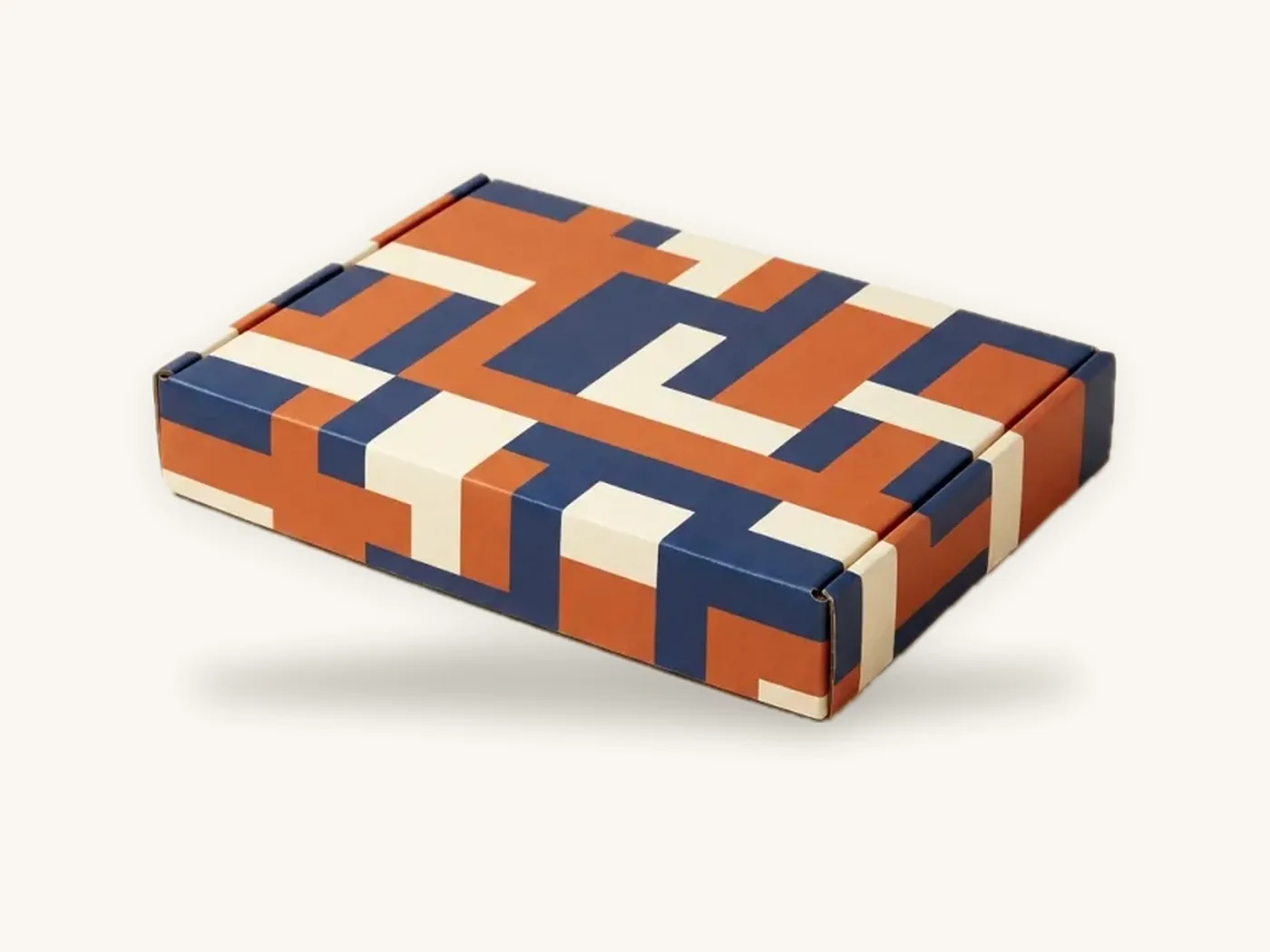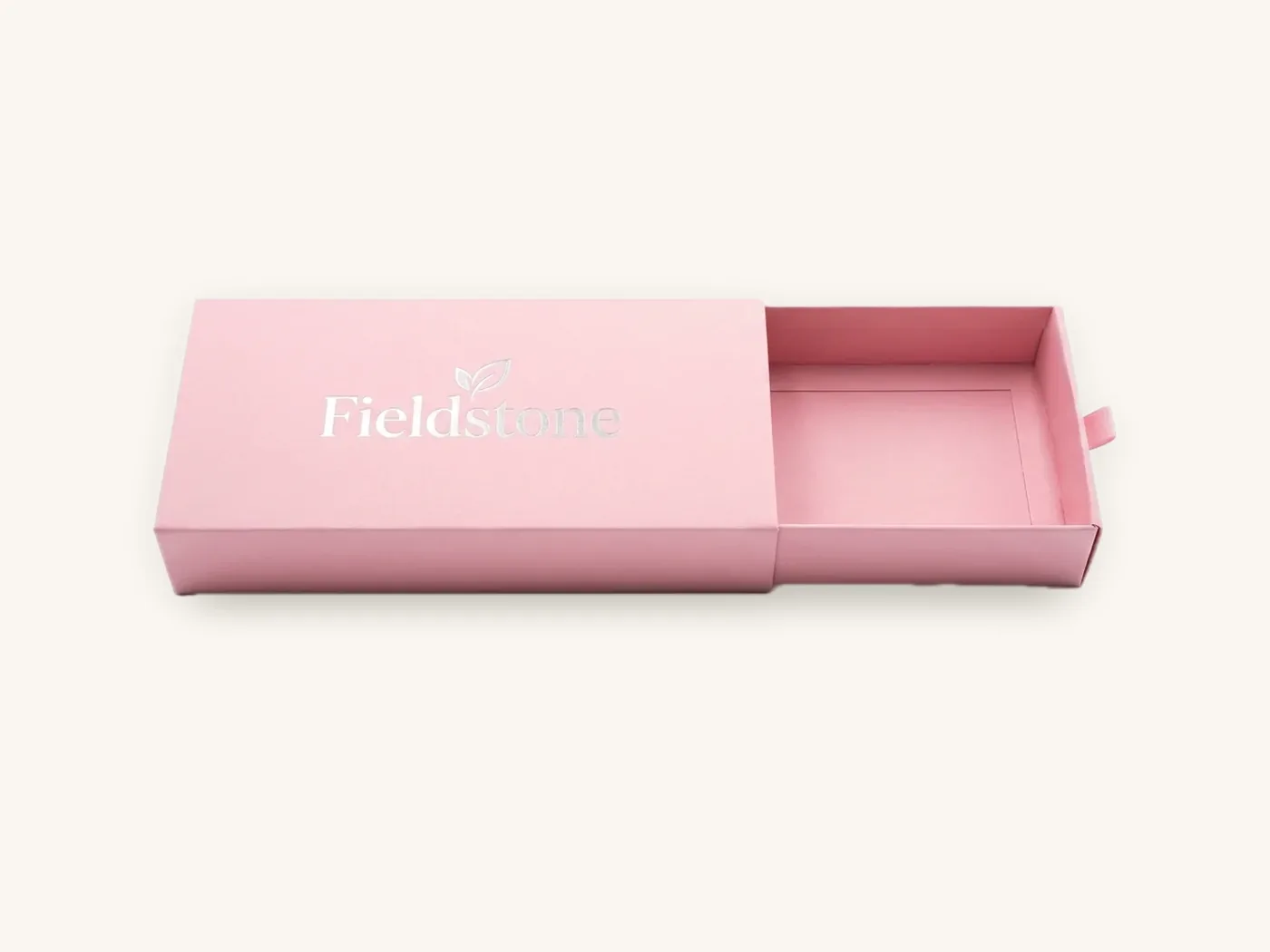
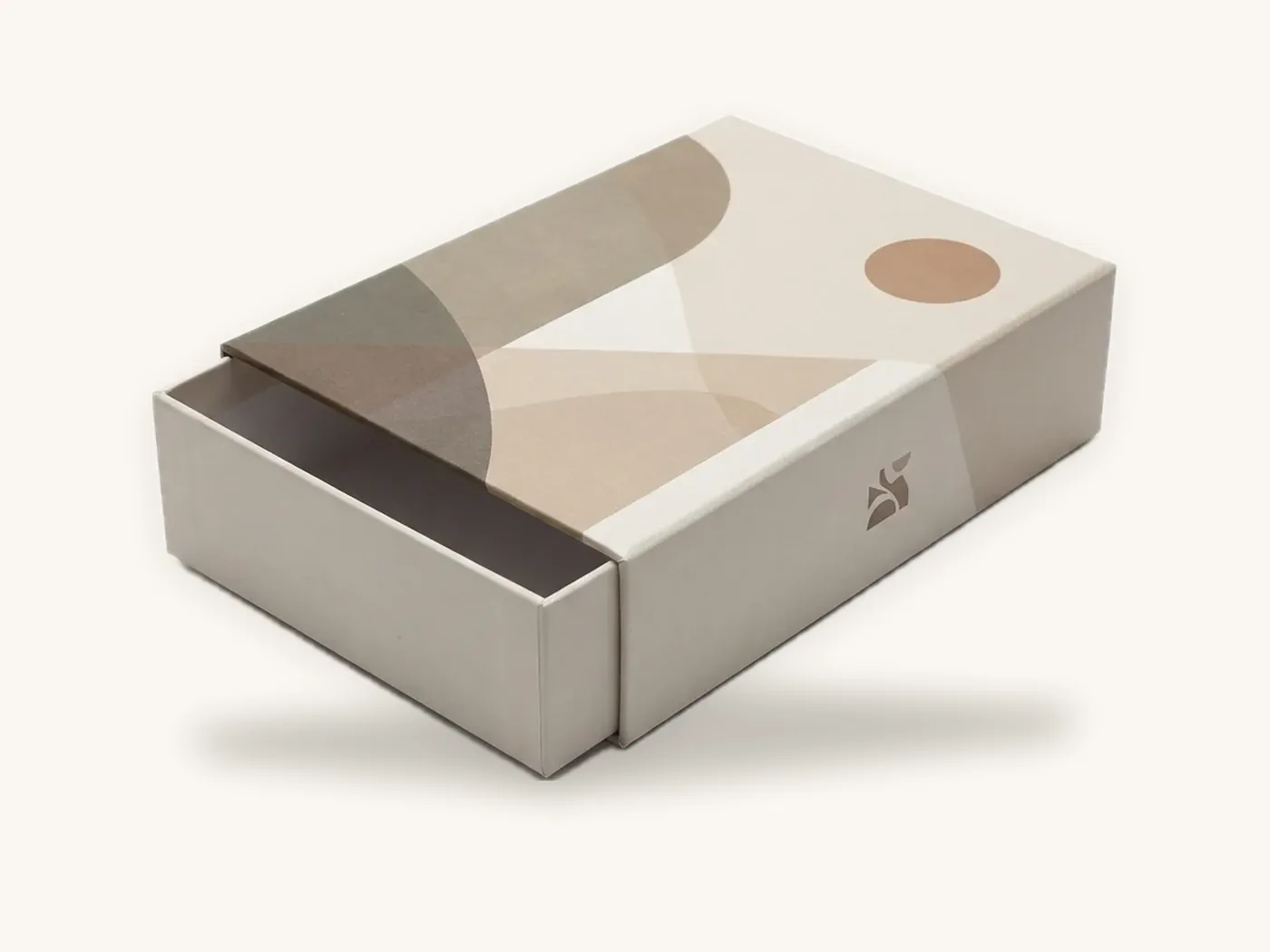
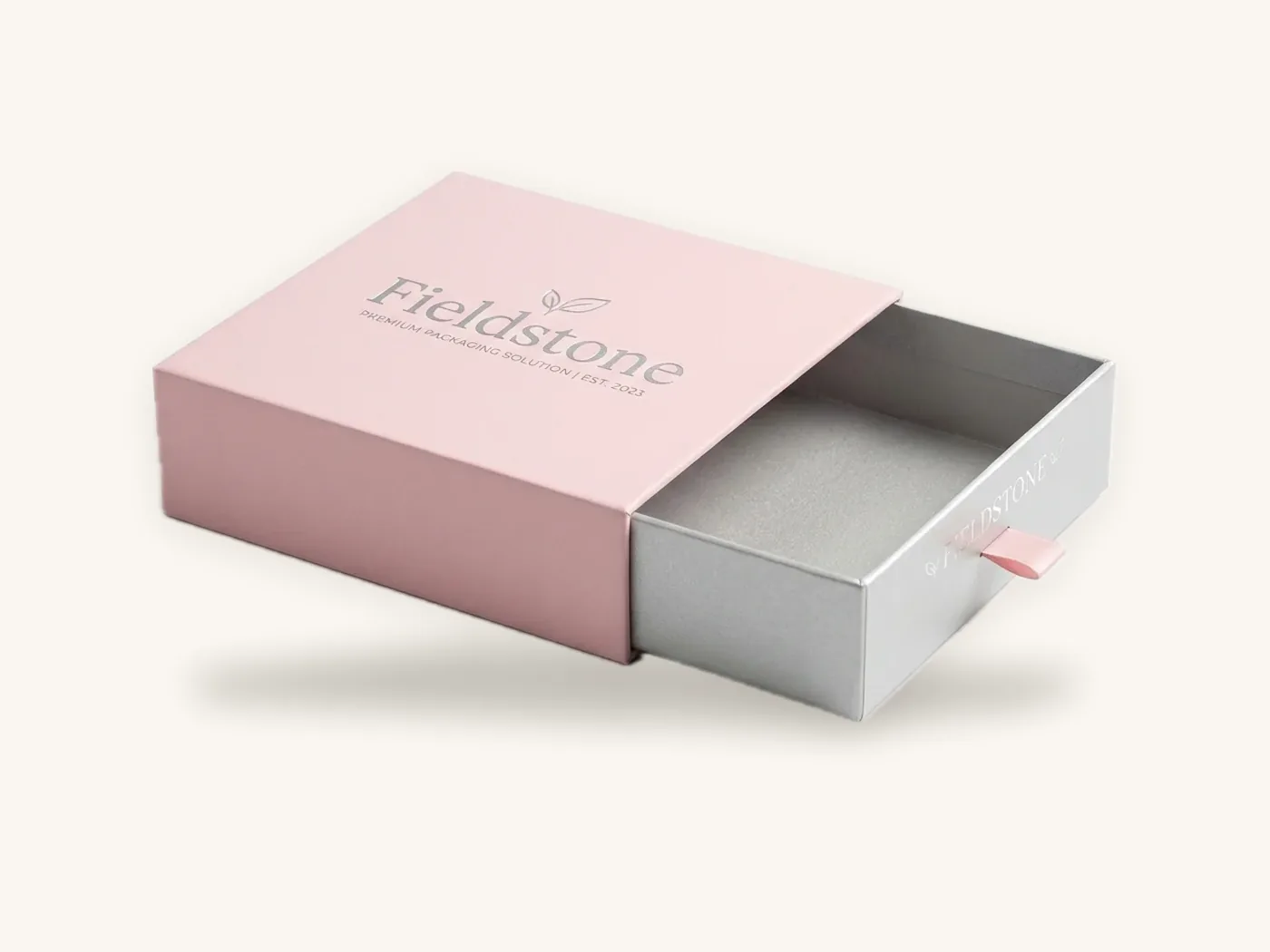
Drawer boxes are two-part boxes in which an inner tray slides out of an outer shell, like a matchbox or a desk drawer. The shell stays closed on at least one end in most builds, so the drawer opens one way, usually with a ribbon pull, a thumb notch or a small tab. They are used for jewelry, watches, stationery and pens, eyelashes, chocolates and tech accessories, and they are one of the few box styles customers tend to keep and reuse.
Three decisions shape every drawer box: how the shell and drawer are built (paperboard or rigid greyboard), how the drawer is pulled open, and what holds the product inside. Get those right and the drawer glides, stops where it should and presents the product at the front. This guide works through each decision, then covers fit, decoration, shipping, pricing and ordering.
Key takeaways
- A drawer box has an outer shell and an inner drawer; the drawer slides out from one end (or either end, on open-ended shells).
- Paperboard drawer boxes are light and economical for short-lived retail packs; rigid greyboard builds, usually around 1.5–2 mm, feel solid and survive reuse.
- The pull decides the opening experience. Ribbon pulls suit rigid gift boxes; thumb notches and die-cut tabs suit paperboard and slim formats.
- Inserts matter as much as the box: foam, paperboard, molded pulp or wrapped cavity inserts hold the product at the front of the drawer.
- A 3x3x1.5 in rigid jewelry box with matte finish, foil and an insert is about $3.35 each at 100 units and about $1.49 at 1,000, with US shipping included.
- Box Sense makes custom slide boxes from 10 units, with free structural samples, a 3D proof and no die or plate charges.
Three ways to build a drawer box
The biggest decision is construction. It sets the feel, cost, weight, how the box ships and how long it lasts in the customer's hands.
| Build | Shell | Drawer | Feel and lifespan | Best for | Tradeoffs |
|---|---|---|---|---|---|
| One-piece paperboard | Folded paperboard sleeve, glued seam | Folded paperboard tray with locking or glued corners | Light, crisp; fine for a few openings | Retail minis, sample kits, candy, eyelashes, soap | Can crease or tear with repeated use |
| Heavy paperboard or E-flute | Thicker paperboard or corrugated shell | Paperboard tray, often with insert | Sturdier; handles moderate weight | Stationery sets, tea, small tech accessories | Thicker walls reduce interior space |
| Rigid greyboard | Greyboard wrapped in printed or specialty paper | Wrapped greyboard tray | Solid, heavy, kept and reused | Jewelry, watches, premium gifts, fragrance sets | Higher unit cost; ships assembled, taking more space |
Paperboard drawer boxes
Paperboard sliding drawer boxes are die-cut from 16 to 24 pt board, printed flat and folded. The shell is a sleeve glued along one seam, with or without an end panel, and the drawer is a simple tray. They ship flat or nested and assemble quickly. For light products, they deliver the drawer reveal at a folding-carton price. The folding carton guide covers paperboard grades in more depth.
Rigid drawer boxes
A rigid drawer box is built from rigid greyboard that is cut, formed and wrapped in paper. The wrap can be printed, textured, colored-through or metallic. Because the walls are thick and do not flex, the drawer runs straight and the whole box feels substantial. This is the construction behind most jewelry and watch drawer boxes. The custom rigid boxes guide explains greyboard thickness and wrap papers.
Open-ended vs closed-end shells
- Closed at one end. The drawer can only be pulled from the open end. It stops the drawer being pushed through and gives the back panel a clean print surface. Most rigid drawer boxes are built this way.
- Open at both ends. Like a matchbox, the drawer can be pushed out from either side. It is simpler to make and is closer to a sleeve and tray box. Our sleeve boxes guide covers that format, including how to use one tray size across many sleeve designs.
Choosing a pull: how the drawer opens
The pull is the first thing a customer touches. It needs to be easy to find, strong enough for the drawer's weight and in keeping with the box's feel.
| Pull type | How it works | Works best on | Watch for |
|---|---|---|---|
| Ribbon pull | A ribbon loop glued under the drawer floor or to the drawer's front wall, emerging from the shell opening | Rigid drawer boxes, gifts, jewelry | Ribbon must be anchored firmly; choose a color that matches the wrap |
| Thumb notch | A half-moon cut-out in the shell edge, exposing the drawer front | Paperboard and slim boxes | Only works on a closed-end shell or on both ends of an open shell |
| Die-cut finger tab | A tab extending from the drawer front | Paperboard slide boxes, eyelash and card boxes | Tab can snag or bend if too thin |
| Push-through hole | A finger hole in the shell's closed back panel to push the drawer out | Rigid and paperboard closed-end boxes | Hole interrupts back-panel printing |
| Rope, cord or leather tab | A loop or tab fixed to the drawer front | Rigid premium boxes, stationery, spirits accessories | Adds hand assembly and cost |
| Metal or wooden knob | A small hardware knob on the drawer front | Keepsake and luxury gift boxes | Adds weight and a separate component |
| No pull, gravity or shake | Drawer slides when the box is tilted | Open-ended matchbox styles | Can open unintentionally; use a seal |
Matching the pull to the product
For a drawer heavier than a small jewelry piece, a ribbon pull anchored under the drawer floor spreads the load and does not tear free. For slim paperboard boxes such as eyelash or gift card packs, a thumb notch is cleanest and costs nothing extra because it is cut in the same die. For a stationery set or pen box that will sit on a desk, a push-through hole at the back is intuitive and invisible from the front.
Tip: put the pull on the side of the box that faces the customer when the product is displayed or unboxed. It sounds obvious, but a ribbon emerging from the back of a drawer box, or a notch on the side that faces a shelf, is a common proofing miss. Check it on the 3D proof.
Insert options for drawer boxes
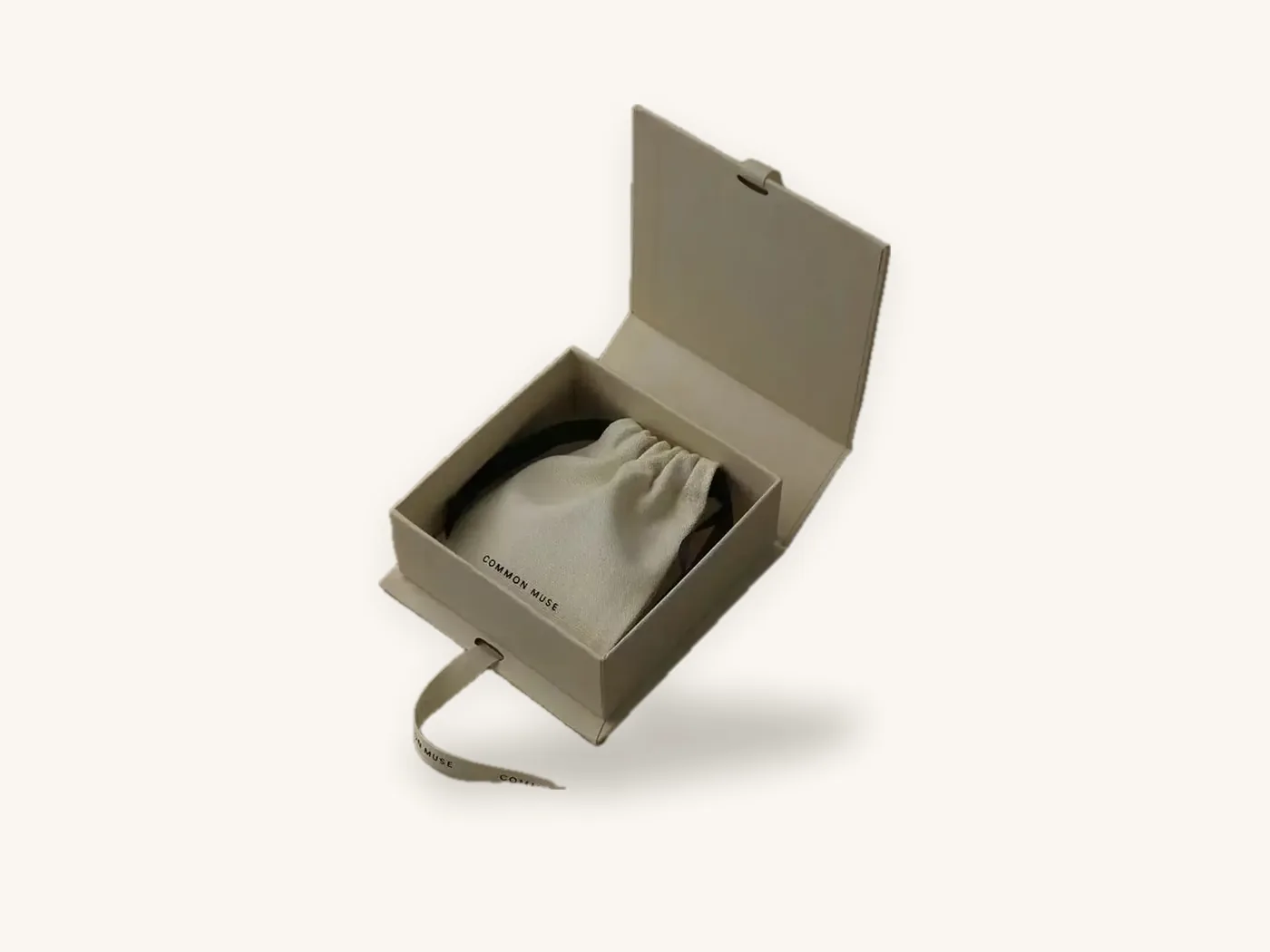
A drawer slides, so anything loose inside it slides too. An insert holds the product in place and positions it where the eye lands as the drawer opens. Our box inserts guide covers inserts across all box types; here is how they apply to drawers.
Foam inserts
EVA or PU foam, cut with a cavity shaped to the product, gives precise hold and cushioning. It suits watches, jewelry, tech accessories, fragrance vials and anything that must not move. Foam can be wrapped in fabric or paper for a finished look.
Paperboard inserts
Die-cut paperboard inserts with slots or cavities are light, printable and fully paper-based. They work well for pens, cards, eyelashes on a tray, small bottles and multi-piece stationery sets. They carry a one-time insert tooling charge when custom-cut.
Wrapped or velvet-covered inserts
A greyboard or foam platform wrapped in paper, velvet or suedette, with a slit or cushion for rings and earrings. This is the classic jewelry drawer format and pairs naturally with a rigid shell.
Molded pulp inserts
Formed from recycled paper fiber, molded pulp trays hold irregular shapes and keep the box plastic-free. They suit tech accessories and small glass items, with a natural, textured look. The molded pulp packaging guide explains the tradeoffs.
Choosing between them
- Choose foam for precision and protection on high-value or fragile items.
- Choose paperboard for light, flat or multi-piece products and the lowest cost.
- Choose wrapped platforms for jewelry presentation.
- Choose molded pulp when a plastic-free story matters and the product has an irregular shape.
Browse the box inserts and dividers page for insert formats we make alongside drawer boxes.
Getting the slide right: fit and tolerances
A drawer box that sticks or rattles undermines everything else. Fit depends on board thickness, wrap paper, coatings and humidity, so it is always confirmed with a physical sample.
How drawer boxes are sized
- Size the drawer interior to the product and insert. Measure the product in its insert, or size the insert first and the drawer around it.
- Add the drawer wall thickness to get the drawer's outside dimensions. On paperboard, each wall adds roughly the board caliper; on rigid builds, each wall adds the greyboard plus wrap paper, often 1.5–2.5 mm in total.
- Add clearance for the slide. The shell's inside needs to be slightly larger than the drawer's outside. Rigid boxes typically need a little more clearance than paperboard because wrapped corners are fuller.
- Set the shell length. On closed-end shells, the drawer should sit flush with the open end. On open-ended shells, match the drawer length exactly.
- Decide on a stop. Some rigid designs add a small internal stop so the drawer cannot be pulled fully out; most leave it free so the drawer can be removed.
- Test a structural sample with the product loaded, including sliding it open while holding the box upright and upside down.
Friction factors
- Soft-touch and matte lamination grip more than uncoated paper, so a laminated drawer in a laminated shell may need more clearance.
- Specialty wrap papers with texture add thickness and friction.
- Humidity swells paperboard slightly; a drawer that fits perfectly in a dry studio can stick in a humid climate.
- Heavy contents pull the drawer down against the shell floor, increasing drag. A slightly firmer fit or a ribbon anchored under the floor helps.
Where drawer boxes work best
Custom slide boxes suit products that benefit from a reveal and a keepsake container. Here is how the main categories use them.
Jewelry and watches
A rigid drawer box with a wrapped insert is a jewelry standard because it presents a ring, necklace or pair of earrings at the front of the drawer and stays on a dresser afterward. Jewelry boxes and watch boxes are often built as drawers with ribbon pulls. The jewelry packaging guide compares drawer, hinged and two-piece formats, and our jewelry and accessories packaging page shows examples.
Stationery, pens and desk goods
Pens, pencils, notebooks, sticky notes and card sets suit long, shallow drawer boxes with a paperboard slot insert. Because the box can stay on a desk as storage, a push-through hole or a subtle notch keeps the front clean. See stationery and pen boxes for common formats.
Eyelashes and small cosmetics
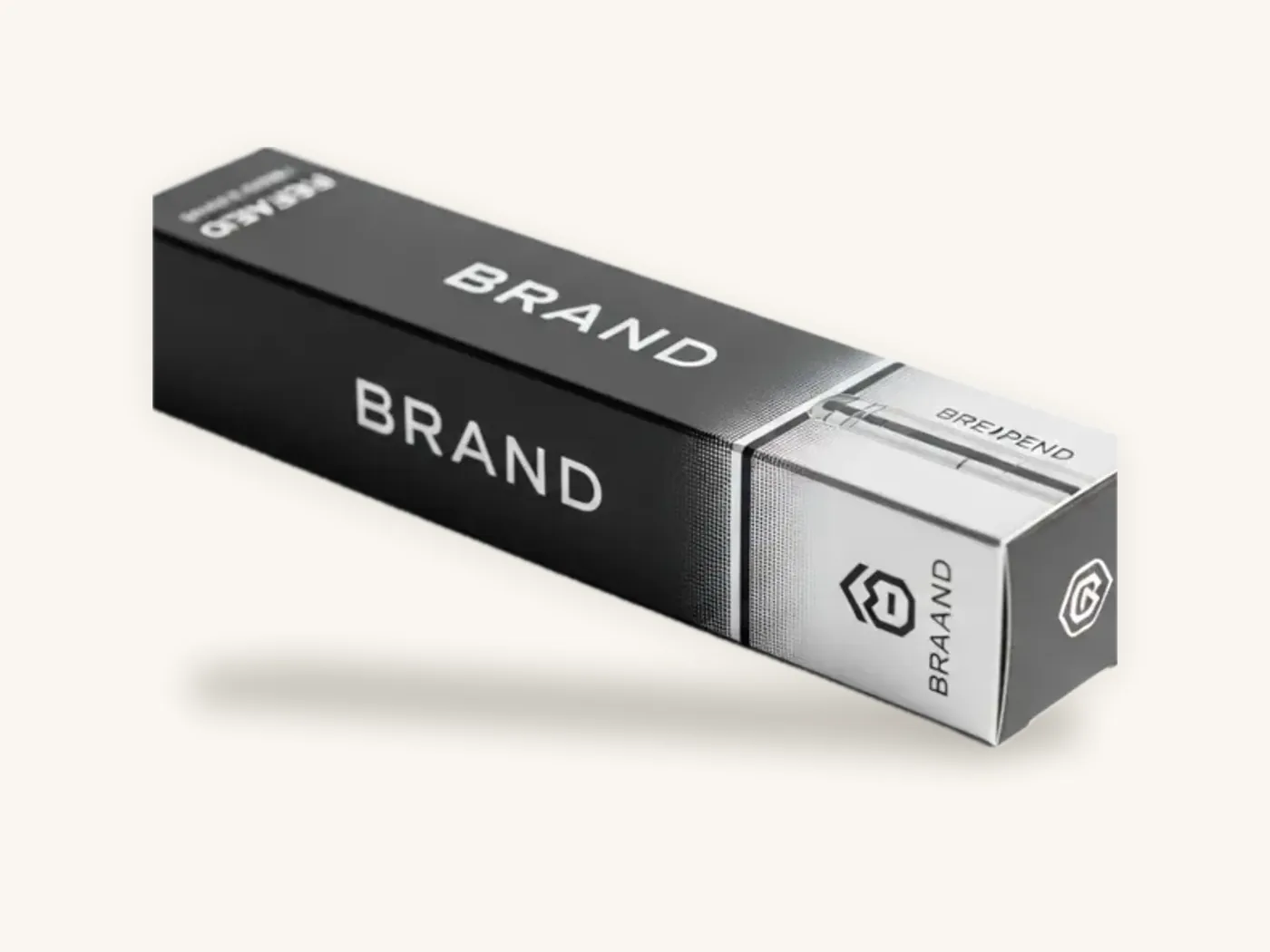
Slim paperboard or rigid drawers with a lash tray insert are common for eyelash brands, often with holographic board or a window in the shell. Lipstick samples, nail sets and fragrance minis use similar formats. The eyelash packaging guide covers tray sizes.
Chocolates and confectionery
A drawer box with a cavity insert delivers chocolates one row at a time and feels more like a gift than a lift-off lid. Use food-contact suitable materials, or individually wrapped pieces, and confirm current requirements with the FDA or your food safety advisor.
Tech accessories and gifts
Cables, earbuds, smart rings and small gadgets use rigid or heavy paperboard drawers with foam or molded pulp inserts. Corporate gift sets use them for pens, cufflinks and small keepsakes, often with a foil logo on the shell.
Decoration: shell, drawer and the reveal
A drawer box gives you two separate surfaces to design, and customers see them in sequence: the shell first, the drawer as it slides out.
Designing the shell
The shell carries the brand and any required product information. On rigid boxes, the wrap paper can be printed in full color, or you can use a colored or textured paper with a foil or embossed logo. On paperboard, full-color printing with matte, gloss or soft-touch lamination is typical. Our printing and finishes page shows the options.
Designing the drawer
A contrasting drawer color, a pattern on the drawer walls or a message printed on the drawer floor under the insert creates a second moment when the box opens. Keeping the drawer in a single solid color and the shell fully printed is a practical middle ground.
Finish ideas that suit drawer boxes
- Foil logo on the shell top, the most visible surface. Foil carries one-time tooling.
- Blind emboss or deboss on textured wrap paper for a quiet premium look, also with one-time tooling.
- Spot UV on a pattern across a matte shell.
- Printed ribbon in a brand color as the pull.
- Inside-drawer message revealed only when the insert is lifted.
Artwork checklist for drawer boxes
- Place artwork on the separate shell and drawer dielines we supply.
- Mark which end of the shell is the open end, and orient artwork so the logo reads correctly when the box sits with the pull facing the customer.
- Keep text at least 1/8 in from every fold, and further from wrapped edges on rigid boxes, where paper turns over the board.
- Add 1/8 in (3 mm) bleed on paperboard, and follow the larger turn-in allowance shown on rigid wrap dielines.
- Leave the thumb notch or push hole clear of important artwork.
- Confirm barcode and product information placement on the shell's back or base.
Shipping drawer boxes
Drawer boxes have one weakness in transit: the drawer. Any vibration or tilt can slide it open, and a rigid box dropped on a corner can dent its wrap.
- Secure the drawer. A clear seal sticker across the shell opening, a printed belly band or a shrink band stops it sliding and adds tamper evidence.
- Overbox rigid drawers. Rigid drawer boxes ship assembled, so they need an outer custom mailer box sized with a little fill. The custom mailer boxes guide explains outer box sizing.
- Protect flat drawer sets. Slim stationery or card drawers ride well in wrap-style mailers that grip flat items; the book mailer boxes guide covers that format.
- Case-pack for wholesale. Retail orders travel in custom shipping boxes with dividers so rigid corners do not rub. The custom shipping boxes guide covers case packs.
Watch out: rigid boxes do not fold flat, so they take far more storage and freight space than paperboard drawers. If warehouse space or freight cost is tight, consider a paperboard drawer, or compare with collapsible rigid formats in the collapsible rigid boxes guide.
What drawer boxes cost
Drawer box pricing depends on construction more than anything else. A paperboard slide box costs in the same general range as a folding carton of similar size and finish, while a rigid drawer box sits in rigid-box territory, because it involves more material and hand wrapping. Size, wrap paper, finishes, the pull and the insert then move the price within each band.
The table shows indicative per-unit prices for rigid box specs from our current rates, with US shipping included. They are useful reference points for rigid drawer builds of similar size and finish. Get a figure for your exact drawer spec from the instant price estimator or a quote.
| Spec | 10 | 100 | 250 | 500 | 1,000 | 5,000 |
|---|---|---|---|---|---|---|
| Jewelry rigid box, 2 mm, 3x3x1.5 in, matte, foil, insert | $5.06 | $3.35 | $2.38 | $1.79 | $1.49 | $1.06 |
| Rigid box, 2 mm greyboard wrapped, 8x6x3 in, full color, matte | $13.76 | $9.10 | $6.47 | $4.85 | $4.05 | $2.87 |
Where the money goes
- Construction: rigid greyboard and hand wrapping cost considerably more than paperboard.
- Size: the jewelry and 8x6x3 in rows show how much a larger rigid box adds.
- Insert: foam and wrapped inserts cost more than paperboard; custom-cut inserts carry one-time tooling.
- Pull: a ribbon or rope pull adds material and assembly; a die-cut notch adds nothing.
- Finishes: foil, embossing and spot UV each add one-time tooling, plus a per-unit cost.
- Quantity: the jewelry box falls from about $5.06 at 10 units to about $1.79 at 500.
How to order drawer boxes from Box Sense
Drawer boxes have two or three matched components, so a complete brief avoids fit revisions.
What to send
- Product dimensions and weight, and a photo or sample if the shape is irregular
- Construction: paperboard, heavy paperboard or rigid greyboard
- Shell style: closed at one end or open at both
- Pull type: ribbon, thumb notch, tab, push hole or other
- Insert type: foam, paperboard, wrapped platform or molded pulp, or ask for a recommendation
- Print and finishes for the shell and drawer separately
- Quantities to price, target delivery date and ship-to location
- Artwork, or a request for our free design services
What happens next
- We confirm your quote within 24 hours.
- Our structural team supplies matched shell, drawer and insert dielines, sets up artwork and sends a 3D digital proof, with two revision rounds included.
- An unprinted structural sample is free, so you can test the slide and the insert with your real product. A printed sample of approved artwork is free on orders of 100 or more; see packaging samples.
- Standard production is 8–12 business days after proof approval. Rush in 5 business days is available on most paperboard styles.
- Shipping is free on every US order, and international shipping is quoted at cost. The minimum is 10 boxes, with no die or plate charges; defective boxes reported within 14 days are reprinted free.
Frequently asked questions
What is a drawer box?
A drawer box is a two-part box in which an inner tray, the drawer, slides out of an outer shell, similar to a matchbox. The shell is usually closed at one end so the drawer opens one way, often with a ribbon pull or thumb notch. Drawer boxes are made in paperboard or rigid greyboard and are popular for jewelry, stationery and gifts.
What is the difference between a drawer box and a sleeve box?
A drawer box usually has a shell closed at one end and is designed to open repeatedly with a pull, often in rigid board. A sleeve box has a sleeve open at both ends that slides fully off a tray, and is more often paperboard. Open-ended matchbox styles sit between the two and are called by either name.
How do you make a sliding drawer box open easily?
Size the shell slightly larger than the drawer, allowing for board thickness, wrap paper and lamination, then add a clear pull such as a ribbon, thumb notch, tab or push hole. Test a structural sample with the product loaded, since coatings, humidity and heavy contents all add friction. Adjust clearance before approving production.
What inserts work in drawer boxes?
Foam inserts give precise hold for watches, jewelry and tech. Paperboard inserts suit pens, cards, eyelashes and multi-piece sets. Wrapped or velvet-covered platforms are the classic ring and earring presentation. Molded pulp trays hold irregular shapes in a plastic-free format. Size the insert first, then build the drawer around it.
Are drawer boxes expensive?
It depends on construction. Paperboard slide boxes cost about the same as similar folding cartons, while rigid drawer boxes cost more. As a reference, a 3x3x1.5 in rigid jewelry box with matte finish, foil and an insert is about $3.35 each at 100 units and about $1.49 at 1,000, including US shipping.
Can drawer boxes ship flat?
Paperboard drawer boxes ship flat or nested and assemble quickly. Standard rigid drawer boxes ship assembled because the greyboard is wrapped and cannot fold, which takes more storage and freight space. If flat shipping matters, choose a paperboard drawer or ask about collapsible rigid formats. Filled drawer boxes should travel inside a mailer or shipping box.
How do I stop a drawer box from sliding open in transit?
Add a secondary closure: a clear seal sticker across the shell opening, a printed belly band or a shrink band. A slightly firmer fit helps, but a closure is more reliable. Then pack the drawer box inside a snug mailer or shipping box with a little paper fill so it cannot shift.
What is the minimum order for custom slide boxes?
Box Sense makes custom slide boxes and drawer boxes from a minimum of 10 units, with no die or plate charges. Short runs are printed digitally, so small launches and gift runs are practical. Unit prices fall as quantity rises, so compare a few quantity tiers in the estimator or in your quote.
Next steps
Decide whether your product needs a paperboard or rigid drawer, choose a pull and an insert, and check your numbers in the drawer box price estimator. Then request a quote for custom drawer boxes and we will confirm pricing within 24 hours, send matched dielines and prepare a free structural sample so you can test the slide.
Boxes in this guide
Order the packaging we covered
Written by the Box Sense Packaging Team
Our structural designers, prepress technicians and production staff print and convert custom boxes every day for brands in the United States, United Kingdom and UAE. Questions about this guide? Talk to us.